TL;DR: A forward deployed engineer writes production code inside one customer; a deployment strategist owns the problem, the adoption and the result. Palantir created both roles and pays its New York engineers more ($135,000 to $200,000 base, against $110,000 to $170,000 for strategists). OpenAI and Anthropic now hire the same pair under the titles Forward Deployed Engineer and Deployment Lead or Technical Deployment Lead.
Inside Palantir, forward deployed engineers go by Delta, from the days when each Business Development team took a NATO alphabet letter. Deployment strategists go by Echo. I read the open postings for both jobs at Palantir, OpenAI and Anthropic on October 5, 2026. Anthropic's draws the clearest line: its deployment lead "won't write production code".
- 1Palantir's job board listed 57 forward deployed software engineer postings and 34 deployment strategist postings out of 316 in total.
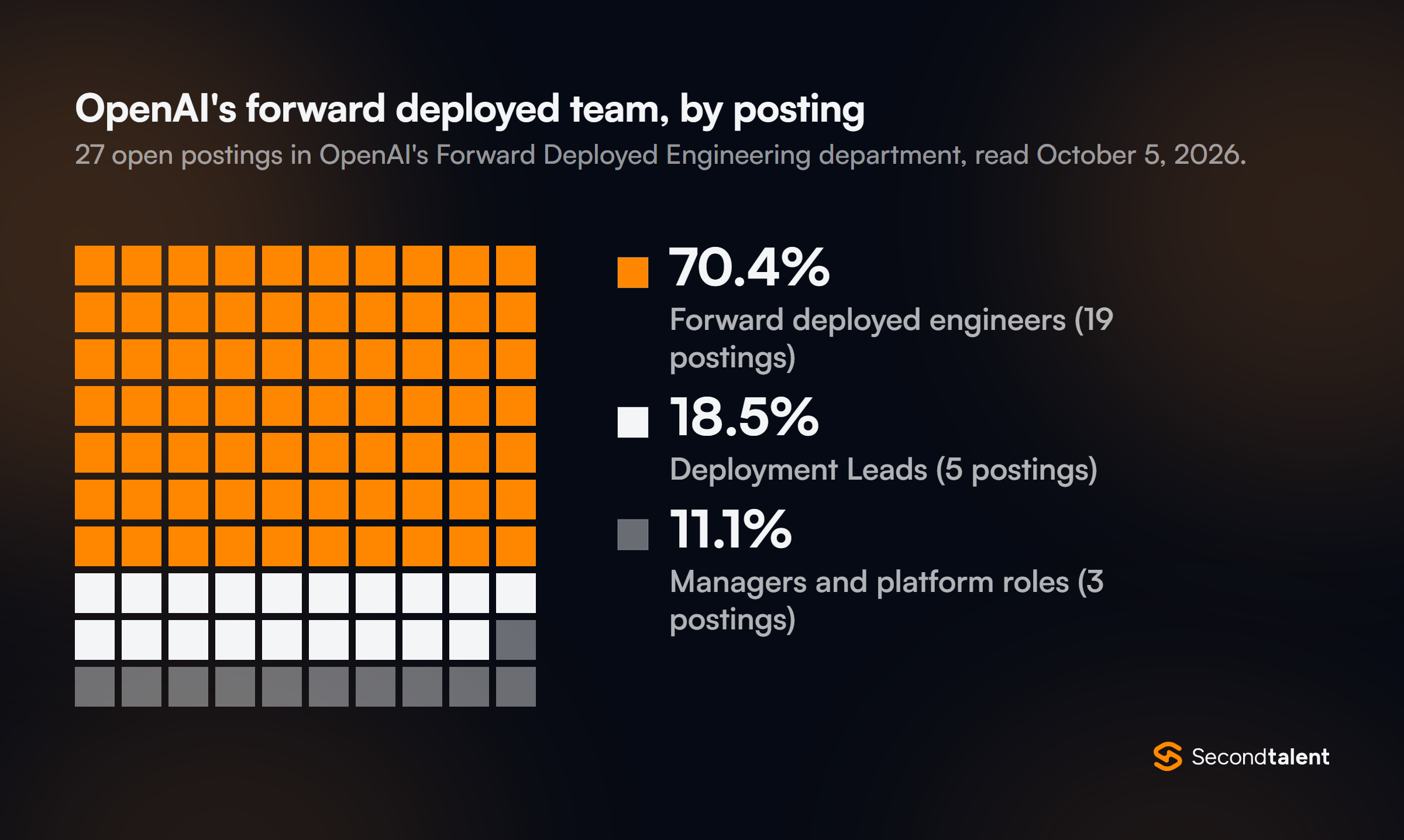
- 2OpenAI's forward deployed department had 19 engineer postings open for every 5 Deployment Lead postings.
- 3Palantir asks strategists to travel 25 to 75% of the time, and its engineers up to 25%.
- 4Lightcast counted forward deployed engineer postings up more than 1,000% in January to August 2026, year on year.
What is the difference between a deployment strategist and a forward deployed engineer?
A forward deployed engineer (FDE) is a software engineer who builds and ships production code inside a customer's systems. A deployment strategist decides what that code should solve, gets the customer's people to use it, and proves it worked. One owns the build. The other owns the problem and the outcome.
Palantir set out the engineering half in a 2019 post, Dev versus Delta. Product engineers, the Devs, focus on "one capability, many customers". Deltas sit in Business Development and focus on "one customer, many capabilities". One of them, G.M. in São Paulo, says a Delta "does significantly more engineering and technical work than a consultant."
The strategist half got its own post in 2022. It opens with the internal name, then admits the line is softer than the titles suggest:
"Theoretically, Echos are more product-managers while Deltas are more technical, but in reality, both roles are a mix between product manager, software engineer and strategist and the lines between the two roles blur heavily quite often."
Palantir Blog, A Day in the Life of a Palantir Deployment Strategist, March 8, 2022
The same post says strategists "run the gamut, from people who code all day, every day" to people "who never touch code". Treat the split as a default, not a wall. Our deployment strategist role guide and forward deployed engineer role guide cover each job on its own.
Responsibilities: who owns what in a deployment
Palantir's New York deployment strategist posting lists nine duties. Only one involves the data pipeline, and the strategist shares it: "Work with Forward Deployed Engineers to integrate the data into a stable and extensible pipeline." The rest are about people and problems.
- Meet customer analysts onsite to find their biggest problems
- Identify the relevant datasets
- Build customized workflows for new user groups
- Lead training sessions
- Present results to audiences up to the C-suite
- Make architecture and design decisions with fellow engineers
- Wrangle massive-scale data, using AI
- Develop custom applications for the customer
- Engage stakeholders from technical teams to executives
- Drive projects from ideation to deployment
OpenAI and Anthropic write the same split into their own postings. The engineer owns system design, the build and the production rollout that follows. The lead owns the delivery plan, adoption and the business case. Mapped across the four stages of a deployment, it looks like this:
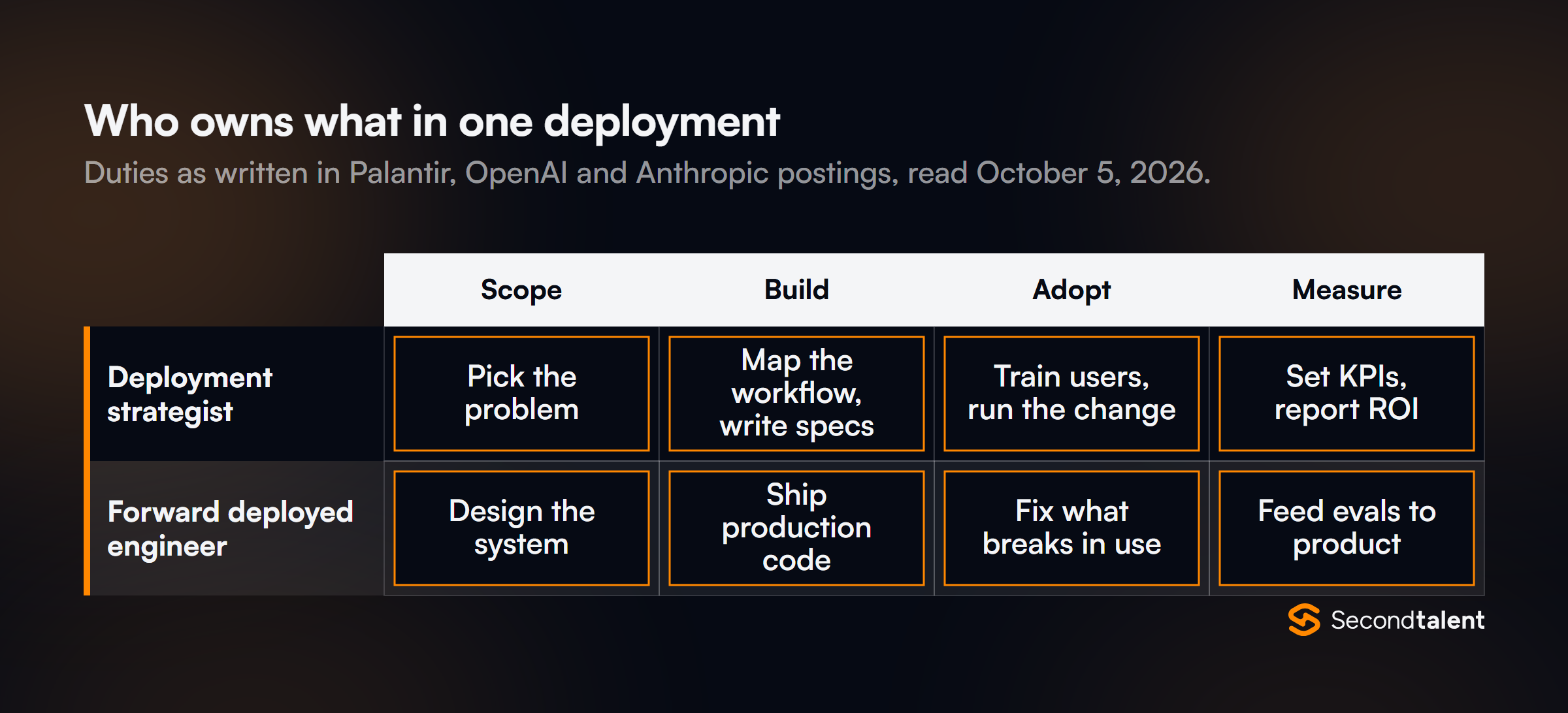
The last column is where the roles separate most. Anthropic's Technical Deployment Lead must "define impact hypotheses, set baselines and KPIs, run pre- and post-deployment measurement". The FDE measures something more technical. OpenAI wants "eval-driven feedback that changes product and model roadmaps."
How OpenAI and Anthropic copied the pair
Neither AI lab uses Palantir's titles. Both rebuilt the same two-person unit. OpenAI's Forward Deployed Engineering department posts two kinds of individual role: the FDE and the Deployment Lead. Anthropic puts its FDEs in the Applied AI team and pairs them with a Technical Deployment Lead.
The FDE work has moved with the models. Anthropic's London forward deployed engineer posting asks for "MCP servers, sub-agents, and agent skills that will be used in production workflows". It also wants production experience with prompt engineering, agents and evaluation frameworks. That is the job the AI forward deployed engineer title describes.
The strategist side has moved less. Anthropic's Technical Deployment Lead posting still centres on SOWs, executive briefings, security reviews, legal approvals and procurement. Apart from its focus on regulated industries, it reads close to Palantir's 2022 description. Outside these three companies the same job often goes by forward deployed consultant.
How the two work as a pair
The engineer executes a plan the strategist sequences. Anthropic's lead must "translate customer business objectives into a sequenced roadmap that FDEs execute against". OpenAI's Deployment Lead makes "real-time trade-offs on scope and priority to protect the critical path." The engineers then decide how to build each item on that path.
The ratio is not one to one. On my count, OpenAI's forward deployed department had about four engineer roles open for every lead:
Anthropic adds a third person at manager level. Its FDE manager posting says the team works "hand-in-hand with Engagement Managers who own delivery logistics and stakeholder management". The manager's job is to make sure the FDEs ship quality code. So the strategist role can split again once a company has enough deployments running.
Skills and background
The coding bar is the clearest divide. Palantir's FDSE posting requires a "strong coder" in Python, Java, C++, TypeScript or JavaScript. Its strategist posting asks only for "experience with programming, scripting or statistical packages (e.g. Python, R, Matlab, SQL)". OpenAI's FDE must "write and review production-grade code across frontend and backend".
The strategist bar is judgment. OpenAI's Deployment Lead needs "strong technical fluency" to pressure-test architectures, and seven years of customer-facing delivery leadership. The engineer roles ask for fewer years:
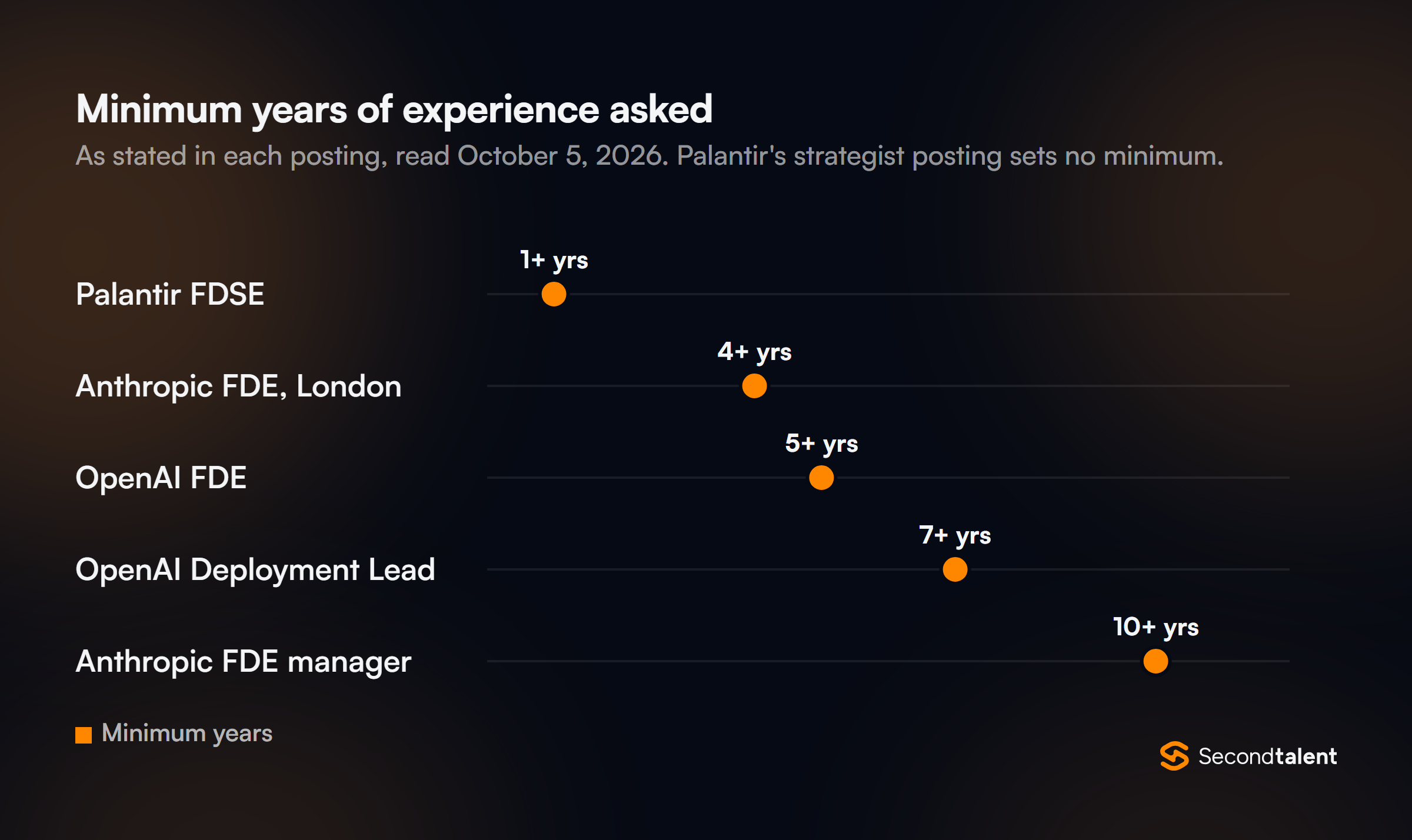
Palantir hires engineers with one year out of college, and its strategist posting names no minimum at all. The AI labs want people who have already shipped LLM systems. Both OpenAI postings and Anthropic's lead posting ask for production AI experience, whichever side of the pair the role sits on.
Backgrounds differ as much as skills. Palantir prefers FDSE degrees in computer science, mathematics, software engineering, physics or data science. Anthropic's lead posting welcomes people who led AI work. It lists backgrounds from founder and data scientist to "a professional services or consulting role." Strategists come from a wider pool. Their interview tests problem decomposition more than code.
A typical day for each role
Dyon, a Delta in Abu Dhabi, describes his week in Palantir's 2019 post. He spends "a couple of days working at the customer premises", split between stakeholder meetings and "monitoring, debugging, deploying, or configuring our software". Back in the office he writes minor code changes, reviews pull requests and plans solutions.
The strategist's day in the 2022 post shows how far the roles overlap. A pilot lead's day includes:
A more senior strategist in the same post, an enterprise lead, has a different day. It holds a pre-sales meeting, a partnership proposal, a one-on-one and a one-page case for a product feature. No code appears in that schedule. At that level the pipeline drops out of the day.
Travel follows the same pattern. Palantir's strategist posting requires 25 to 75% travel. Its FDSE posting asks for up to 25%, "flexible based on personal preferences". At OpenAI and Anthropic both roles carry the same band: up to 50% at OpenAI, 25 to 50% at Anthropic.
Pay: what the postings say
Palantir pays the engineer more. The two AI labs pay their deployment leads more than their engineers. Here are the posted base ranges, all from the companies' own postings:
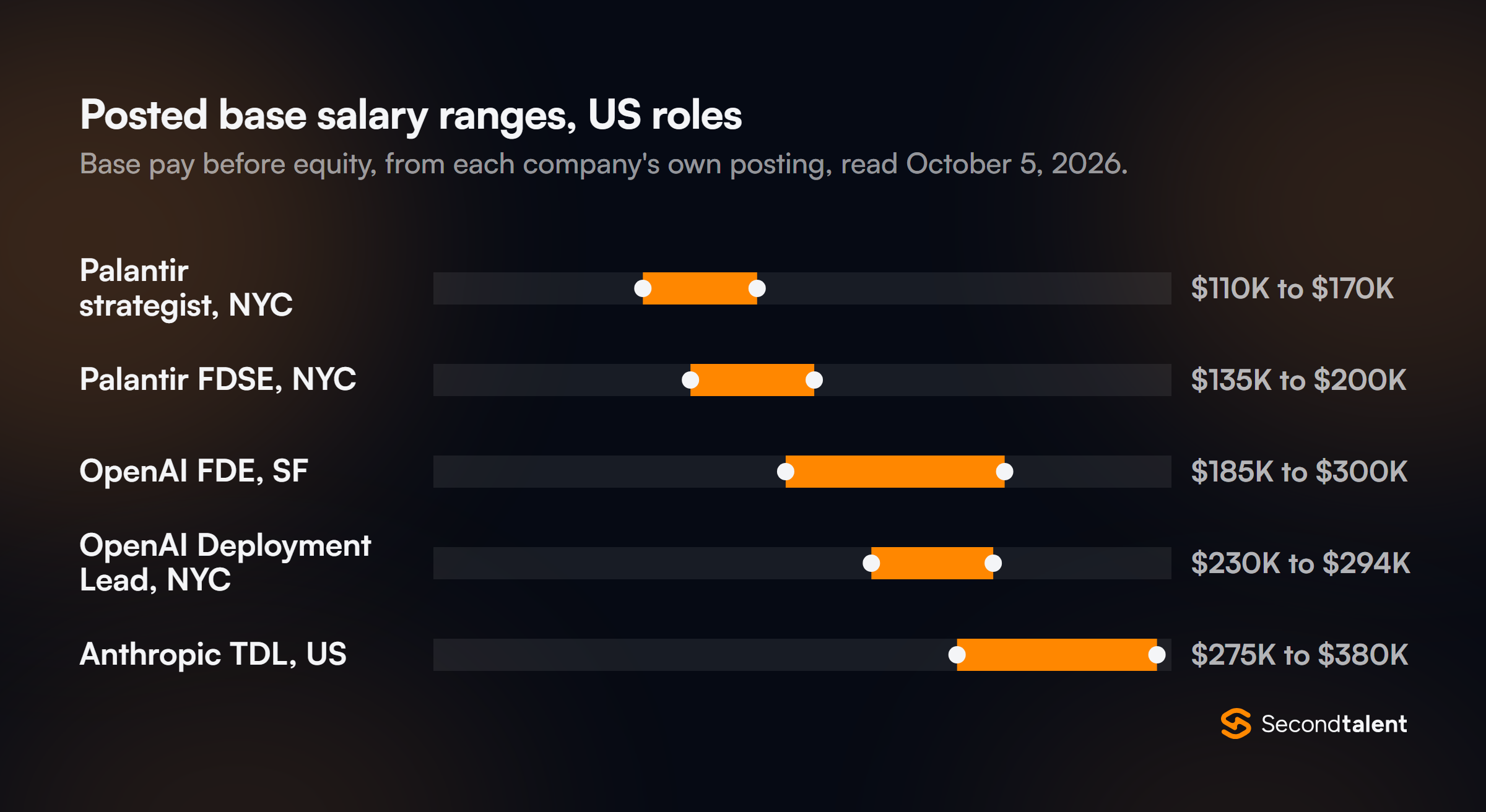
The postings point to seniority. Palantir hires both roles early in a career, and asks its engineers for a year of experience. OpenAI's Deployment Lead posting asks for seven years of delivery leadership, against five for its FDE posting. Anthropic's lead range, $275,000 to $380,000, tops all five.
All of these are base salaries. Palantir adds restricted stock units and a sign-on bonus, and OpenAI lists equity on both of its postings. Across all employers, Fortune reported Lightcast data putting the median advertised FDE salary above $188,000, against about $145,000 for traditional software engineers. Outside the US, our forward deployed engineer rate card tracks hourly rates by market.
Demand: which role companies hire more
All three job boards I counted carry more engineer postings than strategist or lead postings. The same Fortune report put forward deployed engineer postings up more than 1,000% in January to August 2026, year on year.
Of the three boards, Palantir's carries by far the most strategist postings. Its board on October 5 carried 34 strategist postings next to 81 forward deployed engineering postings of all kinds.
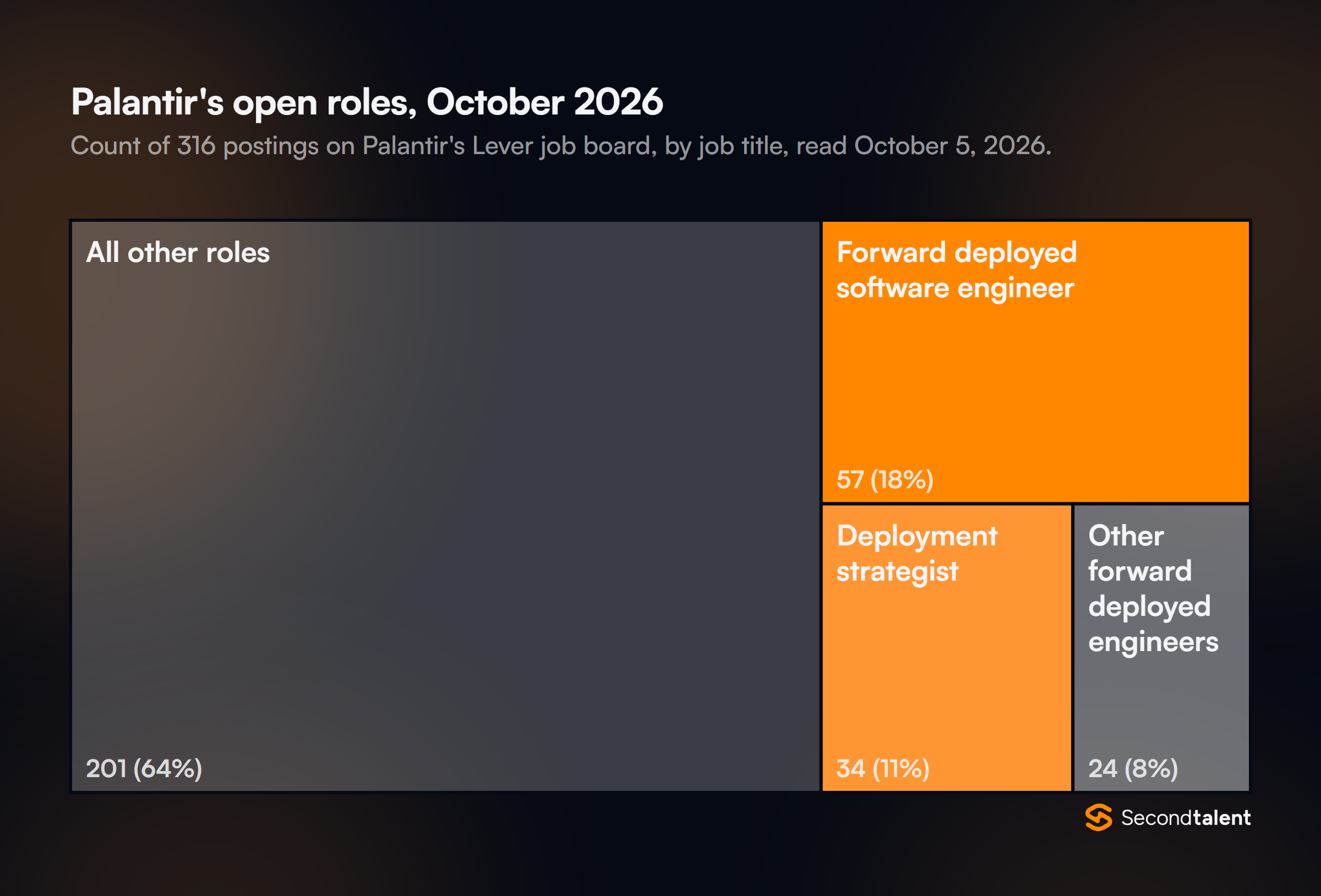
Strategist postings there split by customer type: 6 for US Government and 6 more in its US Government "Build to Apply" track, plus roles for Japan, Korea, Spain and UK Government. The government roles carry US Person and clearance requirements that commercial ones do not, which our deployment strategist guide covers in detail.
Career paths
The engineer's ladder runs FDE, senior FDE, principal FDE, then technical solutions architect and VP of solutions engineering. Anthropic's FDE manager role shows the top of the people track: 10+ years of experience, two of them managing engineers, at $320,000 to $405,000 base in New York.
The strategist's ladder is about scope. A strategist owns a workstream and a senior strategist owns a whole deployment. A lead owns several accounts, and a head of deployment owns the delivery team and its economics. The role is also a common route into product management, since a strategist has watched real users struggle with a product. The forward deployed product manager sits close to that exit.
Moves between the two go both ways. Palantir's Katherine, an FDSE in Washington D.C., describes moving from individual contributor to leading teams and "engaging on business strategy and helping translate it into technical execution". That is strategist work done from the engineering side.
When you need one, the other, or both
Hire the engineer first if the product does not yet do what the customer needs. Add the strategist when the rollout touches many teams or a regulated process. A company running several deployments at once needs both, which is the setup all three companies post for.
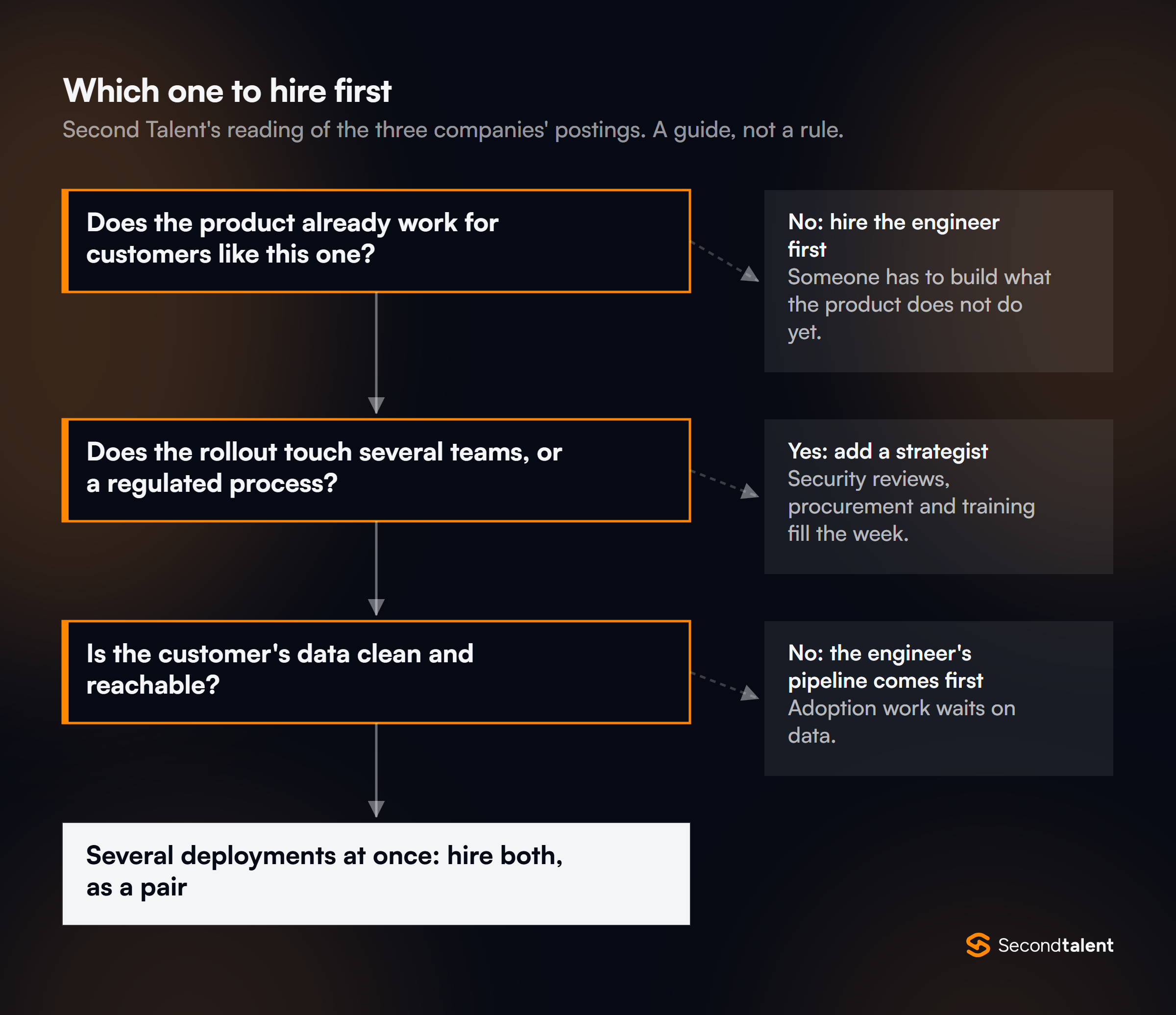
A startup with one or two pilots can ask one person to do both halves. Palantir's 2022 post describes strategists at the coding end of the range who do that.
Once deployments multiply, all three companies post them as two jobs. OpenAI's Deployment Lead runs execution across several FDEs at once. For the outcome numbers a strategist reports, see our post on how enterprises measure AI ROI.
Hire forward deployed engineers from Asia
The engineer is the half all three boards post most often. We match you with vetted forward deployed engineers in 24 hours, at 50-70% below US cost, with a 90-day, one-time replacement guarantee. We employ them through our own EOR in 9 Asian markets, including Vietnam, the Philippines and Singapore.
Our monthly plan is $4,999 a month for a senior engineer, all-inclusive. Tell us what you are deploying and we will send a shortlist.
Frequently Asked Questions
Is a deployment strategist a product manager?
Close, but the scope is one customer rather than one product. Palantir's own 2022 post says Echos are "theoretically" more product managers, and the role feeds field insight back to product teams. It also carries training sessions and the client relationship, both listed in Palantir's posting.
Is a forward deployed engineer the same as a solutions engineer?
No. A solutions engineer helps win the deal. A forward deployed engineer builds the production system after it. Palantir's Deltas sit in Business Development, but they measure success by the customer's outcome. OpenAI measures its FDEs on production adoption.
Can either role be done remotely?
Only in part. The postings cited here all ask for travel to customer sites, from up to 25% for Palantir engineers to 75% for Palantir strategists. Palantir calls its engineers' travel "flexible based on personal preferences" while strategist travel "varies by location and team".