TL;DR: Software architects in Vietnam earn $2,000 to $6,500 a month working for international clients on our cloud engineer rate card, and we shortlist 6-8 candidates within 24 hours. The BLS median for US software developers, which covers architects, was $135,980 a year in May 2025.
Vietnam's Law on Cybersecurity, in force since 1 July 2026, tells internet services handling user data in Vietnam to store it there. A foreign company falls under that duty only after its service is used to break the law and it fails three written requests to help within six months.
Key takeaways
- Our Vietnam, Indonesia and Thailand cloud engineer cards all close at the same ceiling.
- AWS runs a Local Zone in Hanoi attached to its Singapore Region, and Microsoft's Azure region list names no region in Vietnam.
- Vietnam's Decree 356 requires personal data held in cloud computing to be encrypted at rest and in transit.
- Spring Boot 4.0 loses open-source support on 31 December 2026, seven weeks after .NET 8 and .NET 9 leave Microsoft support.
What Software Architects Earn in Vietnam Working for International Clients
Vietnam's floor sits $250 above the Philippines' and $1,930 below Malaysia's. No card of ours covers software architects by title, so every row uses our cloud engineer rate card for its market, the same card family as our software architects page.
The figures are what engineers in each market earn working directly for foreign companies, before any employer or platform costs.
| Market |
Monthly pay working for international clients (USD) |
| Vietnam |
$2,000-$6,500 |
| Philippines |
$1,750-$4,630+ |
| Indonesia |
$1,800-$6,500 |
| Thailand |
$2,200-$6,500 |
| Malaysia |
$3,930-$7,860+ |
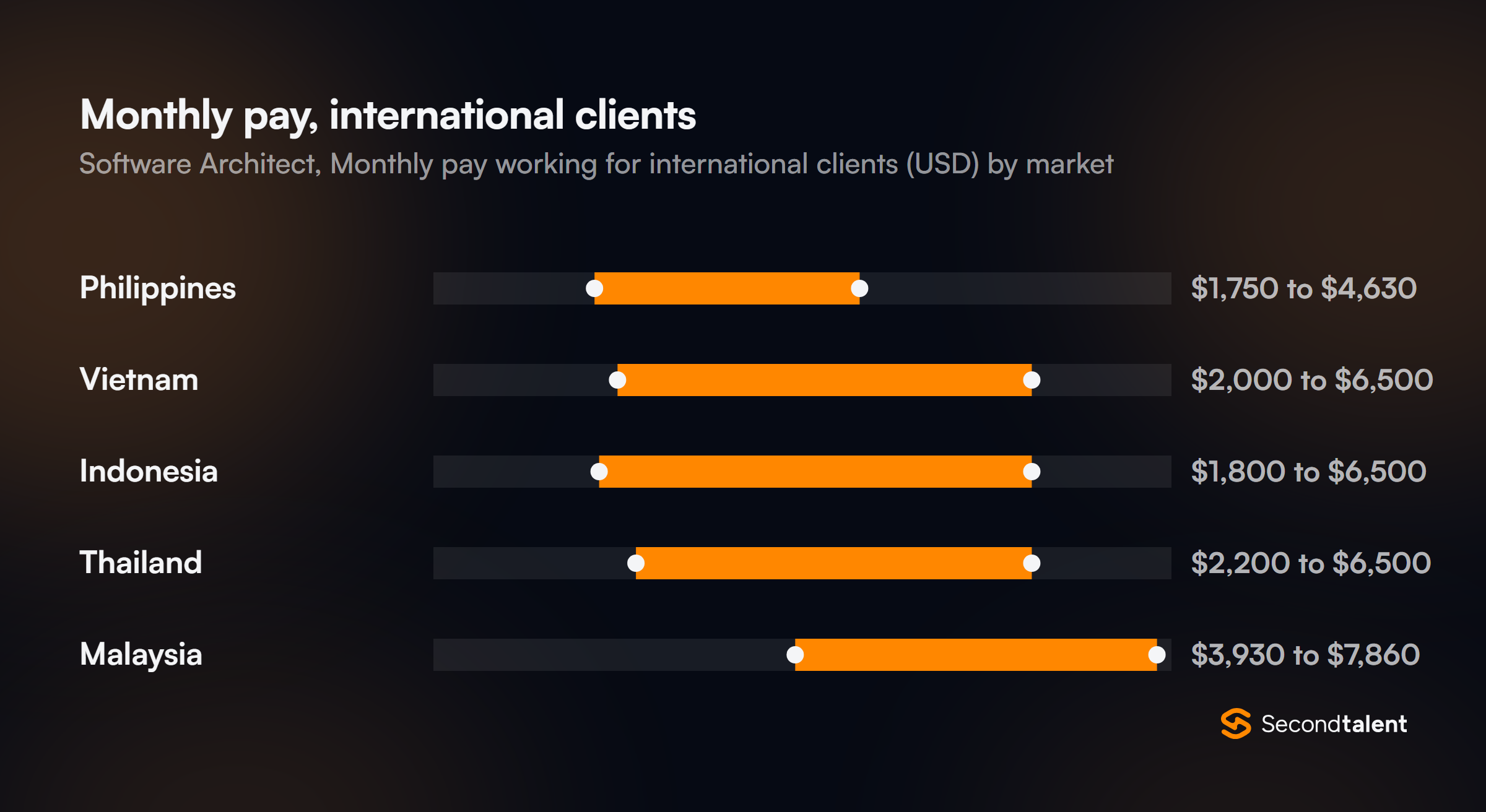
Monthly ranges from the Remote (Working for International Clients) figures on our rate cards for Vietnam, the Philippines, Indonesia, Thailand and Malaysia, converted at ExchangeRate-API mid-market rates for 14 September 2026.
The Vietnam, Indonesia and Thailand cards are set in US dollars and share a $6,500 ceiling, so the three differ only at the floor, within $400 of each other. The Philippine and Malaysian cards quote pesos and ringgit with open tops.
The card prices cloud engineers, not architects. Use the interview to judge whether a candidate has owned a design as well as built one.
Through Second Talent you pay one monthly fee that bundles salary, payroll taxes, statutory contributions and our service fee, quoted per role and market. Our pricing page explains the monthly subscription.
US Pay Benchmark for Software Architects
O*NET lists "Software Architect" among the reported job titles for Software Developers (15-1252), so that occupation is the BLS benchmark for the role.
| BLS OEWS, May 2025, national |
Software Developers (15-1252) |
| Median annual |
$135,980 |
| 10th percentile, monthly |
$6,870 |
| 25th percentile, monthly |
$8,770 |
| Median, monthly |
$11,330 |
| 75th percentile, monthly |
$14,330 |
| 90th percentile, monthly |
$17,890 |
Monthly figures are the annual wages on the OEWS profile for 15-1252 divided by 12, rounded to the nearest $10.
The Vietnam card's ceiling sits $370 under the US 10th percentile. The BLS columns cover the whole occupation, architects included, so they bound the US range rather than price the role.
Salary is only part of the US cost. In the BLS Employer Costs for Employee Compensation release for June 2026, wages and salaries made up 68.5% of employer compensation costs for full-time private industry workers, and benefits the other 31.5%.
Time Zone Overlap: Ho Chi Minh City Against ET, CT and PT
A weekly architecture review at 10:00 am Pacific starts at midnight in Ho Chi Minh City while US daylight time lasts, and at 1:00 am after it ends. Agree that slot before the offer, or move the review to the East Coast morning.
Vietnam keeps UTC+7 all year with no daylight saving, and US clocks stay on daylight time from 8 March to 1 November 2026, per NIST.
The arithmetic: 5:00 pm in New York under EDT (UTC-4) is 21:00 UTC, which is 4:00 am the next day in Ho Chi Minh City. The New York working day therefore covers 8:00 pm to 4:00 am there in September, and 9:00 pm to 5:00 am under EST.
| Ho Chi Minh City shift (UTC+7) |
ET overlap (EDT / EST) |
CT overlap (CDT / CST) |
PT overlap (PDT / PST) |
Hours between 22:00 and 06:00 |
| 9 am-6 pm |
0 / 0 |
0 / 0 |
0 / 0 |
0 |
| 2 pm-11 pm |
3 / 2 |
2 / 1 |
0 / 0 |
1 |
| 4 pm-1 am |
5 / 4 |
4 / 3 |
2 / 1 |
3 |
| 7 pm-4 am |
8 / 7 |
7 / 6 |
5 / 4 |
6 |
Each shift is nine clock hours with a meal break, counted against a 9 am to 5 pm US day. An architect needs live hours for design reviews and trade-off calls, while diagrams, decision records and code review can move through the US night. The 4 pm row covers most of that for Eastern and Central teams.
Vietnam's Labor Code 2019 counts 22:00 to 06:00 as night hours (Article 106) and pays employees at least 30% extra for them (Article 98). Six of the nine hours in the 7 pm row fall in that band. We set the shift in the contract, which is how our placements get 4-6 hours of daily overlap with US hours.
Software Architect Skills to Screen For
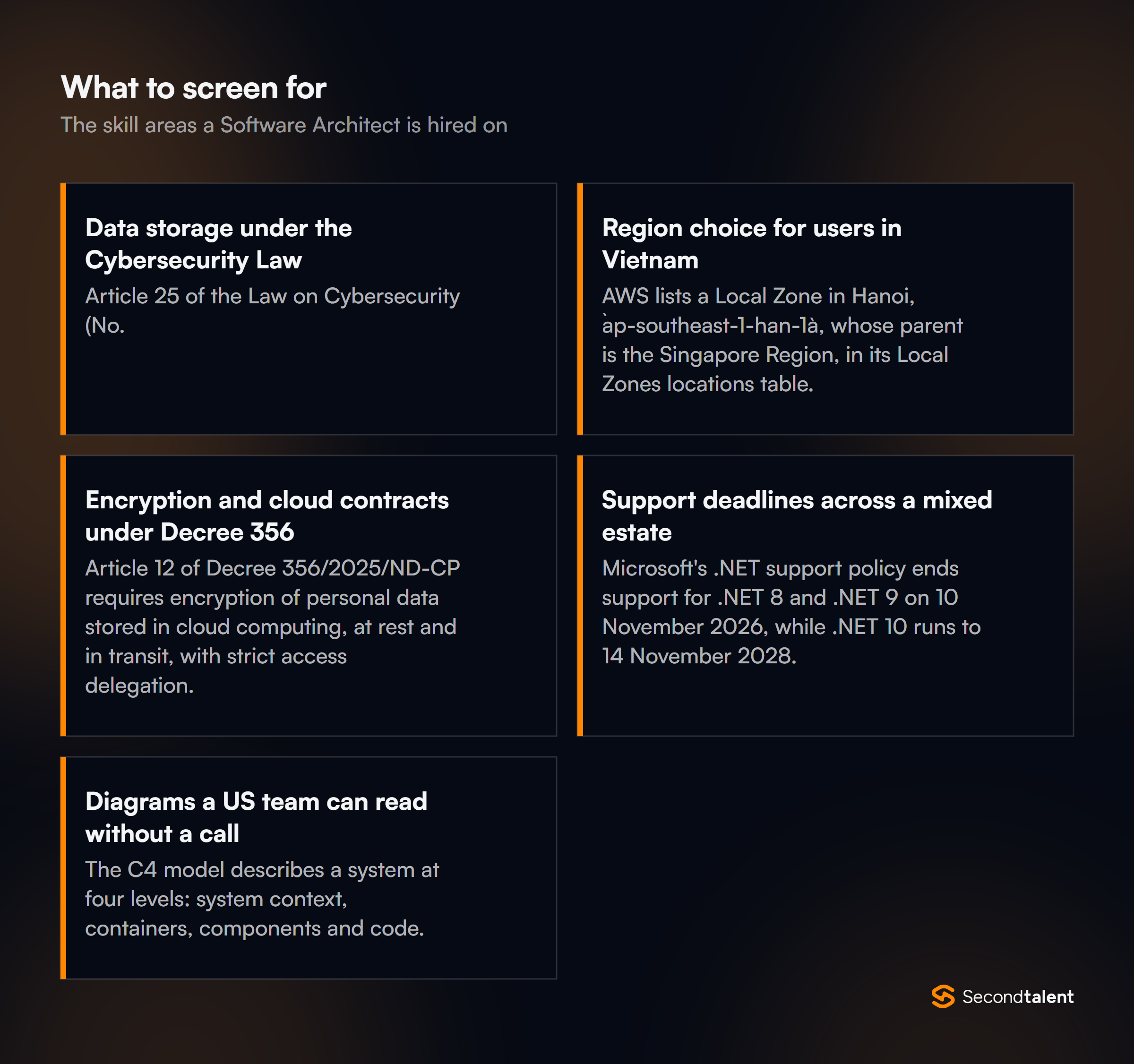
Vietnam's rules on user data took effect in stages in 2026: the personal data law in January, the Cybersecurity Law in July and that law's implementing decree in August. Three of the five areas below follow those rules. The other two test deadlines and documents any US estate has.
Data storage under the Cybersecurity Law
Article 25 of the Law on Cybersecurity (No. 116/2025/QH15) tells domestic and foreign service providers that process user data in Vietnam to store it there. Decree 333/2026/ND-CP, in force since 19 August 2026, lists the data: user personal information, account names, usage times, card details, email addresses, last login and logout IP addresses and registered phone numbers.
Domestic enterprises store it in Vietnam outright (Article 19). A foreign company in a listed field, such as e-commerce, online payment or online applications, must store it and open a branch or representative office once its service has been used to break the cybersecurity law and it fails three written requests within six months.
Storage then runs for at least 24 months, and system logs for investigations stay at least 12 months (Article 20). Ask the candidate how they would split user tables so that data could move to a Vietnam location without a rewrite.
Region choice for users in Vietnam
AWS lists a Local Zone in Hanoi, ap-southeast-1-han-1a, whose parent is the Singapore Region, in its Local Zones locations table. AWS says Local Zones help meet data residency requirements, and it prices their resources differently from the parent Region. Microsoft's Azure regions list names no region in Vietnam.
Ask the candidate which services they would place in Hanoi and which they would leave in Singapore. Then ask which flows would count as a cross-border transfer under Article 20 of the Law on Personal Data Protection, which triggers an impact assessment dossier within 60 days of the first transfer.
Encryption and cloud contracts under Decree 356
Article 12 of Decree 356/2025/ND-CP requires encryption of personal data stored in cloud computing, at rest and in transit, with strict access delegation. A company contracting a cloud provider must also write down the processing flows, each party's role and the deletion deadlines.
Start-ups and small enterprises may skip the law's processing impact assessment and its updates for five years from 1 January 2026 (Article 41). The option does not cover firms that sell processing services, process sensitive personal data directly or reach 100,000 data subjects. Ask the candidate to mark where keys live and who can decrypt each store.
Support deadlines across a mixed estate
Microsoft's .NET support policy ends support for .NET 8 and .NET 9 on 10 November 2026, while .NET 10 runs to 14 November 2028. On the Java side, Spring Boot 3.5 lost open-source support on 30 June 2026, and 4.0 loses it on 31 December 2026.
The Kubernetes project maintains only the three newest minor releases, with about a year of patch support each, and 1.37 reaches end of life on 28 October 2027. Ask for an upgrade sequence across a set of microservices on all three, with the risk each step carries.
Diagrams a US team can read without a call
The C4 model describes a system at four levels: system context, containers, components and code. The C4 site lists the faults of ad hoc diagrams, including unexplained notation, unlabelled relationships and mixed levels of abstraction. Ask for a container diagram of a system the candidate designed and check whether an engineer in New York could follow it cold. Our microservices interview guide has questions for the live round.
Contractor or Employer of Record in Vietnam
Software is not one of the nine categories of commissioned work that can be "work made for hire" under 17 U.S.C. § 101, and a transfer must be in writing and signed under § 204(a). List reference architectures, diagrams, decision records and infrastructure code in the assignment.
Vietnam's Law on Intellectual Property protects computer programs like literary works (Article 22). A party that contracts an author to create a work holds the economic rights unless the contract says otherwise (Article 39). The author keeps the moral rights to be named and to the work's integrity, which cannot be assigned (Article 45), and an assignment contract must be in writing (Article 46).
IRS Publication 515 says the place where services are performed determines the source of the income, so an architect working in Hanoi earns foreign-source income. A foreign individual gives the payer Form W-8BEN to certify foreign status.
Article 13 of the Labor Code treats an agreement covering a paid job, wages and one party's management and supervision as a labor contract, whatever the parties call it. An architect who sits in your planning meetings and signs off your roadmap fits that description.
Article 21 lets an employer agree in writing with an employee who handles technology secrets on how long protection lasts and what a breach costs. An employee on an indefinite-term contract gives at least 45 days' notice to resign (Article 35), which sets the handover you can plan for.
Our Employer of Record service employs the architect in Vietnam, and our Vietnam EOR page covers the setup. This is a summary, not legal advice.
|
Independent contractor |
Employer of Record |
| Legal employer |
None; the architect invoices you |
The EOR's Vietnam entity |
| US paperwork |
Form W-8BEN from the architect |
Service agreement with the EOR |
| IP |
Written assignment of designs, records and code (Articles 39 and 46; § 204(a)) |
Employer holds the economic rights (Article 39), passed on through your EOR agreement |
| Local labor law |
Article 13 labor contract finding if you manage and supervise the work |
Notice, night pay and secrets agreements under the Labor Code |
| Pay currency |
Agreed in the contract, often USD |
Vietnamese dong, as Article 95 requires for Vietnamese employees |
English Level and Working Norms in Vietnam
Strategy and project management staff score 553 on Vietnam's EF English Proficiency Index 2025 page, 53 points above IT staff at 500. Vietnam's national score is also 500, 64th of 123 countries and regions and 12 points above the global average of 488. Hanoi scores 532, per EF's Vietnam page.
An architect's English carries a design to engineers, security reviewers and budget holders. Ask finalists to present one trade-off to a non-technical product lead in ten minutes, then answer written follow-up questions overnight.
Article 112 of the Labor Code gives five paid days for Lunar New Year and two for National Day on 2 September, and the Prime Minister sets the exact dates each year. Keep a region migration or a major cutover out of those weeks once the dates are out.
Thanksgiving on 26 November 2026 is a working day in Vietnam, so an architect there can supervise a change window while your US team is off.
Software Architect Hiring Process in Vietnam
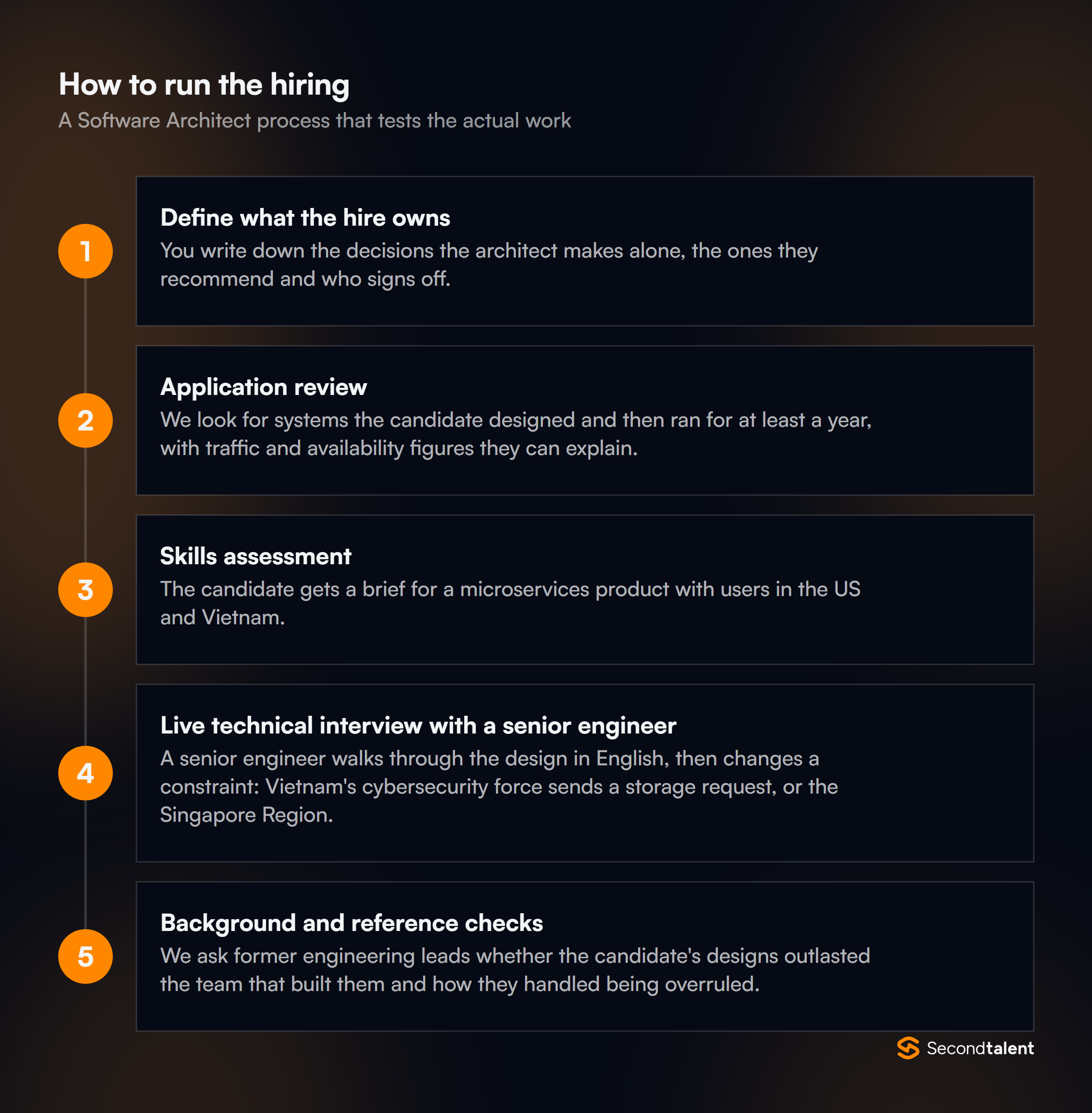
Second Talent's vetting covers stages 2 to 5 before you see a profile.
Stage 1: Define what the hire owns
You write down the decisions the architect makes alone, the ones they recommend and who signs off. Name the systems in scope, where users in Vietnam fit, the next major change and the shift.
Stage 2: Application review
We look for systems the candidate designed and then ran for at least a year, with traffic and availability figures they can explain. Work for banks, e-commerce platforms or telecom operators counts when they can name the controls they designed.
Stage 3: Skills assessment
The candidate gets a brief for a microservices product with users in the US and Vietnam. They return a C4 container diagram, a region and storage plan that names the Vietnamese rules it answers, and an upgrade sequence with dates.
Stage 4: Live technical interview with a senior engineer
A senior engineer walks through the design in English, then changes a constraint: Vietnam's cybersecurity force sends a storage request, or the Singapore Region fails for three hours. The candidate explains what moves, what degrades and what it costs.
Stage 5: Background and reference checks
We ask former engineering leads whether the candidate's designs outlasted the team that built them and how they handled being overruled. You then choose the contractor or EOR route above.
Hire Software Architects from Vietnam with Second Talent
We shortlist 6-8 candidates within 24 hours from 100,000+ pre-vetted engineers, accepting only the top 1% of applicants. Software architects from Vietnam come with $0 upfront, no lock-in and 4-6 hours of daily overlap with US hours. We handle contracts, payroll and equipment, with compliant EOR contracts in Vietnam.
Our pricing page sets out the monthly subscription, and for the teams an architect leads we also staff back-end developers in Vietnam.