TL;DR: Forward deployed engineers in Vietnam earn $2,510 to $5,330+ a month working for international clients on our rate card, the lowest ceiling of the five markets compared, and we shortlist 6-8 candidates within 24 hours. The closest US benchmark, the BLS median for software developers, was $135,980 a year in May 2025.
Vietnam's Law on Artificial Intelligence took effect on 1 March 2026. A deployer that modifies or integrates an AI system in a way that raises its risk must work with the provider to re-classify it (Article 10).
Key takeaways
- Vietnam's floor sits $280 above the Philippines' and $8,150 below Singapore's.
- AI systems already in operation before the law took effect have until 1 March 2027 to comply, or 1 September 2027 in healthcare, education and finance.
- A personal data processor in Vietnam that detects a violation must promptly tell the controller, which has 72 hours to notify the regulator when harm is likely.
- Night overtime in Vietnam carries a further 20% of the day wage on top of overtime and night pay.
What Forward Deployed Engineers Earn in Vietnam Working for International Clients
Vietnam and the Philippines open within $280 of each other, with India's floor between them. China and Singapore start above $9,000. The figures are what forward deployed engineers in each market earn working directly for foreign companies, before any employer or platform costs.
| Market |
Monthly pay working for international clients (USD) |
| Vietnam |
$2,510-$5,330+ |
| Philippines |
$2,230-$5,500+ |
| India |
$2,410-$9,410+ |
| China |
$9,680-$25,760+ |
| Singapore |
$10,660-$22,490+ |
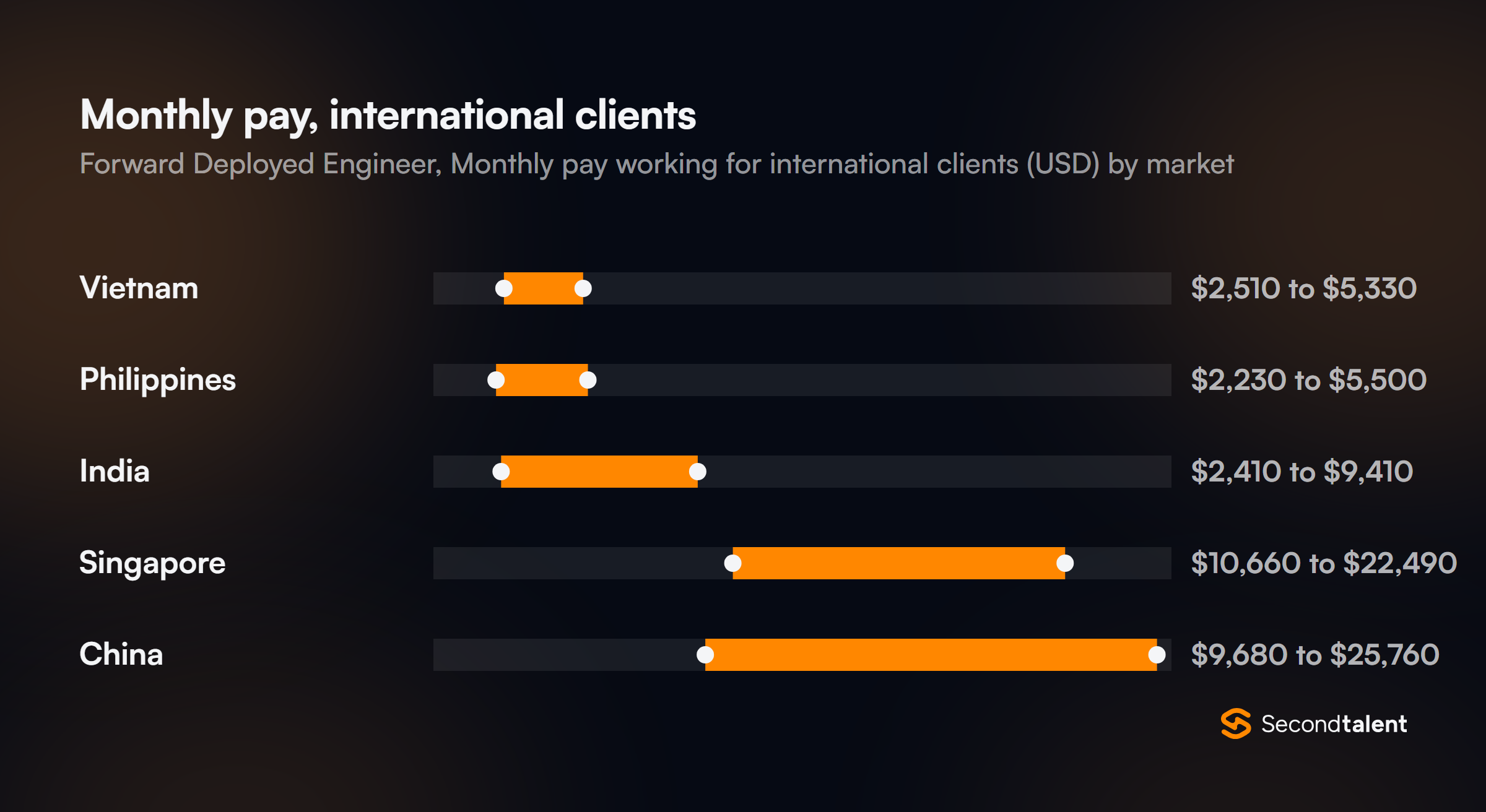
Monthly ranges from the Remote (Working for International Clients) figures on our rate cards for Vietnam, the Philippines, India, China and Singapore, converted at ExchangeRate-API mid-market rates for 14 September 2026.
The Vietnam card quotes ₫65,000,000 to ₫138,000,000+ a month, converted at ₫25,873 to the dollar. India's open top runs $4,080 above Vietnam's, so the Indian card leaves far more room at the senior end.
Through Second Talent you pay one monthly fee that bundles salary, payroll taxes, statutory contributions and our service fee, quoted per role and market. Our pricing page explains the monthly subscription, and our forward deployed engineer cost-to-hire page prices the US contract route.
US Pay Benchmark for Forward Deployed Engineers
BLS publishes no forward deployed engineer occupation. The role maps to Software Developers (SOC 15-1252), because the engineer writes and ships production code, inside a customer's systems.
| BLS OEWS, May 2025, national |
Software Developers (15-1252) |
| Median annual |
$135,980 |
| 10th percentile, monthly |
$6,870 |
| 25th percentile, monthly |
$8,770 |
| Median, monthly |
$11,330 |
| 75th percentile, monthly |
$14,330 |
| 90th percentile, monthly |
$17,890 |
Monthly figures are the annual wages on the OEWS profile for 15-1252 divided by 12, rounded to the nearest $10.
Read the upper columns when you set the brief: this engineer answers to a paying customer as well as to your own team.
Salary is only part of the US cost. In the BLS Employer Costs for Employee Compensation release for June 2026, wages and salaries made up 68.5% of employer compensation costs for full-time private industry workers, and benefits the other 31.5%.
Time Zone Overlap: Ho Chi Minh City Against ET, CT and PT
A customer go-live at 9:00 am Pacific in September starts at 11:00 pm in Ho Chi Minh City, an hour into Vietnam's night-work window. An engineer who stays on the call past a full day shift is working night overtime.
Vietnam keeps UTC+7 all year, the same as Bangkok and Jakarta and an hour behind Manila and Singapore. US daylight time runs from 8 March to 1 November 2026, per NIST.
The arithmetic: 9:00 am in San Francisco under PDT (UTC-7) is 16:00 UTC, which is 11:00 pm in Ho Chi Minh City. Under PST (UTC-8) it is midnight. New York's 9:00 am lands three hours earlier, at 8:00 pm in September.
| Ho Chi Minh City shift (UTC+7) |
ET overlap (EDT / EST) |
CT overlap (CDT / CST) |
PT overlap (PDT / PST) |
Hours between 22:00 and 06:00 |
| 9 am-6 pm |
0 / 0 |
0 / 0 |
0 / 0 |
0 |
| 6 am-3 pm |
0 / 0 |
0 / 0 |
1 / 2 |
0 |
| 3 pm-12 am |
4 / 3 |
3 / 2 |
1 / 0 |
2 |
| 6 pm-3 am |
7 / 6 |
6 / 5 |
4 / 3 |
5 |
Each shift is nine clock hours with a meal break, counted against a 9 am to 5 pm US day. The 9 am row covers customers in Asia and none in the US.
The 3 pm row keeps three hours of a Vietnamese customer's 9-to-6 day and gives an East Coast customer four live hours in September. Only the 6 pm row gives a Pacific customer more than two live hours.
Vietnam's Labor Code 2019 counts 22:00 to 06:00 as night hours (Article 106) and adds at least 30% for employees working them (Article 98). Overtime at night earns a further 20% of the day wage. We fix the shift before the offer, which is how our placements get 4-6 hours of daily overlap with US hours.
Forward Deployed Engineer Skills to Screen For
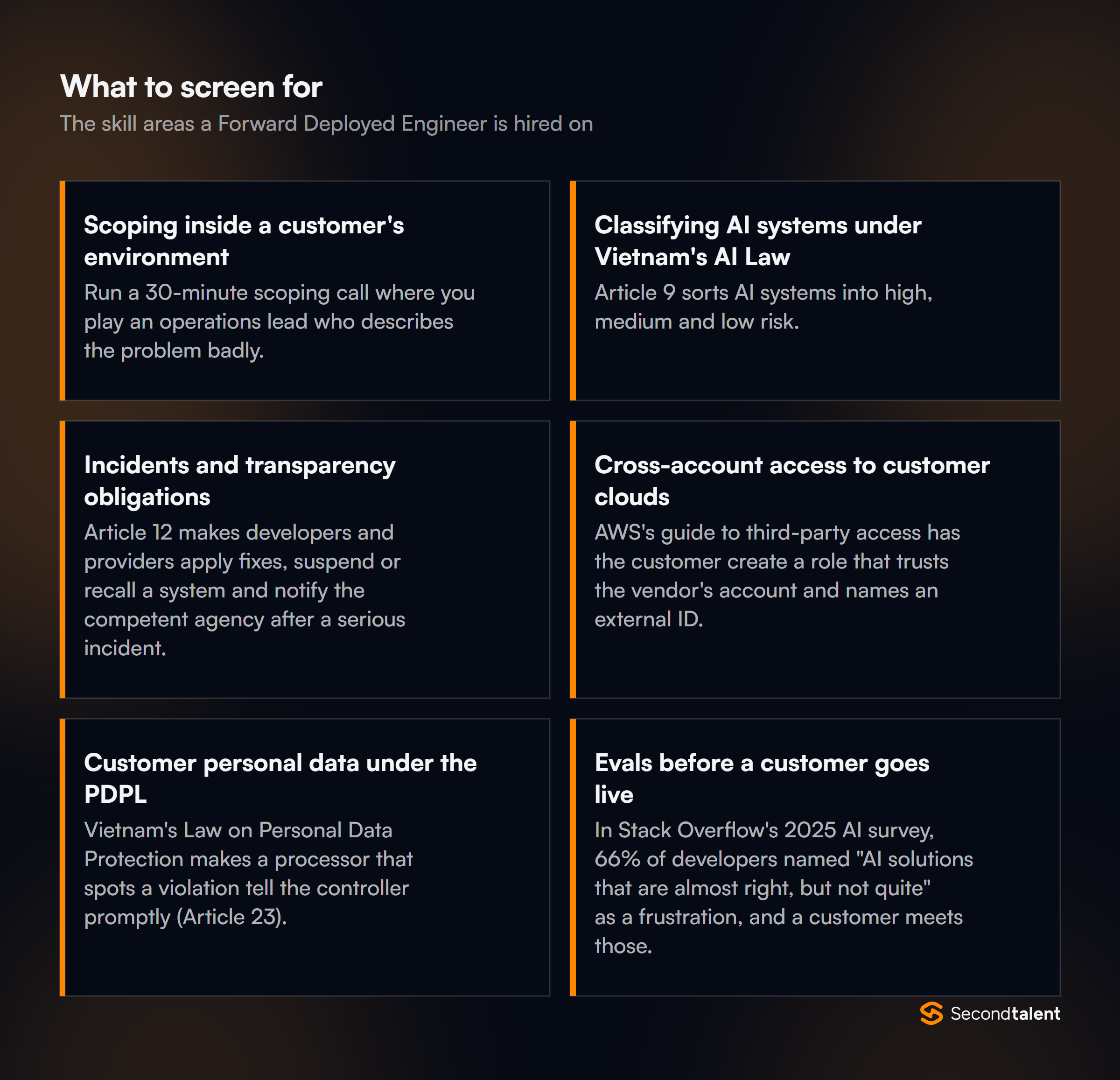
The hire deploys into customer systems and owns the result. The six areas below test the customer half and the code half, and three of them come from Vietnamese laws that took effect in 2026.
Scoping inside a customer's environment
Run a 30-minute scoping call where you play an operations lead who describes the problem badly. Then ask for the written scope: what ships first, what the customer's team must supply, what is out of scope and how both sides will measure success. Mark down a scope that names the architecture before it names the success measure.
Classifying AI systems under Vietnam's AI Law
Article 9 sorts AI systems into high, medium and low risk. Medium risk covers systems that could confuse or manipulate users who cannot tell they are dealing with AI. Providers classify their own systems before service and notify the Ministry of Science and Technology of medium and high results through a one-stop portal (Article 10).
A deployer may inherit the provider's classification until its own changes add risk. Give the candidate a customer that wires a chatbot into loan approvals and ask whether the integration changes the class, and who files what.
Incidents and transparency obligations
Article 12 makes developers and providers apply fixes, suspend or recall a system and notify the competent agency after a serious incident. Deployers and users must record it and report it without delay.
Article 11 requires providers to design systems that talk to people so users can tell they are dealing with AI. Ask the candidate to write the incident runbook for a customer's agent that sent a wrong answer to a borrower.
Cross-account access to customer clouds
AWS's guide to third-party access has the customer create a role that trusts the vendor's account and names an external ID. The external ID guards against the confused deputy problem.
AWS tells customers not to use a value that can be guessed, such as the third party's name, and it does not treat the ID as a secret. Ask the candidate to write the trust policy, then show the call failing with the wrong ID.
Customer personal data under the PDPL
Vietnam's Law on Personal Data Protection makes a processor that spots a violation tell the controller promptly (Article 23). Decree 356/2025/ND-CP adds that AI inference results which can identify a person must be protected as personal data (Article 10).
The same article requires controllers to tell data subjects about automated processing, explain how the algorithm works and offer an opt-out. Ask what the candidate would put in a customer's user notice before an AI feature goes live.
Evals before a customer goes live
In Stack Overflow's 2025 AI survey, 66% of developers named "AI solutions that are almost right, but not quite" as a frustration, and a customer meets those failures first. OWASP's Excessive Agency entry traces agent harm to excessive functionality, permissions and autonomy. Ask for the eval set the candidate would write before go-live, with one case for each cause.
Contractor or Employer of Record in Vietnam
Software is not one of the nine categories of commissioned work that can be "work made for hire" under 17 U.S.C. § 101, and a transfer must be in writing and signed under § 204(a). Your customer contract may hand connectors and scripts to the customer, and you can pass on only the rights the engineer assigned to you.
Vietnam's Law on Intellectual Property protects computer programs like literary works (Article 22). A party that contracts an author to create a work holds the economic rights unless the contract says otherwise (Article 39). The author keeps the moral rights to be named and to the work's integrity, which cannot be assigned (Article 45). Assignment contracts must be in writing (Article 46).
IRS Publication 515 says the place where services are performed determines the source of the income, so an engineer in Hanoi earns foreign-source income. That holds even when every customer is American. A foreign individual gives the payer Form W-8BEN to certify foreign status.
Article 13 of the Labor Code counts any agreement covering a paid job, wages and one party's management and supervision as a labor contract, whatever its title. A standing seat on your customer rotation, with your laptop and your accounts, points to employment.
Customer data raises the stakes on confidentiality. Article 21 covers employees who handle business or technology secrets. Employer and employee can agree in writing on what is protected, for how long and the compensation for a breach. Our Employer of Record service employs the engineer in Vietnam, with local detail on our Vietnam EOR page. This is a summary, not legal advice.
|
Independent contractor |
Employer of Record |
| Legal employer |
None; the engineer invoices you |
The EOR's Vietnam entity |
| US paperwork |
Form W-8BEN from the engineer |
Service agreement with the EOR |
| IP |
Written assignment of connectors, prompts and eval sets (Articles 39 and 46; § 204(a)) |
Employer holds the economic rights (Article 39), passed on through your EOR agreement |
| Local labor law |
Article 13 labor contract finding if you manage and supervise the work |
Night pay, overtime limits and secrets agreements under Article 21 apply |
| Pay currency |
Agreed in the contract, often USD |
Vietnamese dong, as Article 95 requires for Vietnamese employees |
English Level and Working Norms in Vietnam
Vietnam scores 500 on the EF English Proficiency Index 2025, 64th of 123 countries and regions and 12 points above the global average of 488. Its IT job-function score matches the national score at 500, per EF's Vietnam page.
A forward deployed engineer writes for three readers in one day: the customer's executives, its engineers and your product team. Ask finalists to send your account executive a written recap of the scoping call. Then check whether a product manager could act on it without a follow-up call.
Article 112 of the Labor Code gives five paid days for Lunar New Year and two for National Day, with the Prime Minister setting the dates each year. Keep go-lives for Vietnamese customers, and handovers from a Vietnam-based engineer, out of the Tet week.
Thanksgiving on 26 November 2026 is a working day in Vietnam, so an engineer there can watch a customer launch while your US team is off.
Forward Deployed Engineer Hiring Process in Vietnam
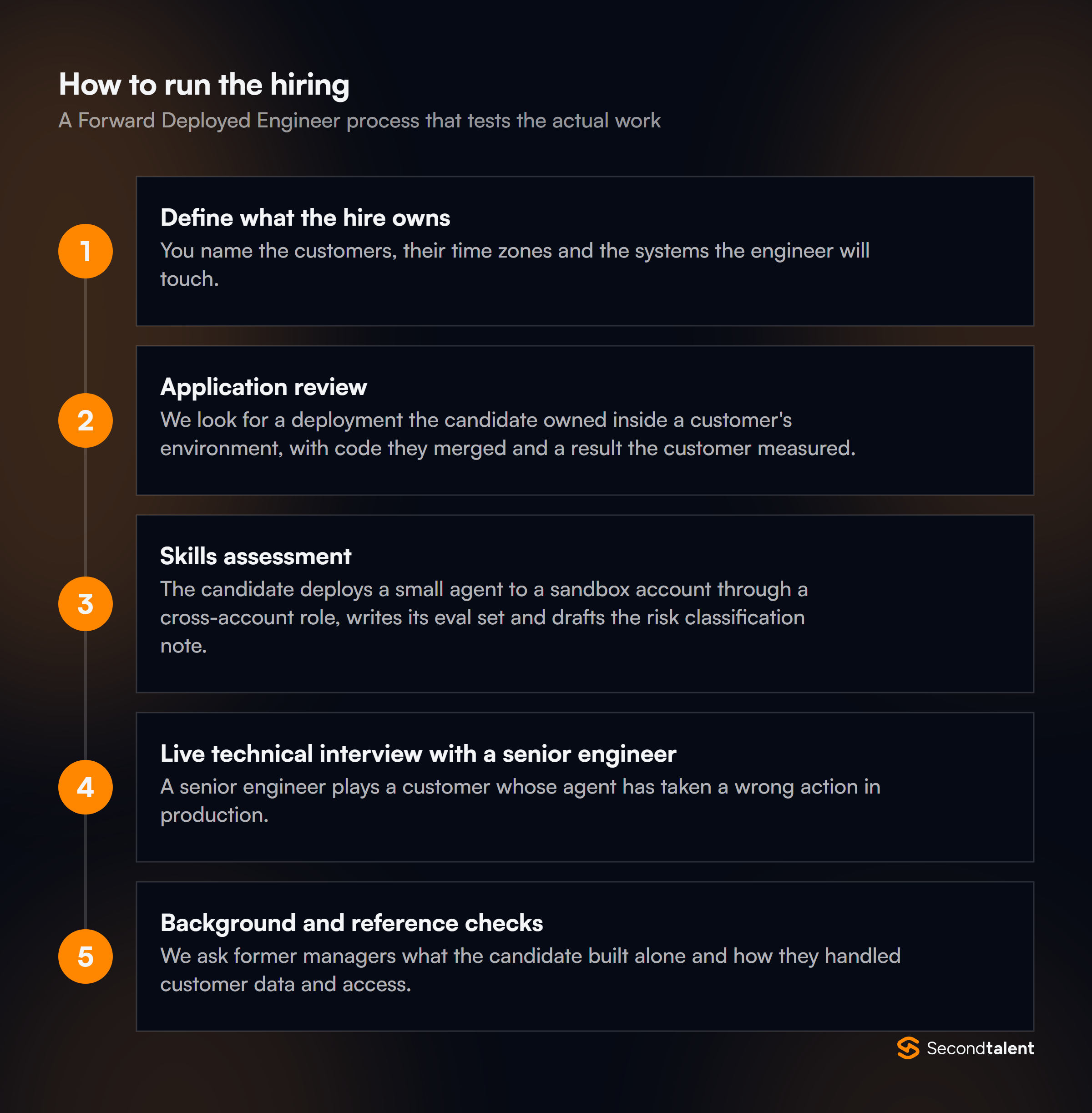
Second Talent's vetting covers stages 2 to 5 before you see a profile.
Stage 1: Define what the hire owns
You name the customers, their time zones and the systems the engineer will touch. Add the models and clouds in play, whether any customer runs AI systems in Vietnam, who signs off a production deployment and a shift from the table above.
Stage 2: Application review
We look for a deployment the candidate owned inside a customer's environment, with code they merged and a result the customer measured. Delivery work behind an account manager counts only when the candidate ran customer calls themselves.
Stage 3: Skills assessment
The candidate deploys a small agent to a sandbox account through a cross-account role, writes its eval set and drafts the risk classification note. The handover note for the customer's team carries the same weight as the code.
Stage 4: Live technical interview with a senior engineer
A senior engineer plays a customer whose agent has taken a wrong action in production. The questions: what the candidate checks first, what they tell the customer in the first ten minutes and when they escalate to your product team.
Stage 5: Background and reference checks
We ask former managers what the candidate built alone and how they handled customer data and access. We also ask what customers said about them. You then choose the contractor or EOR route above.
Hire Forward Deployed Engineers from Vietnam with Second Talent
We shortlist 6-8 candidates within 24 hours from 100,000+ pre-vetted engineers, accepting only the top 1% of applicants. Forward deployed engineers from Vietnam come with $0 upfront, no lock-in and 4-6 hours of daily overlap with US hours. We handle contracts, payroll and equipment, with compliant EOR contracts in Vietnam.
Our pricing page sets out the monthly subscription, and our forward deployed engineers page compares the pool across Asia.