TL;DR: .NET developers in Vietnam earn $1,800 to $5,500 a month working for international clients on our rate card, the second-lowest floor of the five markets compared, and we shortlist 6-8 candidates within 24 hours. The closest US benchmark, the BLS median for software developers, was $135,980 a year in May 2025.
Microsoft's Azure regions list names no region in Vietnam. An ASP.NET Core app on Azure that collects data from Vietnamese users processes it abroad, which Vietnam's personal data law has counted as a cross-border transfer since 1 January 2026.
Key takeaways
- Our Vietnam .NET card is quoted in US dollars, and its top is the only closed ceiling of the five markets compared.
- .NET 8 and .NET 9 both leave support on 10 November 2026, and so does the in-process model for Azure Functions.
- Vietnam's Labor Code sets overtime pay at no less than 150% of the normal wage on workdays, 200% on weekends and 300% on public holidays.
- A controller that finds a harmful personal data violation has 72 hours to notify Vietnam's data protection agency.
What .NET Developers Earn in Vietnam Working for International Clients
Vietnam's floor sits $80 below India's and $440 above the Philippines', while its ceiling clears Malaysia's open top by $460. The figures are what .NET developers in each market earn working directly for foreign companies, before any employer or platform costs.
| Market |
Monthly pay working for international clients (USD) |
| Vietnam |
$1,800-$5,500 |
| Philippines |
$1,360-$3,670+ |
| India |
$1,880-$7,530+ |
| Malaysia |
$2,700-$5,040+ |
| Thailand |
$2,720-$6,950+ |
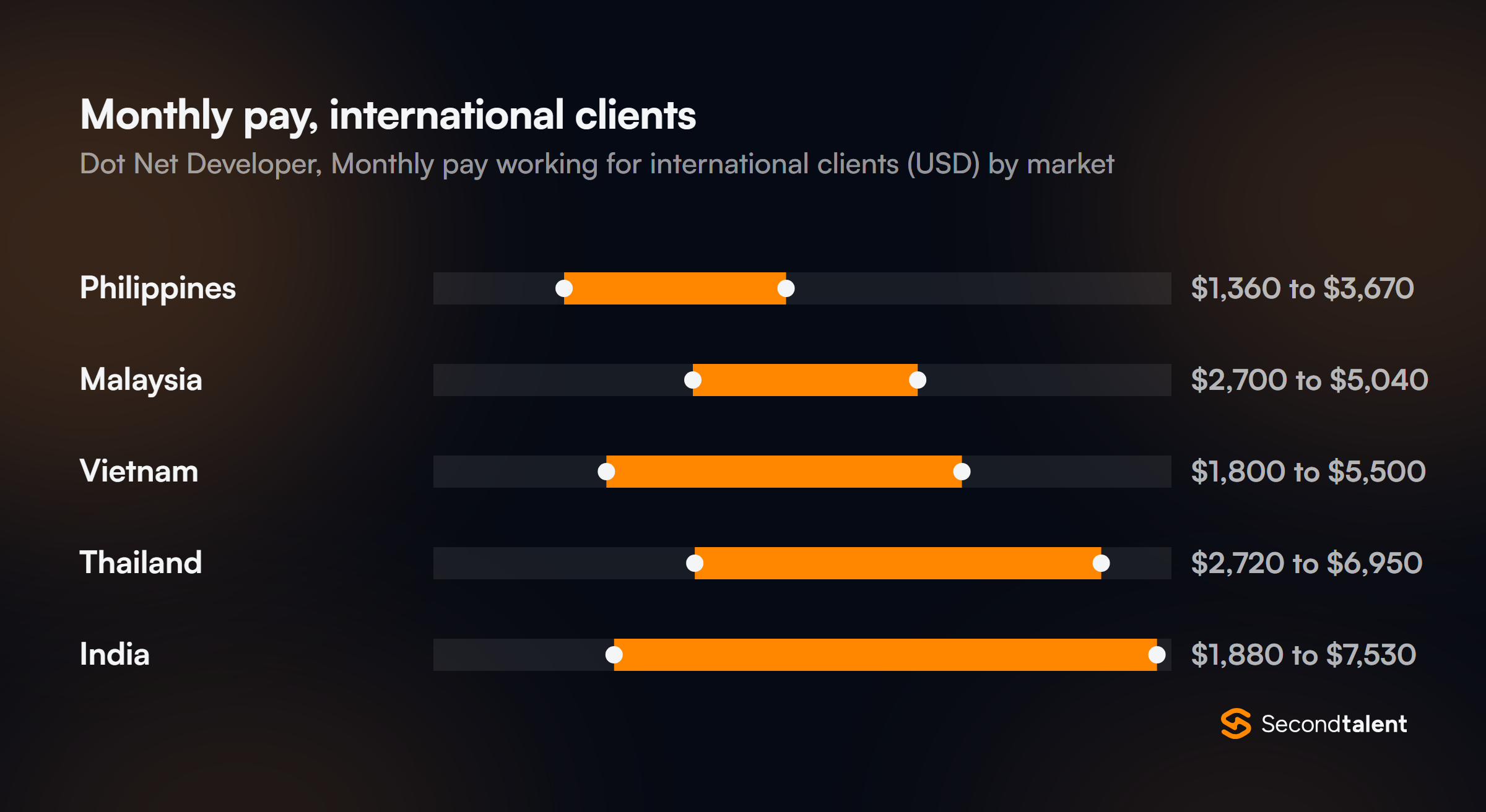
Monthly ranges from the Remote (Working for International Clients) figures on our rate cards for Vietnam, the Philippines, India, Malaysia and Thailand, converted at ExchangeRate-API mid-market rates for 14 September 2026.
The Vietnam card states $1,800 to $5,500 a month in dollars, so no conversion applies to that row. The other four cards quote pesos, rupees, ringgit and baht. India's range is the widest, at $5,650 from floor to open top, against $3,700 for Vietnam.
Through Second Talent you pay one monthly fee that bundles salary, payroll taxes, statutory contributions and our service fee, quoted per role and market. Our pricing page explains the monthly subscription, and our C# and .NET developer cost-to-hire page sets out US freelance rates for the contract route.
US Pay Benchmark for .NET Developers
BLS has no .NET occupation. The role maps to Software Developers (SOC 15-1252), because a .NET developer designs and builds application software, from ASP.NET Core web APIs to Azure-hosted microservices.
| BLS OEWS, May 2025, national |
Software Developers (15-1252) |
| Median annual |
$135,980 |
| 10th percentile, monthly |
$6,870 |
| 25th percentile, monthly |
$8,770 |
| Median, monthly |
$11,330 |
| 75th percentile, monthly |
$14,330 |
| 90th percentile, monthly |
$17,890 |
Monthly figures are the annual wages on the OEWS profile for 15-1252 divided by 12, rounded to the nearest $10.
The Vietnam card tops out below the US 10th percentile. Use the columns to judge scope, not price, and place a candidate by the systems they have run in production rather than by years on a CV.
Salary is only part of the US cost. In the BLS Employer Costs for Employee Compensation release for June 2026, wages and salaries made up 68.5% of employer compensation costs for full-time private industry workers, and benefits the other 31.5%.
Time Zone Overlap: Ho Chi Minh City Against ET, CT and PT
A 1:00 am Eastern release window falls at noon in Ho Chi Minh City while US daylight time lasts. A developer there can ship the deployment, watch the error rate and run the rollback plan during an ordinary day shift.
Vietnam keeps UTC+7 all year, and US daylight time runs from 8 March to 1 November 2026, per NIST. After the change, the same window lands at 1:00 pm.
The arithmetic for live hours: 9:00 am in Chicago under CDT (UTC-5) is 14:00 UTC, which is 9:00 pm in Ho Chi Minh City. Under CST (UTC-6) it is 10:00 pm. New York's 9:00 am lands an hour earlier, at 8:00 pm in September.
| Ho Chi Minh City shift (UTC+7) |
ET overlap (EDT / EST) |
CT overlap (CDT / CST) |
PT overlap (PDT / PST) |
Hours between 22:00 and 06:00 |
| 9 am-6 pm |
0 / 0 |
0 / 0 |
0 / 0 |
0 |
| 12 pm-9 pm |
1 / 0 |
0 / 0 |
0 / 0 |
0 |
| 2 pm-11 pm |
3 / 2 |
2 / 1 |
0 / 0 |
1 |
| 5 pm-2 am |
6 / 5 |
5 / 4 |
3 / 2 |
4 |
Each shift is nine clock hours with a meal break, counted against a 9 am to 5 pm US day. The 2 pm row gives three hours of code review with New York in September for one hour of night work. The 5 pm row adds live hours with California, but four of its nine hours are night hours.
Under Vietnam's Labor Code 2019, night hours run from 22:00 to 06:00 (Article 106) and carry at least 30% extra pay for employees (Article 98). We fix the shift before the offer, which is how our placements get 4-6 hours of daily overlap with US hours.
.NET Developer Skills to Screen For
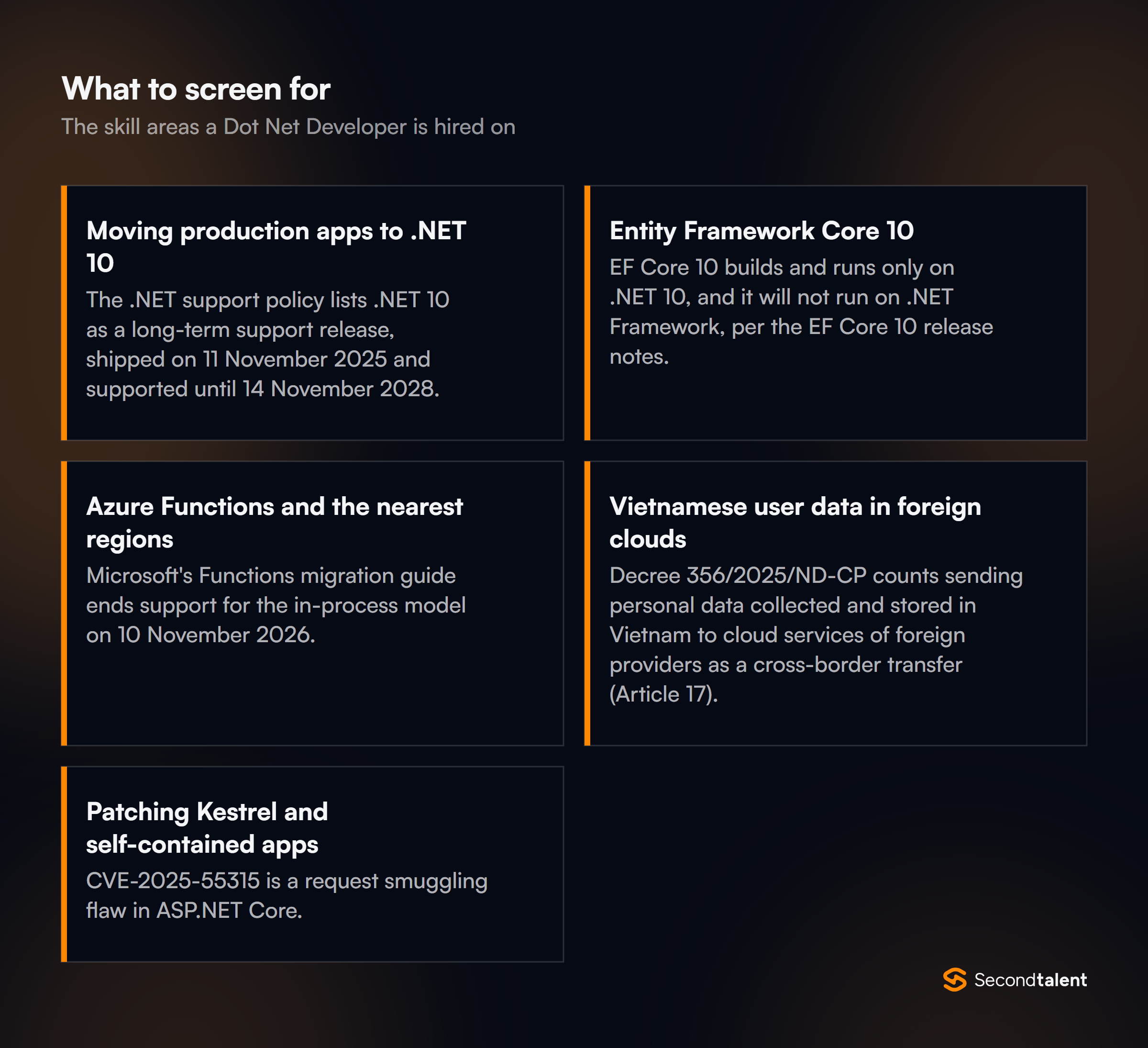
Three of the five areas below come from Microsoft's November 2026 deadlines. The other two are a patching habit and the Vietnamese data rule that follows any app with users in Vietnam.
Moving production apps to .NET 10
The .NET support policy lists .NET 10 as a long-term support release, shipped on 11 November 2025 and supported until 14 November 2028. .NET 8 (LTS) and .NET 9 (STS) are both in maintenance until 10 November 2026.
Ask the candidate to plan the move for an ASP.NET Core API on .NET 8: what they would test first, how they would stage it and where they would stop the rollout.
Entity Framework Core 10
EF Core 10 builds and runs only on .NET 10, and it will not run on .NET Framework, per the EF Core 10 release notes. A team cannot upgrade EF alone and leave the runtime for later.
The release adds named query filters, so a query can switch off a soft-delete filter and keep a tenant filter. Hand over a DbContext with one combined global filter and ask the candidate to split it.
Azure Functions and the nearest regions
Microsoft's Functions migration guide ends support for the in-process model on 10 November 2026. The nearby regions on Microsoft's list include Southeast Asia in Singapore, paired with East Asia in Hong Kong, as well as Malaysia West in Kuala Lumpur and Indonesia Central in Jakarta.
Give the candidate an in-process HTTP trigger to migrate to the isolated worker model. Then ask which region they would deploy it to for Vietnamese users, and what that choice triggers under Vietnam's data rules.
Vietnamese user data in foreign clouds
Decree 356/2025/ND-CP counts sending personal data collected and stored in Vietnam to cloud services of foreign providers as a cross-border transfer (Article 17). Under Article 20 of the Law on Personal Data Protection, the company then files an impact assessment dossier within 60 days of the first transfer.
Article 23 gives a controller 72 hours to notify the regulator after it detects a violation likely to cause harm. Ask the candidate which ASP.NET Core logs and alerts would let your team meet that clock.
Patching Kestrel and self-contained apps
CVE-2025-55315 is a request smuggling flaw in ASP.NET Core. The .NET security advisory lists applications on ASP.NET Core 8.0.20 or earlier and 9.0.9 or earlier as affected. It warns that self-contained apps built on those versions stay vulnerable until they are recompiled and redeployed. Ask how the candidate finds self-contained deployments across a fleet, since updating the shared runtime on a server does not patch them.
Contractor or Employer of Record in Vietnam
Software is not one of the nine categories of commissioned work that can be "work made for hire" under 17 U.S.C. § 101, and a transfer must be in writing and signed under § 204(a). Name the solutions, the NuGet packages and the migration scripts in the assignment.
Vietnam's Law on Intellectual Property protects computer programs like literary works, in source or machine code (Article 22). Its default favours the client: a party that contracts an author to create a work holds the economic rights unless the contract says otherwise (Article 39).
The author still keeps the moral rights to be named and to the work's integrity, which the law bars them from assigning (Article 45). An assignment contract must be in writing (Article 46).
IRS Publication 515 says the place where services are performed determines the source of the income, so a developer working in Ho Chi Minh City earns foreign-source income. A foreign individual gives the payer Form W-8BEN to certify foreign status.
Article 13 of the Labor Code treats an agreement as a labor contract if it covers a paid job, wages and one party's management and supervision, whatever the parties call it. A developer on your release rota with standing access to your Azure subscriptions fits that test.
Employment brings its own terms. Probation for a job that needs a college degree or higher lasts no more than 60 days (Article 25). An employee on an indefinite-term contract gives at least 45 days' notice to resign (Article 35).
Our Employer of Record service employs the developer in Vietnam, with local detail on our Vietnam EOR page. This is a summary, not legal advice.
|
Independent contractor |
Employer of Record |
| Legal employer |
None; the developer invoices you |
The EOR's Vietnam entity |
| US paperwork |
Form W-8BEN from the developer |
Service agreement with the EOR |
| IP |
Written assignment of source, packages and scripts (Articles 39 and 46; § 204(a)) |
Employer holds the economic rights (Article 39), passed on through your EOR agreement |
| Local labor law |
Article 13 labor contract finding if you manage and supervise the work |
Probation, notice, overtime and night pay rules apply |
| Pay currency |
Agreed in the contract, often USD |
Vietnamese dong, as Article 95 requires for Vietnamese employees |
English Level and Working Norms in Vietnam
On the EF English Proficiency Index 2025, Vietnam scores 500 and ranks 64th of 123 countries and regions, 12 points above the global average of 488. Its IT job-function score is also 500, per EF's Vietnam page.
Enterprise .NET work runs on written English that outlasts the sprint: pull request descriptions, runbooks and change records. Ask finalists to write the rollback note for a .NET 10 cutover, addressed to an on-call engineer in Chicago who did not build the app.
Article 112 of the Labor Code gives five paid days for Lunar New Year, and the Prime Minister sets the exact dates each year. Keep runtime upgrades out of the Tet week once the schedule is published. Work on a public holiday earns at least 300% (Article 98), which prices any holiday cutover.
Thanksgiving on 26 November 2026 is a working day in Vietnam, so a developer there can run post-upgrade smoke tests while your US office takes the holiday.
.NET Developer Hiring Process in Vietnam
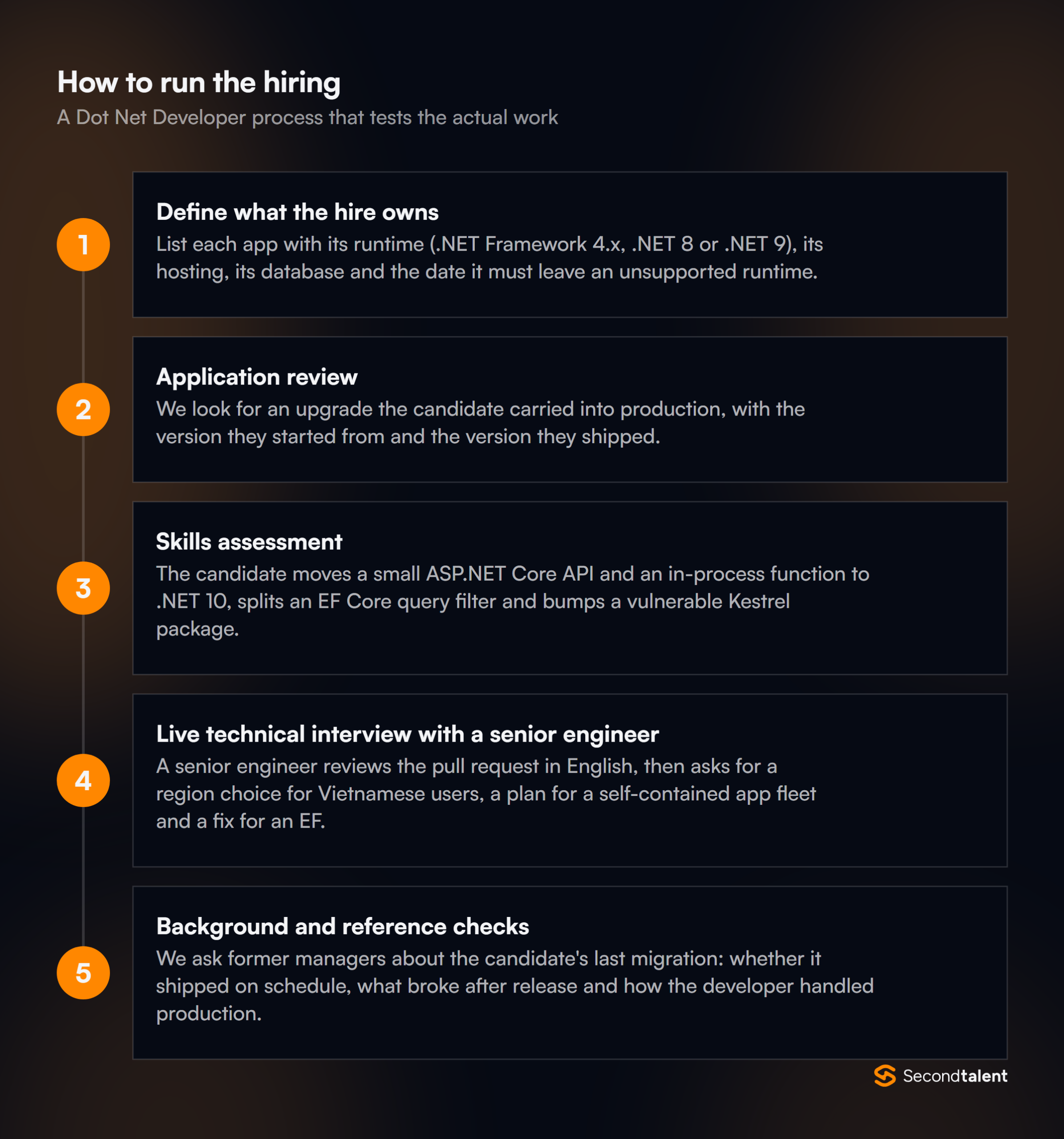
Second Talent's vetting covers stages 2 to 5 before you see a profile.
Stage 1: Define what the hire owns
List each app with its runtime (.NET Framework 4.x, .NET 8 or .NET 9), its hosting, its database and the date it must leave an unsupported runtime. Add whether it stores data from users in Vietnam and a shift from the table above.
Stage 2: Application review
We look for an upgrade the candidate carried into production, with the version they started from and the version they shipped. Work for banks, insurers or telecom operators counts when the candidate can describe the release controls they followed.
Stage 3: Skills assessment
The candidate moves a small ASP.NET Core API and an in-process function to .NET 10, splits an EF Core query filter and bumps a vulnerable Kestrel package. We score the pull request, the test run and the deployment note.
Stage 4: Live technical interview with a senior engineer
A senior engineer reviews the pull request in English, then asks for a region choice for Vietnamese users, a plan for a self-contained app fleet and a fix for an EF Core query that is slow in production.
Stage 5: Background and reference checks
We ask former managers about the candidate's last migration: whether it shipped on schedule, what broke after release and how the developer handled production access. You then pick the contractor or EOR route above.
Hire .NET Developers from Vietnam with Second Talent
We shortlist 6-8 candidates within 24 hours from 100,000+ pre-vetted engineers, accepting only the top 1% of applicants. .NET developers from Vietnam come with $0 upfront, no lock-in and 4-6 hours of daily overlap with US hours. We handle contracts, payroll and equipment, with compliant EOR contracts in Vietnam.
Our pricing page sets out the monthly subscription, our .NET developers page compares the pool across Asia, and our C# and .NET interview guide has question sets for your own final round.