TL;DR: Software architects in Singapore earn $10,260 to $16,180+ a month working for international clients on our cloud engineer rate card, the closest match. We shortlist 6-8 candidates within 24 hours, and the BLS median for US software developers, the occupation that covers architects, was $135,980 a year in May 2025.
Singapore's central bank asks financial institutions to review their IT architecture periodically and map internal and external dependencies to find any single point of failure. A software architect who has worked under those guidelines should be able to show you that map for a system they designed.
Key takeaways
- .NET 8 and .NET 9 both leave Microsoft support on 10 November 2026, seven weeks before open-source support for Spring Boot 4.0 ends.
- Singapore's personal data law lets personal data leave the country only under prescribed requirements, which shapes where an architect puts a database.
- Diagrams and decision records a contractor writes in Singapore stay theirs until a signed written assignment moves them.
- A 2 pm to 11 pm shift in Singapore gives a New York team two live hours in September with nothing after midnight.
What Software Architects Earn in Singapore Working for International Clients
Singapore's floor sits $2,400 above Malaysia's ceiling and $580 below Hong Kong's floor. No card of ours covers software architects by title. Every row uses our cloud engineer rate card for its market, the same card family as our software architects from Asia page.
The figures are what engineers in each market earn working directly for foreign companies, before any employer or platform costs.
| Market |
Monthly pay working for international clients (USD) |
| Singapore |
$10,260-$16,180+ |
| Philippines |
$1,750-$4,630+ |
| Vietnam |
$2,000-$6,500 |
| Malaysia |
$3,930-$7,860+ |
| Hong Kong |
$10,840-$22,320+ |
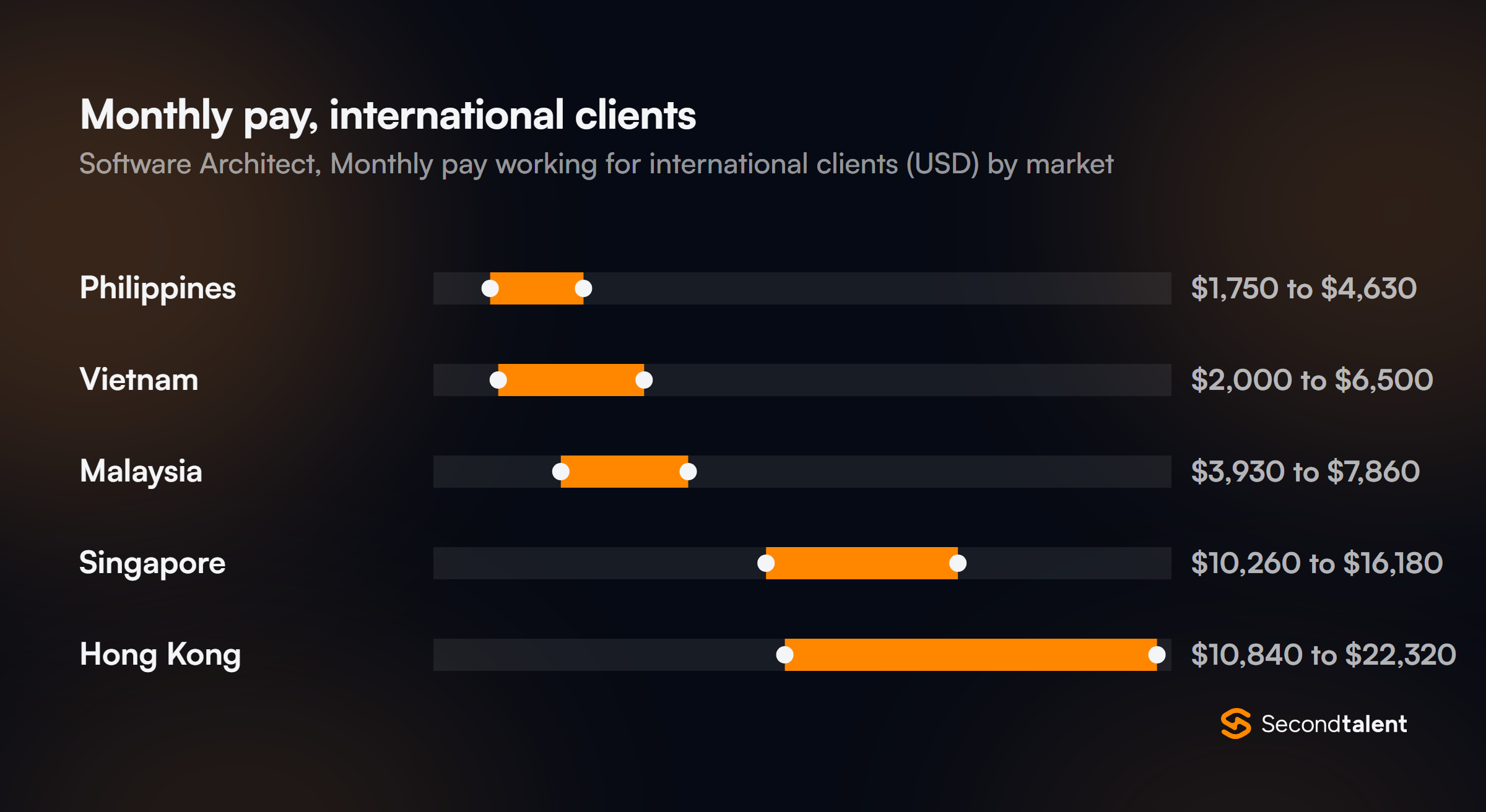
Monthly ranges from the Remote (Working for International Clients) figures on our rate cards for Singapore, the Philippines, Vietnam, Malaysia and Hong Kong, converted at ExchangeRate-API mid-market rates for 14 September 2026.
The Singapore card is set at S$13,000 to S$20,500+ a month. Java Spring Boot and .NET, the stack named at the top of this page, have their own Singapore cards. Our Java developer card runs from $8,680 to $20,130+, and our .NET developer card from $8,290 to $16,180+.
Through Second Talent you pay one monthly fee that bundles salary, payroll taxes, statutory contributions and our service fee, quoted per role and market. Our pricing page explains the subscription.
US Pay Benchmark for Software Architects
O*NET lists "Software Architect" among the reported job titles for Software Developers (15-1252), so that is the BLS benchmark for the role.
| BLS OEWS, May 2025, national |
Software Developers (15-1252) |
| Median annual |
$135,980 |
| 10th percentile, monthly |
$6,870 |
| 25th percentile, monthly |
$8,770 |
| Median, monthly |
$11,330 |
| 75th percentile, monthly |
$14,330 |
| 90th percentile, monthly |
$17,890 |
Monthly figures are the annual wages on the OEWS profile for 15-1252 divided by 12, rounded to the nearest $10.
Singapore's cloud engineer floor sits $1,070 under the US monthly median, and its printed ceiling falls between the US 75th and 90th percentiles.
Salary is only part of the US cost. In the BLS Employer Costs for Employee Compensation release for June 2026, wages and salaries made up 68.5% of employer compensation costs for full-time private industry workers, and benefits the other 31.5%.
Time Zone Overlap: Singapore Against ET, CT and PT
An architect's shared hours go to decisions, not typing. Singapore stays on UTC+8 all year with no daylight saving, while US clocks keep daylight time from 8 March to 1 November 2026, per NIST.
The arithmetic: 5:00 pm in New York under EDT (UTC-4) is 21:00 UTC, which is 5:00 am the next day in Singapore. So the New York working day covers 9:00 pm to 5:00 am Singapore time in September, and 10:00 pm to 6:00 am after 1 November.
| Singapore shift (UTC+8) |
ET overlap (EDT / EST) |
CT overlap (CDT / CST) |
PT overlap (PDT / PST) |
Hours between 10 pm and 6 am |
| 9 am-6 pm |
0 / 0 |
0 / 0 |
0 / 0 |
0 |
| 2 pm-11 pm |
2 / 1 |
1 / 0 |
0 / 0 |
1 |
| 5 pm-2 am |
5 / 4 |
4 / 3 |
2 / 1 |
4 |
| 8 pm-5 am |
8 / 7 |
7 / 6 |
5 / 4 |
7 |
Overlap counts clock hours of a nine-hour shift, meal break included, against a 9 am to 5 pm US day.
Use the live hours for design reviews, incident retrospectives and trade-off calls with product leads. Decision records, diagram updates and code review can move through the US night. A weekly architecture review at 9:00 am Pacific is midnight in Singapore until 1 November, so agree its slot before the offer.
We set the shift in the contract, which is how our placements get 4-6 hours of daily overlap with US hours.
Software Architect Skills to Screen For
Section 8.1.2 of the Monetary Authority of Singapore's Technology Risk Management Guidelines calls for redundancy or fault tolerance in systems that need high availability. Architects who have built for Singapore's banks and insurers work to that standard, so test for the habits it builds.
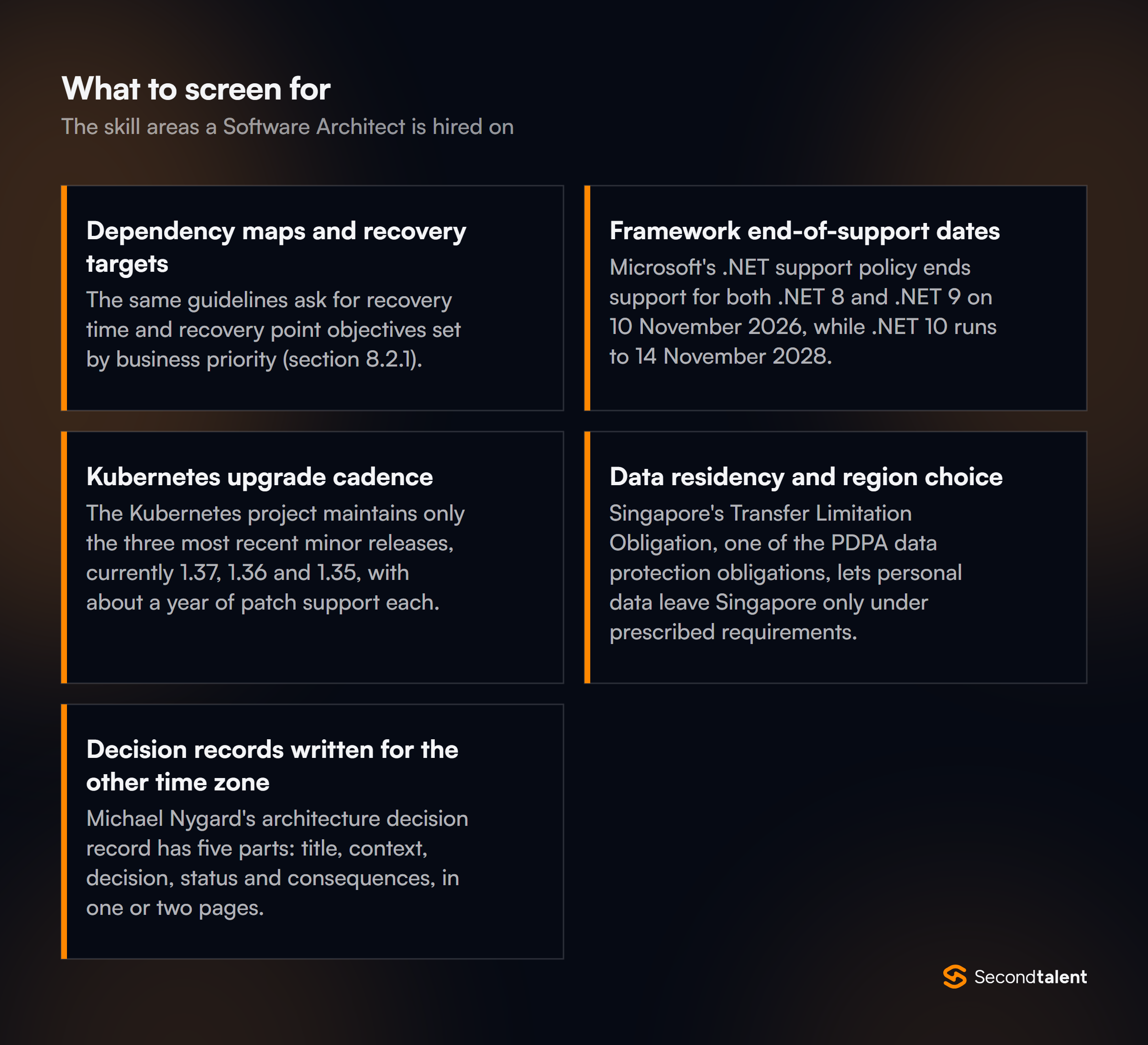
Dependency maps and recovery targets
The same guidelines ask for recovery time and recovery point objectives set by business priority (section 8.2.1). They also ask institutions to run from their recovery site from time to time (section 8.2.4). The drill shows whether that site can carry the business for an extended period.
Ask the candidate to map one of your services, mark every single point of failure and set an RTO and RPO for each tier. Then ask what a quarterly failover drill would cost.
Framework end-of-support dates
Microsoft's .NET support policy ends support for both .NET 8 and .NET 9 on 10 November 2026, while .NET 10 runs to 14 November 2028. On the Spring side, Spring Boot 3.5 lost open-source support on 30 June 2026, and 4.0 loses it on 31 December 2026.
An architect decides which services move first and which stay on paid support. Ask for that sequence across a mixed Java and .NET estate, with the risk each step carries.
Kubernetes upgrade cadence
The Kubernetes project maintains only the three most recent minor releases, currently 1.37, 1.36 and 1.35, with about a year of patch support each. Version 1.37 arrived on 26 August 2026 and reaches end of life on 28 October 2027. Ask how the candidate keeps clusters inside that window without freezing feature work, and which API deprecations they check before each jump.
Data residency and region choice
Singapore's Transfer Limitation Obligation, one of the PDPA data protection obligations, lets personal data leave Singapore only under prescribed requirements. Those requirements keep its protection comparable to the PDPA. A US product with Singapore customers has to decide where their records live, where backups go and which analytics copies cross the border. Ask the candidate to draw that data flow and mark each transfer.
Decision records written for the other time zone
Michael Nygard's architecture decision record has five parts: title, context, decision, status and consequences, in one or two pages. He asks for every consequence, not only the positive ones. Across a 12-hour gap the record replaces the meeting, so ask for a redacted ADR and check whether the costs made it in. Our microservices interview guide has questions for the live round.
Contractor or Employer of Record in Singapore
Software is not one of the nine categories of commissioned work that can be "work made for hire" under 17 U.S.C. § 101, and a transfer must be in writing and signed under § 204(a).
Singapore's Copyright Act 2021 makes the author first owner by default (section 133) and the employer first owner of work made under a contract of service (section 134). A copyright assignment is valid only in writing and signed by the assignor (section 138). IPOS confirms that a commissioned author keeps copyright unless both sides agree otherwise in writing. List reference architectures, diagrams, decision records and proof-of-concept code in the assignment.
IRS Publication 515 says the place where services are performed determines the source of the income, so an architect working from Singapore earns foreign-source income. A foreign individual gives the payer Form W-8BEN to certify foreign status.
The Ministry of Manpower's contract of service guidance applies no single conclusive test. It weighs who controls the timing and method of work, who provides tools and workplace, and whether the person carries profit or loss. An architect who sits in your planning meetings and owns your roadmap points to employment.
Part 4 of the Employment Act, on hours and overtime, does not cover managers or executives. For other employees who are not workmen it stops at a basic salary of S$2,600 a month, per MOM. An architect's shift and on-call terms therefore sit in the contract. Our Employer of Record service employs the architect locally, and our Singapore EOR page covers the setup. This is a summary, not legal advice.
|
Independent contractor |
Employer of Record |
| Legal employer |
None; the architect invoices you |
The EOR's Singapore entity |
| US paperwork |
Form W-8BEN from the architect |
Service agreement with the EOR |
| IP |
Signed written assignment of designs, records and code (section 138) |
Employer first owner (section 134), passed on through your EOR agreement |
| Local labor law |
Employment risk if you control timing, method and tools |
Employment Act core terms; hours and on-call set by contract |
| Pay currency |
Agreed in the contract, often USD |
Local payroll run by the EOR |
English Level and Working Norms in Singapore
Among Singapore residents who speak English most often at home, 80.5% also speak a vernacular language, per the General Household Survey 2025. EF's English Proficiency Index 2025 has no Singapore page, so no EF score applies.
An architect's English carries the design to engineers, security reviewers and budget holders. Ask finalists to present one decision to a non-technical product lead in ten minutes, then answer written follow-up questions overnight.
Singapore's Tripartite Guidelines on Flexible Work Arrangement Requests, in effect since 1 December 2024, set minimum requirements for how employers handle formal requests for flexible work. Put the agreed US-facing shift in the offer rather than leaving it to a later request.
MOM lists 11 public holidays for 2026. Chinese New Year 2027 falls on Saturday 6 and Sunday 7 February, so Monday 8 February is a holiday for employees whose rest day is Sunday. Keep a planned cutover or Region migration out of that week.
Thanksgiving on 26 November 2026 is a working day in Singapore, so an architect there can supervise a change window while your US team is off.
Software Architect Hiring Process in Singapore
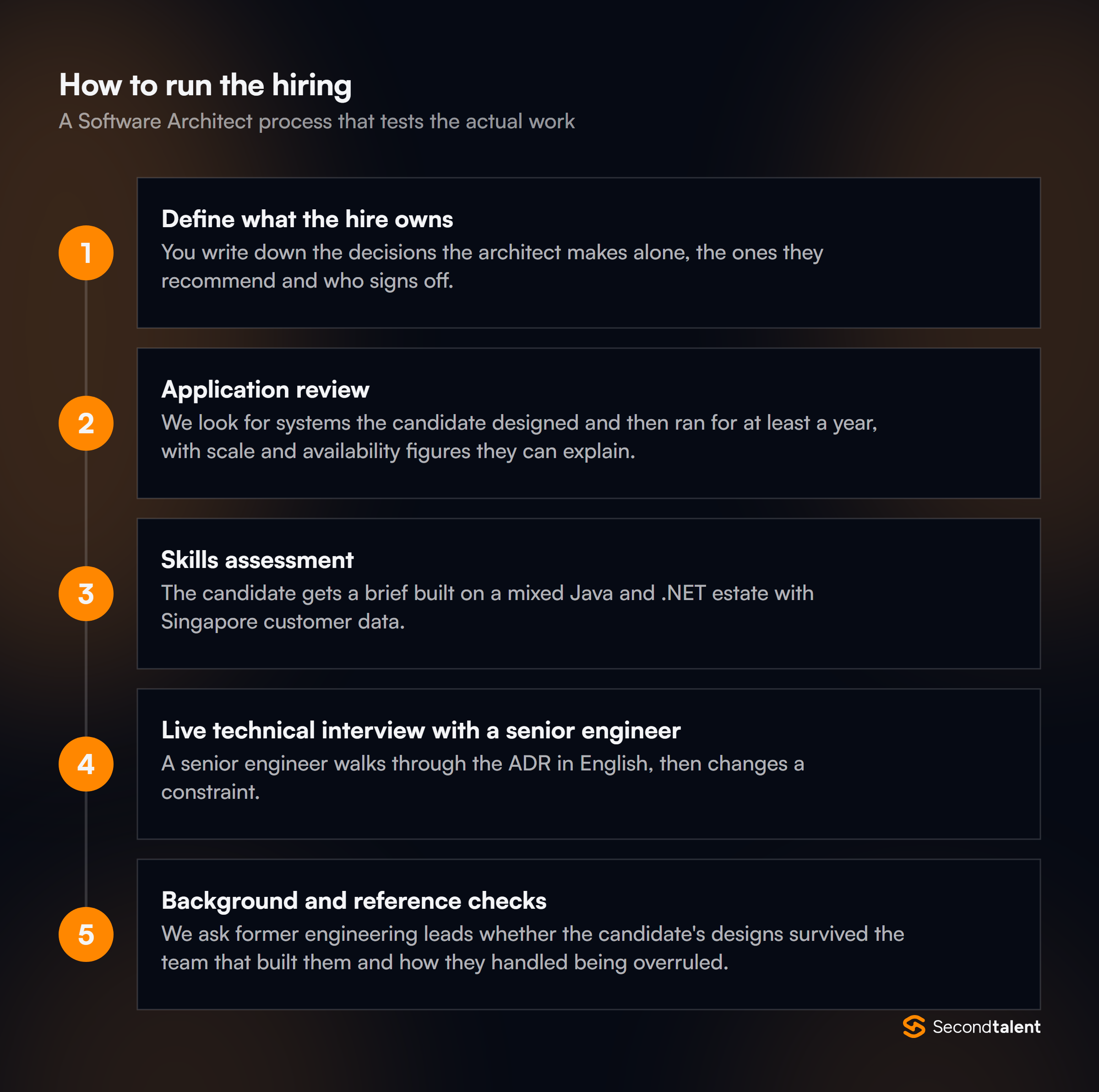
Second Talent's vetting covers stages 2 to 5 before you see a profile.
Stage 1: Define what the hire owns
You write down the decisions the architect makes alone, the ones they recommend and who signs off. Name the systems in scope, the next major change (a .NET or Spring Boot upgrade, a new Region, a monolith split) and the shift.
Stage 2: Application review
We look for systems the candidate designed and then ran for at least a year, with scale and availability figures they can explain. Work under MAS guidelines counts when they can name the controls they designed.
Stage 3: Skills assessment
The candidate gets a brief built on a mixed Java and .NET estate with Singapore customer data. They return a two-page ADR, one dependency diagram with RTO and RPO per tier, and an upgrade sequence with dates.
Stage 4: Live technical interview with a senior engineer
A senior engineer walks through the ADR in English, then changes a constraint. The primary Region fails for three hours during a Kubernetes upgrade, and the candidate explains what breaks, what degrades and what the fallback costs a month.
Stage 5: Background and reference checks
We ask former engineering leads whether the candidate's designs survived the team that built them and how they handled being overruled. You then choose the contractor or EOR route above.
Hire Software Architects from Singapore with Second Talent
We shortlist 6-8 candidates within 24 hours from 100,000+ pre-vetted engineers, accepting only the top 1% of applicants. Software architects from Singapore come with $0 upfront, no lock-in and 4-6 hours of daily overlap with US hours. We handle contracts, payroll and equipment, with compliant EOR contracts in Singapore.
Our pricing page covers subscription, direct-hire and EOR pricing, and for the teams an architect leads we also staff back-end developers in Singapore.