TL;DR: AI developers in Vietnam earn $3,870 to $7,730+ a month working for international clients on our AI engineer rate card, and we shortlist 6-8 candidates within 24 hours. The closest US benchmark, the BLS median for software developers, was $135,980 a year in May 2025.
Vietnam's Law on Artificial Intelligence took effect on 1 March 2026. AI systems already in service before that date have 12 months to comply, or 18 months in healthcare, education and finance. A developer who ships AI to Vietnamese users now classifies each system by risk before it goes live.
Key takeaways
- Vietnam has the highest floor of the four markets compared, $180 above Malaysia's.
- VinAI pre-trained PhoGPT-4B from scratch on 102 billion tokens of Vietnamese text and released it under the BSD-3-Clause licence.
- Vietnam's personal data law sets the maximum fine for a cross-border transfer violation at 5% of an organisation's revenue for the previous year.
- Hanoi scores 532 on the EF English index, 32 points above the national score.
What AI Developers Earn in Vietnam Working for International Clients
India's open top runs $2,420 above Vietnam's, yet no market in the table starts higher than Vietnam. We publish no AI developer card, so the table uses our AI engineer rate cards, the closest match. The figures are what engineers in each market earn working directly for foreign companies, before any employer or platform costs.
| Market |
Monthly pay working for international clients (USD) |
| Vietnam |
$3,870-$7,730+ |
| Philippines |
$2,390-$4,790+ |
| India |
$2,610-$10,150+ |
| Malaysia |
$3,690-$7,370+ |
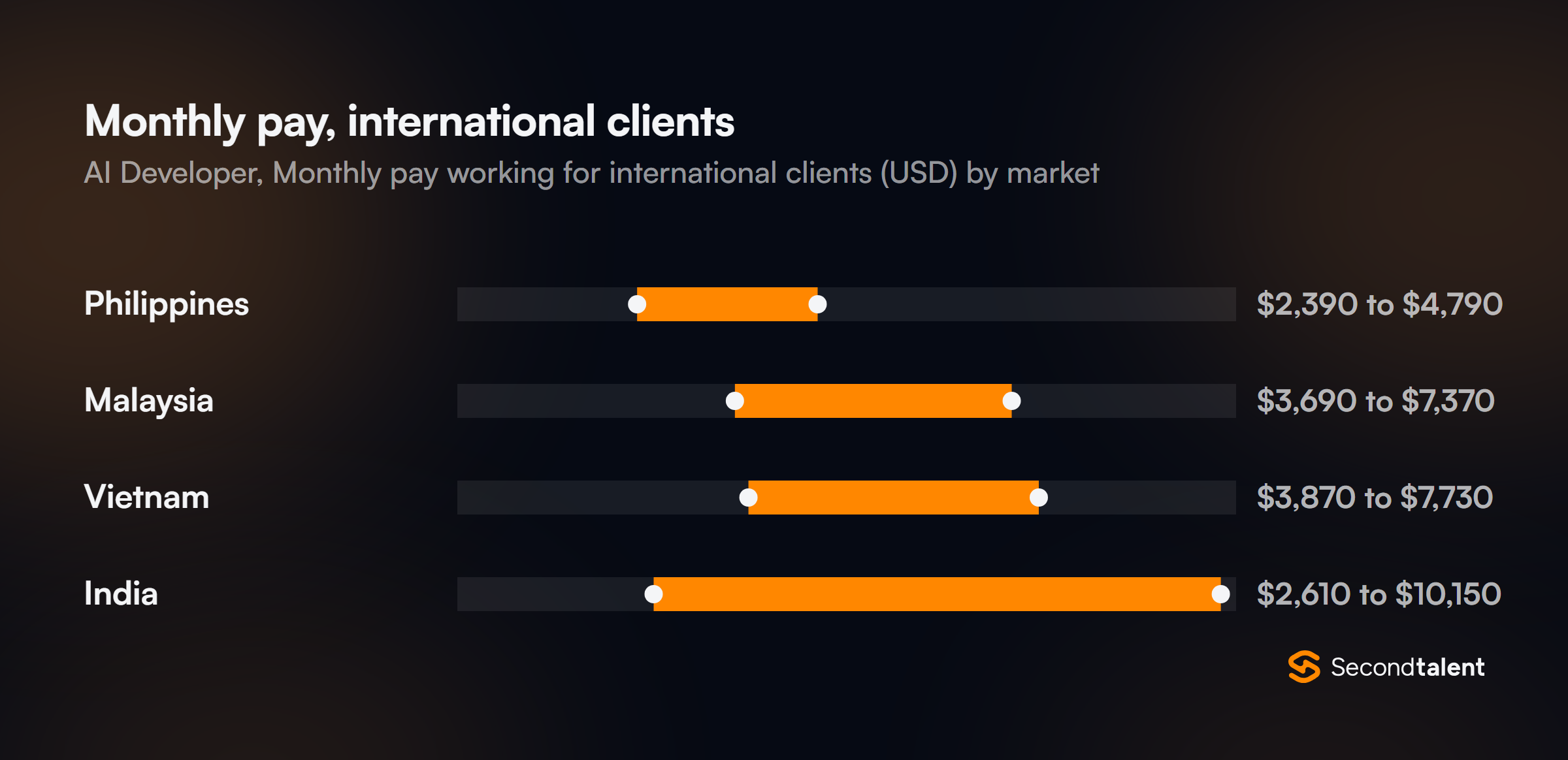
Monthly ranges from the Remote (Working for International Clients) figures on our rate cards for Vietnam, the Philippines, India and Malaysia, converted at ExchangeRate-API mid-market rates for 14 September 2026.
The Vietnam card quotes ₫100,000,000 to ₫200,000,000+ a month. If your brief is model training in TensorFlow or PyTorch, our Vietnam machine learning engineer card quotes $2,500 to $7,000, a floor $1,370 lower.
Through Second Talent you pay one monthly fee that bundles salary, payroll taxes, statutory contributions and our service fee, quoted per role and market. Our pricing page explains the subscription, and our AI engineer cost-to-hire page lists US freelance rates for contract work.
US Pay Benchmark for AI Developers
BLS has no AI developer occupation. The role maps to Software Developers (SOC 15-1252), because an AI developer builds and runs production software around models, retrieval and inference.
| BLS OEWS, May 2025, national |
Software Developers (15-1252) |
| Median annual |
$135,980 |
| 10th percentile, monthly |
$6,870 |
| 25th percentile, monthly |
$8,770 |
| Median, monthly |
$11,330 |
| 75th percentile, monthly |
$14,330 |
| 90th percentile, monthly |
$17,890 |
Monthly figures are the annual wages on the OEWS profile for 15-1252 divided by 12, rounded to the nearest $10.
The Vietnam card's floor is $3,000 below the US 10th percentile monthly figure. Its open top passes that figure by $860 and stays $3,600 under the US median.
Salary is only part of the US cost. In the BLS Employer Costs for Employee Compensation release for June 2026, wages and salaries made up 68.5% of employer compensation costs for full-time private industry workers, and benefits the other 31.5%.
Time Zone Overlap: Ho Chi Minh City Against ET, CT and PT
A fine-tuning run started at 9 am in Ho Chi Minh City begins at 10 pm the evening before in New York while US daylight time lasts. Vietnam keeps UTC+7 all year with no daylight saving, and US clocks stay on daylight time from 8 March to 1 November 2026, per NIST.
The arithmetic: 9:00 am in Chicago is 14:00 UTC under CDT (UTC-5), and 14:00 UTC is 9:00 pm in Ho Chi Minh City. Under CST (UTC-6) it is 10:00 pm. New York's 9:00 am lands an hour earlier, at 8:00 pm, and San Francisco's at 11:00 pm.
| Ho Chi Minh City shift (UTC+7) |
ET overlap (EDT / EST) |
CT overlap (CDT / CST) |
PT overlap (PDT / PST) |
Hours in the 22:00-06:00 night window |
| 9 am-6 pm |
0 / 0 |
0 / 0 |
0 / 0 |
0 |
| 3 pm-12 am |
4 / 3 |
3 / 2 |
1 / 0 |
2 |
| 5 pm-2 am |
6 / 5 |
5 / 4 |
3 / 2 |
4 |
| 7 pm-4 am |
8 / 7 |
7 / 6 |
5 / 4 |
6 |
Each shift is nine clock hours with a meal break, counted against a 9 am to 5 pm US day.
The last column carries a cost. Vietnam's Labor Code 2019 counts 22:00 to 06:00 as night work (Article 106) and pays at least 30% extra for it (Article 98). Overtime at night adds a further 20%. The 3 pm to midnight row gives New York four live hours with two of them at the night rate.
For AI work, split the day. Your team posts failing traces and eval requests before logging off, and the engineer runs sweeps in the Vietnamese daytime. The shared hours go to prompt changes that touch production and model incidents. We fix the shift before the offer, which is how our placements get 4-6 hours of daily overlap with US hours.
AI Developer Skills to Screen For

Vietnam appears on the supported-country lists for Anthropic, the OpenAI API and Google's Gemini API, so an engineer there can work with your hosted models without a workaround. Screen the five areas below, three of which come from Vietnamese law or the Vietnamese language.
Vietnamese text before the model
Written Vietnamese puts spaces between syllables as well as between words, and the PhoBERT paper cites a finding that 85% of Vietnamese word types have at least two syllables.
The model card for PhoBERT-base-v2 states that raw text must pass through a word segmenter before it reaches the model, and lists a maximum length of 256 tokens. Give the candidate a Vietnamese support-ticket dataset and ask where segmentation, diacritics and chunk length each enter their retrieval pipeline.
Open Vietnamese models and benchmarks
The PhoGPT technical report describes a base model with 3.7 billion parameters, an 8,192-token context and a vocabulary of 20,480 token types. Its chat variant was fine-tuned on 70,000 instructional prompts and 290,000 conversations.
For evaluation, the VMLU benchmark suite includes Vi-MQA, a multiple-choice set across 58 subjects, most with about 200 questions. Ask the candidate to choose between a small Vietnamese model you host and a frontier API, and name the benchmark and the in-house test set that would decide it.
Risk classification under the AI Law
Vietnam's Law on Artificial Intelligence sorts systems into high, medium and low risk (Article 9). A medium-risk system is one that could confuse or manipulate users who cannot tell they are dealing with AI. Providers classify their own systems before launch, and file medium and high results with the Ministry of Science and Technology through a one-stop portal (Article 10).
Ask the candidate to classify a Vietnamese-language chatbot for a bank and defend the level.
Personal data in training and retrieval
Vietnam's Law on Personal Data Protection took effect on 1 January 2026. Article 30 requires risk-level classification when AI processes personal data. Article 20 treats processing data collected in Vietnam on a platform outside the country as a cross-border transfer, with an impact assessment dossier due within 60 days of the first transfer.
Ask where the candidate's last retrieval index stored Vietnamese customer records and who filed the dossier.
Computer vision and generated media
The AI Law requires providers to mark AI-generated audio, images and video in a machine-readable format (Article 11). Deployers must label content that simulates a real person's appearance or voice. For a vision engineer, ask how they would add that marking to an image pipeline and what survives a resize or a screenshot.
Contractor or Employer of Record in Vietnam
Software is not one of the nine categories of commissioned work that can be "work made for hire" under 17 U.S.C. § 101, and a copyright transfer must be in writing and signed under § 204(a).
Vietnam's defaults sit closer to the client. Under Article 39 of the Law on Intellectual Property, an organisation that assigns an author the task of creating a work holds the economic rights, and so does an organisation or individual that contracts an author to create one, unless otherwise agreed. The 2022 amendments protect computer programs as literary works, whether written as source code or machine code (Article 22).
A 2025 amending law, in force since 1 April 2026, adds that the Government will set how rights arise in subject matter created with AI systems. Name models, weights, prompts, datasets and code in your agreement rather than rely on the default.
IRS Publication 515 says the place where services are performed determines the source of the income, so an engineer working from Hanoi or Ho Chi Minh City earns foreign-source income. A foreign individual gives the payer Form W-8BEN to certify foreign status.
Vietnam's Labor Code looks past the label. Under Article 13, an agreement under another name that covers a paid job, wages and one party's management and supervision counts as a labor contract. A full-time engineer on your sprints, credentials and hours meets that description.
Our Employer of Record service employs that engineer in Vietnam, and our Vietnam EOR page covers the details. This is a summary, not legal advice.
|
Independent contractor |
Employer of Record |
| Legal employer |
None; the engineer invoices you |
The EOR's Vietnamese entity |
| US paperwork |
Form W-8BEN from the engineer |
Service agreement with the EOR |
| IP |
Contracting party holds economic rights unless agreed (Article 39); list weights, prompts and datasets |
Assigning organisation holds economic rights (Article 39), passed on through your EOR agreement |
| Local labor law |
Labor contract finding under Article 13 if you manage and supervise |
Night pay, overtime caps and public holidays apply |
| Pay currency |
Agreed in the contract, often USD |
Vietnam dong; wages in labor contracts are stated in dong (Article 95) |
English Level and Working Norms in Vietnam
Vietnam's reading score on the EF English Proficiency Index 2025 is 522, while its speaking score is 461. The overall score is 500, 64th of 123 countries and regions and 2 points above the previous edition, against a global average of 488, per EF's Vietnam page. The IT job-function score is also 500, and Da Nang scores 509 to Ho Chi Minh City's 508.
The 61-point gap between reading and speaking suits AI work, where design docs, eval reports and model cards carry most decisions. Give a written eval report the same weight as the live call.
Article 112 of the Labor Code gives five paid days for Lunar New Year, and the Prime Minister sets the exact Tet and National Day dates each year. Hold model releases and retraining jobs that need a human on call until that week passes.
Thanksgiving on 26 November 2026 is a working day in Vietnam, so an engineer there can watch a model release while your US team is off.
AI Developer Hiring Process in Vietnam
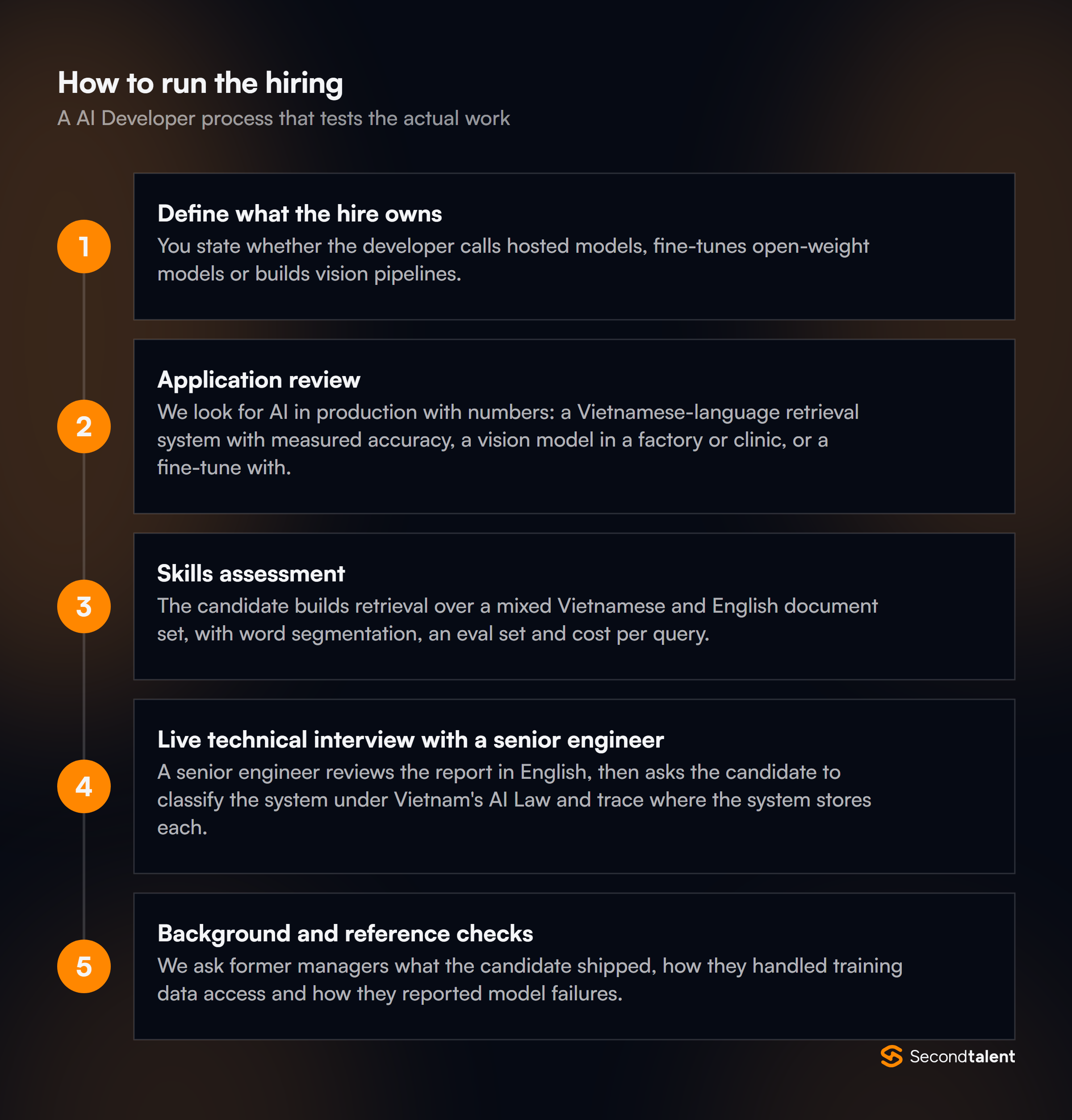
Second Talent's vetting covers stages 2 to 5 before you see a profile.
Stage 1: Define what the hire owns
You state whether the developer calls hosted models, fine-tunes open-weight models or builds vision pipelines. Name the users, including any in Vietnam, the personal data in scope and a shift from the table above.
Stage 2: Application review
We look for AI in production with numbers: a Vietnamese-language retrieval system with measured accuracy, a vision model in a factory or clinic, or a fine-tune with before-and-after scores. A notebook demo alone does not pass.
Stage 3: Skills assessment
The candidate builds retrieval over a mixed Vietnamese and English document set, with word segmentation, an eval set and cost per query. We score the pipeline and the written report.
Stage 4: Live technical interview with a senior engineer
A senior engineer reviews the report in English, then asks the candidate to classify the system under Vietnam's AI Law and trace where the system stores each personal record.
Stage 5: Background and reference checks
We ask former managers what the candidate shipped, how they handled training data access and how they reported model failures. You then choose the contractor or EOR route above.
Hire AI Developers from Vietnam with Second Talent
We shortlist 6-8 candidates within 24 hours from 100,000+ pre-vetted engineers, accepting only the top 1% of applicants. AI developers from Vietnam come with $0 upfront, no lock-in and 4-6 hours of daily overlap with US hours. We handle contracts, payroll and equipment, with compliant EOR contracts in Vietnam.
Our pricing page covers the subscription, and for work built on large language models we also staff LLM engineers in Vietnam.