TL;DR: .NET developers in Singapore earn $8,290 to $16,180+ a month working for international clients on our rate card, the second-highest floor of the five markets compared, and we shortlist 6-8 candidates within 24 hours. The closest US benchmark, the BLS median for software developers, was $135,980 a year in May 2025.
Microsoft ends support for .NET 8 and .NET 9 on the same day, 10 November 2026, two days after Deepavali in Singapore. A .NET developer hired there this quarter can expect to start by moving production code to .NET 10, supported until 14 November 2028.
Key takeaways
- Singapore's .NET floor sits $1,270 below Hong Kong's and $2,330 above China's.
- Azure's Southeast Asia region runs in Singapore and is paired with East Asia in Hong Kong.
- Private organisations in Singapore have until 31 December 2026 to stop using NRIC numbers for authentication, which reaches ASP.NET Core login and account recovery code.
- A new Employment Pass outside financial services needs a qualifying salary of at least S$5,600 a month, rising to S$6,000 for applications from 1 January 2027.
What .NET Developers Earn in Singapore Working for International Clients
Singapore sits in the upper pair of this table with Hong Kong, while China's card spans both groups, from $5,960 to $17,120+. The figures are what .NET developers in each market earn working directly for foreign companies, before any employer or platform costs.
| Market |
Monthly pay working for international clients (USD) |
| Singapore |
$8,290-$16,180+ |
| Philippines |
$1,360-$3,670+ |
| Malaysia |
$2,700-$5,040+ |
| China |
$5,960-$17,120+ |
| Hong Kong |
$9,560-$17,850+ |
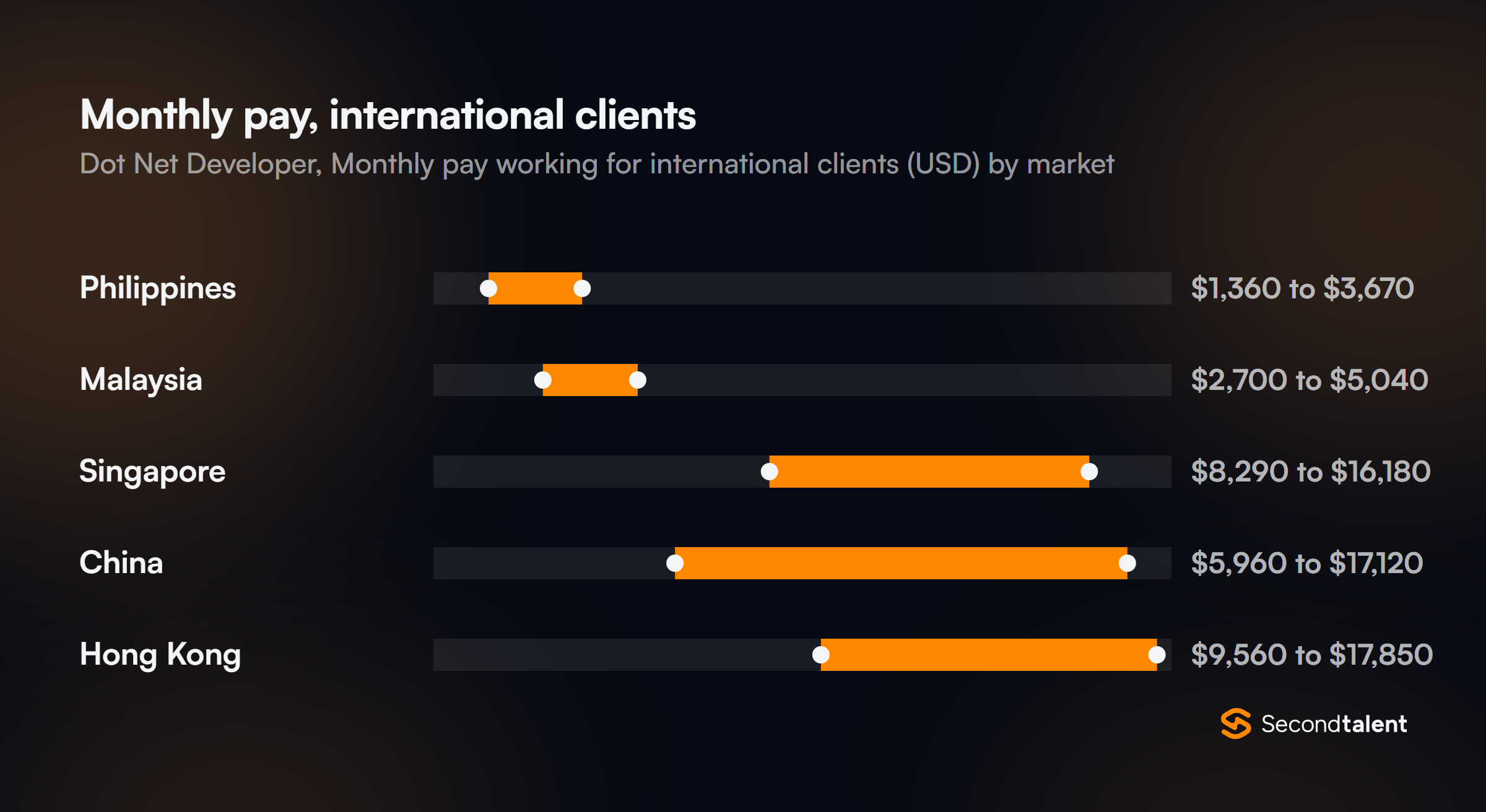
Monthly ranges from the Remote (Working for International Clients) figures on our rate cards for Singapore, the Philippines, Malaysia, China and Hong Kong, converted at ExchangeRate-API mid-market rates for 14 September 2026.
The Singapore card quotes S$10,500 to S$20,500+ a month. Its floor sits S$7,500 below the Singapore cards for data engineers and AI engineers, which both open at S$18,000.
Through Second Talent you pay one monthly fee that bundles salary, payroll taxes, statutory contributions and our service fee, quoted per role and market. Our pricing page explains the monthly subscription, and our C# and .NET developer cost-to-hire page sets out US freelance rates for the contract route.
US Pay Benchmark for .NET Developers
BLS has no .NET occupation. The role maps to Software Developers (SOC 15-1252), because a .NET developer designs and builds application software, from ASP.NET Core APIs to Azure Functions.
| BLS OEWS, May 2025, national |
Software Developers (15-1252) |
| Median annual |
$135,980 |
| 10th percentile, monthly |
$6,870 |
| 25th percentile, monthly |
$8,770 |
| Median, monthly |
$11,330 |
| 75th percentile, monthly |
$14,330 |
| 90th percentile, monthly |
$17,890 |
Monthly figures are the annual wages on the OEWS profile for 15-1252 divided by 12, rounded to the nearest $10.
Place a Singapore candidate against these columns by what they have owned, not by years. A developer who ran a bank's migration off .NET Framework belongs near the open top.
Salary is only part of the US cost. In the BLS Employer Costs for Employee Compensation release for June 2026, wages and salaries made up 68.5% of employer compensation costs for full-time private industry workers, and benefits the other 31.5%.
Time Zone Overlap: Singapore Against ET, CT and PT
Microsoft publishes the Windows monthly security release on the second Tuesday of the month, at around 10:00 am Pacific. The .NET support policy lists 8 September 2026, that month's second Tuesday, as the latest patch date for .NET 8, 9 and 10.
On 13 October 2026, 10:00 am PDT is 17:00 UTC, or 1:00 am on Wednesday in Singapore. After US clocks change, 10:00 am PST on 10 November is 18:00 UTC, or 2:00 am on Wednesday 11 November. A developer who starts at 9 am can patch and redeploy before your US team logs on.
Singapore keeps UTC+8 all year, and US daylight time runs from 8 March to 1 November 2026, per NIST.
| Singapore shift (UTC+8) |
ET overlap (EDT / EST) |
CT overlap (CDT / CST) |
PT overlap (PDT / PST) |
Hours between 10 pm and 6 am |
| 9 am-6 pm |
0 / 0 |
0 / 0 |
0 / 0 |
0 |
| 2 pm-11 pm |
2 / 1 |
1 / 0 |
0 / 0 |
1 |
| 5 pm-2 am |
5 / 4 |
4 / 3 |
2 / 1 |
4 |
| 8 pm-5 am |
8 / 7 |
7 / 6 |
5 / 4 |
7 |
Each shift is nine clock hours with a meal break, counted against a 9 am to 5 pm US day. The 5 pm row, 09:00 to 18:00 UTC, suits code review and pairing on a migration: five hours with New York in September, four with Chicago.
Part 4 of the Employment Act sets hours and overtime, and it covers non-workmen only up to a basic monthly salary of S$2,600. A senior developer's shift and any allowance for it sit in the contract. We fix the shift before the offer, which is how our placements get 4-6 hours of daily overlap with US hours.
.NET Developer Skills to Screen For
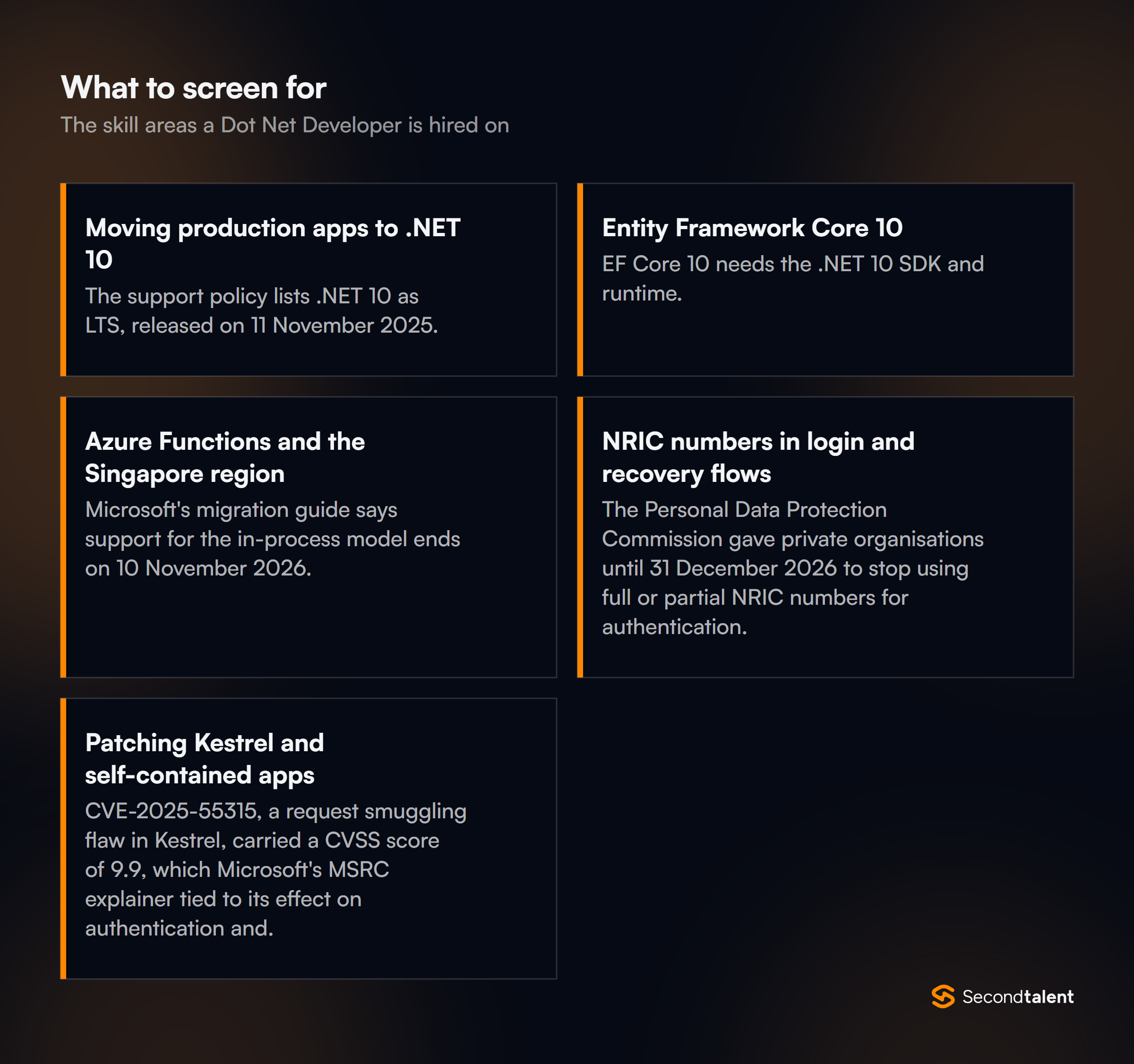
Four of the five areas below test the move from .NET 8, .NET 9 and older estates to .NET 10 on Azure. The fifth is a Singapore rule on authentication that lands in the same quarter.
Moving production apps to .NET 10
The support policy lists .NET 10 as LTS, released on 11 November 2025. .NET 8 (LTS) and .NET 9 (STS) both sit in maintenance until 10 November 2026. Ask which release the candidate would pick for a .NET 8 app that must run until 2028, and what they would test before switching the runtime in production.
Entity Framework Core 10
EF Core 10 needs the .NET 10 SDK and runtime. It will not run on .NET Framework, per Microsoft's EF Core 10 release notes. The release adds named query filters, so one query can switch off a soft-delete filter and keep the tenant filter. It also supports the vector data type on Azure SQL Database and SQL Server 2025. Give the candidate a multi-tenant DbContext with one global filter and ask them to split it.
Azure Functions and the Singapore region
Microsoft's migration guide says support for the in-process model ends on 10 November 2026. The Azure regions list places the Southeast Asia region, southeastasia, in Singapore, with East Asia in Hong Kong as its pair. Give the candidate an in-process HTTP trigger to migrate, then ask where they would fail over and what data residency question that raises.
NRIC numbers in login and recovery flows
The Personal Data Protection Commission gave private organisations until 31 December 2026 to stop using full or partial NRIC numbers for authentication. Enforcement steps up from 1 January 2027. Its example is a default password such as '567A01Jan80'. Show the candidate an ASP.NET Core Identity flow that resets a password with the last four NRIC characters and a birth date, and ask for the replacement.
Patching Kestrel and self-contained apps
CVE-2025-55315, a request smuggling flaw in Kestrel, carried a CVSS score of 9.9, which Microsoft's MSRC explainer tied to its effect on authentication and authorization. The .NET advisory lists ASP.NET Core 8.0.20 and 9.0.9 and earlier as affected. It tells teams to recompile and redeploy self-contained apps built on those versions. Ask how the candidate finds self-contained deployments in a fleet, since a server runtime update does not reach them.
Contractor or Employer of Record in Singapore
Software is not one of the nine categories of commissioned work that can be "work made for hire" under 17 U.S.C. § 101, and a transfer must be in writing and signed under § 204(a). Name the solution, the NuGet packages the developer publishes for you and the migration scripts in the assignment.
Singapore's Copyright Act 2021 makes the author of a computer program its default first owner, including when a client paid for it, unless a written agreement says otherwise (section 133). An employer is first owner of work an employee makes under a contract of service (section 134), and an assignment must be in writing and signed (section 138). The IPOS ownership guide states the same default.
IRS Publication 515 says the place where services are performed determines the source of the income, so a developer working in Singapore earns foreign-source income. A foreign individual gives the payer Form W-8BEN to certify foreign status.
The Ministry of Manpower finds no single conclusive test for a contract of service. It looks at control over the work, who provides the tools and workplace, and who bears the profit or loss. A developer on your release rota with standing Azure subscription access fits the employee side.
Foreign nationals add a work pass step. An Employment Pass candidate must earn the qualifying salary, now S$5,600 outside financial services and S$6,200 inside it. The candidate must also pass the points-based COMPASS framework unless exempted. Our Employer of Record service handles the pass, payroll and CPF, with local detail on our Singapore EOR page. This is a summary, not legal advice.
|
Independent contractor |
Employer of Record |
| Legal employer |
None; the developer invoices you |
The EOR's Singapore entity |
| US paperwork |
Form W-8BEN from the developer |
Service agreement with the EOR |
| IP |
Signed written assignment of source, packages and scripts (sections 133 and 138) |
Employer first owner (section 134), passed on through your EOR agreement |
| Local labor law |
Employment finding if you control the work, tools and hours |
Employment Act, public holidays and work pass rules apply |
| Pay currency |
Agreed in the contract, often USD |
Singapore dollar payroll run by the EOR |
English Level and Working Norms in Singapore
EF's English Proficiency Index 2025 publishes no Singapore page, so there is no EF score to quote. In the General Household Survey 2025, 58.1% of residents aged 5 and over spoke English most often at home, up from 48.3% in 2020, and 80.5% of that group also used a vernacular language.
Enterprise .NET work leaves written English that outlives the project: pull request descriptions, migration runbooks and the change records an auditor reads later. Ask finalists to write the upgrade note for one breaking change in EF Core 10, in the form your team would file it.
Plan the November cutover around both calendars. The Ministry of Manpower's holiday list puts Deepavali on Sunday 8 November 2026, with Monday 9 November off for employees whose rest day is Sunday, the day before .NET 8 and 9 lose support. Thanksgiving on 26 November 2026 is a working day in Singapore, so a developer there can run post-upgrade smoke tests while your US office takes the holiday.
.NET Developer Hiring Process in Singapore
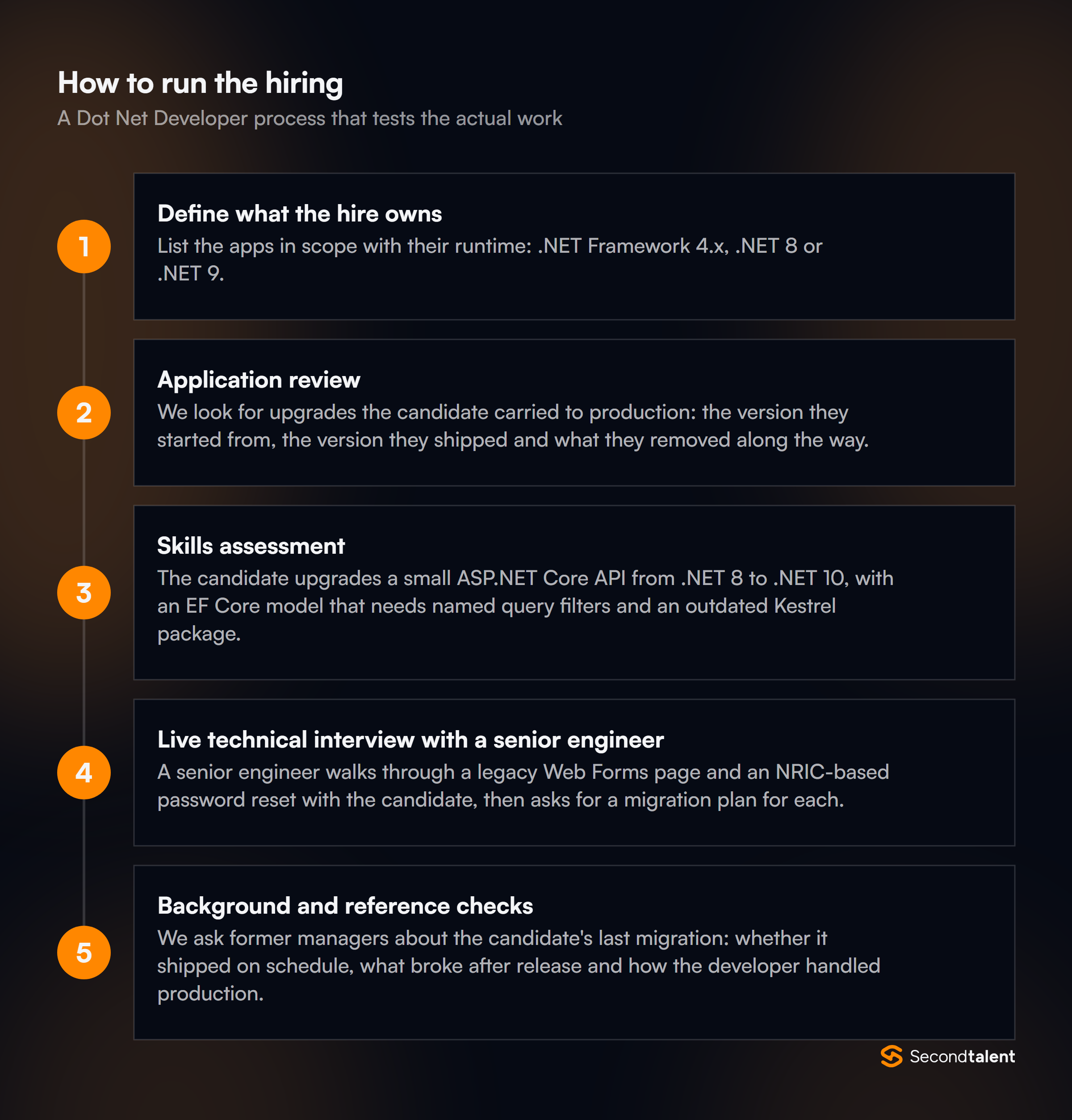
Second Talent's vetting covers stages 2 to 5 before you see a profile.
Stage 1: Define what the hire owns
List the apps in scope with their runtime: .NET Framework 4.x, .NET 8 or .NET 9. Add the hosting (IIS, App Service, Functions or containers), the Azure region, the database and the date each app must leave an unsupported runtime.
Stage 2: Application review
We look for upgrades the candidate carried to production: the version they started from, the version they shipped and what they removed along the way. Work on regulated systems in Singapore counts when the candidate can describe the change controls they worked under.
Stage 3: Skills assessment
The candidate upgrades a small ASP.NET Core API from .NET 8 to .NET 10, with an EF Core model that needs named query filters and an outdated Kestrel package. We score the pull request, the test run and the deployment notes.
Stage 4: Live technical interview with a senior engineer
A senior engineer walks through a legacy Web Forms page and an NRIC-based password reset with the candidate, then asks for a migration plan for each. The second half covers EF Core queries that are slow in production.
Stage 5: Background and reference checks
We ask former managers about the candidate's last migration: whether it shipped on schedule, what broke after release and how the developer handled production access. You then pick the contractor or EOR route above.
Hire .NET Developers from Singapore with Second Talent
We shortlist 6-8 candidates within 24 hours from 100,000+ pre-vetted engineers, accepting only the top 1% of applicants. .NET developers from Singapore come with $0 upfront, no lock-in and 4-6 hours of daily overlap with US hours. We handle contracts, payroll and equipment, with compliant EOR contracts in Singapore.
Our pricing page sets out the monthly subscription, our .NET developers page compares the pool across Asia, and our C# and .NET interview guide has question sets for your own final round.