TL;DR: Java developers in India earn $2,200 to $8,470+ a month working for international clients on our rate card, the highest ceiling of five markets, and we shortlist 6-8 candidates within 24 hours. The closest US benchmark, the BLS median for software developers, was $135,980 a year in May 2025.
Oracle's Premier Support for Java 17 ends in September 2026, per its support roadmap, and JDK 27 reached general availability on 15 September. Ask a Java developer from India which LTS upgrade they last led, and what broke.
Key takeaways
- Mid-level freelance Java developers in India bill $20 to $52 an hour on our cost-to-hire page, against $85 to $135 in the US.
- Kafka 4.0 removed ZooKeeper and needs Java 17 on brokers, Connect and tools.
- Spring Boot 3.5 lost open-source support on 30 June 2026, and 4.0 keeps it only until 31 December 2026.
- Under India's Copyright Act, a written assignment that names no period is deemed to last five years.
What Java Developers Earn in India Working for International Clients
India's open top is $970 above the Philippines' fixed ceiling, and its floor matches Taiwan's. The figures are what Java developers in each market earn working directly for foreign companies, before any employer or platform costs.
| Market |
Monthly pay working for international clients (USD) |
| India |
$2,200-$8,470+ |
| Taiwan |
$2,200-$6,500 |
| Philippines |
$2,500-$7,500 |
| Thailand |
$2,870-$6,200+ |
| Malaysia |
$2,950-$6,270+ |
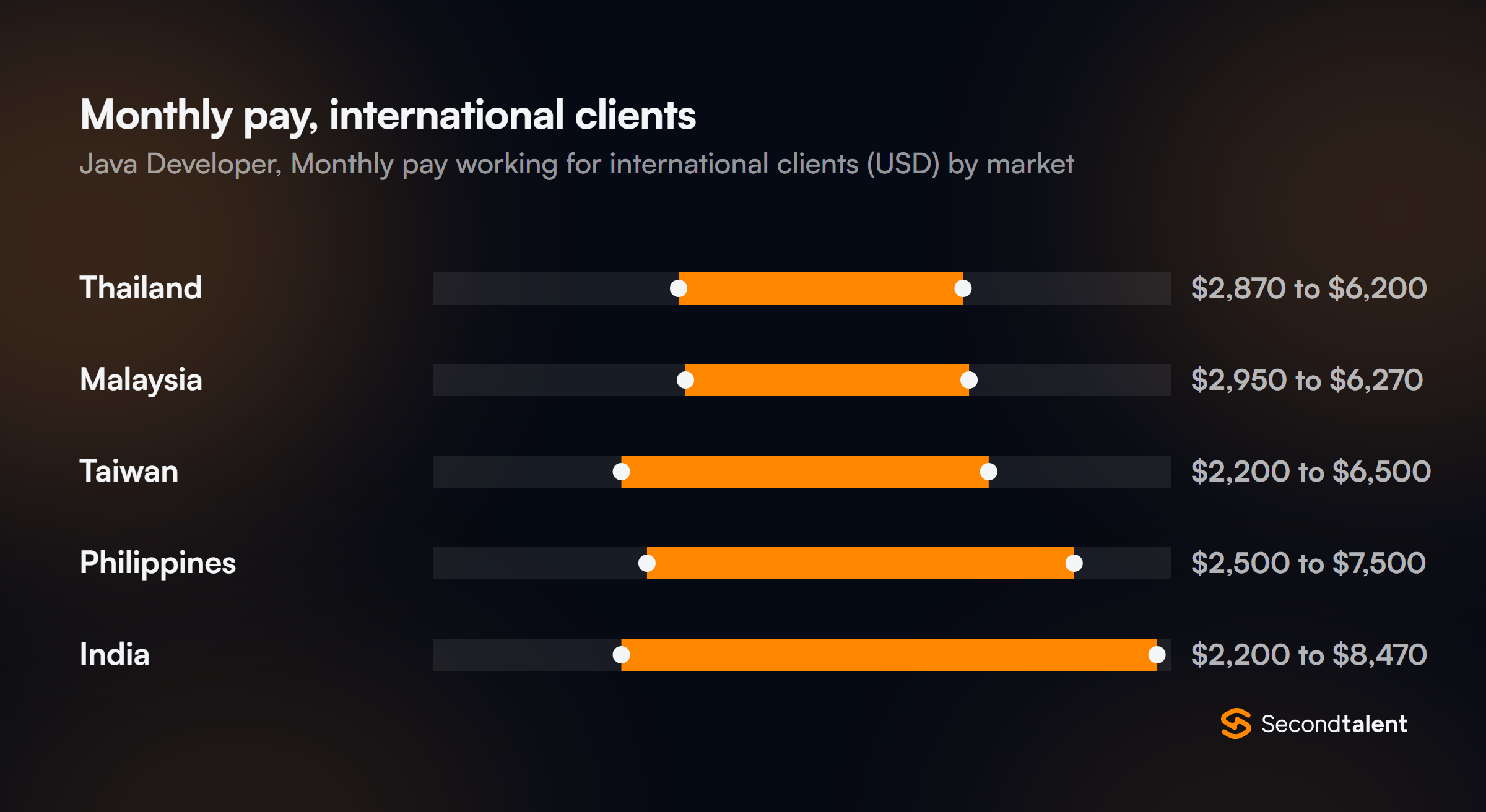
Monthly ranges from the Remote (Working for International Clients) figures on our rate cards for India, Taiwan, the Philippines, Thailand and Malaysia, converted at ExchangeRate-API mid-market rates for 14 September 2026.
The India card quotes ₹210,000 to ₹810,000+ a month. The Taiwan and Philippine cards publish US dollars with a fixed top, so those rows need no conversion.
The India spread, $6,270 from floor to open top, follows the work. A developer maintaining Spring MVC screens sits near the floor. One who owns a Kafka-backed payments service and its JVM tuning sits near the top.
Through Second Talent you pay one monthly fee that bundles salary, payroll taxes, statutory contributions and our service fee, quoted per role and market. Our pricing page explains the monthly subscription, and our Java developers page covers hires from anywhere in Asia.
US Pay Benchmark for Java Developers
Java developers map to Software Developers (SOC 15-1252), because the job is building and maintaining application software on the JVM.
| BLS OEWS, May 2025, national |
Software Developers (15-1252) |
| Median annual |
$135,980 |
| 10th percentile, monthly |
$6,870 |
| 25th percentile, monthly |
$8,770 |
| Median, monthly |
$11,330 |
| 75th percentile, monthly |
$14,330 |
| 90th percentile, monthly |
$17,890 |
Monthly figures are the annual wages on the OEWS profile for 15-1252 divided by 12, rounded to the nearest $10.
Salary is only part of the US cost. In the BLS Employer Costs for Employee Compensation release for June 2026, wages and salaries made up 68.5% of employer compensation costs for full-time private industry workers, and benefits the other 31.5%.
For contract work, our Java developer cost-to-hire page converts the hourly rates at 160 billable hours: $13,600 to $21,600 a month for a mid-level US freelancer and $3,200 to $8,320 in India.
Time Zone Overlap: Bengaluru Against ET, CT and PT
A Java service team that deploys during US business hours wants the developer online for the rollout and the first hour of traffic. Bengaluru keeps UTC+5:30 with no daylight saving, and US clocks stay on daylight time from 8 March to 1 November 2026, per NIST.
The arithmetic for Chicago: 9:00 am CDT (UTC-5) is 14:00 UTC, which is 7:30 pm in Bengaluru. Under CST (UTC-6) it is 8:30 pm.
| Bengaluru shift (UTC+5:30) |
ET overlap (EDT / EST) |
CT overlap (CDT / CST) |
PT overlap (PDT / PST) |
Hours after 7 pm |
| 9:30 am-6:30 pm |
0 / 0 |
0 / 0 |
0 / 0 |
0 |
| 1:30 pm-10:30 pm |
4 / 3 |
3 / 2 |
1 / 0 |
3.5 |
| 3:30 pm-12:30 am |
6 / 5 |
5 / 4 |
3 / 2 |
5.5 |
| 6:30 pm-3:30 am |
8 / 8 |
8 / 7 |
6 / 5 |
8.5 |
Each shift is nine clock hours with a meal break, counted against a 9 am to 5 pm US day.
The 3:30 pm row gives a Chicago team five live hours in September, enough for a morning deploy and the traffic after it. The day-shift row still has a use: batch jobs and reconciliation runs scheduled for the US night get a developer watching them in Bengaluru daylight.
Late rows carry a legal condition for employees. Under Section 43 of India's Occupational Safety, Health and Working Conditions Code, women may work before 6 am and after 7 pm with their consent, and the government's OSH Code factsheet says the employer arranges safety, facilities and transport.
We agree the shift before the offer, which is how our placements get 4-6 hours of daily overlap with US hours.
Java Developer Skills to Screen For
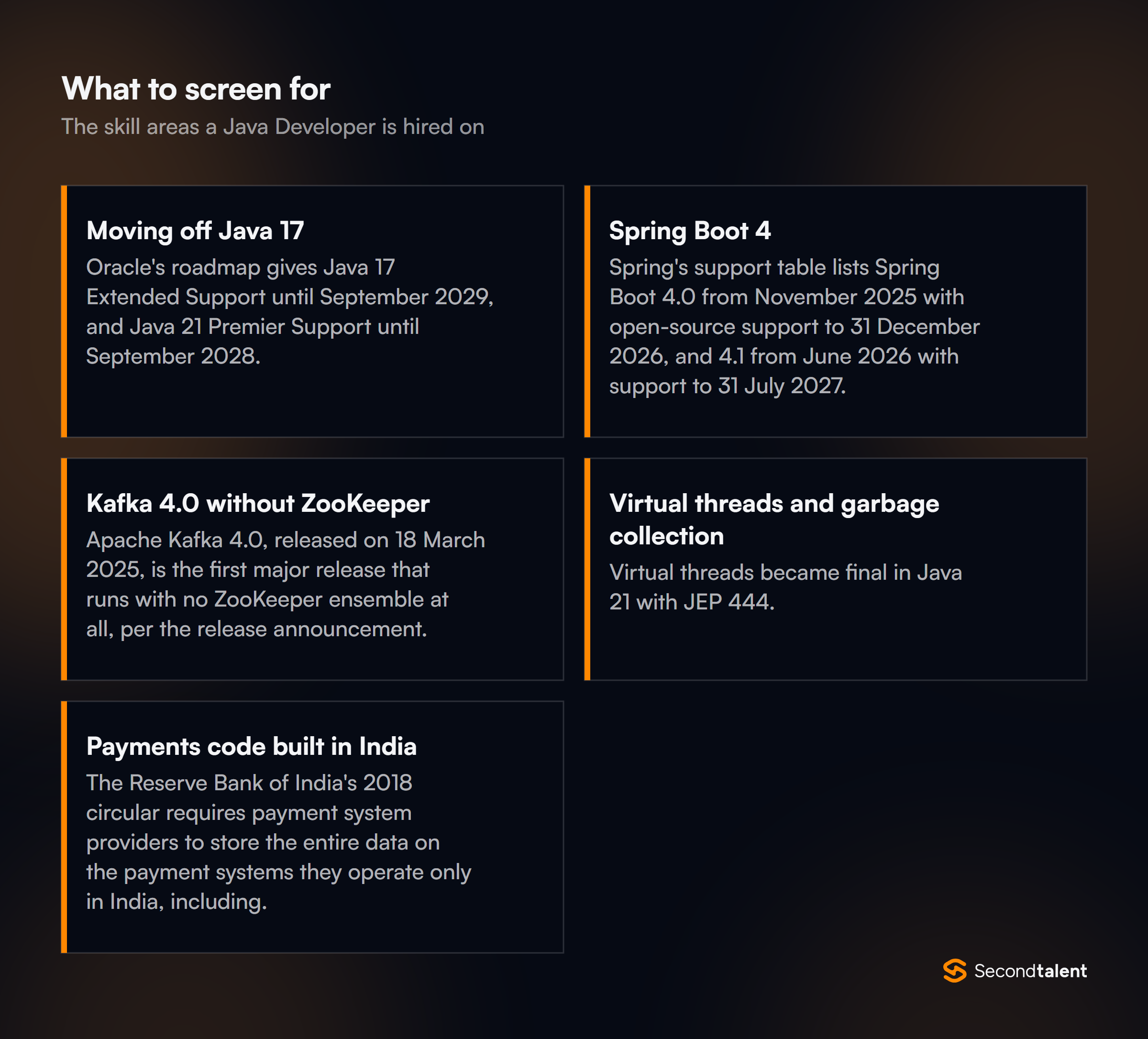
The JDK 27 feature list opens with two changes a payments service will feel: G1 as the default garbage collector in all environments, and post-quantum hybrid key exchange for TLS 1.3. Test the five areas below against the JDK and frameworks you run.
Moving off Java 17
Oracle's roadmap gives Java 17 Extended Support until September 2029, and Java 21 Premier Support until September 2028. Java 25, released in September 2025, carries Premier Support until September 2030. Oracle plans the next LTS, Java 29, for September 2027.
Ask the candidate whether they would move a Java 17 estate to 21 or straight to 25, and which dependency held the last upgrade back.
Spring Boot 4
Spring's support table lists Spring Boot 4.0 from November 2025 with open-source support to 31 December 2026, and 4.1 from June 2026 with support to 31 July 2027. Spring Boot 3.5 now runs on commercial support only. Hand the candidate a 3.5 service with a custom security filter chain and ask for the upgrade order, from build plugins to integration tests. Our Spring Boot interview guide lists more questions for this stage of the screen.
Kafka 4.0 without ZooKeeper
Apache Kafka 4.0, released on 18 March 2025, is the first major release that runs with no ZooKeeper ensemble at all, per the release announcement. Kafka clients and Kafka Streams now require Java 11, while brokers, Connect and tools require Java 17. The release also made the KIP-848 consumer group protocol generally available to cut rebalance downtime.
Ask how the candidate would move a ZooKeeper cluster to KRaft, and what their Streams application did during the last rebalance.
Virtual threads and garbage collection
Virtual threads became final in Java 21 with JEP 444. JEP 491, delivered in Java 24, lets a virtual thread that blocks inside a synchronized block release its platform thread, which removes nearly all pinning. JDK 27's JEP 523 then picks G1 when no collector is set, even on machines with one CPU or under 1,792 MB of memory, where the JVM used to pick Serial. Give the candidate a thread dump and a GC log from one service and ask what they would change first.
Payments code built in India
The Reserve Bank of India's 2018 circular requires payment system providers to store the entire data on the payment systems they operate only in India, including end-to-end transaction details. For the foreign leg of a transaction, a copy may also sit abroad. A Java developer from an Indian bank or payments company can explain how their team split storage along that line.
In JDK 27, JEP 527 adds hybrid key exchange to TLS 1.3 through javax.net.ssl by default, with no code change. Ask what the candidate would test before a JDK upgrade changes the handshake with a partner bank.
Contractor or Employer of Record in India
Software is not one of the nine categories of commissioned work that can be "work made for hire" under 17 U.S.C. § 101, and a transfer must be in writing and signed under § 204(a). IRS Publication 515 says the place where services are performed determines the source of the income, and a foreign individual gives the payer Form W-8BEN to certify foreign status.
India's Copyright Act, 1957 makes the employer first owner only of work made under a contract of service, in section 17. A contractor's services, Kafka consumers and schema migrations stay the contractor's until they sign a written assignment. Section 19 deems an assignment with no stated period to last five years and one with no stated territory to cover India. It also lets an assignment lapse if the assignee does not exercise the rights within a year, unless the document says otherwise.
In Sushilaben Indravadan Gandhi v. New India Assurance (2020), the Supreme Court held that control is one in a series of factors, with integration into the employer's business another important test. A developer who owns one of your production services is part of your business on that test.
India's four Labour Codes have applied since 21 November 2025. The government lists mandatory appointment letters for all workers, salary by the 7th of each month for IT and ITES workers, and gratuity for fixed-term employees after one year of continuous service. An Employer of Record with an Indian entity takes on those duties. This is a summary, not legal advice.
|
Independent contractor |
Employer of Record |
| Legal employer |
None; the developer invoices you |
The EOR's Indian entity |
| US paperwork |
Form W-8BEN from the developer |
Service agreement with the EOR |
| IP |
Signed assignment of code and schemas, with period and territory stated (section 19) |
Employer first owner under a contract of service (section 17), passed on through your EOR agreement |
| Local labor law |
Employment finding if the developer is integrated into your business |
Labour Codes apply, including appointment letters and fixed-term gratuity |
| Pay currency |
Agreed in the contract, often USD |
Local payroll run by the EOR |
English Level and Working Norms in India
India's EF English Proficiency Index 2025 score is 484, 74th of 123 countries and regions and six points below its previous edition, against a global average of 488. Its IT job-function score is 487, per EF's India page.
City scores range from Bengaluru at 569 to Pune at 502, with Hyderabad at 554 and Chennai at 534. Java work leans on reading as much as writing, since a developer inheriting a service reads years of design documents and Javadoc before changing it. India's reading score is 494.
Ask finalists to read a short design document you wrote and list the two decisions they would challenge.
Holidays vary by city. The Reserve Bank of India keeps separate holiday lists for Bengaluru, Chennai, Hyderabad, Mumbai, New Delhi and others, so check the developer's list before a release freeze. Thanksgiving on 26 November 2026 is a working day in India, so a developer there can watch month-end batch preparation while your US team is off.
Java Developer Hiring Process in India
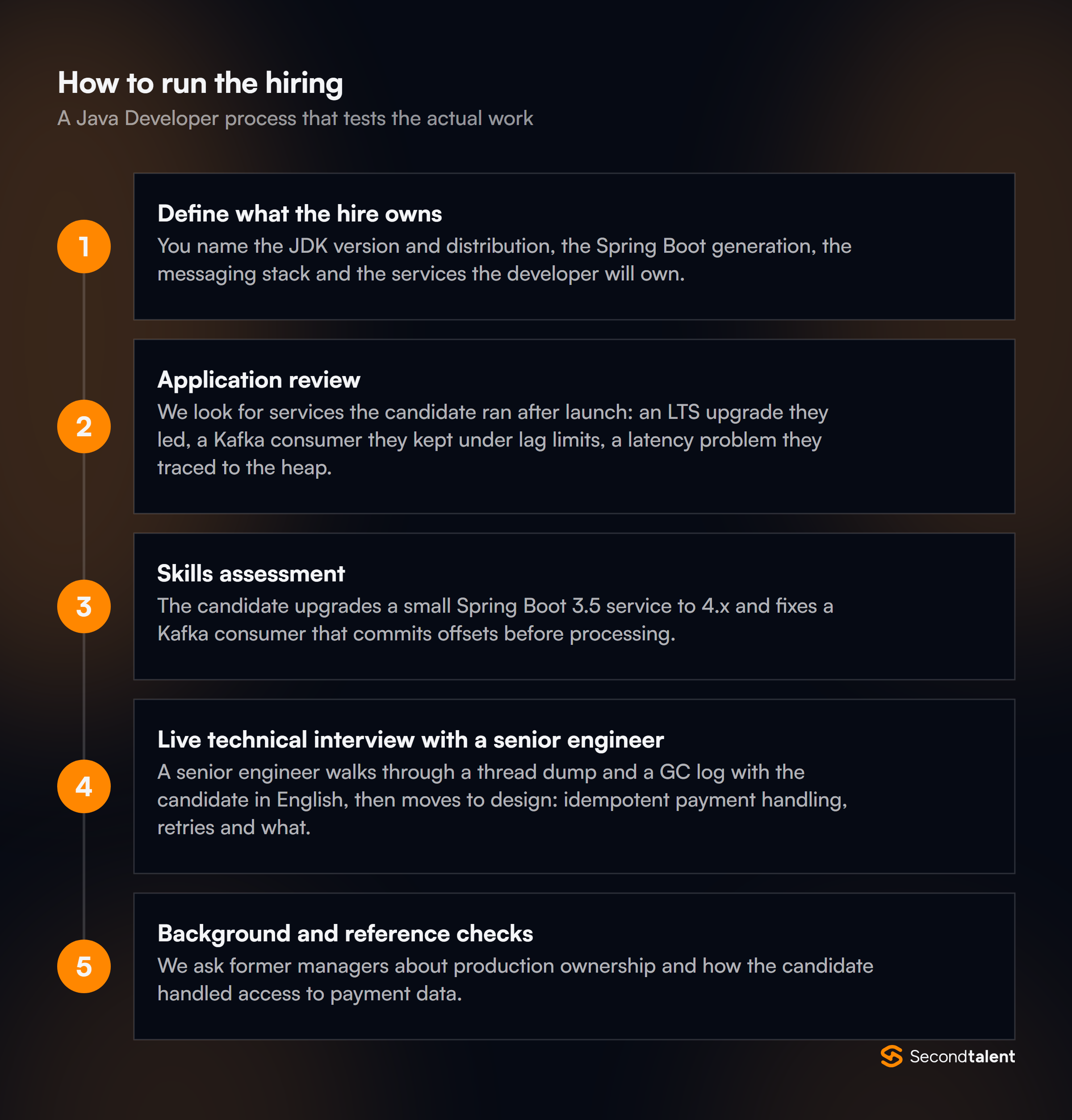
Second Talent's vetting covers stages 2 to 5 before you see a profile.
Stage 1: Define what the hire owns
You name the JDK version and distribution, the Spring Boot generation, the messaging stack and the services the developer will own. Add the shift from the table above and any payments or personal data in scope.
Stage 2: Application review
We look for services the candidate ran after launch: an LTS upgrade they led, a Kafka consumer they kept under lag limits, a latency problem they traced to the heap. Scale goes in numbers, such as requests a second or messages a day.
Stage 3: Skills assessment
The candidate upgrades a small Spring Boot 3.5 service to 4.x and fixes a Kafka consumer that commits offsets before processing. We score the pull request description with the code.
Stage 4: Live technical interview with a senior engineer
A senior engineer walks through a thread dump and a GC log with the candidate in English, then moves to design: idempotent payment handling, retries and what happens during a consumer rebalance.
Stage 5: Background and reference checks
We ask former managers about production ownership and how the candidate handled access to payment data. We also confirm the notice period in the candidate's appointment letter. You then choose the contractor or EOR route above.
Hire Java Developers from India with Second Talent
We shortlist 6-8 candidates within 24 hours from 100,000+ pre-vetted engineers, accepting only the top 1% of applicants. Java developers from India come with $0 upfront, no lock-in and 4-6 hours of daily overlap with US hours. We handle contracts, payroll and equipment.
Our pricing page sets out the monthly subscription, and for services built around APIs we also staff back-end developers in India.