TL;DR: AI agent developers in India earn $2,610 to $10,150+ a month working for international clients on our AI engineer rate card, and we shortlist 6-8 candidates within 24 hours. The closest US benchmark, the BLS median for software developers, was $135,980 a year in May 2025.
On 9 October 2025, Razorpay, NPCI and OpenAI announced a pilot of agentic payments on ChatGPT, built on UPI Circle and UPI Reserve Pay. In Razorpay's example, the agent checks BigBasket's catalogue, presents options and places the order after a single confirmation from the user. India's payment rail already has a shopping agent in pilot.
Key takeaways
- OpenAI's Agents SDK records traces by default, and tracing is unavailable to organisations on Zero Data Retention.
- A LangGraph interrupt saves graph state and waits indefinitely for a human, so an approval can outlast a server restart.
- The Model Context Protocol authorization spec forbids an MCP server from passing a client's token through to upstream APIs.
- Sarvam-30B, an open-weight model built for Indian languages, runs 2.4 billion non-embedding active parameters and handles voice calls with tool calls.
What AI Agent Developers Earn in India Working for International Clients
India's ceiling runs $2,420 above Vietnam's, while its floor sits within $220 of the Philippines'. We publish no agent developer card by market, so the table uses our AI engineer rate cards, the closest match. The figures are what engineers in each market earn working directly for foreign companies, before any employer or platform costs.
| Market |
Monthly pay working for international clients (USD) |
| India |
$2,610-$10,150+ |
| Philippines |
$2,390-$4,790+ |
| Malaysia |
$3,690-$7,370+ |
| Vietnam |
$3,870-$7,730+ |
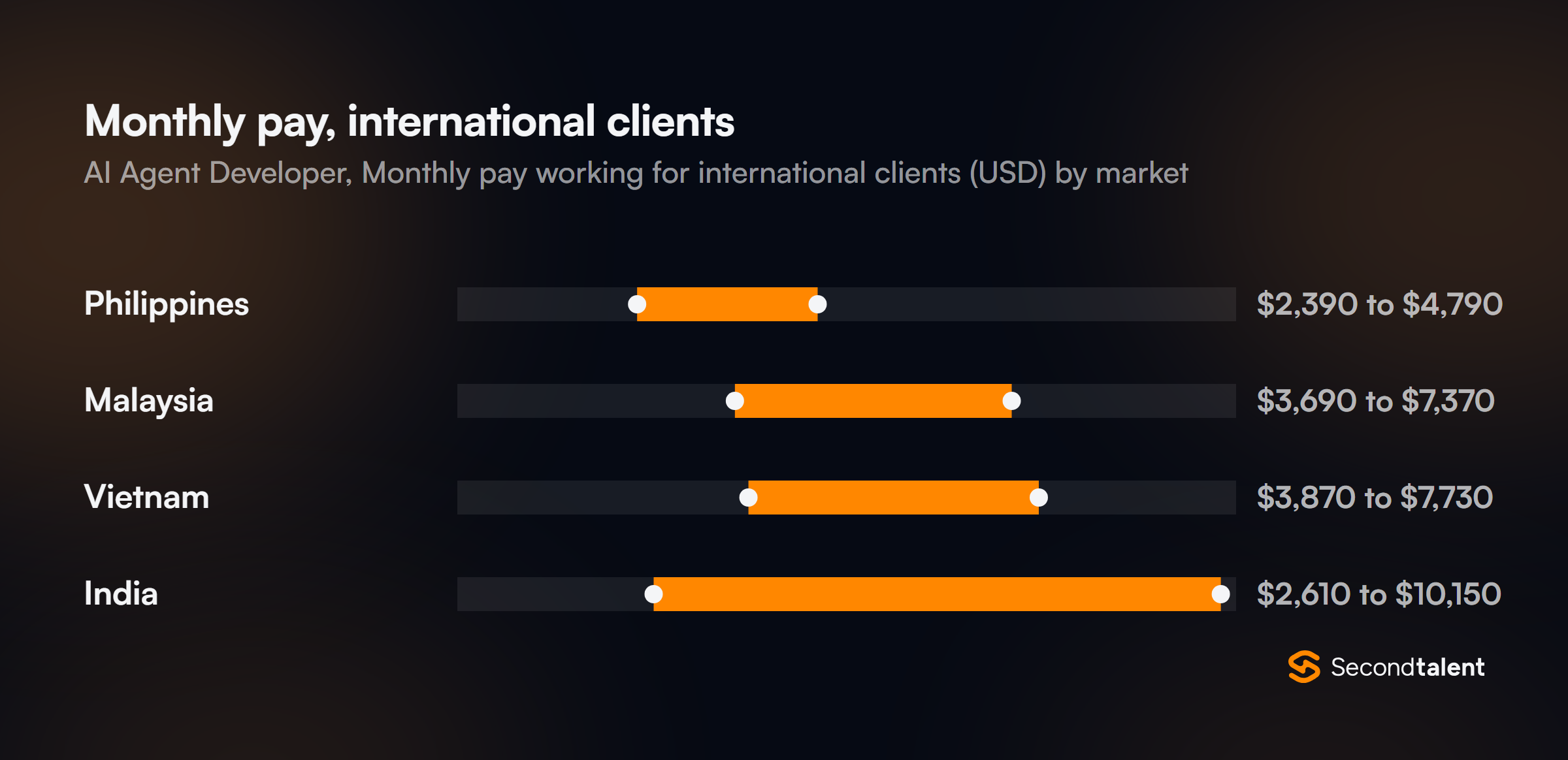
Monthly ranges from the Remote (Working for International Clients) figures on our rate cards for India, the Philippines, Malaysia and Vietnam, converted at ExchangeRate-API mid-market rates for 14 September 2026.
The India card quotes ₹250,000 to ₹970,000+ a month. An agent developer who sits with your customers and adapts the agent to their systems is closer to a forward deployed engineer. Our India forward deployed engineer card puts that hire at $2,410 to $9,410+.
Through Second Talent you pay one monthly fee that bundles salary, payroll taxes, statutory contributions and our service fee, quoted per role and market. Our pricing page covers the subscription, and for short agent projects our AI agent developer cost-to-hire page lists US freelance rates.
US Pay Benchmark for AI Agent Developers
No federal occupation covers agent development. The role maps to Software Developers (SOC 15-1252), because an agent developer writes and runs production software whose control flow passes through model calls and tools.
| BLS OEWS, May 2025, national |
Software Developers (15-1252) |
| Median annual |
$135,980 |
| 10th percentile, monthly |
$6,870 |
| 25th percentile, monthly |
$8,770 |
| Median, monthly |
$11,330 |
| 75th percentile, monthly |
$14,330 |
| 90th percentile, monthly |
$17,890 |
Monthly figures are the annual wages on the OEWS profile for 15-1252 divided by 12, rounded to the nearest $10.
Salary is only part of the US cost. In the BLS Employer Costs for Employee Compensation release for June 2026, wages and salaries made up 68.5% of employer compensation costs for full-time private industry workers, and benefits the other 31.5%.
Time Zone Overlap: Bengaluru Against ET, CT and PT
An agent that pauses for human approval waits for whoever holds the approval. With a developer in Bengaluru and approvers in Chicago, the shift decides whether a paused run clears in minutes or the next day.
Bengaluru runs on UTC+5:30 all year. US daylight time lasts from 8 March to 1 November 2026, per NIST. The arithmetic for Chicago: 9:00 am CDT is 14:00 UTC, and 14:00 plus five and a half hours is 7:30 pm in Bengaluru. Under CST it becomes 8:30 pm.
| Bengaluru shift (UTC+5:30) |
ET overlap (EDT / EST) |
CT overlap (CDT / CST) |
PT overlap (PDT / PST) |
Hours between 10 pm and 6 am |
| 9:30 am-6:30 pm |
0 / 0 |
0 / 0 |
0 / 0 |
0 |
| 1:30 pm-10:30 pm |
4 / 3 |
3 / 2 |
1 / 0 |
0.5 |
| 3:30 pm-12:30 am |
6 / 5 |
5 / 4 |
3 / 2 |
2.5 |
| 6:30 pm-3:30 am |
8 / 8 |
8 / 7 |
6 / 5 |
5.5 |
Overlap counts clock hours of a nine-hour shift, meal break included, against a 9 am to 5 pm US day.
The 1:30 pm row gives a New York team four live hours in September and three after the clocks change. That covers approvals, failed-run reviews and permission changes.
A West Coast team gets one hour at most from that shift. For San Francisco, keep the developer on the 3:30 pm row or move autonomous runs to steps that need no approval.
India's Labour Codes, in force since 21 November 2025, allow women to work night shifts in all establishments with their consent and required safety measures. We agree the shift before the offer, which is how our placements get 4-6 hours of daily overlap with US hours.
AI Agent Developer Skills to Screen For
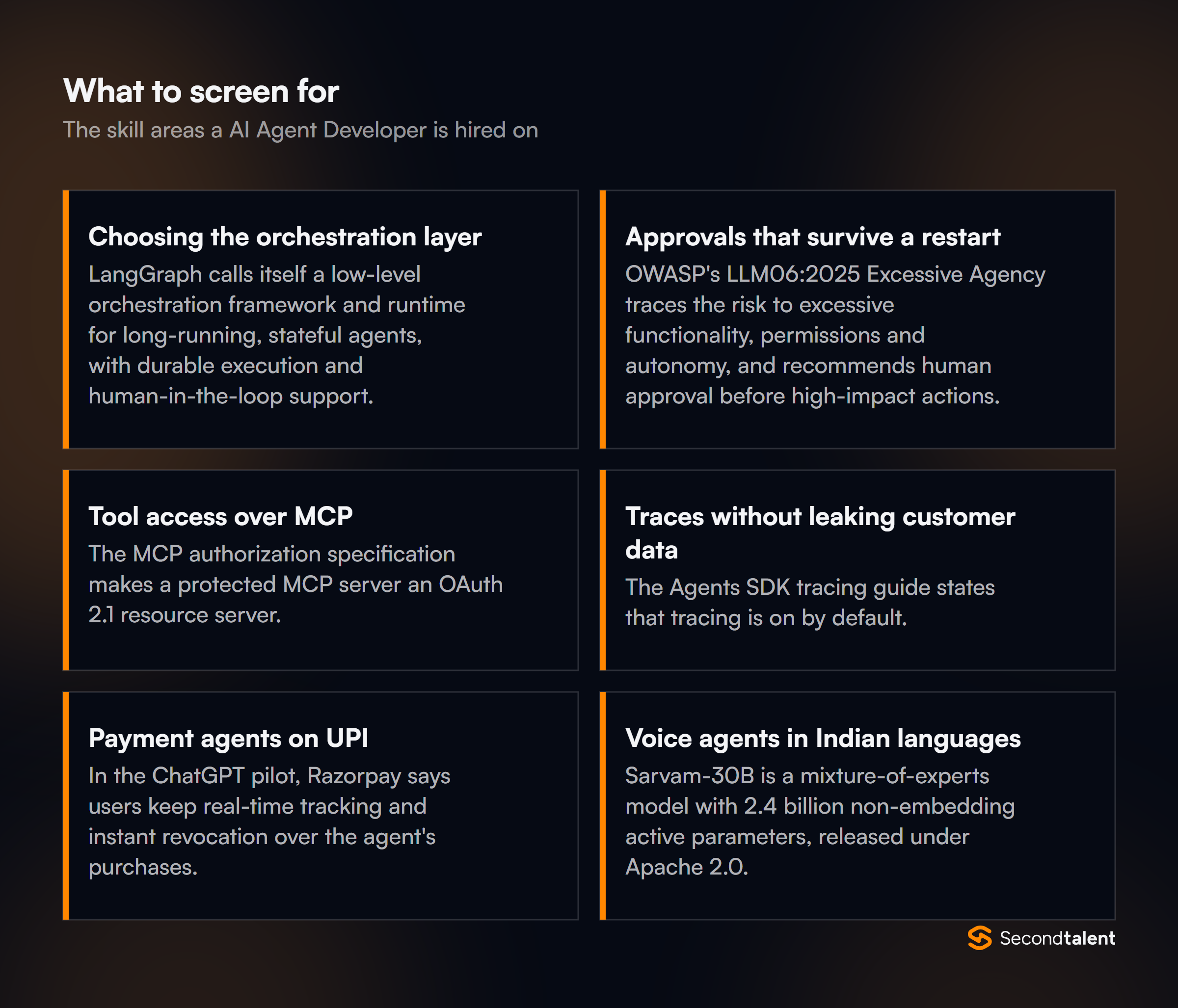
In the Stack Overflow 2025 survey, 14.1% of developers used AI agents at work daily. A candidate from that group should be able to show you a run that went wrong and the trace that explained it.
Choosing the orchestration layer
LangGraph calls itself a low-level orchestration framework and runtime for long-running, stateful agents, with durable execution and human-in-the-loop support. CrewAI pairs Flows, which manage state and control execution, with Crews of agents that collaborate on tasks the Flow delegates. The OpenAI Agents SDK gives you agents, handoffs, guardrails, sessions and tracing.
Ask the candidate which of the three they would pick for your use case, and what they would write by hand instead of taking from the framework.
Approvals that survive a restart
OWASP's LLM06:2025 Excessive Agency traces the risk to excessive functionality, permissions and autonomy, and recommends human approval before high-impact actions. LangGraph's interrupts implement that pause: the checkpointer writes graph state, and a thread_id tells it which state to load on resume.
Give the candidate an agent that issues refunds. Ask where the interrupt goes, what the approver sees, and what happens if the process dies while the approval is pending.
Tool access over MCP
The MCP authorization specification makes a protected MCP server an OAuth 2.1 resource server. It must check that it is the intended audience of each access token. It must not pass through the token it received from the client when it calls an upstream API, because that invites a confused deputy.
Show the candidate an MCP server that forwards the user's token to your billing API and ask for the fix.
Traces without leaking customer data
The Agents SDK tracing guide states that tracing is on by default. Generation and function spans can hold sensitive inputs and outputs, and RunConfig.trace_include_sensitive_data turns that capture off. Organisations using OpenAI's APIs under Zero Data Retention cannot use tracing at all.
Ask the candidate how they would debug a failed run under a no-retention contract, and which fields they would redact before a trace leaves your account.
Payment agents on UPI
In the ChatGPT pilot, Razorpay says users keep real-time tracking and instant revocation over the agent's purchases. Any agent that spends money raises the same four design questions: consent, limits, revocation and the merchant's order record.
Ask how they would cap an agent's spend per user, how revocation reaches an in-flight run, and which log proves the user confirmed the order.
Voice agents in Indian languages
Sarvam-30B is a mixture-of-experts model with 2.4 billion non-embedding active parameters, released under Apache 2.0. Its model card says it can handle multilingual voice calls while performing tool calls. For a support agent that must answer in Hindi or Tamil, ask the candidate to measure tool-call accuracy by language rather than as one average.
Contractor or Employer of Record in India
Software is not one of the nine categories of commissioned work that can be "work made for hire" under 17 U.S.C. § 101, and a copyright transfer must be in writing and signed under § 204(a).
Under India's Copyright Act, 1957, the author owns the work first unless an exception applies. Section 17(c) gives first ownership to an employer only for work made under a contract of service. A contractor's tool definitions, prompts, graphs and eval sets stay with the contractor until a signed written assignment moves them (section 19(1)).
Under section 19, an assignment that states no term is deemed to run five years, and one that names no territory is presumed to cover India only. Write both into the contract.
IRS Publication 515 says the place where services are performed determines the source of the income, so a developer working from Pune or Bengaluru earns foreign-source income. A foreign individual gives the payer Form W-8BEN to certify foreign status.
In Sushilaben Indravadan Gandhi v. New India Assurance, India's Supreme Court held in 2020 that no single test decides whether a contract is of service or for service. It weighed control, integration into the business, ownership of the tools and whether the worker is in business on their own account. A developer on your on-call rota with credentials to production systems leans toward employee on each.
Our Employer of Record overview covers the nine Asian markets where we run EOR contracts, and India is not among them. For India we handle contracts and payroll. This is a summary, not legal advice.
|
Independent contractor |
Employer of Record |
| Legal employer |
None; the developer invoices you |
An EOR's employing entity in India |
| US paperwork |
Form W-8BEN from the developer |
Service agreement with the EOR |
| IP |
Signed assignment naming agent code, tools, prompts and eval sets, with term and territory |
Employer first owner under section 17(c), passed on through the EOR agreement |
| Local labor law |
Employment finding if control and integration point that way |
Labour Codes apply; IT and ITES salaries must be released by the 7th of each month |
| Pay currency |
Agreed in the contract, often USD |
Rupee payroll run by the EOR |
English Level and Working Norms in India
India's writing score on the EF English Proficiency Index 2025 is 504 and its speaking score 500, while listening trails at 457. The national score is 484, 74th of 123 countries and regions, against a global average of 488, and the IT job-function score is 487, per EF's India page.
Agent work runs on writing: tool descriptions a model must follow, system prompts and incident notes. Among cities, Mumbai scores 570 and Bengaluru 569, while Pune scores 502. Test each finalist on a written tool description, not on the national average.
The central government's 2026 holiday order lists three national holidays, including Gandhi's birthday on Friday 2 October, and puts Diwali on Sunday 8 November. Some states mark Diwali a day early. Freeze changes to agent permissions that week, and name a US approver for any run that pauses.
Thanksgiving on 26 November 2026 is a working day in India, so a developer there can watch agent runs while your US team is off.
AI Agent Developer Hiring Process in India
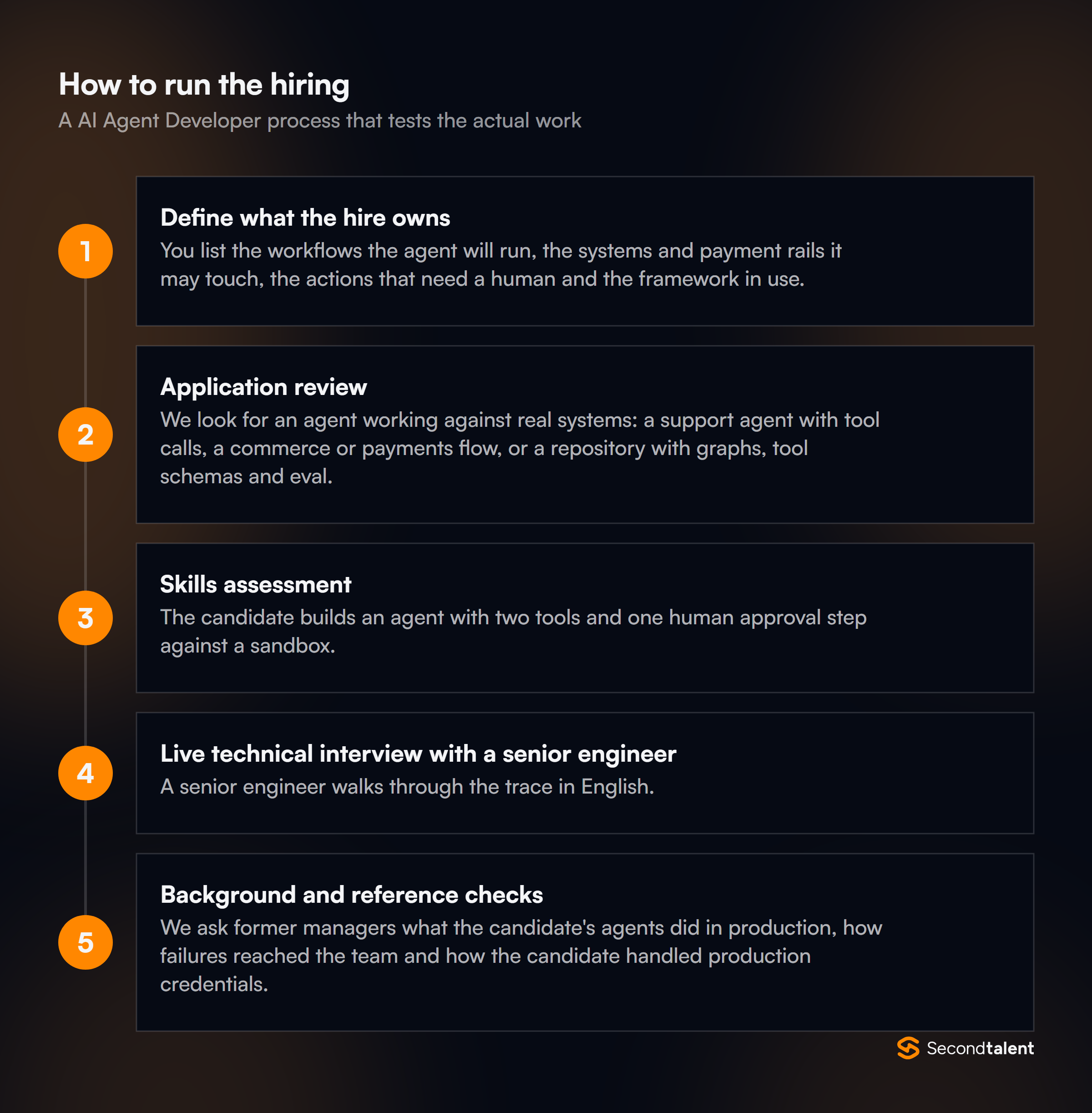
Second Talent's vetting covers stages 2 to 5 before you see a profile.
Stage 1: Define what the hire owns
You list the workflows the agent will run, the systems and payment rails it may touch, the actions that need a human and the framework in use. Name the approvers and the Bengaluru shift that matches their hours.
Stage 2: Application review
We look for an agent working against real systems: a support agent with tool calls, a commerce or payments flow, or a repository with graphs, tool schemas and eval runs. A notebook demo alone does not pass.
Stage 3: Skills assessment
The candidate builds an agent with two tools and one human approval step against a sandbox. They add a spend or step limit, write an eval and hand in the trace with sensitive fields redacted.
Stage 4: Live technical interview with a senior engineer
A senior engineer walks through the trace in English. The questions cover what happens when the process restarts during an approval, how the MCP server handles tokens, and which framework feature the candidate would drop.
Stage 5: Background and reference checks
We ask former managers what the candidate's agents did in production, how failures reached the team and how the candidate handled production credentials. You then sign the contractor agreement with the IP assignment in place.
Hire AI Agent Developers from India with Second Talent
We shortlist 6-8 candidates within 24 hours from 100,000+ pre-vetted engineers, accepting only the top 1% of applicants. AI agent developers from India come with $0 upfront, no lock-in and 4-6 hours of daily overlap with US hours. We handle contracts, payroll and equipment.
Our pricing page explains the monthly subscription, and for retrieval and training work we also staff AI developers in India.