TL;DR: NLP engineers in India earn $2,410 to $9,410+ a month working for international clients on our machine learning engineer rate card, and we shortlist 6-8 candidates within 24 hours. The closest US benchmark, the BLS median for software developers, was $135,980 a year in May 2025.
India's Constitution lists 22 scheduled languages, and until AI4Bharat released IndicTrans2 no translation model supported all of them. An NLP engineer from India has often built for Hindi, Tamil or code-mixed Hinglish text before an English-only product ever reached them.
Key takeaways
- spaCy publishes no trained pipeline for Hindi, Bengali, Marathi, Tamil, Telugu or Urdu, so Indic text work starts with other tokenizers and models.
- Under India's Copyright Act, an assignment that names no period lasts five years, and one that names no territory covers India only.
- A 3:30 pm to 12:30 am shift in Bengaluru gives a New York team six live hours while US daylight time lasts.
- India's data protection law lifts most duties when an Indian engineer handles foreign residents' data for a foreign client. The duty to keep reasonable security safeguards stays.
What NLP Engineers Earn in India Working for International Clients
India's ceiling of $9,410+ is the second highest in the table, behind Malaysia. Its floor sits $90 below the Philippines and Vietnam.
We publish no NLP engineer card, so the table uses our machine learning engineer rate cards, the closest match. The figures are what engineers in each market earn working directly for foreign companies, before any employer or platform costs.
| Market |
Monthly pay working for international clients (USD) |
| India |
$2,410-$9,410+ |
| Indonesia |
$2,200-$8,500 |
| Philippines |
$2,500-$6,000 |
| Vietnam |
$2,500-$7,000 |
| Malaysia |
$3,930-$11,300+ |
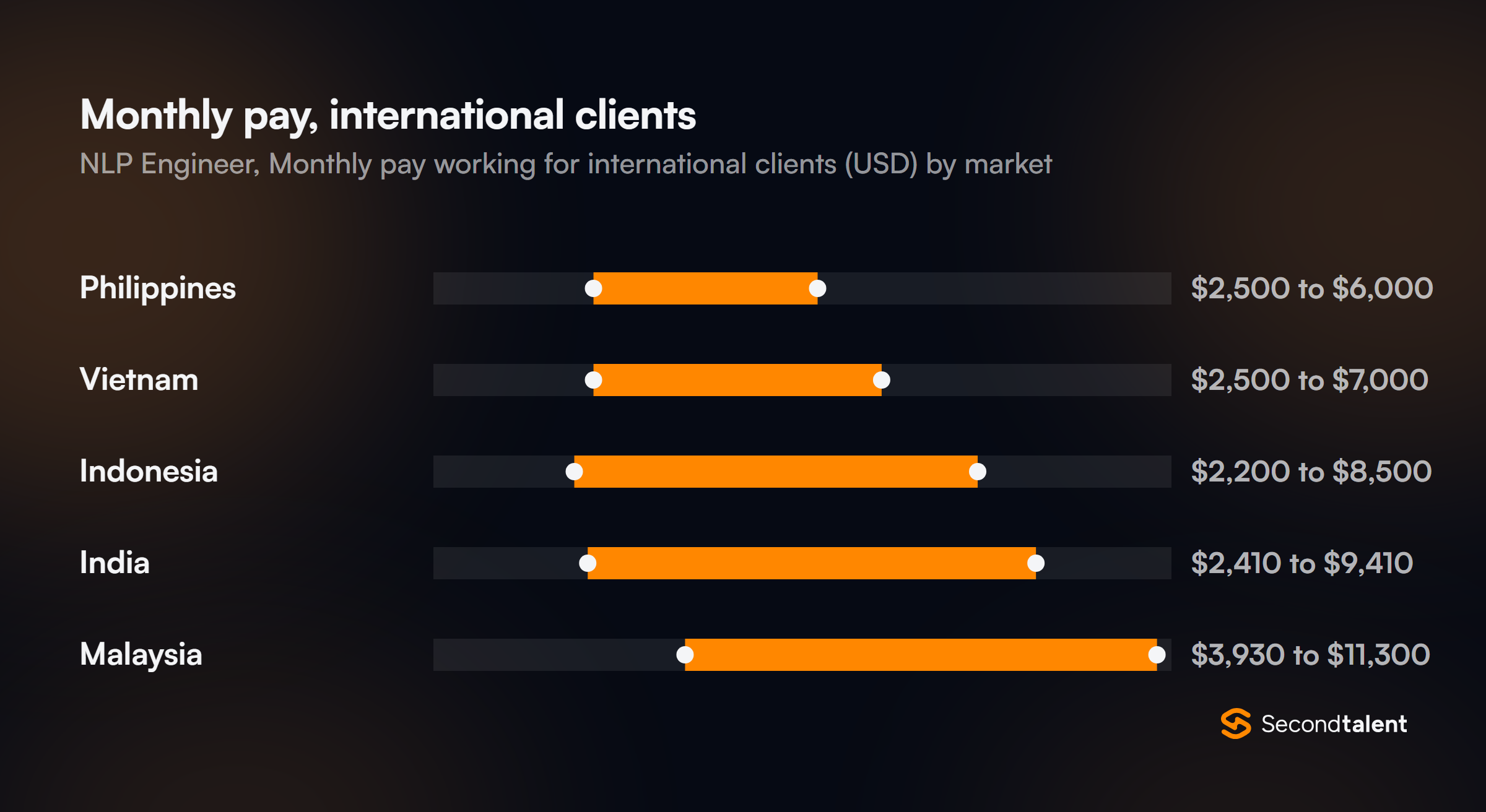
Monthly ranges from the Remote (Working for International Clients) figures on our rate cards for India, Indonesia, the Philippines, Vietnam and Malaysia, converted at ExchangeRate-API mid-market rates for 14 September 2026.
The India card quotes ₹230,000 to ₹900,000+ a month for machine learning engineers as a whole. Check whether your brief is text extraction or model training before you compare rows. For a brief built around generation rather than extraction, our India AI engineer card runs from $2,610 to $10,150+.
Through Second Talent you pay one monthly fee that bundles salary, payroll taxes, statutory contributions and our service fee, quoted per role and market. Our pricing page explains the monthly subscription.
US Pay Benchmark for NLP Engineers
BLS has no NLP engineer occupation. Engineers who ship text pipelines, retrieval and model-backed features map to Software Developers (15-1252). Those whose job is training and evaluating new language models sit closer to Computer and Information Research Scientists (15-1221).
| BLS OEWS, May 2025, national |
Median annual |
10th percentile, monthly |
Median, monthly |
90th percentile, monthly |
| Software Developers (15-1252) |
$135,980 |
$6,870 |
$11,330 |
$17,890 |
| Computer and Information Research Scientists (15-1221) |
$140,300 |
$6,850 |
$11,690 |
$19,220 |
Monthly figures are the annual wages on the BLS OEWS profiles for 15-1252 and 15-1221 divided by 12, rounded to the nearest $10.
Salary is only part of the US cost. In the BLS Employer Costs for Employee Compensation release for June 2026, wages and salaries made up 68.5% of employer compensation costs for full-time private industry workers, and benefits the other 31.5%.
For project work, our NLP engineer cost-to-hire page puts a mid-level US freelance or contract NLP engineer at $119 to $185 an hour, before payroll, insurance and leave.
Time Zone Overlap: Bengaluru Against ET, CT and PT
Bengaluru runs half an hour off the US grid, so each shared window starts or ends on the half hour. India keeps UTC+5:30 all year with no daylight saving, and US daylight time runs from 8 March to 1 November 2026, per NIST.
The arithmetic: 9:00 am in New York under EDT (UTC-4) is 13:00 UTC, and 13:00 UTC is 6:30 pm in Bengaluru. Under EST (UTC-5) the same meeting lands at 7:30 pm. Chicago adds an hour and San Francisco three.
| Bengaluru shift (UTC+5:30) |
ET overlap (EDT / EST) |
CT overlap (CDT / CST) |
PT overlap (PDT / PST) |
Hours between 10 pm and 6 am |
| 10 am-7 pm |
0.5 / 0 |
0 / 0 |
0 / 0 |
0 |
| 1 pm-10 pm |
3.5 / 2.5 |
2.5 / 1.5 |
0.5 / 0 |
0 |
| 3:30 pm-12:30 am |
6 / 5 |
5 / 4 |
3 / 2 |
2.5 |
| 6:30 pm-3:30 am |
8 / 8 |
8 / 7 |
6 / 5 |
5.5 |
Overlap counts clock hours of a nine-hour shift, including a meal break, against a 9 am to 5 pm US day.
NLP work needs live time at three points: label guideline reviews, error analysis on a failed release, and demos where stakeholders see wrong answers. A 1 pm to 10 pm shift covers those for an East Coast team. Annotation batches, fine-tuning runs and evaluation sweeps can run in the gap and report by your morning.
We fix the shift before the offer, which is how our placements get 4-6 hours of daily overlap with US hours.
NLP Engineer Skills to Screen For
Sarvam AI's Saaras speech-to-text model supports all 22 scheduled languages, 8kHz telephony audio and code-mixed speech, according to a February 2026 government backgrounder. The same release names Sarvam as one of 12 organisations the IndiaAI Mission selected to build indigenous foundation models. Indian NLP teams build for phone-line audio and mixed-script text, and the screen below tests for that.
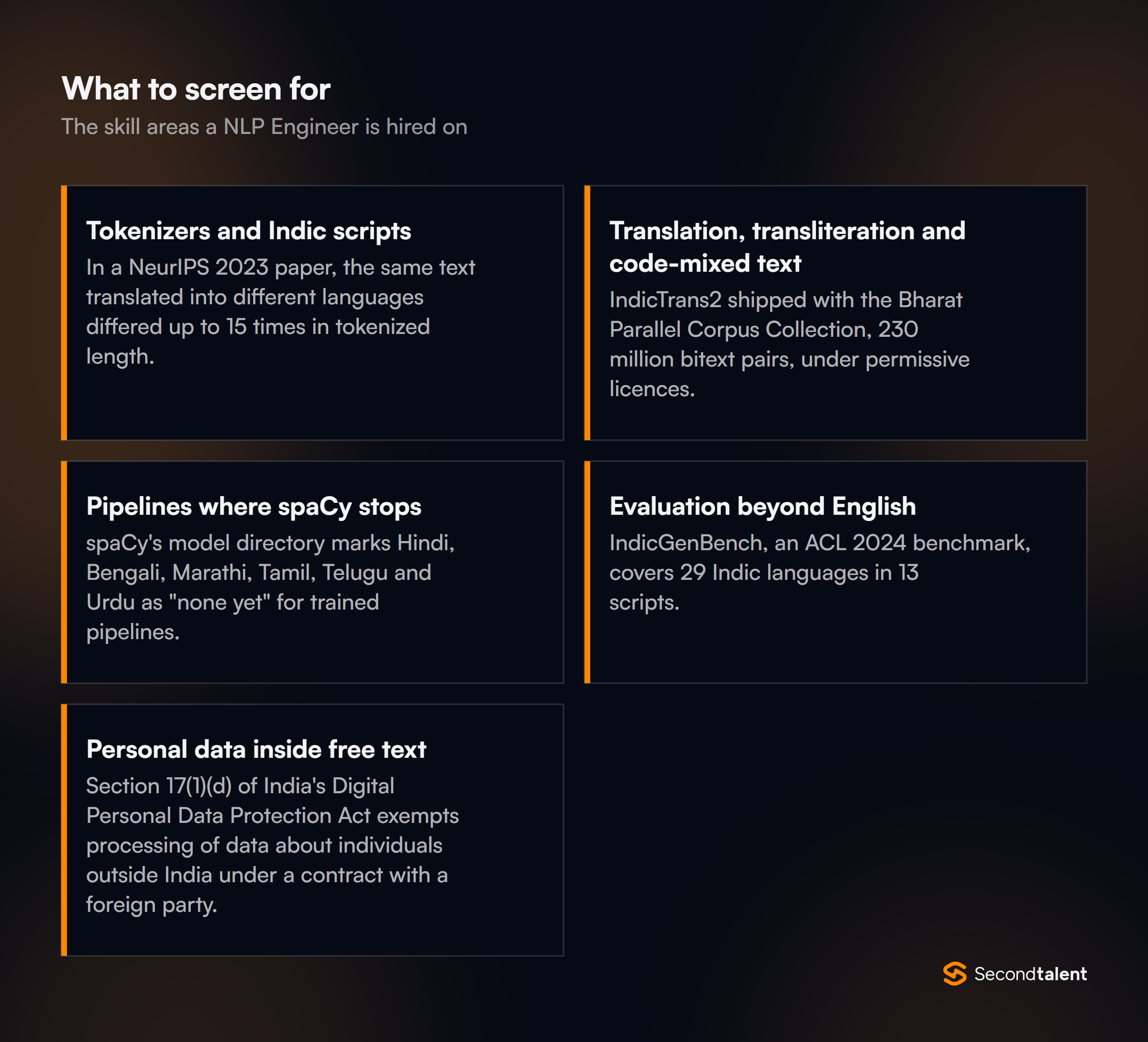
Tokenizers and Indic scripts
In a NeurIPS 2023 paper, the same text translated into different languages differed up to 15 times in tokenized length. The gap held even for tokenizers trained for multilingual use. Longer sequences raise cost per request and latency and leave less room for context.
Hand the candidate Devanagari and Tamil samples and ask them to measure tokens per word on your model before they design anything.
Translation, transliteration and code-mixed text
IndicTrans2 shipped with the Bharat Parallel Corpus Collection, 230 million bitext pairs, under permissive licences. Indian input often mixes scripts, though: a support ticket can mix romanised Hindi with English product names. Give the candidate 50 such tickets. Ask whether they would transliterate, translate or classify the raw text, and how they would test each choice.
Pipelines where spaCy stops
spaCy's model directory marks Hindi, Bengali, Marathi, Tamil, Telugu and Urdu as "none yet" for trained pipelines. A candidate who has shipped Indic entity extraction has built or borrowed the tokenizer, sentence splitter and labels themselves. Ask what they used and what broke when the input switched script mid-sentence.
Evaluation beyond English
IndicGenBench, an ACL 2024 benchmark, covers 29 Indic languages in 13 scripts. Even the best model its authors tested, the largest PaLM-2, showed a significant gap against English across the benchmark's languages. Ask the candidate to report scores per language rather than one average, and to show the language where your current model fails worst.
Personal data inside free text
Section 17(1)(d) of India's Digital Personal Data Protection Act exempts processing of data about individuals outside India under a contract with a foreign party. Sections 8(1) and 8(5) still apply, including the duty to take reasonable security safeguards. Support tickets and call transcripts carry names and account numbers, so ask how the candidate redacts them before text reaches annotators or a training set.
Contractor or Employer of Record in India
Software is not one of the nine categories of commissioned work that can be "work made for hire" under 17 U.S.C. § 101, and a transfer must be in writing and signed under § 204(a).
India's Copyright Act, 1957 counts computer programmes as literary works. Section 17(c) makes the employer first owner of work made under a contract of service; a freelancer's code stays with the freelancer.
Section 19 requires a written, signed assignment. If the assignment names no period, the Act deems it to last five years; if it names no territory, the Act presumes it covers India only. Write "worldwide" and "for the full term of copyright" into the contract, and list models, adapters, label sets and prompts.
IRS Publication 515 says the place where services are performed determines the source of the income, so work done in India is foreign-source income. A foreign individual gives the payer Form W-8BEN to certify foreign status.
India's Supreme Court surveyed the tests for employment in Sushilaben Indravadan Gandhi v. New India Assurance (2020). The court weighed control, integration into the business, and who owns the tools and carries profit or loss. In its words, "No one test of universal application can ever yield the correct result." India's four labour codes took effect on 21 November 2025 and require appointment letters for all workers.
A full-time engineer inside your sprints fits that test. The EOR route needs a provider with its own Indian entity. Our Employer of Record overview explains how the model works; Second Talent's own EOR contracts cover nine other Asian markets. This is a summary, not legal advice.
|
Independent contractor |
Employer of Record |
| Legal employer |
None; the engineer invoices you |
The EOR provider's Indian entity |
| US paperwork |
Form W-8BEN from the engineer |
Service agreement with the EOR |
| IP |
Written assignment naming worldwide rights and full term (section 19) |
Employer first owner (section 17(c)), passed on through the EOR agreement |
| Local labor law |
Employment finding if control and integration point that way |
Labour codes apply, including appointment letters |
| Pay currency |
Agreed in the contract, often USD |
Local payroll in rupees |
English Level and Working Norms in India
India's scores on the EF English Proficiency Index 2025 vary more by city than by skill. Bengaluru scores 569 and Hyderabad 554, while Delhi scores 407, per EF's India page. The national score is 484, 74th of 123 countries and regions, against a global average of 488, and the IT job-function score is 487.
Listening is India's weakest skill at 457, below writing at 504. NLP work runs on written artefacts: labelling guidelines, error taxonomies and evaluation reports. Test those in writing, then hold one live call to check listening on your team's accents.
India's central government holiday list for 2026 makes Mahatma Gandhi's Birthday on 2 October, Dussehra and Diwali compulsory holidays in its offices. Offices outside Delhi add three more from a list of 12, and Diwali moves with the lunar calendar, so ask for the engineer's local list before you plan a release.
Thanksgiving on 26 November 2026 is a working day in India, so an engineer there can watch a model release while your US team is off.
NLP Engineer Hiring Process in India
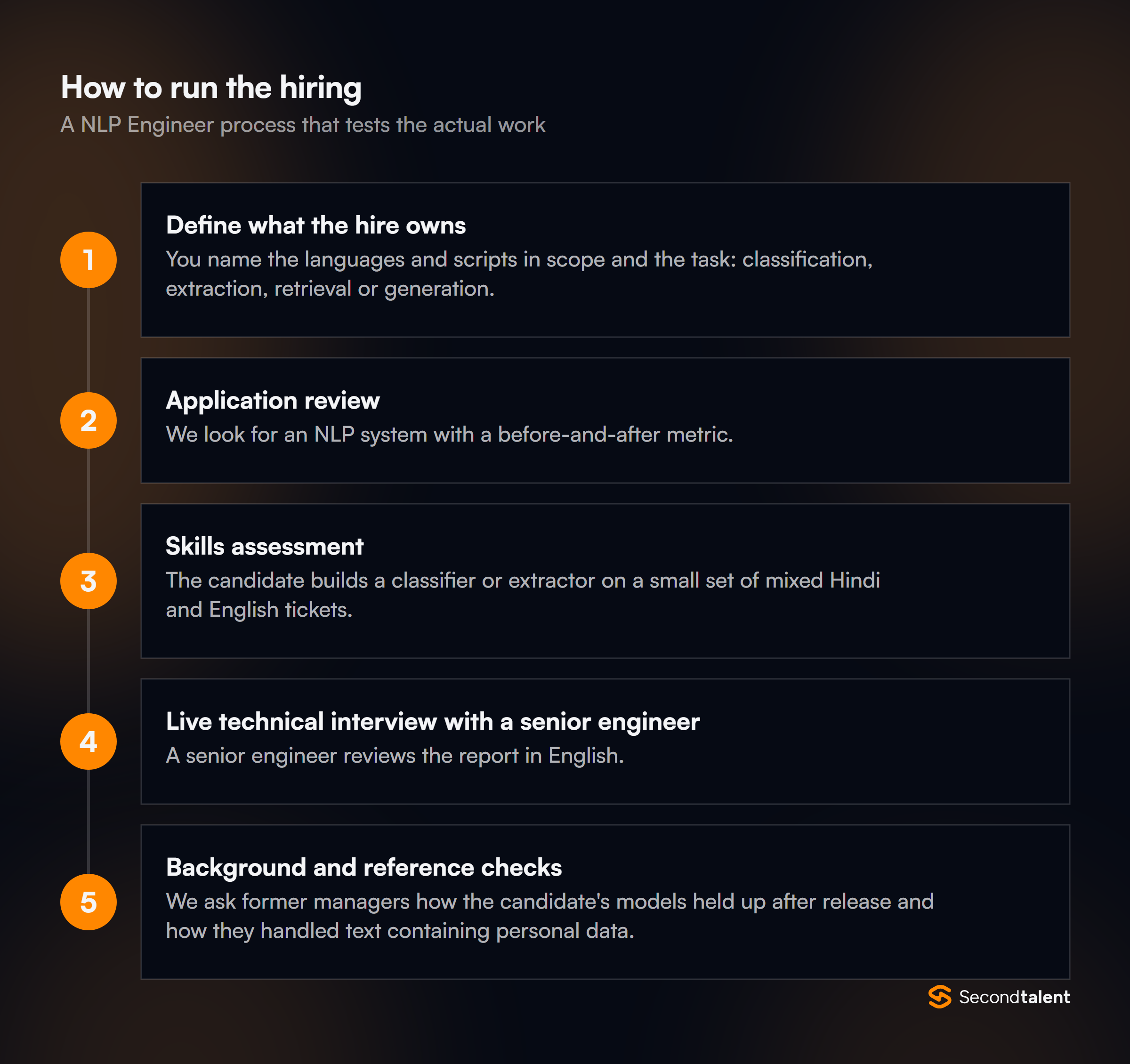
Second Talent's vetting covers stages 2 to 5 before you see a profile.
Stage 1: Define what the hire owns
You name the languages and scripts in scope and the task: classification, extraction, retrieval or generation. Add the latency budget and the personal data the text contains. Add the Bengaluru shift from the table above.
Stage 2: Application review
We look for an NLP system with a before-and-after metric. An entity extractor in production, a ticket router with per-class scores or a retrieval feature with measured recall all qualify. Indic or code-mixed work counts when the candidate can name the tokenizer they used.
Stage 3: Skills assessment
The candidate builds a classifier or extractor on a small set of mixed Hindi and English tickets. They report per-language and per-class scores, token counts per word and one failure category they would fix first.
Stage 4: Live technical interview with a senior engineer
A senior engineer reviews the report in English. The candidate defends the data split, the metric and the redaction step. Then they move to serving: batching, latency and what changes when a second script arrives.
Stage 5: Background and reference checks
We ask former managers how the candidate's models held up after release and how they handled text containing personal data. We also ask how they wrote up failures. You then choose the contractor or EOR route above.
Hire NLP Engineers from India with Second Talent
We shortlist 6-8 candidates within 24 hours from 100,000+ pre-vetted engineers, accepting only the top 1% of applicants. NLP engineers from India come with $0 upfront, no lock-in and 4-6 hours of daily overlap with US hours. We handle contracts, payroll and equipment.
Our pricing page sets out the monthly subscription, and for generation-heavy work we also staff LLM engineers in India.