TL;DR: AI developers in India earn $2,610 to $10,150+ a month working for international clients on our AI engineer rate card, and we shortlist 6-8 candidates within 24 hours. The closest US benchmark, the BLS median for software developers, was $135,980 a year in May 2025.
In the generative AI data of GitHub's Octoverse 2025, developers in India made about 5 million contributions, second only to the US, and worked in more distinct repositories: 405,000 against 342,000. India also added 5.2 million developers in 2025, more than any other country. Ask an AI developer from India for the repository before the CV.
Key takeaways
- India's data protection law lifts most of its duties when an engineer in India processes data on individuals outside India under a contract with a foreign company, but the security safeguards duty stays.
- A copyright assignment from an Indian contractor that states no term is deemed to last five years, and one that names no territory covers India only.
- Sarvam-105B, an open-weight model built for 22 Indian languages, ships under Apache 2.0 with 10.3 billion active parameters.
- A 3:30 pm to 12:30 am shift in Bengaluru gives a New York team six live hours while US daylight time lasts.
What AI Developers Earn in India Working for International Clients
India's ceiling sits $60 below Indonesia's, and its floor sits $220 above the Philippines'. No other market in the table spans as wide a range. The figures are what engineers in each market earn working directly for foreign companies, before any employer or platform costs.
| Market |
Monthly pay working for international clients (USD) |
| India |
$2,610-$10,150+ |
| Philippines |
$2,390-$4,790+ |
| Vietnam |
$3,870-$7,730+ |
| Indonesia |
$4,540-$10,210+ |
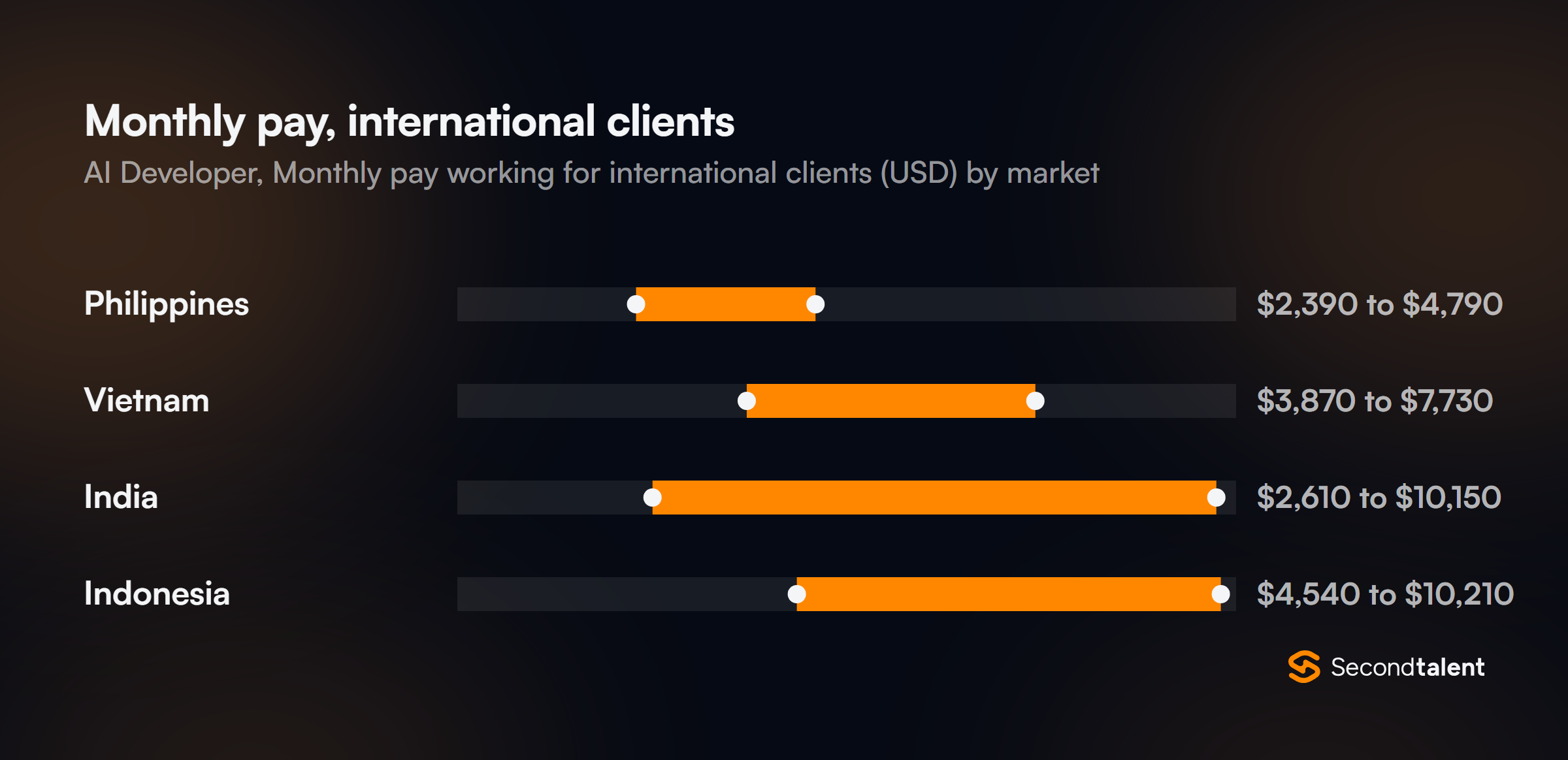
Monthly ranges from the Remote (Working for International Clients) figures on our rate cards for India, the Philippines, Vietnam and Indonesia, converted at ExchangeRate-API mid-market rates for 14 September 2026.
The India card quotes ₹250,000 to ₹970,000+ a month. A range that wide covers two different hires. At the bottom sits an engineer who wires model APIs into a product. At the top sits one who owns PyTorch training runs and the evaluation that decides whether a model ships. For the training-heavy brief, our India machine learning engineer card runs $2,410 to $9,410+.
Through Second Talent you pay one monthly fee that bundles salary, payroll taxes, statutory contributions and our service fee, quoted per role and market. Our pricing page explains the subscription, and our AI engineer cost-to-hire page sets out US freelance rates for the contract route.
US Pay Benchmark for AI Developers
BLS publishes no AI developer occupation. The role maps to Software Developers (SOC 15-1252), because an engineer who builds retrieval, agents and model-serving code into a product is writing production software around a model.
| BLS OEWS, May 2025, national |
10th percentile, monthly |
25th percentile, monthly |
Median, monthly |
75th percentile, monthly |
90th percentile, monthly |
| Software Developers (15-1252), median annual $135,980 |
$6,870 |
$8,770 |
$11,330 |
$14,330 |
$17,890 |
Monthly figures are the annual wages on the OEWS profile for 15-1252 divided by 12, rounded to the nearest $10.
Salary is only part of the US cost. In the BLS Employer Costs for Employee Compensation release for June 2026, wages and salaries made up 68.5% of employer compensation costs for full-time private industry workers, and benefits the other 31.5%.
Time Zone Overlap: Bengaluru Against ET, CT and PT
Bengaluru keeps a half-hour offset, UTC+5:30, with no daylight saving. Shifts that start on the half hour line up with the US hour. US clocks stay on daylight time from 8 March to 1 November 2026, per NIST.
The arithmetic: 9:00 am in New York is 13:00 UTC under EDT (UTC-4). Add five and a half hours and it is 6:30 pm in Bengaluru. Under EST (UTC-5) the same meeting lands at 7:30 pm, and 9:00 am in San Francisco lands at 9:30 pm in September.
| Bengaluru shift (UTC+5:30) |
ET overlap (EDT / EST) |
CT overlap (CDT / CST) |
PT overlap (PDT / PST) |
Hours between 10 pm and 6 am |
| 9:30 am-6:30 pm |
0 / 0 |
0 / 0 |
0 / 0 |
0 |
| 1:30 pm-10:30 pm |
4 / 3 |
3 / 2 |
1 / 0 |
0.5 |
| 3:30 pm-12:30 am |
6 / 5 |
5 / 4 |
3 / 2 |
2.5 |
| 6:30 pm-3:30 am |
8 / 8 |
8 / 7 |
6 / 5 |
5.5 |
Each shift is nine clock hours, including a meal break, counted against a 9 am to 5 pm US day.
A plain Bengaluru office day gives no live overlap with any US time zone. That suits training work. The engineer starts a fine-tuning job or an evaluation sweep before logging off at 6:30 pm, which is 9:00 am in New York, and your team can read the results before its own day ends.
For retrieval and agent features that need design calls and fast bug turnaround, the 1:30 pm or 3:30 pm start works better. India's Labour Codes, in force since 21 November 2025, permit women to work night shifts in all establishments, subject to their consent and required safety measures. Agree the shift in writing before the offer. We do the same, which is how our placements get 4-6 hours of daily overlap with US hours.
AI Developer Skills to Screen For
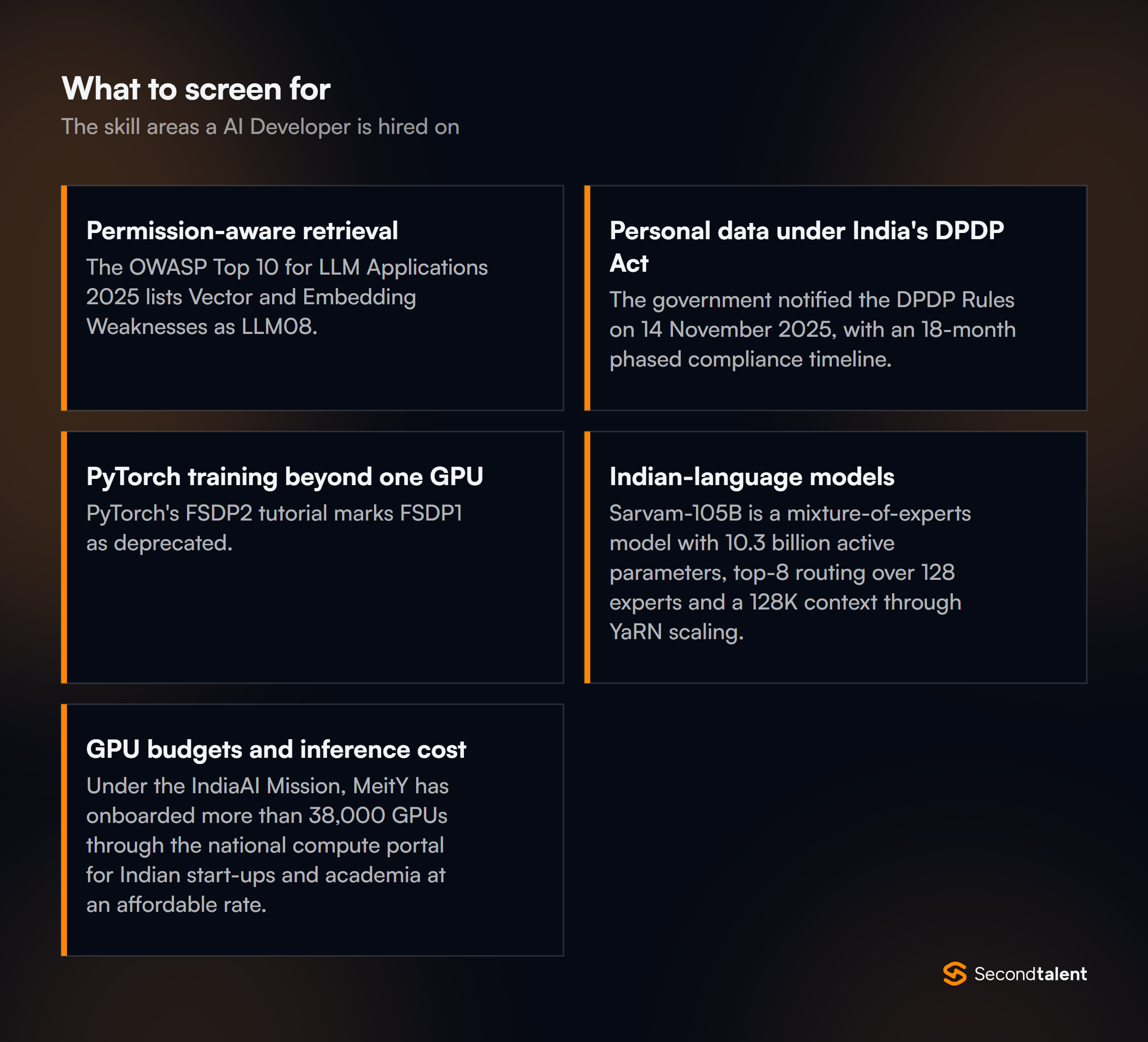
Most AI hires from India will touch three things: retrieval in production, PyTorch training, and models served on AWS or GCP. Each area below comes with a test.
Permission-aware retrieval
The OWASP Top 10 for LLM Applications 2025 lists Vector and Embedding Weaknesses as LLM08. Its first risk is weak access control on embeddings. In a shared vector database, one group's documents can surface in answers to another group's queries. OWASP's fix is a permission-aware store with strict partitioning.
Give the candidate a two-tenant index and ask where the tenant filter runs: before the similarity search or after it, and why that order matters.
Personal data under India's DPDP Act
The government notified the DPDP Rules on 14 November 2025, with an 18-month phased compliance timeline. For a US client, the key clause is section 17(1)(d) of the Digital Personal Data Protection Act, 2023. That clause disapplies the Act's data fiduciary duties, data principal rights and cross-border transfer rule for a person in India who processes data of individuals outside India under a contract with someone outside India.
Two duties survive: complying with the Act under section 8(1), and reasonable security safeguards against a breach under section 8(5). Ask the candidate which parts of your RAG pipeline would fall under Indian law if you later add users in India, and what changes in consent, retention and breach notice.
PyTorch training beyond one GPU
PyTorch's FSDP2 tutorial marks FSDP1 as deprecated. FSDP2 represents sharded parameters as DTensor, gives sharded state dicts without communication, and exposes an extension point used for NF4 in QLoRA. A candidate who has only trained on one GPU has had no reason to learn the change.
Hand over a training script wrapped in the old API and ask for the migration, the checkpoint format and the prefetch settings for a large batch.
Indian-language models
Sarvam-105B is a mixture-of-experts model with 10.3 billion active parameters, top-8 routing over 128 experts and a 128K context through YaRN scaling. Its model card claims the best results for its size across 22 Indian languages, and it ships under the Apache License.
If your product serves users in Hindi, Tamil or Bengali, ask the candidate to compare it with the hosted model you use today on three things: token count for the same Hindi prompt, answer quality on your eval set, and serving cost per thousand requests.
GPU budgets and inference cost
Under the IndiaAI Mission, MeitY has onboarded more than 38,000 GPUs through the national compute portal for Indian start-ups and academia at an affordable rate. A candidate from an Indian start-up may have trained on that subsidised capacity. Your workloads will run on your own AWS or GCP account.
Ask for the GPU hours and cost of their last fine-tuning run, then price the same run on your cloud account together.
Contractor or Employer of Record in India
Software is not one of the nine categories of commissioned work that can be "work made for hire" under 17 U.S.C. § 101, and a transfer must be in writing and signed under § 204(a).
India's Copyright Act, 1957 counts computer programmes as literary works. Section 17(c) makes the employer first owner of work made under a contract of service, unless an agreement says otherwise. A contractor works under a contract for service, keeps first ownership and must assign in writing (section 19(1)). Section 19 also sets defaults that catch US templates.
With no term stated, the assignment is deemed to last five years. With no territory named, it is presumed to cover India only.
Name model weights, adapters, eval sets, prompts and pipeline code, and state "worldwide" and "for the full term of copyright".
IRS Publication 515 says the place where services are performed determines the source of the income, so an engineer working from Bengaluru earns foreign-source income. A foreign individual gives the payer Form W-8BEN to certify foreign status.
In 2020, India's Supreme Court set out the employment test in Sushilaben Indravadan Gandhi v. New India Assurance. It held that no single test decides the question. Courts weigh the right to control, integration into the business, who owns the tools, and whether the worker runs a business of their own. An engineer who works your sprints on your hours, inside your systems, points toward employment on all four.
Our Employer of Record overview lists the nine Asian markets where we run EOR contracts. India is not one of them, so for India we handle contracts and payroll. This is a summary, not legal advice.
|
Independent contractor |
Employer of Record |
| Legal employer |
None; the engineer invoices you |
An EOR's employing entity in India |
| US paperwork |
Form W-8BEN from the engineer |
Service agreement with the EOR |
| IP |
Written assignment naming weights, datasets and code, with term and territory stated (section 19) |
Employer first owner under section 17(c), passed on through the EOR agreement |
| Local labor law |
Employment finding if control and integration point that way |
Labour Codes apply, including a written appointment letter |
| Pay currency |
Agreed in the contract, often USD |
Rupee payroll run by the EOR |
English Level and Working Norms in India
Bengaluru scores 569 on the EF English Proficiency Index 2025 and Hyderabad 554, while Delhi scores 407. India's national score is 484, 74th of 123 countries and regions and 6 points below its previous edition, against a global average of 488. Its IT job-function score is 487, per EF's India page.
India's skill scores split the way AI work does: writing is the highest at 504 and listening the lowest at 457. Model cards, eval reports and design docs lean on writing, while a fast design call with overlapping voices tests listening. Run one assessment stage in writing and one live, and score them apart.
India's three national holidays are Republic Day, Independence Day and Gandhi's birthday, which falls on Friday 2 October 2026. The central government's 2026 holiday order puts Diwali on Sunday 8 November, with some states observing the day before. Avoid model releases that week.
Thanksgiving on 26 November 2026 is a working day in India, so an engineer there can watch a model rollout while your US team is off.
AI Developer Hiring Process in India
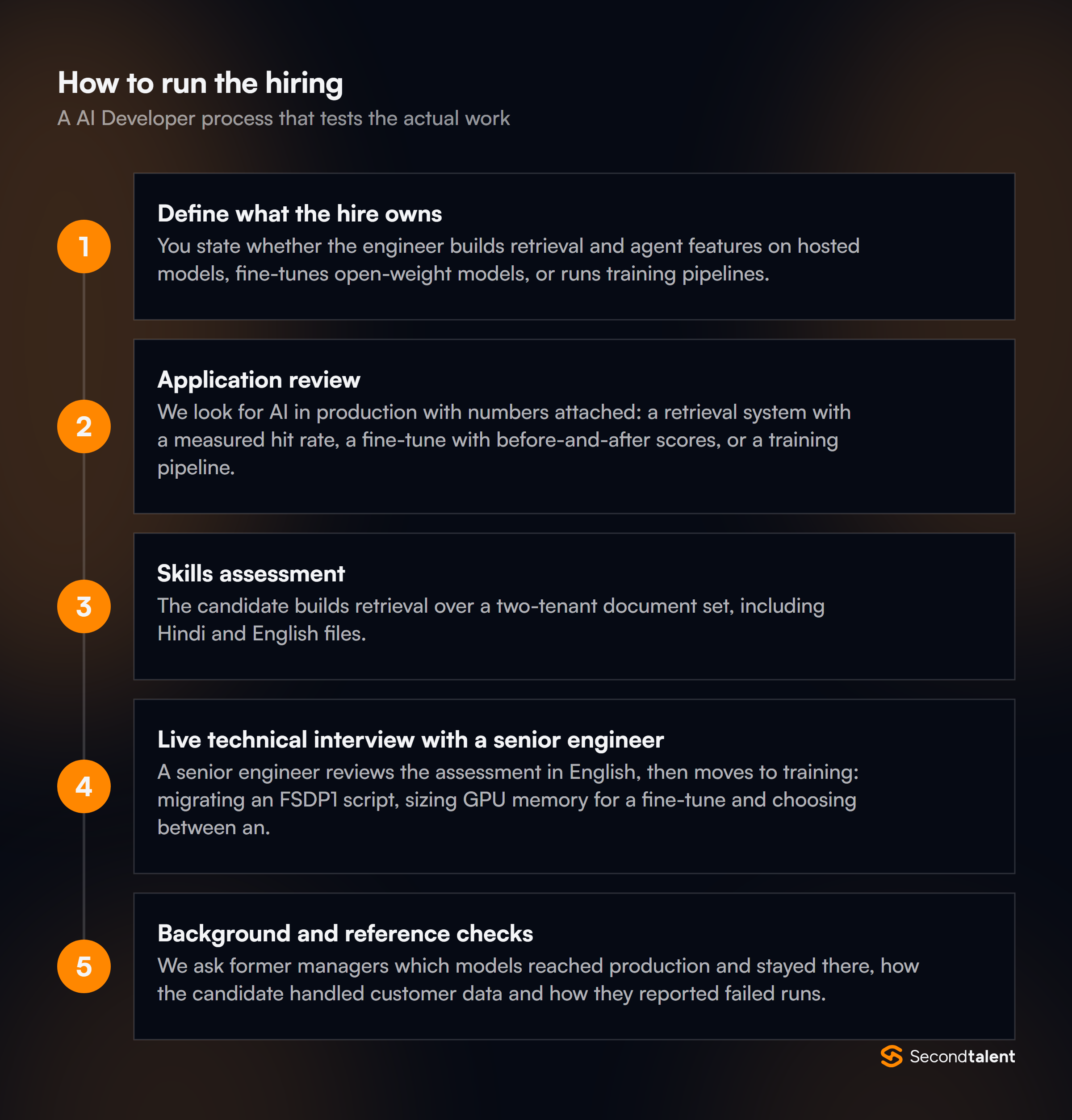
Second Talent's vetting covers stages 2 to 5 before you see a profile.
Stage 1: Define what the hire owns
You state whether the engineer builds retrieval and agent features on hosted models, fine-tunes open-weight models, or runs training pipelines. Name the cloud, the data the engineer may touch and whose personal data it is. Add the Bengaluru shift from the table above.
Stage 2: Application review
We look for AI in production with numbers attached: a retrieval system with a measured hit rate, a fine-tune with before-and-after scores, or a training pipeline with its GPU bill. Public repositories count when the candidate wrote the code that matters.
Stage 3: Skills assessment
The candidate builds retrieval over a two-tenant document set, including Hindi and English files. They write the eval, prove tenant isolation and report cost per thousand queries.
Stage 4: Live technical interview with a senior engineer
A senior engineer reviews the assessment in English, then moves to training: migrating an FSDP1 script, sizing GPU memory for a fine-tune and choosing between an open-weight Indian-language model and a hosted one.
Stage 5: Background and reference checks
We ask former managers which models reached production and stayed there, how the candidate handled customer data and how they reported failed runs. You then sign the contractor agreement with a full IP assignment.
Hire AI Developers from India with Second Talent
We shortlist 6-8 candidates within 24 hours from 100,000+ pre-vetted engineers, accepting only the top 1% of applicants. AI developers from India come with $0 upfront, no lock-in and 4-6 hours of daily overlap with US hours. We handle contracts, payroll and equipment.
Our pricing page sets out the monthly subscription, and for agent-focused briefs we also staff AI agent developers in India.