Hire QA Automation Engineers in India | Onboard in Aug, 2026
Skip to content

Hire QA Automation Engineers in India

Hire QA automation engineers in India who build Playwright, Selenium and Cypress suites, wire them into CI, and cut regression cycles from days to minutes. Shortlists in 24 hours.

Adobe Crypto.com Lacoste L'Occitane Lululemon Yusen Logistics Neopets Adobe Crypto.com Lacoste L'Occitane Lululemon Yusen Logistics Neopets Adobe Crypto.com Lacoste L'Occitane Lululemon Yusen Logistics Neopets Adobe Crypto.com Lacoste L'Occitane Lululemon Yusen Logistics Neopets

We help companies save $103,000+ per hire

24 Hours

to get matched

4.9

avg client rating

200 +

companies building with us

92 %

talent retention rate

50-70 %

payroll savings

Automate Workflows Build AI Agents Ship LLM Features Build RAG Pipelines Cut LLM Costs Tame AI Sprawl Build MVPs Scale Engineering Automate Workflows Build AI Agents Ship LLM Features Build RAG Pipelines Cut LLM Costs Tame AI Sprawl Build MVPs Scale Engineering
End DevOps Burnout Modernize Stack Hit Q4 Roadmap Cut Burn Rate Replace Agencies Extend Runway Build Without Borders Ship 3x Faster End DevOps Burnout Modernize Stack Hit Q4 Roadmap Cut Burn Rate Replace Agencies Extend Runway Build Without Borders Ship 3x Faster

1,350+ QA Automation Engineers Available to Hire in August 2026

What our clients say

Thanks to Second Talent, Open Campus quickly built a skilled tech team of 10 within two months, boosting productivity by 70% and accelerating our Web3 platform's development.

This success has strengthened our role in decentralized education and fueled our market expansion, highlighting our leadership in Web3 innovation.

Jonah L.

Jonah L.

Head of Portfolio (raised US$100m)

Animoca Brands

Second Talent helped Beyond Cars (acquired by Carro) swiftly build a top-tier tech team in just a month, accelerating our platform's development and boosting productivity.

This success allowed us to expand into new markets, ultimately leading to our acquisition by a major automotive e-commerce company.

Garry Y.

Garry Y.

Co-Founder (acquired by Carro)

Carro

Partnering with Second Talent has been a game-changer for our tech expansion.

Their ability to source top-tier talent from Vietnam helped us scale rapidly while maintaining quality. Their pre-vetted candidates integrated seamlessly, and their account management ensured smooth onboarding.

Tom F.

Tom F.

Co-founder (#1 US Real Estate Coach)

Tom Ferry

Second Talent played a key role in our tech expansion, quickly providing high-quality frontend talent that integrated seamlessly into our projects.

Their pre-vetted candidates, smooth onboarding process, and excellent support helped us build a strong, cost-effective team that drives our success.

Marco A.

Marco A.

Co-founder & CTO

Finno

Second Talent built our team of pre-vetted engineers who made our hiring decisions straightforward.

Once onboarded, our tech team saw a significant boost in productivity and development speed. Their excellent account management and responsive customer service also ensured smooth handling of all post-onboarding HR matters.

Jack N.

Jack N.

Director of IT (10,000+ employees)

Lane Crawford

Second Talent helped us rapidly scale by sourcing top-quality SDR talent from Indonesia.

Their pre-screened candidates fit perfectly, and their smooth onboarding and support built a strong, cost-effective team that helped to test and experiment sales with another market.

Leo W.

Leo W.

Co-founder (raised US$5m)

imbee

Why Second Talent?

Engineers who build, ship and automate with AI. Less overhead, more output.

  • 75% cost savings

    No office overhead, no traditional employee expenses.

  • AI-native talent

    Teams equipped with the latest AI tools.

  • Working U.S. hours

    4-6 hours of overlap to stay aligned.

  • Rigorous vetting

    Coding tests, peer interviews, and role checks, matched to your exact stack.

How Second Talent Works

Hire QA Automation Engineers in India from the US, EU, and Australia

We work with engineering teams in the United States, Europe, the UK, and Australia who hire QA Automation Engineers in India every week. The model is the same across origins. Senior, pre-vetted talent. Time-zone overlap that fits your workday. Compliant employment handled by Second Talent.

Hiring from United States

  • 4โ€“6 hours of overlap with US Eastern, 6โ€“8 with Pacific
  • Delaware MSA, NDA and IP assignment on file
  • USD billing, monthly invoices, Stripe or bank transfer

Most US clients hiring QA Automation Engineers in India start with one engineer and scale to a 3โ€“5 person team within the first quarter.

Hiring from Europe & the UK

  • 6โ€“8 hours of daily overlap with CET and UK working hours
  • GDPR aligned, EU standard contractual clauses available
  • EUR or GBP billing supported, SEPA / Wise / bank transfer

European teams hiring QA Automation Engineers in India typically replace 3โ€“4 senior open roles with one Second Talent engagement.

Hiring from Australia

  • 6โ€“8 hours of daily overlap with Sydney and Melbourne working hours
  • AU-aligned contracts, ABN-friendly invoicing
  • AUD or USD billing, monthly cycle

Australian teams hiring QA Automation Engineers in India get the closest time-zone alignment of any offshore destination.

Hiring QA Automation Engineers is Easy with Second Talent

Hire in 3 steps, not 3 months.

1

Tell Us What You Are Building

Share what to ship, automate, or scale. Plus stack, budget, and timezone overlap.

2

Meet Top Picks in 24 Hours

6โ€“8 pre-vetted QA Automation Engineers fluent in Claude Code and modern AI stacks. Interview the ones you like.

3

Ship From Day One

We handle contracts, payroll, and equipment. Your QA Automation Engineer ships real output within the first week.

Hire QA Automation Engineers in India

Contents (10 sections)

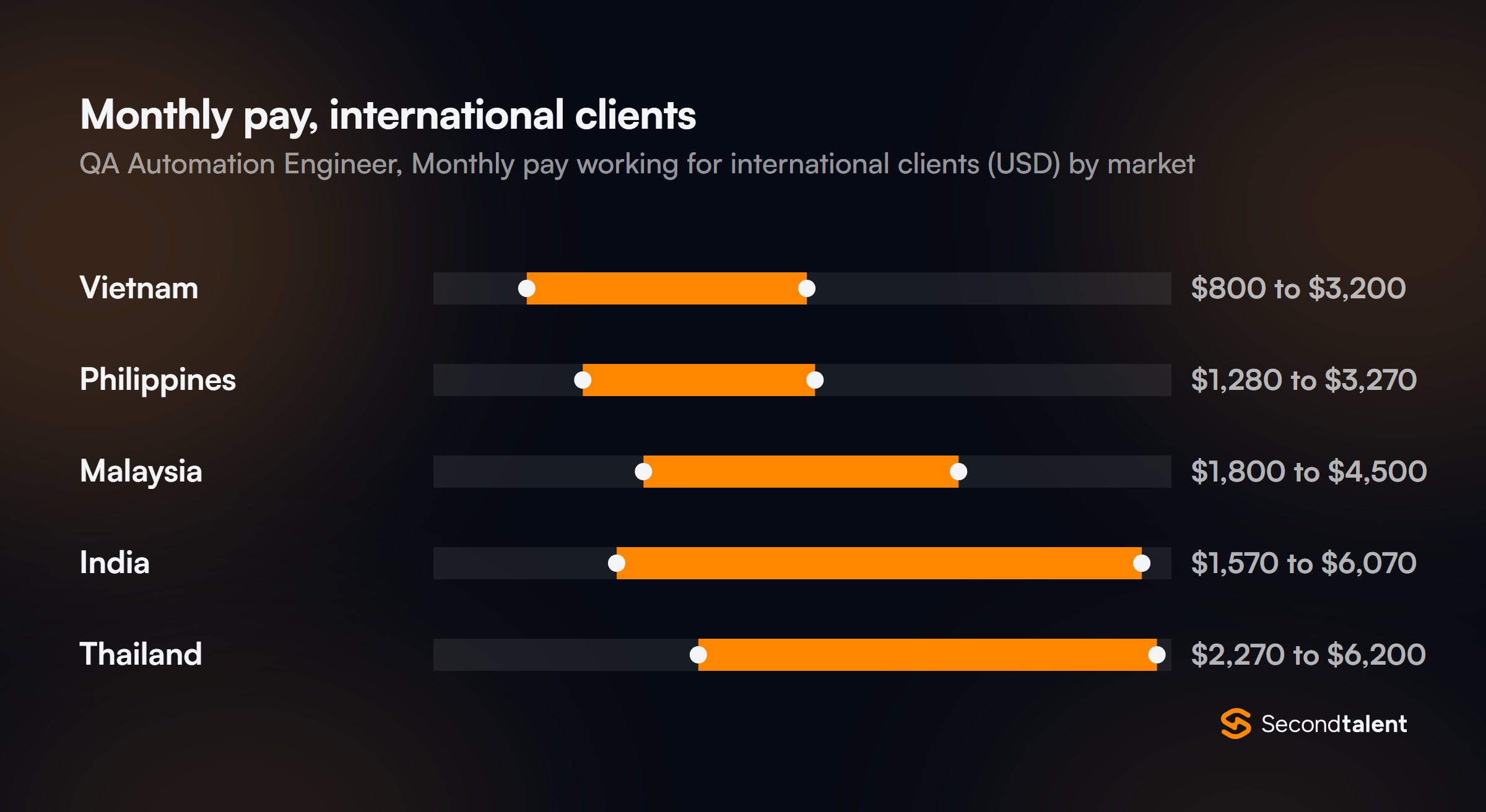
TLDR: In 2026, QA automation engineers in India cost $1,800 to $6,000 a month at mid and senior levels. Bengaluru, Pune and Hyderabad hold the deepest Playwright and Selenium pools.

Why companies hire QA automation engineers in India

India has been the centre of the world's software testing work for over two decades. That history is the reason the talent pool is so unusual. Independent testing practices grew up inside TCS, Infosys, Wipro, Cognizant, Capgemini and LTIMindtree. Those delivery centres trained hundreds of thousands of engineers on test strategy, regression planning, defect triage and release gates. Product companies then pulled the best of them out and retrained them on Playwright, Cypress, Appium, k6 and container-based CI.

The result in 2026 is a pool that is both large and deep in test discipline. You are not just buying scripting hours. You are buying engineers who have shipped release sign-offs under pressure, who know what a risk-based test plan looks like, and who have argued with a product manager about whether a P2 defect blocks a launch.

Cost is the second reason. The gap against US rates is wide enough to fund an entire QA function.

Level India monthly (Second Talent) US monthly, all in Annual saving per hire
Junior, 1 to 3 years $1,000 to $1,800 $11,000 to $18,000 ~$120,000+
Mid-level, 3 to 5 years $1,800 to $3,200 $11,000 to $18,000 ~$130,000+
Senior, 5 to 8 years $2,500 to $6,000 $11,000 to $18,000 ~$100,000+
Staff or lead, 8+ years $6,000 to $9,000 $11,000 to $18,000 ~$70,000+

The third reason is coverage of hours. QA work clusters around release windows. Indian Standard Time sits at UTC+5:30, which means a regression suite can run and get triaged while a US team sleeps. Teams that hire developers in India often start with QA precisely because the handoff model works so well.

What has changed for QA in 2026

Three shifts matter when you write the job spec.

First, Playwright has taken clear share from Selenium for new web projects. Selenium still dominates enterprise estates and legacy suites, so most senior candidates know both. Second, API-first testing is now the default. Strong candidates spend more time in Postman, REST Assured, Pact and Playwright's request fixtures than in the browser. Third, AI-assisted test generation is real but shallow. Candidates who claim an LLM writes their suites usually cannot explain their flakiness rate.

India's QA automation ecosystem and hubs

The market is not uniform. Rates, stack and availability differ by city.

Hub QA automation strength Common stack Rate pressure
Bengaluru Deepest product QA pool. SDET roles at scale-ups and global R&D centres Playwright, Cypress, TypeScript, Kubernetes-based CI Highest, 10 to 20 percent above national average
Pune Strong enterprise and automotive QA. Excellent Java and Selenium depth Selenium, TestNG, REST Assured, Jenkins Moderate
Hyderabad Large cloud and SaaS QA base, heavy Azure and AWS exposure Playwright, Python, pytest, Azure DevOps Moderate to high
Chennai Banking, insurance and payments QA. Mainframe-to-API integration testing Selenium, Cucumber, JMeter, IBM tooling Moderate
Delhi NCR (Noida, Gurugram) Consumer and e-commerce QA, strong mobile automation Appium, Cypress, JavaScript, BrowserStack Moderate
Tier 2 (Indore, Coimbatore, Kochi, Ahmedabad, Jaipur) Growing remote-first SDET pool, lower attrition Selenium, Playwright, Python, GitHub Actions Lowest, 15 to 25 percent below Bengaluru

Since 2021 remote hiring has flattened these differences, but not erased them. A senior SDET in Bengaluru with SaaS product experience will quote at the top of our senior band. A comparable engineer in Coimbatore often quotes 20 percent lower for the same skill set. We source across all of these hubs rather than defaulting to Bengaluru, which is how we keep senior offers inside the $2,500 to $6,000 range.

Where the supply actually sits

A rough picture of the pool we recruit from. India produces well over a million engineering graduates a year, and testing remains one of the largest entry paths. The consequence is a very wide base and a much narrower top. Engineers who can write clean framework code, own a pipeline and reason about test architecture are maybe 5 to 8 percent of applicants we see. That is the group worth paying senior rates for.

The skills and stack to screen for

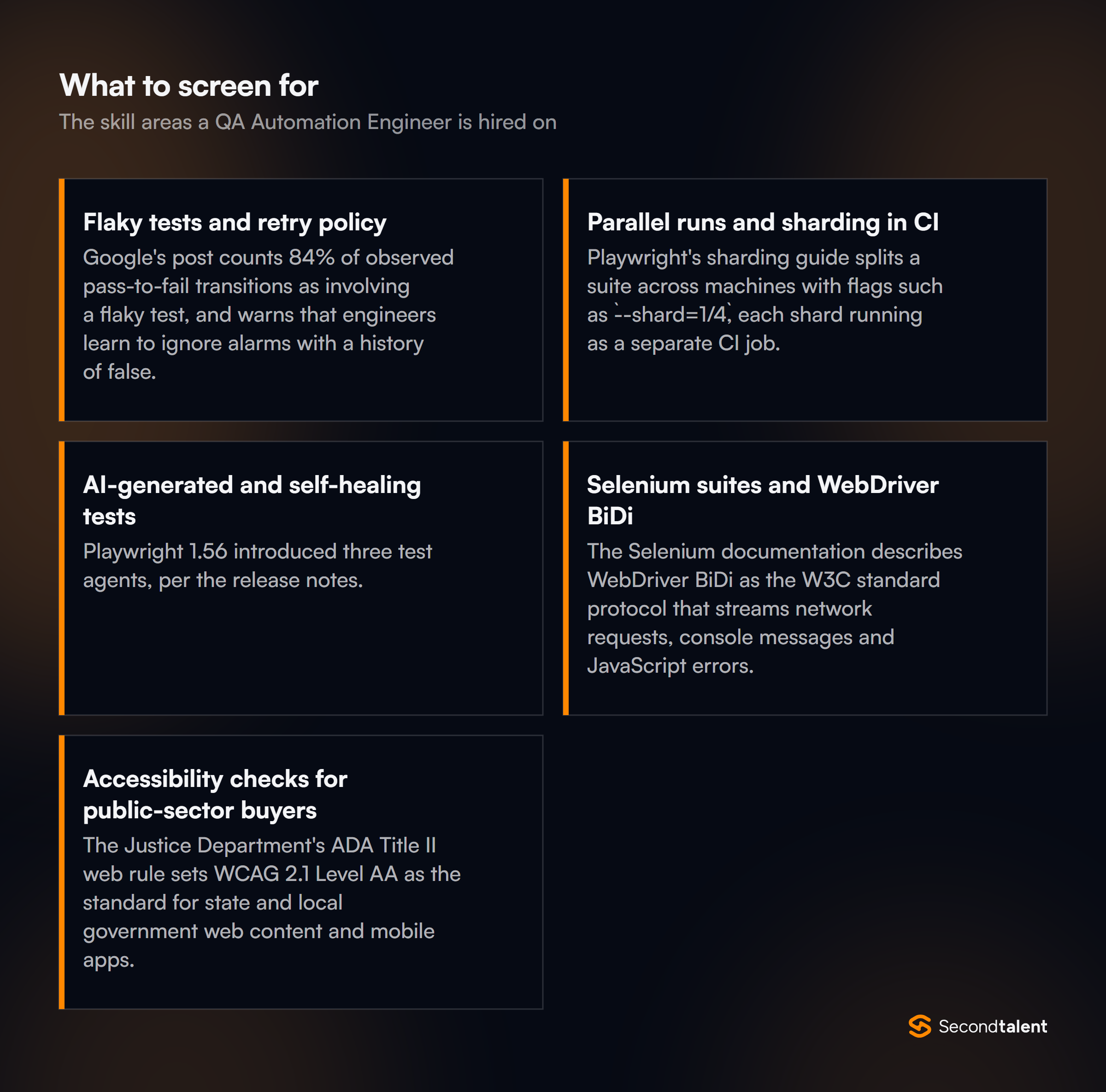
Do not write a job spec that lists twelve tools. Write one that names the layers you need covered. Here is how we break it down for clients.

Layer Tools we see most in India What to verify in the interview
Web UI automation Playwright, Cypress, Selenium 4, WebdriverIO Locator strategy, auto-waiting, page object or fixture design
API and contract REST Assured, Postman/Newman, Playwright request, Pact, Karate Schema validation, auth flows, negative cases, contract versioning
Mobile Appium, Espresso, XCUITest, BrowserStack, LambdaTest Device farm cost control, gesture handling, flaky-app strategies
Performance JMeter, k6, Gatling, Locust Load model design, think time, reading p95 not average
Test infra and CI GitHub Actions, Jenkins, GitLab CI, Azure DevOps, Docker, Kubernetes Parallel sharding, artefacts, retries, merge gating
Test data and env Testcontainers, WireMock, factory patterns, seeded databases Isolation between runs, no shared mutable fixtures
Reporting Allure, ReportPortal, Xray, TestRail, Zephyr Failure triage speed, flake tracking, coverage against risk

Languages

Most India-based QA automation engineers write in one of three languages. Java remains dominant in banking, insurance and enterprise estates, usually with TestNG and Selenium. Python is common in data-heavy and platform teams, usually pytest with Playwright or requests. TypeScript is standard for new Playwright and Cypress work at product companies. Match the language to your codebase, because a QA engineer who shares a language with your developers reviews their code and gets reviewed back.

If your product has heavy back-end complexity, look for QA candidates who can read service code. Teams that already hire back-end developers in India usually find that the same sourcing pool contains strong SDETs, since the boundary between the two is thin.

The adjacent skills that raise value

The QA automation engineers who deliver the most in the first six months usually bring one adjacent skill. Pipeline ownership is the most valuable. An engineer who can maintain runners, containers and secrets removes a dependency on your platform team. That overlaps closely with what we screen for when clients hire DevOps engineers in India.

Mobile automation is the second. Appium plus a device cloud is a specialist skill, and it is a common gap on teams that hire mobile app developers in India without planning test coverage first.

The third is evaluation work for AI features. If your product ships an LLM feature, someone has to build regression tests for non-deterministic output. That means golden datasets, rubric scoring and drift alerts. Some of our QA candidates have done exactly this alongside teams that hire AI developers in India. It is a fast-growing brief and worth asking about.

2026 salary bands for QA automation engineers in India

These are the monthly rates we quote in 2026. They are all-in costs to you, not take-home pay.

Experience Monthly rate Typical scope
Junior, 1 to 3 years $1,000 to $1,800 Writes and maintains tests in an existing framework, manual plus automation mix
Mid-level, 3 to 5 years $1,800 to $3,200 Owns a suite end to end, builds API coverage, fixes flakiness, runs CI jobs
Senior, 5 to 8 years $2,500 to $6,000 Designs the framework, sets the test strategy, owns pipeline gating and performance testing
Staff or lead, 8+ years $6,000 to $9,000 Quality strategy across multiple teams, tooling decisions, mentors SDETs, defines release criteria
US equivalent $11,000 to $18,000 Same scope, 4x to 6x the cost

What pushes a rate to the top of a band

Five things, in the order we see them affect offers. Framework authorship, meaning the candidate built a suite from zero rather than inheriting one. Pipeline ownership in Kubernetes or containerised runners. Performance testing with real load models, not a JMeter script from a tutorial. Domain depth in payments, healthcare or trading, where correctness carries regulatory weight. And team leadership, once a candidate is coordinating three or more testers.

What does not justify a premium is a long tool list, a stack of certifications, or years spent in a services firm running the same regression pack. We check that distinction on every profile. For broader benchmarks across our markets, see the Asia tech salary index.

How to interview and vet for this role

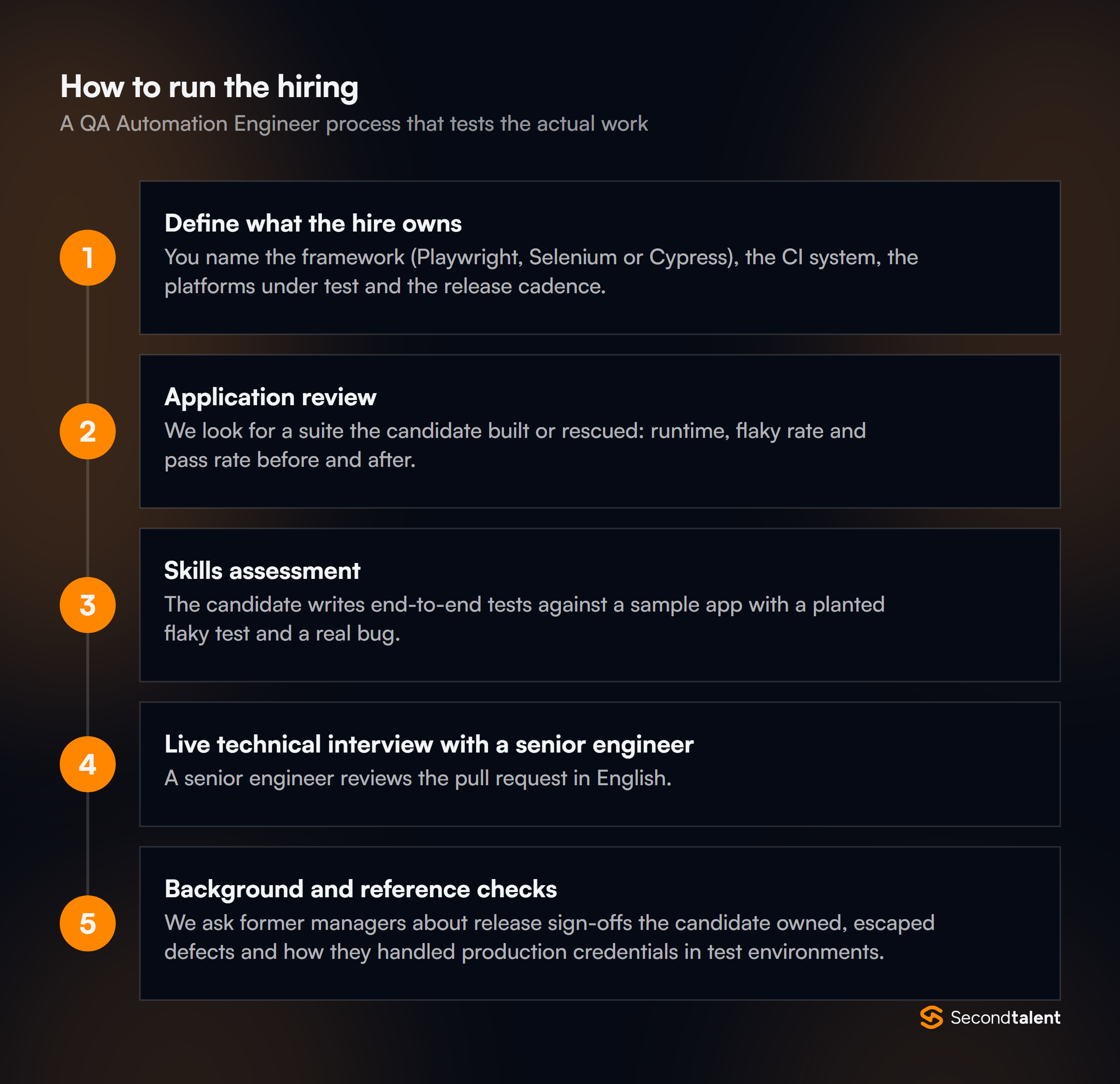
QA automation is the role most often hired badly, because the interview is easy to fake. Recorded scripts look like automation. Here is the four-stage loop we run.

Stage 1, profile screen

We look for a number. Suite runtime before and after, flake rate, escaped defects per release, or coverage of critical user journeys. Candidates who can quote a metric have owned outcomes. Candidates who list tools have executed tasks. We also check whether the automation was theirs or inherited.

Stage 2, live coding

Sixty minutes against a real application. The task is simple. Automate a login and a checkout flow, then handle a dynamic element that appears late. We watch locator choices first. Anyone using XPath copied from browser devtools gets a follow-up question about resilience. Then we ask them to refactor into reusable components. Good candidates do it without prompting.

Stage 3, take-home or pair session

We give a small suite with three deliberately flaky tests. The task is to diagnose and fix them. The failures come from a hard sleep, a shared test fixture and an unhandled race on an async request. Strong candidates find all three in under two hours and explain why retries are the wrong fix.

Stage 4, strategy conversation

No code. Questions like these separate senior from mid.

  • You have four hours before release and a suite that takes six. What do you run?
  • Which tests belong in CI on every commit, and which run nightly?
  • How do you decide something should not be automated?
  • A developer says your test is broken, not their code. Walk me through the next ten minutes.
  • How do you test a feature whose output changes every run?

Red flags we screen out

Signal Why it matters
Retries used as the default flake fix Hides real defects and inflates confidence
Only UI automation, no API layer Slow, brittle, expensive suites
Cannot describe their CI configuration Someone else owned the pipeline
Tests share a database with no reset Failures will be non-reproducible
Talks only in counts of test cases Volume is not coverage
Cannot write a clear bug report on the spot Written communication is core to the job

Time zones and working models

IST is UTC+5:30 with no daylight saving, so your overlap is stable all year.

Your team Overlap with 10am to 7pm IST Model that works
London About 5 hours Full collaboration, shared standups
Berlin, Amsterdam About 5.5 hours Full collaboration
Dubai About 7 hours Near-full overlap
Singapore, Hong Kong About 2.5 hours plus shift options Morning IST standup, async afternoons
Sydney About 4 hours in the IST morning Australia afternoon reviews
US Eastern 1.5 to 3 hours India works 1pm to 10pm IST, overlap 3.30am to 12.30pm ET
US Pacific 2 to 3 hours with a shifted day Nightly suite runs, triage handed off at US start of day

The nightly regression pattern is the strongest fit for US teams. Developers merge during US hours. The suite runs overnight India time. The QA engineer triages failures during the IST morning and posts a clean report before the US team logs on. We have clients who reduced their release cycle from fortnightly to twice weekly on that pattern alone.

For European teams, treat the QA hire as a fully embedded team member. Five hours of overlap is enough for standups, pairing on flaky tests and joint release calls.

Entity, payroll and compliance in India

You do not need an Indian subsidiary. Setting one up takes two to three months and brings ongoing statutory filing obligations. Most of our clients use our Employer of Record instead.

Under EOR we hold the local employment contract. That covers TDS deduction under the Income Tax Act, Employees' Provident Fund contributions at 12 percent where applicable, Employees' State Insurance for lower salary bands, Professional Tax in states that levy it, and gratuity accrual after five years of service. Leave entitlements are set by the relevant state Shops and Establishments Act, typically 15 to 21 days of earned leave plus public holidays.

Two points that matter specifically for QA hires. First, if you want shifted hours, put them in the contract. Night shift allowances and women's night-work provisions vary by state, and we handle that at contracting. Second, IP assignment must be explicit. Our contracts assign all work product, including test frameworks and tooling the engineer builds, to you under Indian law. Many QA engineers write internal tooling that becomes genuinely valuable, so this is not a formality.

Contractor engagements are possible and common for short projects. For a full-time QA role with fixed hours and managed work, EOR is the safer classification.

Common hiring mistakes

Hiring a manual tester and calling it automation. The India pool contains a very large number of manual testers with a Selenium certificate. They can run a suite. They cannot build one. Our live coding stage exists to catch this.

Buying a tool list instead of judgement. A candidate who knows nine frameworks shallowly is worth less than one who knows Playwright deeply and can reason about test pyramids.

Skipping the pipeline question. A suite nobody runs automatically is documentation. Ask who owns the CI config in every interview.

Hiring one QA for six developers and expecting full coverage. A realistic ratio for automation-led teams is one QA automation engineer per five to eight developers, and that assumes developers write their own unit tests.

Underpaying for senior work. A $1,600 offer for framework authorship attracts candidates who will leave in five months. Attrition in India QA roles is real. Pay inside the band that matches the scope.

Ignoring test data. Half the flakiness we see in client suites comes from shared, mutable test data. Screen for isolation strategy, not just test code.

How Second Talent matches for QA automation

We operate across 9 Asian markets and have placed engineers with more than 200 clients. For QA automation in India, our process is specific.

We start with your stack and your pain. Flaky suite, no API coverage, no CI gating, slow releases, or a mobile app with zero automation. Those five problems need different engineers. We then pull from our vetted India pool and run a fresh technical screen against your actual context, not a generic script.

You get a shortlist in about 24 hours, usually three to five profiles with recorded technical screens, a sample of the candidate's framework code and a written bug report they produced under time pressure. There is $0 upfront. Every placement carries a 14-day replacement guarantee. If the fit is wrong in the first two weeks, we replace the engineer at no cost.

We worked with a Singapore-based B2B SaaS company whose regression suite took 4 hours and failed unpredictably. Releases had slipped to once every three weeks. We placed a senior SDET from Pune at $4,100 a month. She rebuilt the suite in Playwright with TypeScript, moved 60 percent of coverage down to the API layer, containerised the runners and sharded them across eight parallel jobs. Runtime dropped to 22 minutes. Flake rate fell from 18 percent to under 2 percent. The team now ships twice a week. Their US-based QA lead role, budgeted at $14,000 a month, was never filled because it was no longer needed.

When to hire more than one

One QA automation engineer can hold the line on a single product with a stable stack. You need a second once you have more than one platform, for example web plus mobile, or once you add performance testing as a standing requirement. At three or more, hire a lead in the $6,000 to $9,000 band to own strategy, and pair them with mid-level engineers at $1,800 to $3,200.

Many clients build the QA function alongside other roles from the same pool. We regularly staff combined briefs when companies hire engineers in India for platform and quality at the same time. Current rates for every role we place sit on our developer rate card.

Next step

Tell us your stack, your release cadence and the overlap hours you need. We will send a shortlist of vetted QA automation engineers in India in about 24 hours, with no upfront cost and a 14-day replacement guarantee.

Find the talent you need and start reviewing profiles this week.

Guide to Hiring Developers in India

Everything you need to know about employment laws, payroll, and compliance when hiring developers in India.

Working Hours

48 hours/week max (9 hrs/day) under state Shops & Establishments Acts. Tech firms run 40 hrs (Mon-Fri).

Overtime Pay

200% of ordinary wages beyond 9 hrs/day or 48 hrs/week. Exact caps vary by state.

Probation Period

No statutory cap. Set by contract, typically 3-6 months in tech.

Leave Entitlements in India

Leave Type
Entitlement
Annual Leave
15-21 days earned leave per year depending on state. Tech firms commonly offer 18-24.
Sick Leave
12 days casual/sick leave per year is the common state standard. ESI covers wages under INR 21,000/mo.
Maternity Leave
26 weeks paid for the first two children, 12 weeks thereafter. Paid by the employer.
Paternity Leave
No private-sector statutory entitlement. 5-15 days by company policy is standard in tech.
Public Holidays
3 mandatory national holidays plus state holidays. 10-14 days total in practice.

Notice Period

30-90 days by contract. 60-90 days is the norm for senior tech roles in India.

Severance Pay

Retrenchment: 15 days average pay per completed year. Gratuity: 15 days wages per year after 5 years.

Payroll & Tax in India

Component
Details
Employer Contributions
~13% (EPF 12% of basic + admin charges). ESI 3.25% for wages under INR 21,000/mo.
Employee Contributions
EPF 12% of basic. ESI 0.75% where applicable. Professional tax varies by state.
Income Tax
Progressive 0%-30% (new regime). Income up to INR 12 lakh is effectively tax-free after the 87A rebate.
Minimum Wage
Set per state and skill level. Delhi skilled: INR 24,356/mo (~$280). Karnataka is lower.
13th Month / Bonus
Not a 13th month. Statutory bonus of 8.33%-20% applies under INR 21,000/mo; tech pays performance bonuses.
Senior Developer Salary
$2,500-$6,000/mo

Second Talent handles all of this for you

Payroll, taxes, social contributions, leave tracking, contracts, and compliance in India. You focus on building your product.

Hire Talent

Frequently Asked Questions

What does it cost to hire a QA automation engineer in India in 2026?
Our India rates run $1,000 to $1,800 a month for junior engineers with 1 to 3 years, $1,800 to $3,200 for mid-level, $2,500 to $6,000 for senior engineers with 5 to 8 years, and $6,000 to $9,000 for staff or lead level. A comparable US hire costs $11,000 to $18,000 a month all in. Rates shift with framework depth, CI ownership and performance testing skill.
How do you vet QA automation engineers before I see them?
Every candidate does a live coding screen in their primary language, usually Python, JavaScript or Java. We watch them write a Playwright or Selenium test against a real app, then refactor it into page objects with stable locators. We review a sample suite for flakiness handling, waits, fixtures and CI wiring. We also test defect reporting and test strategy thinking, not just syntax.
Will an India-based QA engineer overlap with my team's hours?
IST gives you strong overlap with Europe, the Gulf, Singapore and Australia. UK teams share about five hours, Singapore about two and a half. US Pacific teams typically get a 2 to 3 hour window with an early India start or a shifted 1pm to 10pm IST day. Many QA engineers we place prefer shifted hours because release windows land at night anyway.
Is English a problem for QA roles in India?
Rarely, and QA is a role where writing matters most. India's engineers work in English by default. We screen written output specifically, because a QA automation hire files bug reports, writes test plans and documents coverage gaps. Candidates we shortlist score at CEFR C1 or above in writing and can run a bug triage call with product and engineering without a translator.
Do I need an Indian entity to hire, and who handles compliance?
You do not need one. We run Employer of Record in India, so we hold the local employment contract, run payroll, deduct TDS, file Provident Fund and Professional Tax, and manage gratuity accrual. You get one invoice and full IP assignment under Indian law. Contractor engagements are also possible, but EOR is safer for full-time QA roles with fixed hours.
What separates a good India QA automation hire from an average one?
Average candidates record scripts and hand you a suite that fails 20 percent of the time. Strong candidates own the pipeline. They cut flakiness with proper waits and test data isolation, run suites in parallel on containers, gate merges in GitHub Actions or Jenkins, and report coverage against risk. Ask what their suite runtime was before and after them. Good engineers know the number.

Asia's top QA Automation Engineers fully compliant, matched in 24 hours.

$0 upfront costs, pay only when you make a hire

Start Hiring
WhatsApp