TL;DR: Data scientists in India earn $2,300 to $8,990+ a month working for international clients on our rate card, and we shortlist 6-8 candidates within 24 hours. The closest US benchmark, the BLS median for data scientists, was $120,230 a year in May 2025.
IIT Madras's online BS in Data Science and Applications has more than 36,000 students, 3,000+ of them working professionals. A data science credential from India is common. A churn, forecasting or pricing model that changed a business decision is rarer, and that is what to screen for.
Key takeaways
- EF scores Indian R&D staff at 592 for English, the top mark among the job functions it lists for India.
- On Bing, CUPED cut metric variance by about 50%, the same statistical power with half the users.
- A 3:30 pm to 12:30 am shift in Bengaluru gives a Chicago team five live hours while US daylight time lasts.
- Rights under a copyright assignment in India lapse if left unused for a year, unless the assignment says otherwise.
What Data Scientists Earn in India Working for International Clients
India's range reaches $8,990+, more than double the Philippine ceiling and the highest of the four markets, while its floor sits $200 below Vietnam's. The figures are what data scientists in each market earn working directly for foreign companies, before any employer or platform costs.
| Market |
Monthly pay working for international clients (USD) |
| India |
$2,300-$8,990+ |
| Philippines |
$1,750-$4,070+ |
| Vietnam |
$2,500-$6,500 |
| Malaysia |
$2,950-$7,860+ |
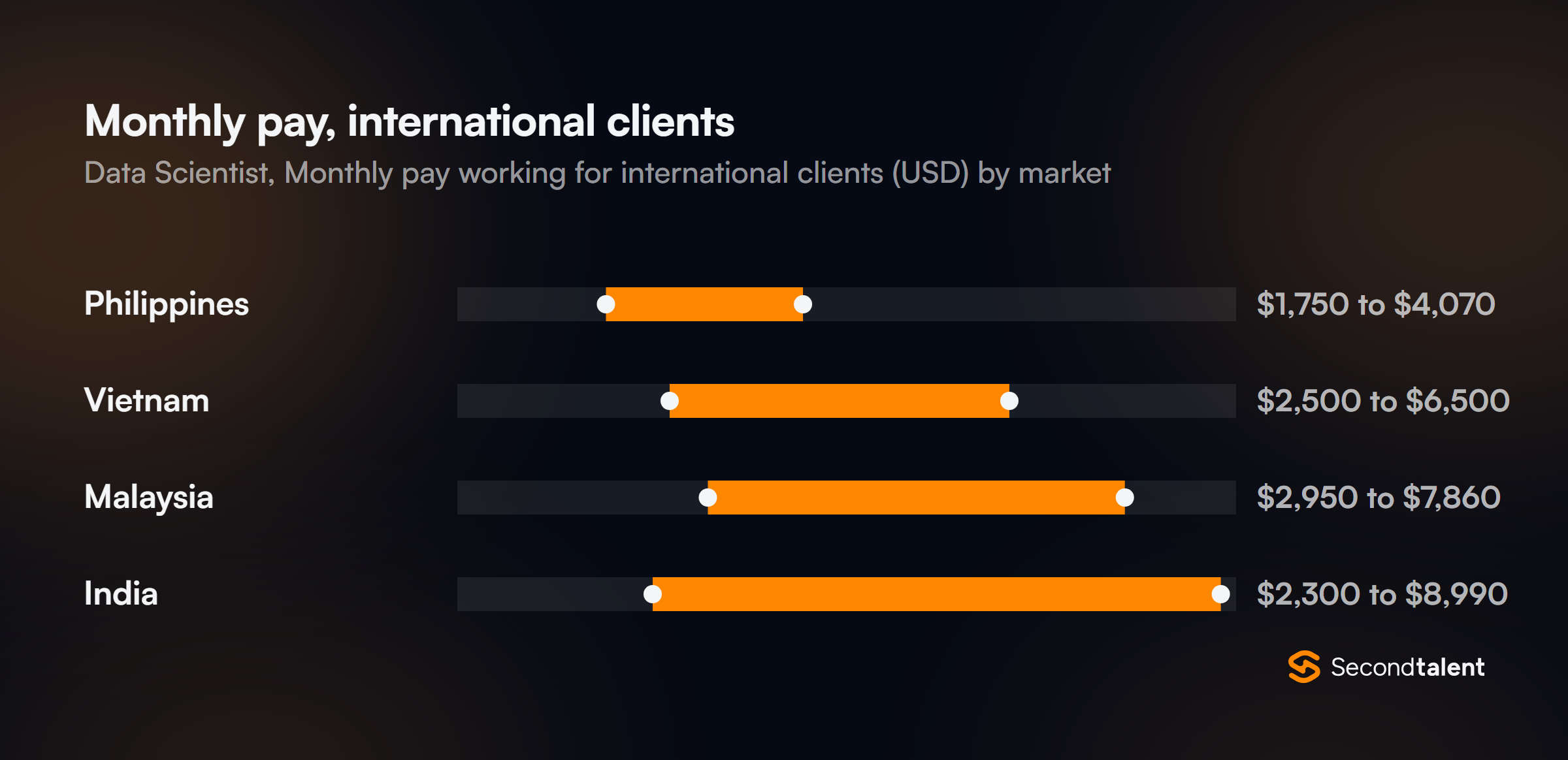
Monthly ranges from the Remote (Working for International Clients) figures on our rate cards for India, the Philippines, Vietnam and Malaysia, converted at ExchangeRate-API mid-market rates for 14 September 2026.
The India card quotes ₹220,000 to ₹860,000+ a month. If the hire will train and serve models more than analyse them, compare our India machine learning engineer card, which runs from $2,410 to $9,410+.
Through Second Talent you pay one monthly fee that bundles salary, payroll taxes, statutory contributions and our service fee, quoted per role and market. Our pricing page explains the monthly subscription.
Mid-level US freelance data scientists cost $92 to $145 an hour on our data scientist cost-to-hire page, the reference point for a fixed-scope project.
US Pay Benchmark for Data Scientists
BLS publishes a Data Scientists occupation (15-2051), so the role maps to it with no stand-in title.
| BLS OEWS, May 2025, national |
Data Scientists (15-2051) |
| Median annual |
$120,230 |
| 10th percentile, monthly |
$5,600 |
| 25th percentile, monthly |
$7,140 |
| Median, monthly |
$10,020 |
| 75th percentile, monthly |
$13,240 |
| 90th percentile, monthly |
$16,590 |
Monthly figures are the annual wages on the OEWS profile for 15-2051 divided by 12, rounded to the nearest $10.
The US 90th percentile is close to three times the 10th, so decide which end of the occupation your hire replaces before you compare.
Salary is only part of the US cost. In the BLS Employer Costs for Employee Compensation release for June 2026, wages and salaries made up 68.5% of employer compensation costs for full-time private industry workers, and benefits the other 31.5%.
Time Zone Overlap: Bengaluru Against ET, CT and PT
A Bengaluru data scientist who starts at 9:30 am starts at midnight in New York, so a weekly forecast can refresh and pass a review before your planning meeting. India keeps UTC+5:30 with no daylight saving, and US daylight time runs from 8 March to 1 November 2026, per NIST.
The arithmetic: 9:00 am in San Francisco is 16:00 UTC under PDT (UTC-7), which is 9:30 pm in Bengaluru. Under PST (UTC-8) it is 10:30 pm. New York's 9:00 am lands at 6:30 pm in summer and Chicago's at 7:30 pm.
| Bengaluru shift (UTC+5:30) |
ET overlap (EDT / EST) |
CT overlap (CDT / CST) |
PT overlap (PDT / PST) |
Hours between 10 pm and 6 am |
| 9:30 am-6:30 pm |
0 / 0 |
0 / 0 |
0 / 0 |
0 |
| 12:30 pm-9:30 pm |
3 / 2 |
2 / 1 |
0 / 0 |
0 |
| 3:30 pm-12:30 am |
6 / 5 |
5 / 4 |
3 / 2 |
2.5 |
| 5:30 pm-2:30 am |
8 / 7 |
7 / 6 |
5 / 4 |
4.5 |
Each shift is nine clock hours with a meal break, counted against a 9 am to 5 pm US day.
Experiment readouts need a live conversation more than model training does. The 12:30 pm row gives an East Coast product team three hours in summer, enough for a weekly review. A West Coast team gets overlap only from the two later rows.
We fix the shift before the offer, which is how our placements get 4-6 hours of daily overlap with US hours.
Data Scientist Skills to Screen For
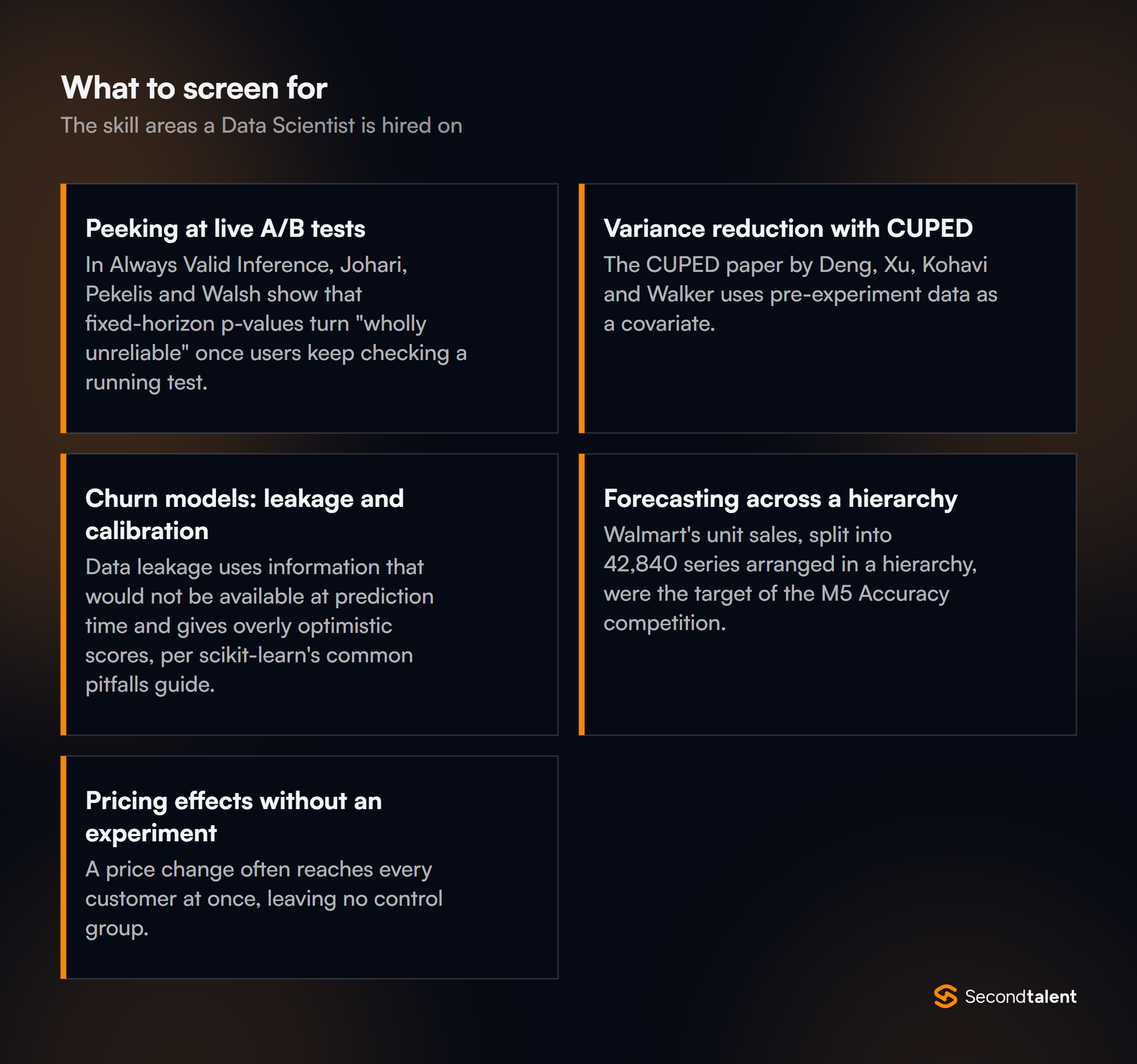
Most online experiments end flat or negative, the Microsoft team behind CUPED notes, citing earlier studies. Screen for the data scientist who writes a losing test up as a loss instead of hunting for a segment that clears significance.
Peeking at live A/B tests
In Always Valid Inference, Johari, Pekelis and Walsh show that fixed-horizon p-values turn "wholly unreliable" once users keep checking a running test. At 10,000 samples, the Type I error rate can rise fivefold. Your product manager wants a live dashboard on a test: ask the candidate what they would put behind it so the daily look does not manufacture winners.
Variance reduction with CUPED
The CUPED paper by Deng, Xu, Kohavi and Walker uses pre-experiment data as a covariate. On Bing it cut variance by about 50%, so a test reached the same power with half the traffic or in half the time. Give the candidate a checkout test on a skewed revenue metric and ask which pre-period covariate they would choose.
Churn models: leakage and calibration
Data leakage uses information that would not be available at prediction time and gives overly optimistic scores, per scikit-learn's common pitfalls guide. Its calibration guide adds that of the samples a well calibrated classifier scores near 0.8, about 80% should belong to the positive class. Plant a cancellation-date feature in a churn dataset and ask the candidate to find it, then to check whether the scores can set a retention budget.
Forecasting across a hierarchy
Walmart's unit sales, split into 42,840 series arranged in a hierarchy, were the target of the M5 Accuracy competition. The organisers' results preprint found LightGBM behind most methods, and many teams could not pick their own best entry, likely misled by validation scores. Ask for the backtest design on the candidate's last forecast and how they reconciled item forecasts with the total.
Pricing effects without an experiment
A price change often reaches every customer at once, leaving no control group. DoWhy splits effect estimation into four steps (model, identify, estimate, refute), and its README names the refutation and falsification API as a key feature. Ask which refutation could have sunk the candidate's last pricing estimate, and whether they ran it.
Contractor or Employer of Record in India
Software is not one of the nine categories of commissioned work that can be "work made for hire" under 17 U.S.C. § 101, and a transfer must be in writing and signed under § 204(a).
Under India's Copyright Act, 1957, the author owns the work first, and section 17(c) passes that to the employer only for work made under a contract of service. A contractor's notebooks and model code stay theirs until a written, signed assignment under section 19.
That assignment defaults to five years if it names no term and to India if it names no territory. Rights left unused for a year lapse unless it says otherwise.
IRS Publication 515 says the place where services are performed determines the source of the income, so a data scientist in Bengaluru earns foreign-source income. A foreign individual gives the payer Form W-8BEN to certify foreign status.
India's Supreme Court, in Ram Singh v. Union Territory, Chandigarh, called control an important test of employment but not the sole one, and pointed to integration into the business. A data scientist who sits in your weekly metrics review and holds standing warehouse access scores high on integration.
India's Digital Personal Data Protection Act, 2023 lifts most of its duties, in section 17(1)(d), when a person based in India processes non-residents' personal data under a contract with a person outside India. The section 8(5) duty to take reasonable security safeguards still applies.
Our Employer of Record overview explains how an EOR employs a hire through its own local entity. This is a summary, not legal advice.
|
Independent contractor |
Employer of Record |
| Legal employer |
None; the data scientist invoices you |
The EOR's Indian entity |
| US paperwork |
Form W-8BEN from the data scientist |
Service agreement with the EOR |
| IP |
Section 19 assignment naming notebooks, features and trained models, with term and territory |
Employer first owner under section 17(c), passed on through your EOR agreement |
| Local labor law |
Employment finding if the data scientist is integrated into your team |
Indian employment and social security rules apply |
| Pay currency |
Agreed in the contract, often USD |
Local payroll in rupees run by the EOR |
English Level and Working Norms in India
EF's 2025 English Proficiency Index gives Indian R&D staff 592 and strategy and project management staff 572, per EF's India page. The national score is 484, 74th of 123 countries and regions against a global average of 488, with an IT job-function score of 487, and Bengaluru's city score is 569.
For this role, English is the test summary a product lead reads without opening the notebook. Ask finalists for three paragraphs on a test that lost: what the team tried, what the data showed, what to do next.
India's central government list for 2026, set by a DoPT office memorandum of 3 July 2025, puts Dussehra on Tuesday 20 October and Diwali on Sunday 8 November. Private employers publish their own lists, so collect the data scientist's leave plans before you schedule a quarterly readout.
Thanksgiving on 26 November 2026 is a working day in India, so a data scientist there can close the November sales readout while your US team is off.
Data Scientist Hiring Process in India
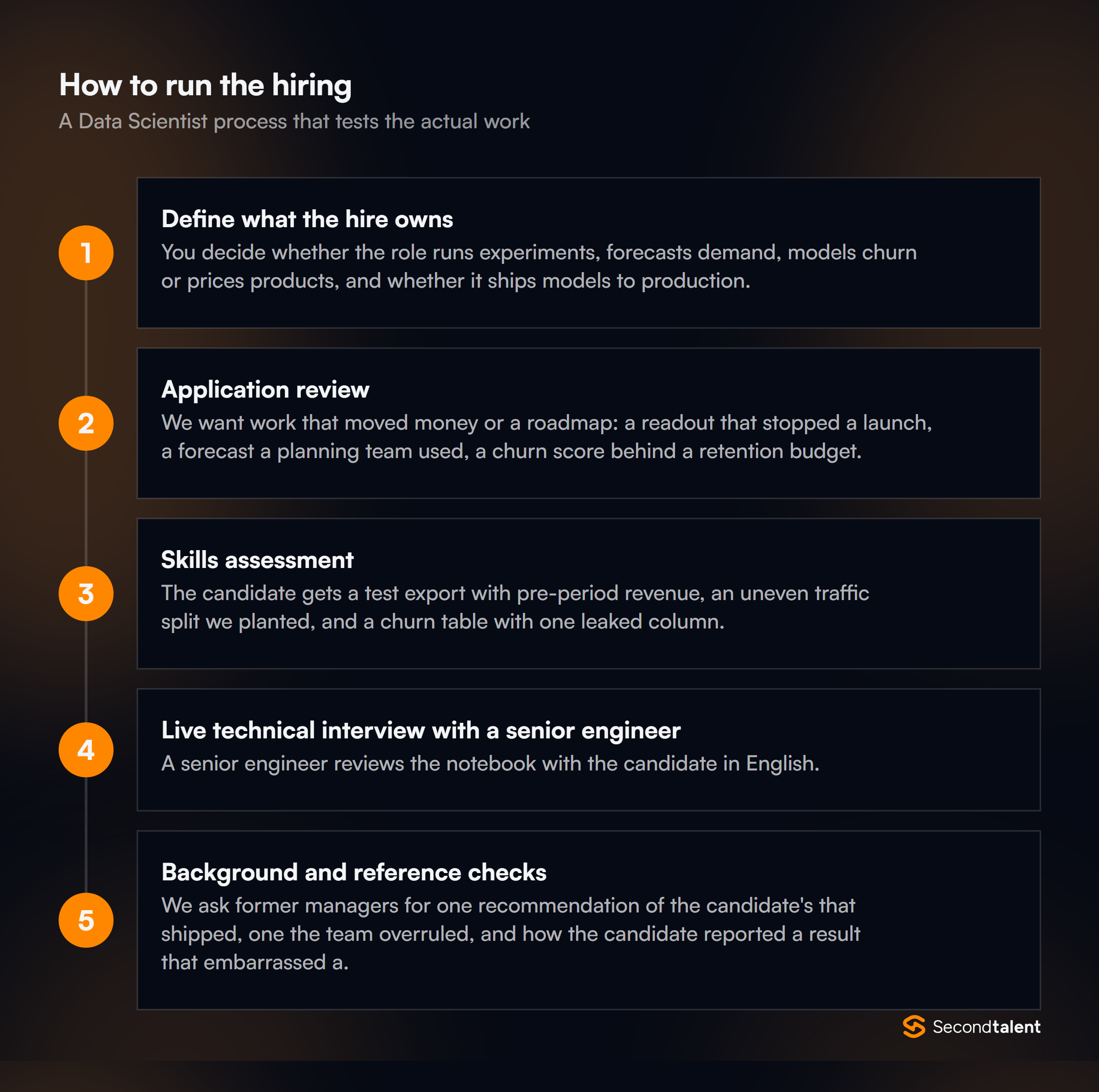
Second Talent's vetting covers stages 2 to 5 before you see a profile.
Stage 1: Define what the hire owns
You decide whether the role runs experiments, forecasts demand, models churn or prices products, and whether it ships models to production. Name the warehouse, the notebook platform, such as Databricks, and the decisions the work feeds.
Stage 2: Application review
We want work that moved money or a roadmap: a readout that stopped a launch, a forecast a planning team used, a churn score behind a retention budget. Each claim comes with its metric and sample size. A course certificate alone does not pass.
Stage 3: Skills assessment
The candidate gets a test export with pre-period revenue, an uneven traffic split we planted, and a churn table with one leaked column. They write up the test result and the churn model's calibration.
Stage 4: Live technical interview with a senior engineer
A senior engineer reviews the notebook with the candidate in English. The questions cover when to stop a test, how to estimate a price effect with no randomisation and how to validate a forecast.
Stage 5: Background and reference checks
We ask former managers for one recommendation of the candidate's that shipped, one the team overruled, and how the candidate reported a result that embarrassed a stakeholder. You then choose the contractor or EOR route above.
Hire Data Scientists from India with Second Talent
We shortlist 6-8 candidates within 24 hours from 100,000+ pre-vetted engineers, accepting only the top 1% of applicants. Data scientists from India come with $0 upfront, no lock-in and 4-6 hours of daily overlap with US hours. We handle contracts, payroll and equipment.
Our pricing page covers the subscription, and for the pipelines under your models we also staff data engineers in India.