TL;DR: Mobile app developers in India earn $1,880 to $7,530+ a month working for international clients on our Android developer rate card, the highest ceiling of five markets compared. The closest US benchmark, the BLS median for software developers, was $135,980 a year in May 2025.
StatCounter put Android on 92.77% of India's mobile web traffic in August 2026, while iOS led the United States at 60.71%. A mobile developer from India learned the trade in an Android market. If your US revenue runs on iPhones, test iOS depth on its own.
Key takeaways
- iOS rose from 4.53% to 7.17% of India's mobile web traffic between August 2025 and August 2026.
- Google Play requires new apps and updates to target Android 16 (API level 36) from 31 August 2026, with extensions available to 1 November.
- Apps that let users in India pay through an alternative billing system pay Google a service fee reduced by 4% on those purchases.
- A 2 pm to 11 pm shift in Bengaluru covers a New York team's first four and a half hours while US daylight time lasts.
What Mobile App Developers Earn in India Working for International Clients
India's ceiling of $7,530+ is more than double the Philippines' $3,350+, and its floor sits $30 below the Philippine floor.
We publish no mobile app developer card for India, so the India row uses our Android developer card, the closest match. The other rows use mobile app developer cards. The figures are what developers in each market earn working directly for foreign companies, before any employer or platform costs.
| Market |
Monthly pay working for international clients (USD) |
| India |
$1,880-$7,530+ |
| Indonesia |
$1,130-$2,550+ |
| Philippines |
$1,910-$3,350+ |
| Malaysia |
$2,460-$4,910+ |
| Vietnam |
$2,500-$6,500+ |
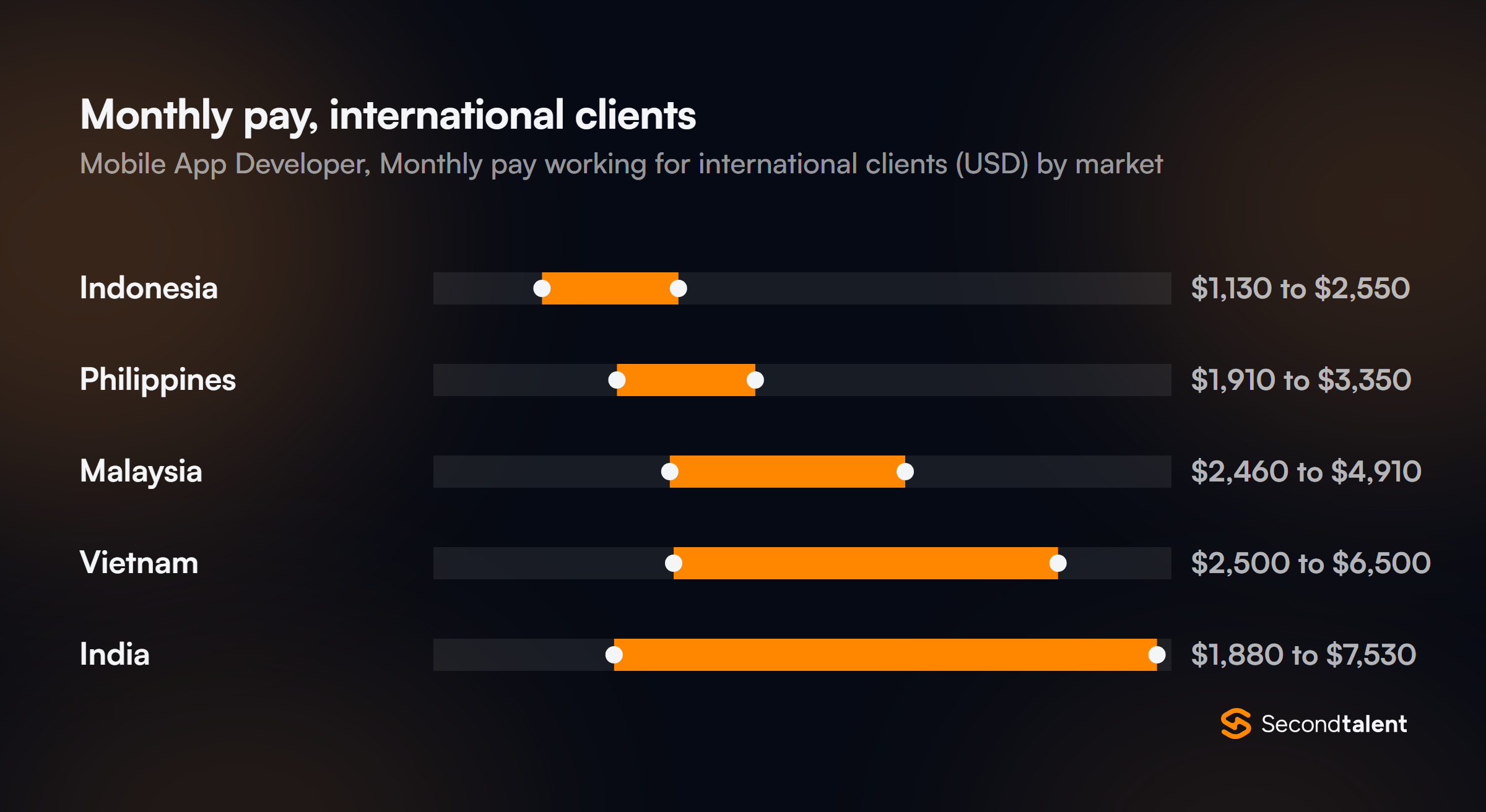
Monthly ranges from the Remote (Working for International Clients) figures on our rate cards for India, Indonesia, the Philippines, Malaysia and Vietnam, converted at ExchangeRate-API mid-market rates for 14 September 2026.
The India Android card quotes ₹180,000 to ₹720,000+ a month, at ₹95.61 to the dollar. Two other India cards cover the same hire from different angles. Our India iOS developer card runs $2,090 to $8,050+, and our India Flutter developer card runs $1,880 to $7,010+.
The iOS card sits above the Android card at both ends, by $210 at the floor and $520 at the top.
Through Second Talent you pay one monthly fee that bundles salary, payroll taxes, statutory contributions and our service fee, quoted per role and market. Our pricing page explains the subscription, and our mobile app developer cost-to-hire page sets out US freelance rates for a contract build.
US Pay Benchmark for Mobile App Developers
India's Android ceiling of $7,530+ sits between the US 10th and 25th percentiles for software developers. BLS has no mobile developer occupation, so the role maps to Software Developers (15-1252), which covers engineers who design and build applications whether they ship in Swift, Kotlin or Dart.
| BLS OEWS, May 2025, national |
Software Developers (15-1252) |
| Median annual |
$135,980 |
| 10th percentile, monthly |
$6,870 |
| 25th percentile, monthly |
$8,770 |
| Median, monthly |
$11,330 |
| 75th percentile, monthly |
$14,330 |
| 90th percentile, monthly |
$17,890 |
Monthly figures are the annual wages on the OEWS profile for 15-1252 divided by 12, rounded to the nearest $10.
Salary is only part of the US cost. In the BLS Employer Costs for Employee Compensation release for June 2026, wages and salaries made up 68.5% of employer compensation costs for full-time private industry workers, and benefits the other 31.5%.
Time Zone Overlap: Bengaluru Against ET, CT and PT
A staged rollout your team starts at 10 am in New York begins at 7:30 pm Bengaluru time while US daylight time lasts, so a developer on a late shift sees the first crash reports. India keeps UTC+5:30 all year, and US daylight time runs from 8 March to 1 November 2026, per NIST.
For Los Angeles, the arithmetic runs: 9:00 am under PDT (UTC-7) is 16:00 UTC, which is 9:30 pm in Bengaluru. Under PST (UTC-8) it is 10:30 pm.
| Bengaluru shift (UTC+5:30) |
ET overlap (EDT / EST) |
CT overlap (CDT / CST) |
PT overlap (PDT / PST) |
Hours after 10 pm |
| 9:30 am-6:30 pm |
0 / 0 |
0 / 0 |
0 / 0 |
0 |
| 1 pm-10 pm |
3.5 / 2.5 |
2.5 / 1.5 |
0.5 / 0 |
0 |
| 2 pm-11 pm |
4.5 / 3.5 |
3.5 / 2.5 |
1.5 / 0.5 |
1 |
| 3 pm-12 am |
5.5 / 4.5 |
4.5 / 3.5 |
2.5 / 1.5 |
2 |
Each shift counts nine clock hours with a meal break against a 9 am to 5 pm US day.
Mobile work splits well across the gap. Builds, UI tests on device farms and store submissions run in the Indian day, and the shared hours cover design reviews and release calls. Pacific teams get two and a half hours at most from these rows, so keep release decisions in writing.
India's Labour Codes, in force since 21 November 2025, let women work night shifts with their consent and mandatory safety measures, so agree transport and security for any shift past 10 pm. We fix the shift before the offer, which is how our placements get 4-6 hours of daily overlap with US hours.
Mobile App Developer Skills to Screen For
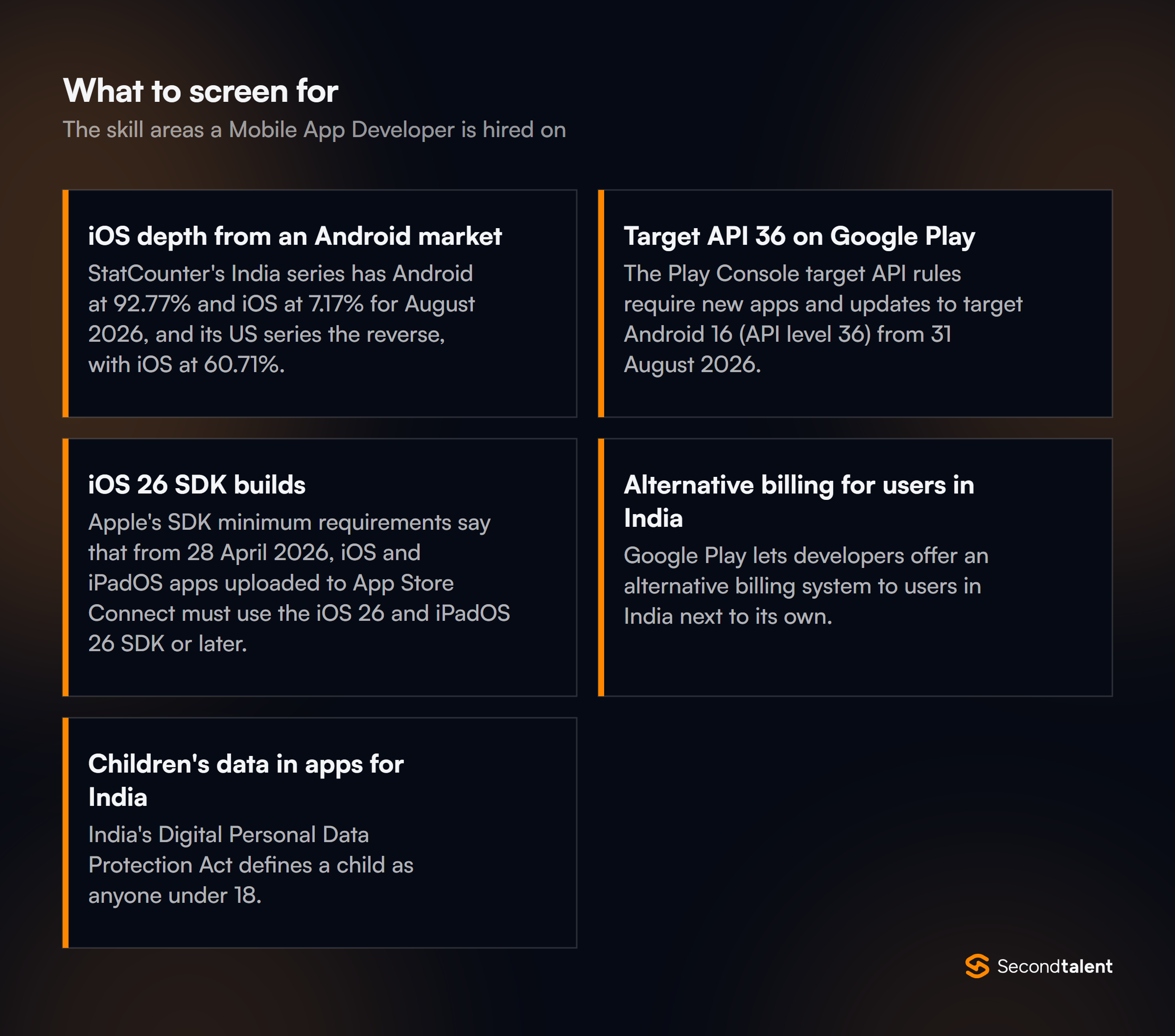
Two store deadlines fell in 2026: Apple's SDK floor on 28 April and Google Play's target API floor on 31 August. A developer who shipped through both can tell you what each one broke.
iOS depth from an Android market
StatCounter's India series has Android at 92.77% and iOS at 7.17% for August 2026, and its US series the reverse, with iOS at 60.71%. Ask for App Store history on its own, apart from Play Store work. Then set a SwiftUI task with background refresh and push notifications, even if the CV lists Swift.
Target API 36 on Google Play
The Play Console target API rules require new apps and updates to target Android 16 (API level 36) from 31 August 2026. Existing apps must target Android 15 (API level 35) to stay available to new users on newer devices. Extensions run to 1 November 2026. Ask what the candidate changed on their last target SDK bump and which test caught the regression.
iOS 26 SDK builds
Apple's SDK minimum requirements say that from 28 April 2026, iOS and iPadOS apps uploaded to App Store Connect must use the iOS 26 and iPadOS 26 SDK or later. A CI pipeline pinned to an older SDK cannot upload a build. Ask the candidate to walk through how their build machines pick an SDK version, and who updates them.
Alternative billing for users in India
Google Play lets developers offer an alternative billing system to users in India next to its own. The service fee drops by 4% on purchases users make that way. The developer must report those transactions to Google Play within 24 hours through the alternative billing APIs. Ask how the candidate would add a second payment path without breaking subscription state, and how they would test the 24-hour reporting.
Children's data in apps for India
India's Digital Personal Data Protection Act defines a child as anyone under 18. Section 9 requires verifiable parental consent before processing a child's personal data and bars tracking, behavioural monitoring and targeted advertising directed at children. The Act reaches apps outside India that serve users in India (section 3).
Ask the candidate to audit the analytics and ad SDKs in a sample app and list what would switch off for a user under 18.
Contractor or Employer of Record in India
Software is not one of the nine categories of commissioned work that can be "work made for hire" under 17 U.S.C. § 101, and a transfer must be in writing and signed under § 204(a).
India's Copyright Act gives the same result for app code. Under section 17(c), an employer owns work made under a contract of service by default, and a contractor owns what they write. A contractor's transfer needs a signed, written assignment under section 19.
Without a stated term the law reads five years, and without a territory it reads India only. Unused rights lapse after a year unless the deed says otherwise. List source code, store listing assets and design files.
IRS Publication 515 says the place where services are performed determines the source of the income, so a developer building your app from Hyderabad earns foreign-source income. A foreign individual gives the payer Form W-8BEN to certify foreign status.
India's Supreme Court looks at the whole relationship. In Sushilaben Indravadan Gandhi v. New India Assurance (2020), it treated control, integration into the business and ownership of the tools as factors to weigh together, with no single test deciding. A developer on your sprint board, releasing under your developer accounts, sits on the employment side of most of them.
An Employer of Record with an Indian entity can employ that developer instead. This is a summary, not legal advice.
|
Independent contractor |
Employer of Record |
| Legal employer |
None; the developer invoices you |
The EOR's Indian entity |
| US paperwork |
Form W-8BEN from the developer |
Service agreement with the EOR |
| IP |
Signed section 19 assignment of code and store assets, with territory and term stated |
Employer first owner under section 17(c), passed to you in the EOR agreement |
| Local labor law |
Employment finding if the facts, weighed together, point to service |
Labour Codes apply, including appointment letters and consent for women on night shifts |
| Pay currency |
Agreed in the contract, often USD |
Local payroll run by the EOR |
Keep store accounts, signing certificates and keystores in your company's name on either route, and grant the developer access rather than ownership.
English Level and Working Norms in India
Hyderabad scores 554 on the EF English Proficiency Index 2025 and Chennai 534, both above India's national score of 484. India ranks 74th of 123 countries and regions against a global average of 488, and its IT job-function score is 487, per EF's India page. Speaking sits at 500 and listening at 457.
App Store review replies, release notes and crash write-ups all go out in written English. Ask finalists to answer a sample App Review rejection in writing before the live call.
India's central government holiday list for 2026 puts Diwali on Sunday 8 November, Guru Nanak's Birthday on Tuesday 24 November and Christmas on Friday 25 December. Private employers set their own lists, so agree dates in the contract and plan store submissions around them.
Thanksgiving on 26 November 2026 is a working day in India, so a developer there can watch a release while your US team is off.
Mobile App Developer Hiring Process in India
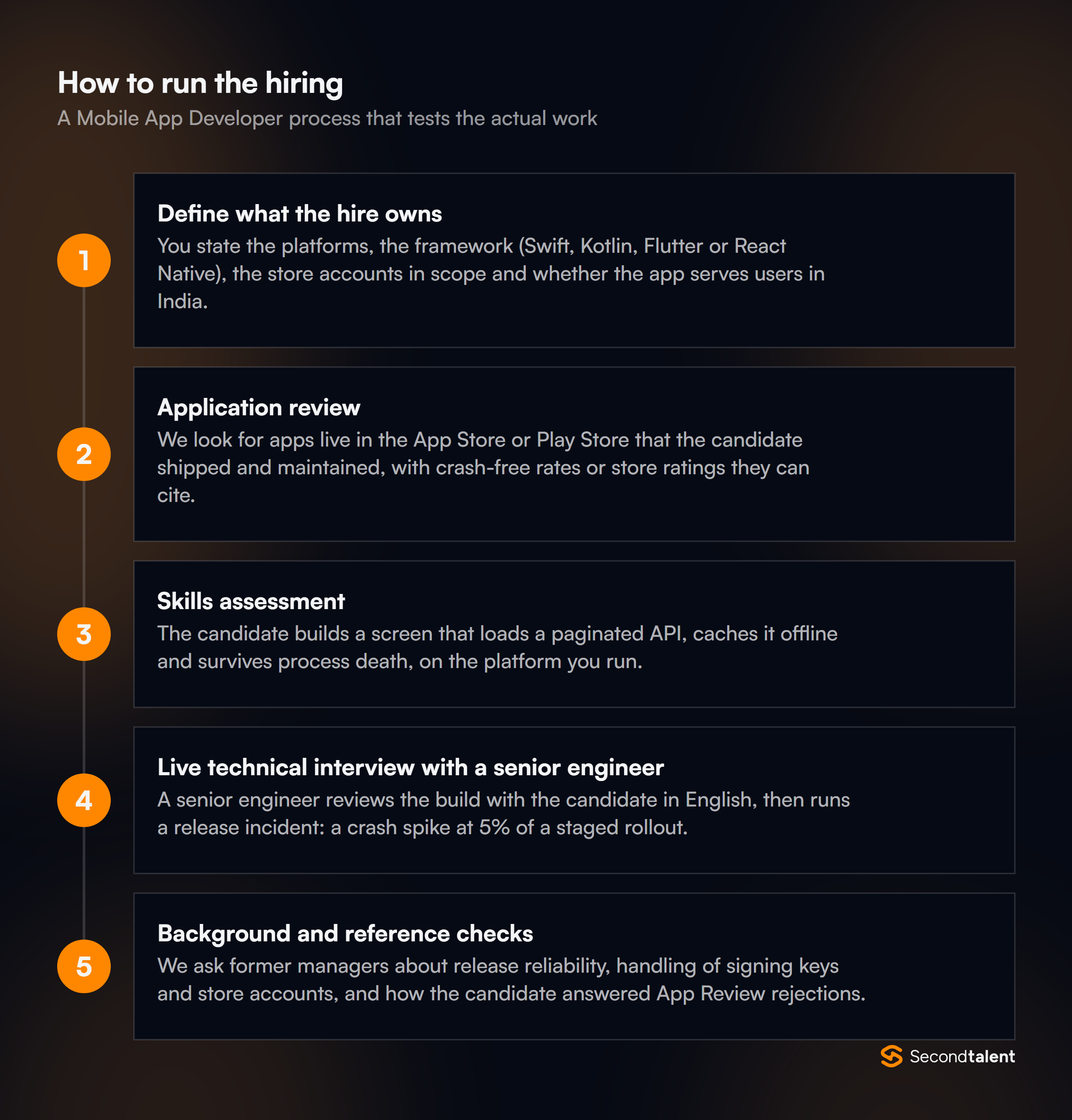
Second Talent's vetting covers stages 2 to 5 before you see a profile.
Stage 1: Define what the hire owns
You state the platforms, the framework (Swift, Kotlin, Flutter or React Native), the store accounts in scope and whether the app serves users in India. Add the release cadence and the Bengaluru shift from the table above.
Stage 2: Application review
We look for apps live in the App Store or Play Store that the candidate shipped and maintained, with crash-free rates or store ratings they can cite. We flag Android-only histories when the brief needs iOS.
Stage 3: Skills assessment
The candidate builds a screen that loads a paginated API, caches it offline and survives process death, on the platform you run. We add a target SDK bump and score what they test after it.
Stage 4: Live technical interview with a senior engineer
A senior engineer reviews the build with the candidate in English, then runs a release incident: a crash spike at 5% of a staged rollout. The candidate decides between halt, fix and rollback.
Stage 5: Background and reference checks
We ask former managers about release reliability, handling of signing keys and store accounts, and how the candidate answered App Review rejections. You then choose the contractor or EOR route above.
Hire Mobile App Developers from India with Second Talent
We shortlist 6-8 candidates within 24 hours from 100,000+ pre-vetted engineers, accepting only the top 1% of applicants. Mobile app developers from India come with $0 upfront, no lock-in and 4-6 hours of daily overlap with US hours. We handle contracts, payroll and equipment.
Our pricing page sets out the monthly subscription, and for a single-framework build we also staff Flutter developers.