TL;DR: Full-stack developers in India earn $1,880 to $7,530+ a month working for international clients on our Node.js rate card, the highest ceiling of five markets, and we shortlist 6-8 candidates within 24 hours. The closest US benchmark, the BLS median for software developers, was $135,980 a year in May 2025.
India added over 5.2 million developers to GitHub in 2025, more than any other country, and now has the largest open source contributor base, per GitHub's Octoverse. Ask a full-stack candidate from India for a public pull request before the first call.
Key takeaways
- Mid-level freelance full-stack developers in India bill $20 to $52 an hour on our cost-to-hire page, the cheapest of the ten markets it covers.
- Next.js 16 replaced middleware.ts with proxy.ts and requires Node.js 20.9 or later, and Node.js 20 itself reached end of life on 30 April 2026.
- India's data protection act lifts most duties when someone in India processes data on users outside India under a contract with a foreign company, but the security safeguards duty stays.
- A 1:30 pm to 10:30 pm shift in Bengaluru gives a New York team four live hours in September.
What Full-Stack Developers Earn in India Working for International Clients
India's open top of $7,530+ sits above Vietnam's $7,000+, while its floor falls between Malaysia's and the Philippines'. The figures are what developers in each market earn working directly for foreign companies, before any employer or platform costs.
| Market |
Monthly pay working for international clients (USD) |
| India |
$1,880-$7,530+ |
| Indonesia |
$850-$2,270+ |
| Philippines |
$1,600-$3,350+ |
| Malaysia |
$2,090-$5,040+ |
| Vietnam |
$3,000-$7,000+ |
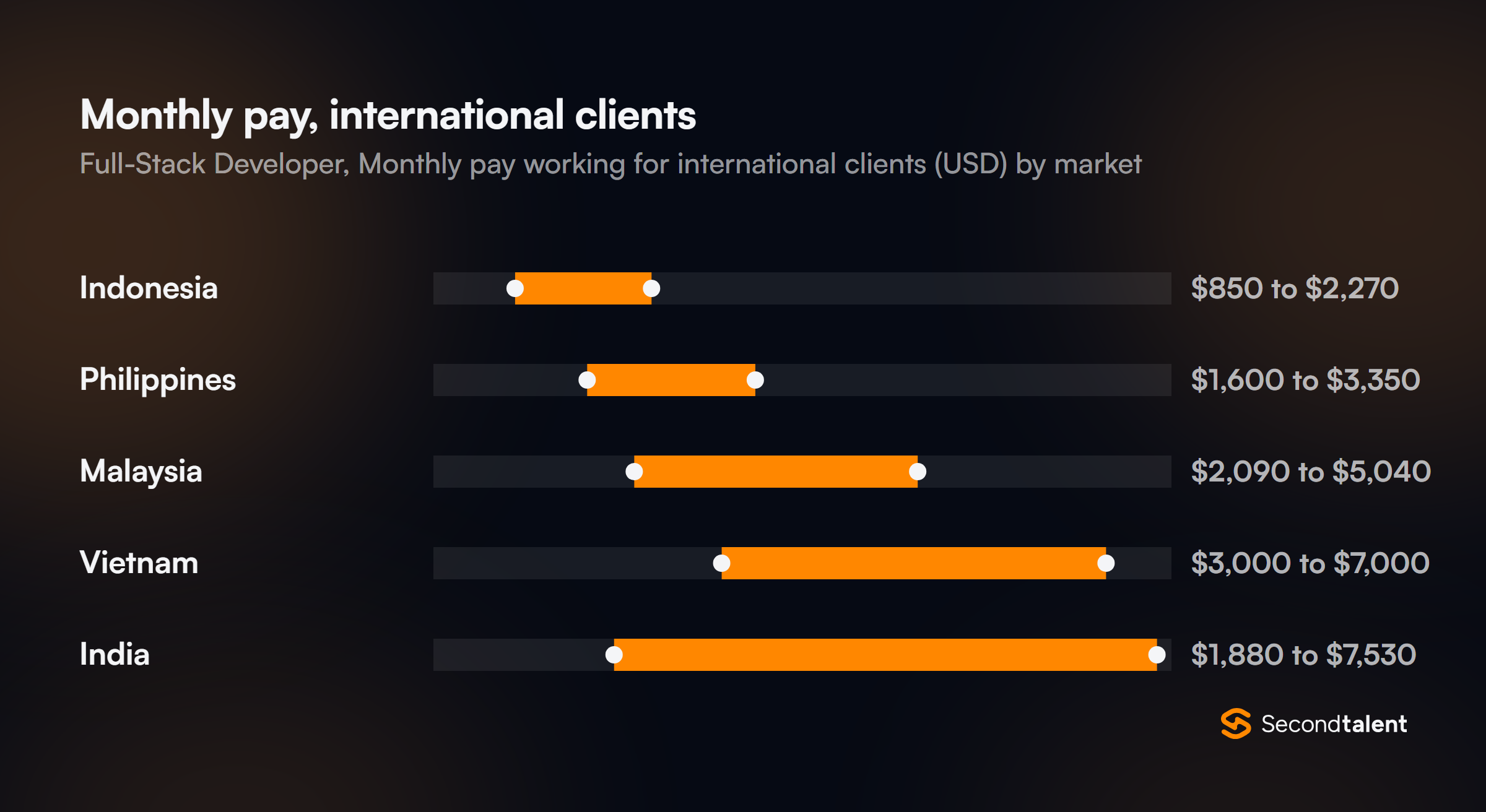
Monthly ranges from the Remote (Working for International Clients) figures on our rate cards for India, Indonesia, the Philippines, Malaysia and Vietnam, converted at ExchangeRate-API mid-market rates for 14 September 2026.
We publish no full-stack card for India, so the India row uses our Node.js developer rate card, the closest match for a JavaScript stack. It quotes ₹180,000 to ₹720,000+ a month, and our React developer card for India quotes the same range. The other four rows come from full-stack cards, and the Vietnam card publishes US dollars, so it needs no conversion.
A range this wide rewards a precise brief. Say whether the hire owns the database and deploys or spends most of the week building screens against an API someone else runs.
Through Second Talent you pay one monthly fee that bundles salary, payroll taxes, statutory contributions and our service fee, quoted per role and market. Our pricing page explains the monthly subscription.
US Pay Benchmark for Full-Stack Developers
Full-stack developers map to Software Developers (SOC 15-1252), because the job is designing and building application software from the schema to the interface.
| BLS OEWS, May 2025, national |
Software Developers (15-1252) |
| Median annual |
$135,980 |
| 10th percentile, monthly |
$6,870 |
| 25th percentile, monthly |
$8,770 |
| Median, monthly |
$11,330 |
| 75th percentile, monthly |
$14,330 |
| 90th percentile, monthly |
$17,890 |
Monthly figures are the annual wages on the OEWS profile for 15-1252 divided by 12, rounded to the nearest $10.
Salary is only part of the US cost. In the BLS Employer Costs for Employee Compensation release for June 2026, wages and salaries made up 68.5% of employer compensation costs for full-time private industry workers, and benefits the other 31.5%.
For the contract route, our full-stack developer cost-to-hire page puts a mid-level US freelancer at $85 to $135 an hour, against the India figure in the takeaways above.
Time Zone Overlap: Bengaluru Against ET, CT and PT
Code review is where time zones cost a full-stack team most: a pull request opened at the end of a Bengaluru day waits for a US reviewer, and the reply lands after the author has logged off. Bengaluru keeps UTC+5:30 all year, and US clocks stay on daylight time from 8 March to 1 November 2026, per NIST.
The arithmetic: 9:00 am in New York under EDT (UTC-4) is 13:00 UTC, which is 6:30 pm in Bengaluru. After 1 November, under EST (UTC-5), the same meeting starts at 7:30 pm there.
| Bengaluru shift (UTC+5:30) |
ET overlap (EDT / EST) |
CT overlap (CDT / CST) |
PT overlap (PDT / PST) |
Hours after 7 pm |
| 9:30 am-6:30 pm |
0 / 0 |
0 / 0 |
0 / 0 |
0 |
| 1:30 pm-10:30 pm |
4 / 3 |
3 / 2 |
1 / 0 |
3.5 |
| 3:30 pm-12:30 am |
6 / 5 |
5 / 4 |
3 / 2 |
5.5 |
| 6:30 pm-3:30 am |
8 / 8 |
8 / 7 |
6 / 5 |
8.5 |
Each shift is nine clock hours with a meal break, counted against a 9 am to 5 pm US day.
For an East Coast team, the 1:30 pm row covers standup and a review pass each day. A West Coast team needs the 3:30 pm row to get three shared hours in summer.
The other West Coast option keeps the developer on a day shift and moves review into writing. Pull requests opened by 6:30 pm Bengaluru time are waiting when San Francisco signs in.
The last column counts hours that need consent from women employees. Under Section 43 of India's Occupational Safety, Health and Working Conditions Code, women may work before 6 am and after 7 pm with their consent, and the government's OSH Code factsheet adds that the employer arranges safety, facilities and transport.
We set the shift before the offer, which is how our placements get 4-6 hours of daily overlap with US hours.
Full-Stack Developer Skills to Screen For
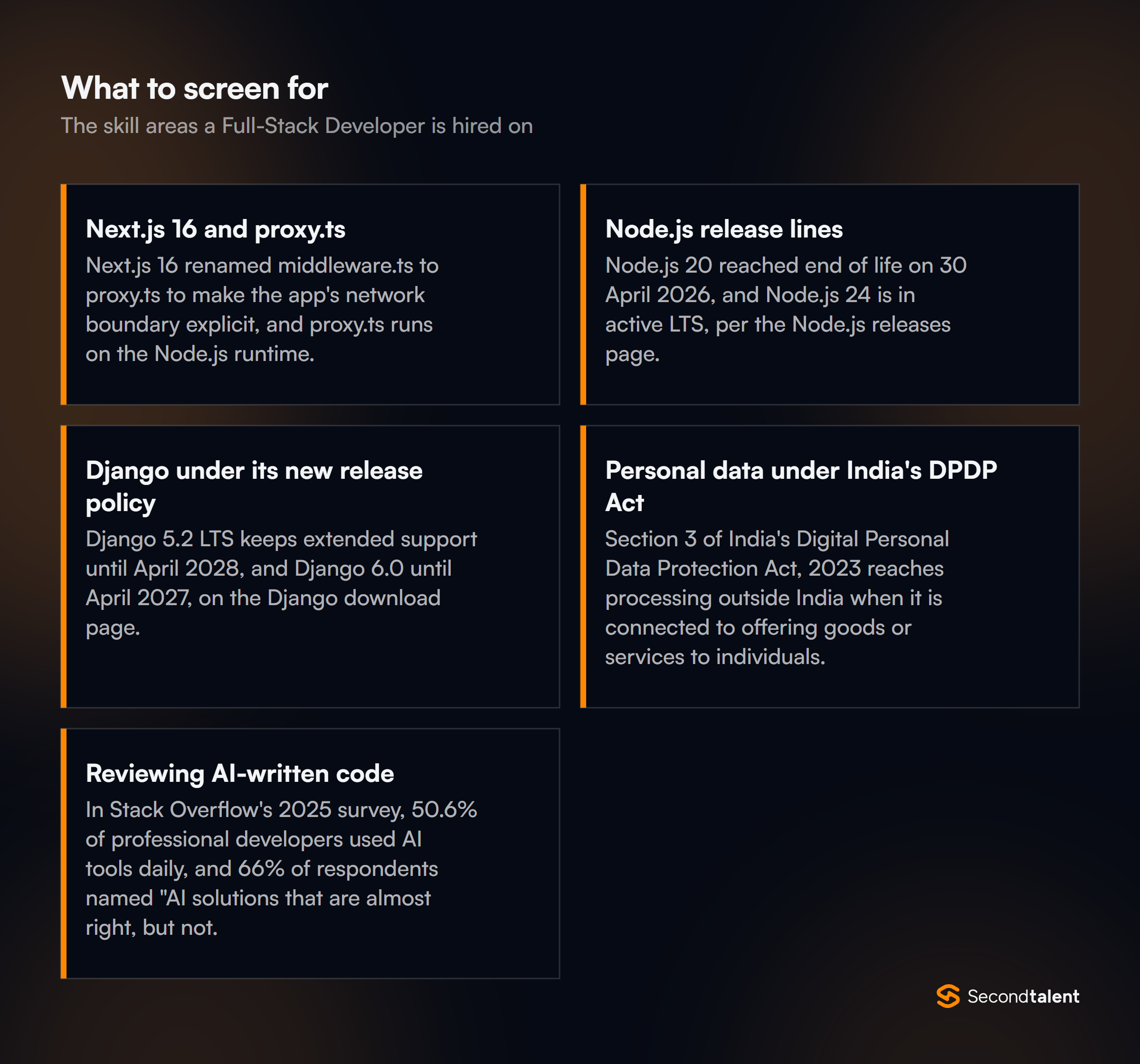
Next.js 16, released on 21 October 2025, made Turbopack the default bundler for all apps, per the Next.js team's release post. Framework defaults move that fast, so screen for upgrade judgement along with the stack itself.
Next.js 16 and proxy.ts
Next.js 16 renamed middleware.ts to proxy.ts to make the app's network boundary explicit, and proxy.ts runs on the Node.js runtime. middleware.ts still works for Edge runtime cases, but the Next.js team has deprecated it. Ask the candidate which checks their last app ran in middleware, and which of those belonged in the route handler instead.
Node.js release lines
Node.js 20 reached end of life on 30 April 2026, and Node.js 24 is in active LTS, per the Node.js releases page. Node.js 26 moves to LTS on 28 October 2026. From Node.js 27 the project switches to one major release a year, and each major moves to LTS after its Current phase. Ask which runtime the candidate's last production service ran and what broke when it moved.
Django under its new release policy
Django 5.2 LTS keeps extended support until April 2028, and Django 6.0 until April 2027, on the Django download page. Django 6.2 is the last release under the old numbering. From Django 2028, feature releases come each January with three years of support apiece. For a Django and React hire, give the candidate a 5.2 project and ask for an upgrade plan that keeps the API contract with the front end stable.
Personal data under India's DPDP Act
Section 3 of India's Digital Personal Data Protection Act, 2023 reaches processing outside India when it is connected to offering goods or services to individuals in India. Section 17(1)(d) runs the other way. It lifts most of the Act's duties when a person based in India processes data on individuals outside India under a contract with someone outside India, but section 8(5) on reasonable security safeguards still applies.
The government's DPDP Rules backgrounder puts the top penalty, up to ₹250 crore, on failure to keep those safeguards. The government notified the Rules on 14 November 2025 and gave organisations eighteen months of phased compliance. Ask the candidate how they kept production records out of staging databases and error logs.
Reviewing AI-written code
In Stack Overflow's 2025 survey, 50.6% of professional developers used AI tools daily, and 66% of respondents named "AI solutions that are almost right, but not quite" as a frustration.
A full-stack pull request touches a migration, an endpoint and a component at once, so an almost-right change can pass review on the part the reviewer checks. Hand the candidate an AI-written change with an authorization gap in the endpoint and score whether they find it.
Contractor or Employer of Record in India
Software is not one of the nine categories of commissioned work that can be "work made for hire" under 17 U.S.C. § 101, and a transfer must be in writing and signed under § 204(a). IRS Publication 515 says the place where services are performed determines the source of the income, and a foreign individual gives the payer Form W-8BEN to certify foreign status.
Under section 17 of India's Copyright Act, 1957, the employer is first owner of work made under a contract of service. A contractor keeps the copyright in components, API routes and migrations until they sign a written assignment, which section 19 requires. That assignment should state its period and territory: without them, the Act deems it to last five years and to cover India only.
Status turns on the whole relationship. In Sushilaben Indravadan Gandhi v. New India Assurance (2020), the Supreme Court treated control as one in a series of factors and weighed full-time work, a bar on other work and the employer's conduct rules as signs of employment. A developer in your sprints, forty hours a week, with no other clients, shows those signs.
India's four Labour Codes have applied since 21 November 2025, with mandatory appointment letters and, for IT and ITES workers, salary paid by the 7th of each month. An Employer of Record with an Indian entity employs the developer under those rules. This is a summary, not legal advice.
|
Independent contractor |
Employer of Record |
| Legal employer |
None; the developer invoices you |
The EOR's Indian entity |
| US paperwork |
Form W-8BEN from the developer |
Service agreement with the EOR |
| IP |
Signed assignment of code, schemas and designs, with period and territory stated (section 19) |
Employer first owner under a contract of service (section 17), passed on through your EOR agreement |
| Local labor law |
Employment finding if the developer works full time under your rules |
Labour Codes apply, including appointment letters and salary by the 7th |
| Pay currency |
Agreed in the contract, often USD |
Local payroll run by the EOR |
English Level and Working Norms in India
Bengaluru scores 569 on the EF English Proficiency Index 2025, Hyderabad 554 and Pune 502, while India as a whole scores 484 and ranks 74th of 123 countries and regions. The global average is 488 and India's IT job-function score is 487, per EF's India page.
Full-stack work runs on written English, in tickets, pull request descriptions and product specs, and India's writing score of 504 is its highest skill score. Ask finalists to write the pull request description for their assessment, then ask a US product manager to review it without a call.
The Reserve Bank of India keeps separate holiday lists for Bengaluru, Chennai, Hyderabad, Mumbai, New Delhi and other cities, so ask for the developer's own list before planning a release. Thanksgiving on 26 November 2026 is a working day in India, so a developer there can ship fixes while your US team is off.
Full-Stack Developer Hiring Process in India
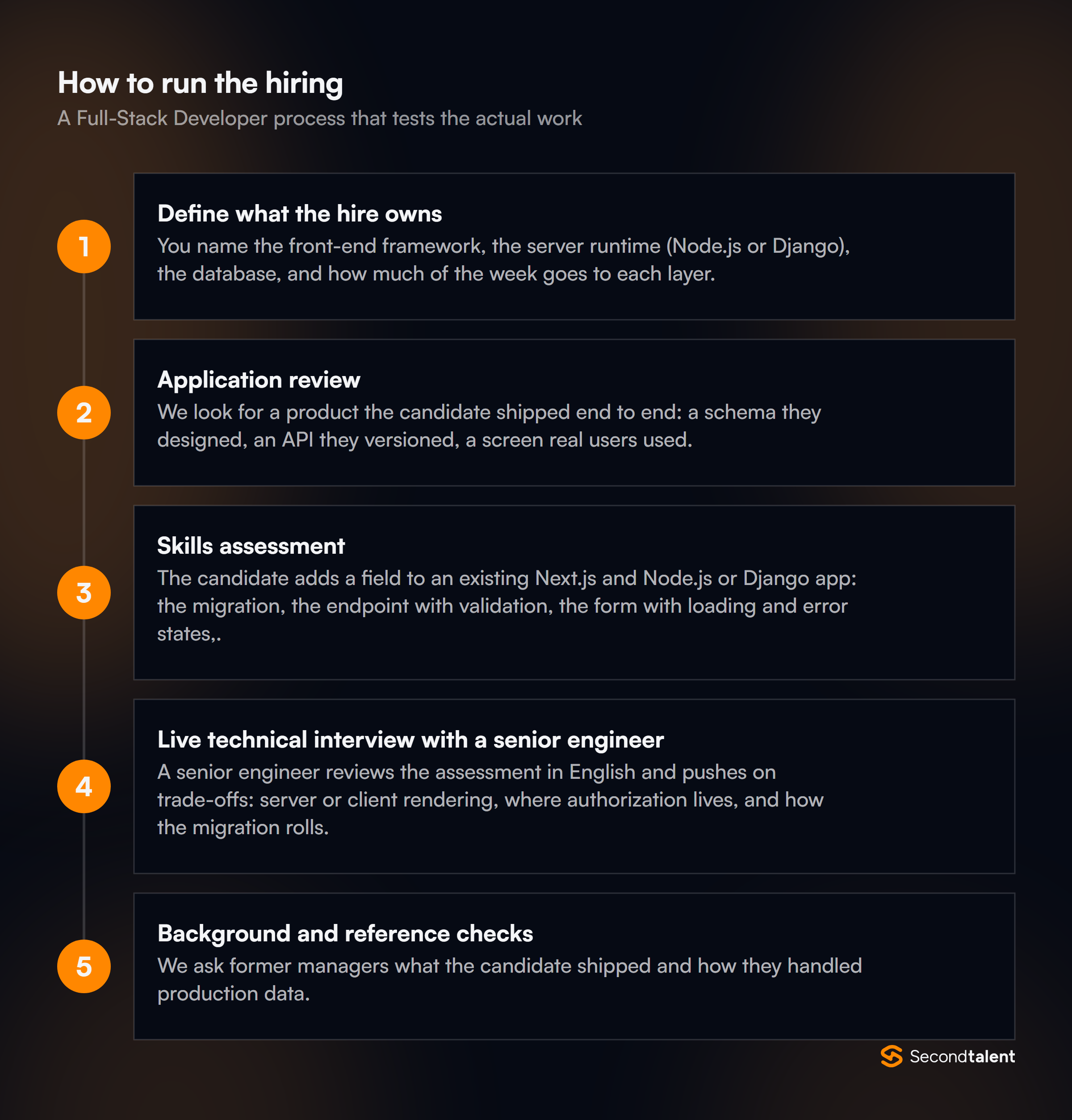
Second Talent's vetting covers stages 2 to 5 before you see a profile.
Stage 1: Define what the hire owns
You name the front-end framework, the server runtime (Node.js or Django), the database, and how much of the week goes to each layer. Add the shift from the table above and whether the developer touches personal data.
Stage 2: Application review
We look for a product the candidate shipped end to end: a schema they designed, an API they versioned, a screen real users used. Public pull requests on GitHub count when the candidate can walk through the review comments.
Stage 3: Skills assessment
The candidate adds a field to an existing Next.js and Node.js or Django app: the migration, the endpoint with validation, the form with loading and error states, and one test. We score the pull request description with the code.
Stage 4: Live technical interview with a senior engineer
A senior engineer reviews the assessment in English and pushes on trade-offs: server or client rendering, where authorization lives, and how the migration rolls back.
Stage 5: Background and reference checks
We ask former managers what the candidate shipped and how they handled production data. We also confirm the notice period in the candidate's current appointment letter, so your start date holds. You then choose the contractor or EOR route above.
Hire Full-Stack Developers from India with Second Talent
We shortlist 6-8 candidates within 24 hours from 100,000+ pre-vetted engineers, accepting only the top 1% of applicants. Full-stack developers from India come with $0 upfront, no lock-in and 4-6 hours of daily overlap with US hours. We handle contracts, payroll and equipment.
Our pricing page sets out the monthly subscription, and for API-heavy products we also staff back-end developers in India.