TL;DR: DevOps engineers in India earn $2,200 to $8,470+ a month working for international clients on our rate card, the lowest floor of five markets, and we shortlist 6-8 candidates within 24 hours. The closest US benchmark, the BLS median for computer network architects, was $134,050 a year in May 2025.
Indian companies must report listed cyber incidents to CERT-In within six hours and keep 180 days of system logs inside India, under 2022 directions. Ask a DevOps engineer from India what their last employer changed in its logging pipeline to comply.
Key takeaways
- Kubernetes 1.34 reaches end of life on 27 October 2026, so a new hire's first project may be a cluster upgrade.
- A Bengaluru shift from 9:30 am to 6:30 pm covers midnight to 9:00 am in New York while US daylight time lasts, which suits overnight on-call.
- Under India's Copyright Act, an assignment that names no period lasts five years and one that names no territory covers only India.
- India's four Labour Codes took effect on 21 November 2025, making appointment letters mandatory for every worker.
What DevOps Engineers Earn in India Working for International Clients
India's range is also the widest in the table: $6,270 from floor to open top, against $2,400 for the Philippines. The figures are what DevOps engineers in each market earn working directly for foreign companies, before any employer or platform costs.
| Market |
Monthly pay working for international clients (USD) |
| India |
$2,200-$8,470+ |
| Philippines |
$2,390-$4,790+ |
| Vietnam |
$3,090-$6,180+ |
| Malaysia |
$3,690-$7,370+ |
| Indonesia |
$4,540-$10,210+ |
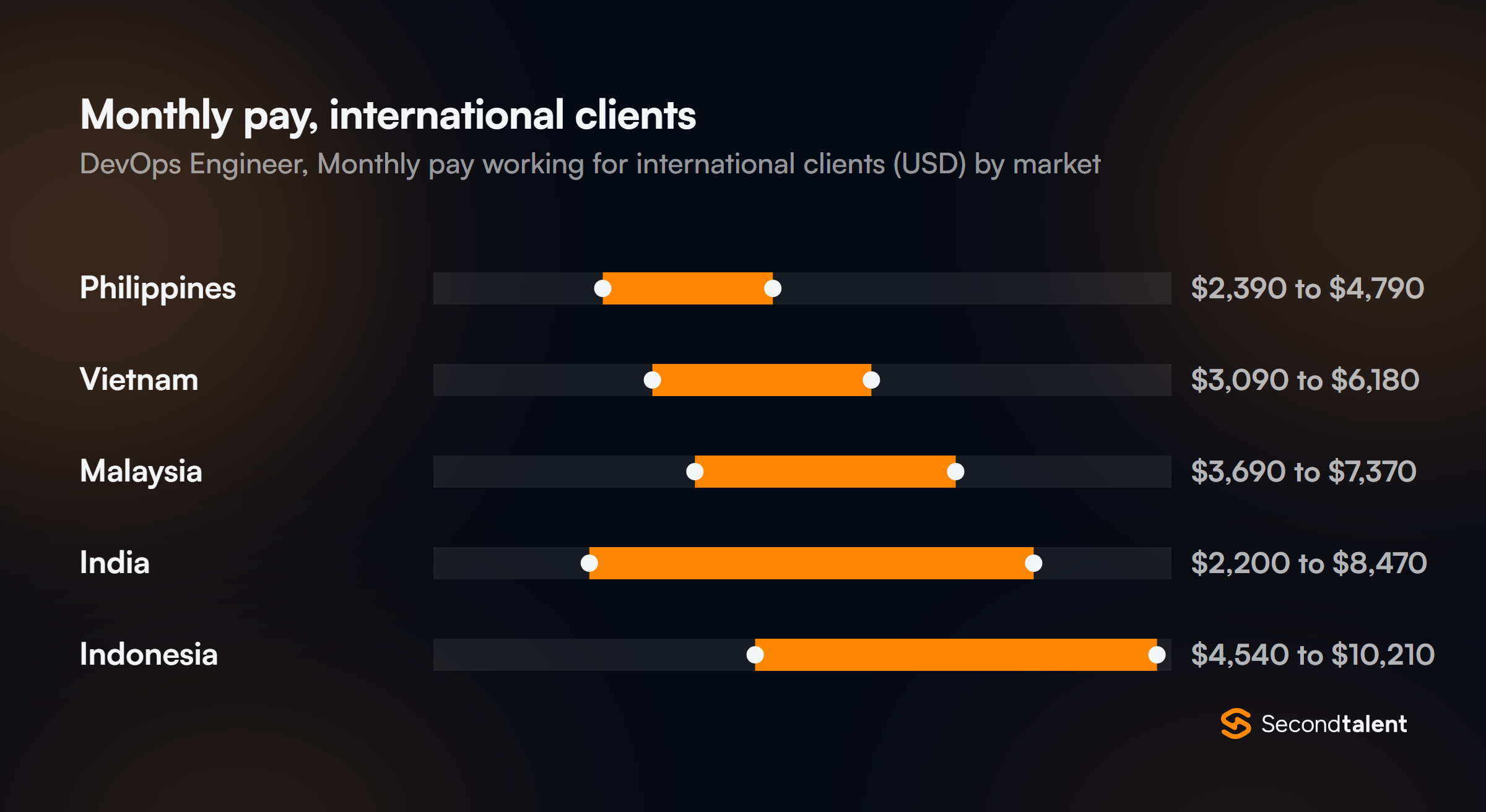
Monthly ranges from the Remote (Working for International Clients) figures on our rate cards for India, the Philippines, Vietnam, Malaysia and Indonesia, converted at ExchangeRate-API mid-market rates for 14 September 2026.
The India card quotes ₹210,000 to ₹810,000+ a month, converted at ₹95.61 to the dollar. Only Indonesia's card tops out higher. A wide spread means the brief sets the offer: an engineer who keeps Jenkins jobs green sits near the floor, while one who owns multi-account AWS design and the pager sits near the top.
Through Second Talent you pay one monthly fee that bundles salary, payroll taxes, statutory contributions and our service fee, quoted per role and market. Our pricing page explains the monthly subscription. For a hire based anywhere in Asia, our DevOps engineers page compares the wider pool.
US Pay Benchmark for DevOps Engineers
BLS has no DevOps occupation. The role maps to Computer Network Architects (15-1241), because a DevOps engineer designs the delivery and infrastructure systems software runs on, with Network and Computer Systems Administrators (15-1244) alongside for a job built around operating existing systems.
| BLS OEWS, May 2025, national |
Computer Network Architects (15-1241) |
Network and Computer Systems Administrators (15-1244) |
| Median annual |
$134,050 |
$99,130 |
| 10th percentile, monthly |
$6,660 |
$5,220 |
| Median, monthly |
$11,170 |
$8,260 |
| 90th percentile, monthly |
$16,890 |
$12,920 |
Monthly figures are the annual wages on the BLS OEWS profiles for 15-1241 and 15-1244 divided by 12, rounded to the nearest $10.
Read the architects column for a hire who will design landing zones and clusters. For a ticket queue and patch cycle, the administrators column is the fairer comparison.
Salary is only part of the US cost. In the BLS Employer Costs for Employee Compensation release for June 2026, wages and salaries made up 68.5% of employer compensation costs for full-time private industry workers, and benefits the other 31.5%.
Time Zone Overlap: Bengaluru Against ET, CT and PT
Bengaluru keeps UTC+5:30 all year, so US start times land on the half hour there. US clocks stay on daylight time from 8 March to 1 November 2026, per NIST.
The arithmetic: 9:00 am in New York under EDT (UTC-4) is 13:00 UTC, and 13:00 UTC is 6:30 pm in Bengaluru. Under EST (UTC-5) it is 7:30 pm. Chicago's 9:00 am lands an hour later again, and San Francisco's three hours later.
| Bengaluru shift (UTC+5:30) |
ET overlap (EDT / EST) |
CT overlap (CDT / CST) |
PT overlap (PDT / PST) |
Hours after 7 pm |
| 9:30 am-6:30 pm |
0 / 0 |
0 / 0 |
0 / 0 |
0 |
| 1:30 pm-10:30 pm |
4 / 3 |
3 / 2 |
1 / 0 |
3.5 |
| 3:30 pm-12:30 am |
6 / 5 |
5 / 4 |
3 / 2 |
5.5 |
| 6:30 pm-3:30 am |
8 / 8 |
8 / 7 |
6 / 5 |
8.5 |
Each shift is nine clock hours with a meal break, counted against a 9 am to 5 pm US day.
The top row is the on-call row. A 9:30 am to 6:30 pm day in Bengaluru runs from 04:00 to 13:00 UTC, which is midnight to 9:00 am EDT and 9:00 pm to 6:00 am PDT. The engineer holds the pager through the US night on a local day shift and hands over as your team signs in.
The third row suits deploy windows and pairing. The last column matters for employees: Section 43 of the Occupational Safety, Health and Working Conditions Code lets women work before 6 am and after 7 pm with their consent, and the government's OSH Code factsheet says the employer must arrange safety, facilities and transport.
We agree the shift before the offer, which is how our placements get 4-6 hours of daily overlap with US hours.
DevOps Engineer Skills to Screen For
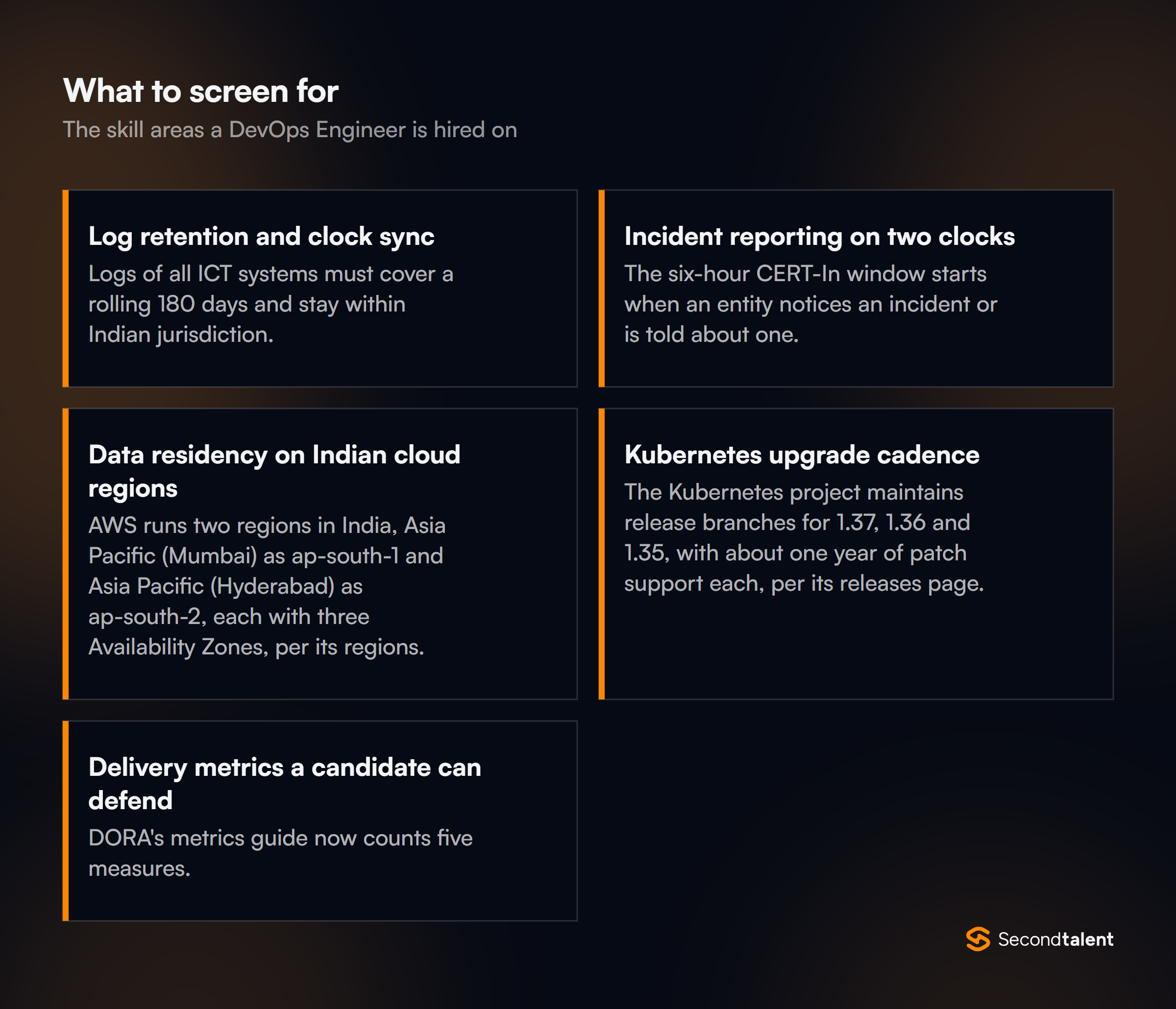
Section 70B of India's IT Act lets CERT-In give directions to service providers, data centres and any body corporate, and its 2022 directions made log retention and incident reporting mandatory. Screen the five areas below, starting with the two that directions shaped.
Log retention and clock sync
Logs of all ICT systems must cover a rolling 180 days and stay within Indian jurisdiction. Clocks must sync to the NTP servers of the National Informatics Centre or the National Physical Laboratory, though an entity spread across several countries may use another accurate source that does not deviate from them.
Ask the candidate how their last team stored six months of logs without runaway storage bills, and how they proved clocks agreed when an incident timeline mattered.
Incident reporting on two clocks
The six-hour CERT-In window starts when an entity notices an incident or is told about one. India's Digital Personal Data Protection Act adds a separate duty in section 8(6): after a personal data breach, the Data Fiduciary informs the Data Protection Board and each affected individual. Run a mock breach and ask who files what, and in which order.
Data residency on Indian cloud regions
AWS runs two regions in India, Asia Pacific (Mumbai) as ap-south-1 and Asia Pacific (Hyderabad) as ap-south-2, each with three Availability Zones, per its regions list. An engineer who kept an Indian entity's logs in-country while the product served US users has solved a routing and IAM problem your team may meet too. Ask for the account structure they used.
Kubernetes upgrade cadence
The Kubernetes project maintains release branches for 1.37, 1.36 and 1.35, with about one year of patch support each, per its releases page. Version 1.34 reaches end of life on 27 October 2026 and 1.35 on 28 February 2027. Ask for the candidate's last minor upgrade: the deprecated APIs they found, the node pool order and the rollback plan. Our Kubernetes engineers track covers deeper cluster work.
Delivery metrics a candidate can defend
DORA's metrics guide now counts five measures. Throughput covers change lead time, deployment frequency and failed deployment recovery time. Instability covers change fail rate and deployment rework rate.
Ask for before-and-after numbers on two of them. A candidate who quotes deployment frequency alone may have shipped faster while breaking more. Our CI/CD interview guide lists follow-up questions for each metric.
Contractor or Employer of Record in India
Software is not one of the nine categories of commissioned work that can be "work made for hire" under 17 U.S.C. § 101, and a transfer must be in writing and signed under § 204(a). IRS Publication 515 says the place where services are performed determines the source of the income, and a foreign individual gives the payer Form W-8BEN to certify foreign status.
Indian law points the same way on IP. Section 17 of the Copyright Act, 1957 makes the author first owner, and the employer first owner only for work made under a contract of service. A contractor works under a contract for service, so Terraform modules, pipelines and runbooks stay the contractor's until assigned. Section 19 requires a signed written assignment. If it states no period, the assignment is deemed to last five years, and if it states no territory, it is presumed to cover India only.
India's Supreme Court decides status on several factors. In Sushilaben Indravadan Gandhi v. New India Assurance (2020), it called control one in a series of factors and named integration into the employer's business as another important test. A DevOps engineer on your pager rotation, with standing admin access, sits inside your business on that test.
Employment inside India now runs under the four Labour Codes, in force since 21 November 2025. The government lists mandatory appointment letters for all workers and salary release by the 7th of each month for IT and ITES workers. An Employer of Record with an Indian entity carries those duties for you. This is a summary, not legal advice.
|
Independent contractor |
Employer of Record |
| Legal employer |
None; the engineer invoices you |
The EOR's Indian entity |
| US paperwork |
Form W-8BEN from the engineer |
Service agreement with the EOR |
| IP |
Signed assignment naming the work, rights, period and territory (section 19) |
Employer first owner under a contract of service (section 17), passed on through your EOR agreement |
| Local labor law |
Employment finding if you control and integrate the engineer |
Labour Codes apply, including appointment letters and consent for women's work after 7 pm |
| Pay currency |
Agreed in the contract, often USD |
Local payroll run by the EOR |
English Level and Working Norms in India
India's listening score on the EF English Proficiency Index 2025 is 457, the lowest of its four skill scores, with writing at 504. Overall, India scores 484 and ranks 74th of 123 countries and regions, against a global average of 488, and its IT job-function score is 487, per EF's India page.
The same page scores Bengaluru at 569 and Hyderabad at 554, well above the national figure. For on-call work the gap between listening and writing matters: a bridge call at 3 am tests listening, while the postmortem your team reads tests writing. Run one live incident drill and one written handover in the assessment.
Holidays in India differ by city. The Reserve Bank of India publishes separate holiday lists for Bengaluru, Chennai, Hyderabad, Mumbai and New Delhi, so ask for the engineer's own list before you build the on-call roster. Thanksgiving on 26 November 2026 is a working day in India, so an engineer there can hold the pager while your US team is off.
DevOps Engineer Hiring Process in India
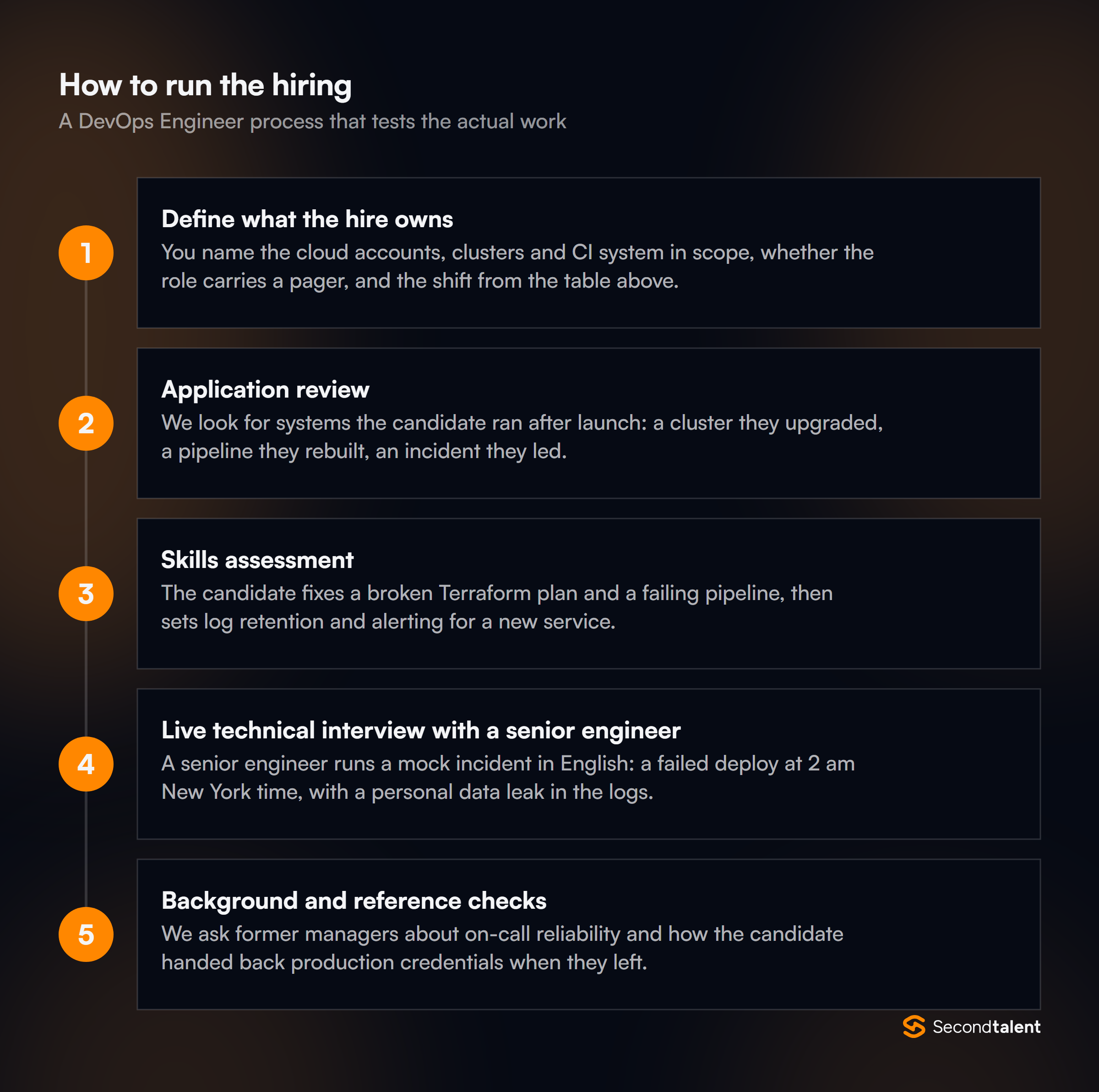
Second Talent's vetting covers stages 2 to 5 before you see a profile.
Stage 1: Define what the hire owns
You name the cloud accounts, clusters and CI system in scope, whether the role carries a pager, and the shift from the table above. Say whether any logs or data must stay in India.
Stage 2: Application review
We look for systems the candidate ran after launch: a cluster they upgraded, a pipeline they rebuilt, an incident they led. Scale goes in plain numbers, such as nodes, services or deploys a week.
Stage 3: Skills assessment
The candidate fixes a broken Terraform plan and a failing pipeline, then sets log retention and alerting for a new service. We score the pull request description along with the code.
Stage 4: Live technical interview with a senior engineer
A senior engineer runs a mock incident in English: a failed deploy at 2 am New York time, with a personal data leak in the logs. The candidate picks rollback or fix-forward and writes the status update.
Stage 5: Background and reference checks
We ask former managers about on-call reliability and how the candidate handed back production credentials when they left. You then choose the contractor or EOR route above.
Hire DevOps Engineers from India with Second Talent
We shortlist 6-8 candidates within 24 hours from 100,000+ pre-vetted engineers, accepting only the top 1% of applicants. DevOps engineers from India come with $0 upfront, no lock-in and 4-6 hours of daily overlap with US hours. We handle contracts, payroll and equipment.
Our pricing page sets out the monthly subscription, and for infrastructure-heavy briefs we also staff cloud engineers in India.