TL;DR: Cloud engineers in India earn $2,200 to $8,470+ a month working for international clients on our rate card, and we shortlist 6-8 candidates within 24 hours. The closest US benchmark, the BLS median for computer network architects, was $134,050 a year in May 2025.
CERT-In's 2022 directions give service providers, data centres and companies in India 6 hours to report listed cyber incidents after noticing them, and require logs of all ICT systems kept for a rolling 180 days within Indian jurisdiction. A cloud engineer who ran production for an Indian company built logging and paging around that clock.
Key takeaways
- AWS lists Hyderabad (ap-south-2) as an opt-in Region, while Mumbai (ap-south-1) is on by default in every account.
- Amazon EKS charges $0.60 per cluster hour once a Kubernetes version slips into extended support, six times the standard rate.
- A 3:30 pm to 12:30 am shift in Bengaluru gives a New York team six live hours while US daylight time lasts.
- Under India's Copyright Act, an assignment that states no term lasts five years, and one that states no territory is presumed to cover India only.
What Cloud Engineers Earn in India Working for International Clients
India's range has the highest ceiling of the four markets, while its floor sits $200 above Vietnam's. The figures are what cloud engineers in each market earn working directly for foreign companies, before any employer or platform costs.
| Market |
Monthly pay working for international clients (USD) |
| India |
$2,200-$8,470+ |
| Philippines |
$1,750-$4,630+ |
| Vietnam |
$2,000-$6,500 |
| Malaysia |
$3,930-$7,860+ |
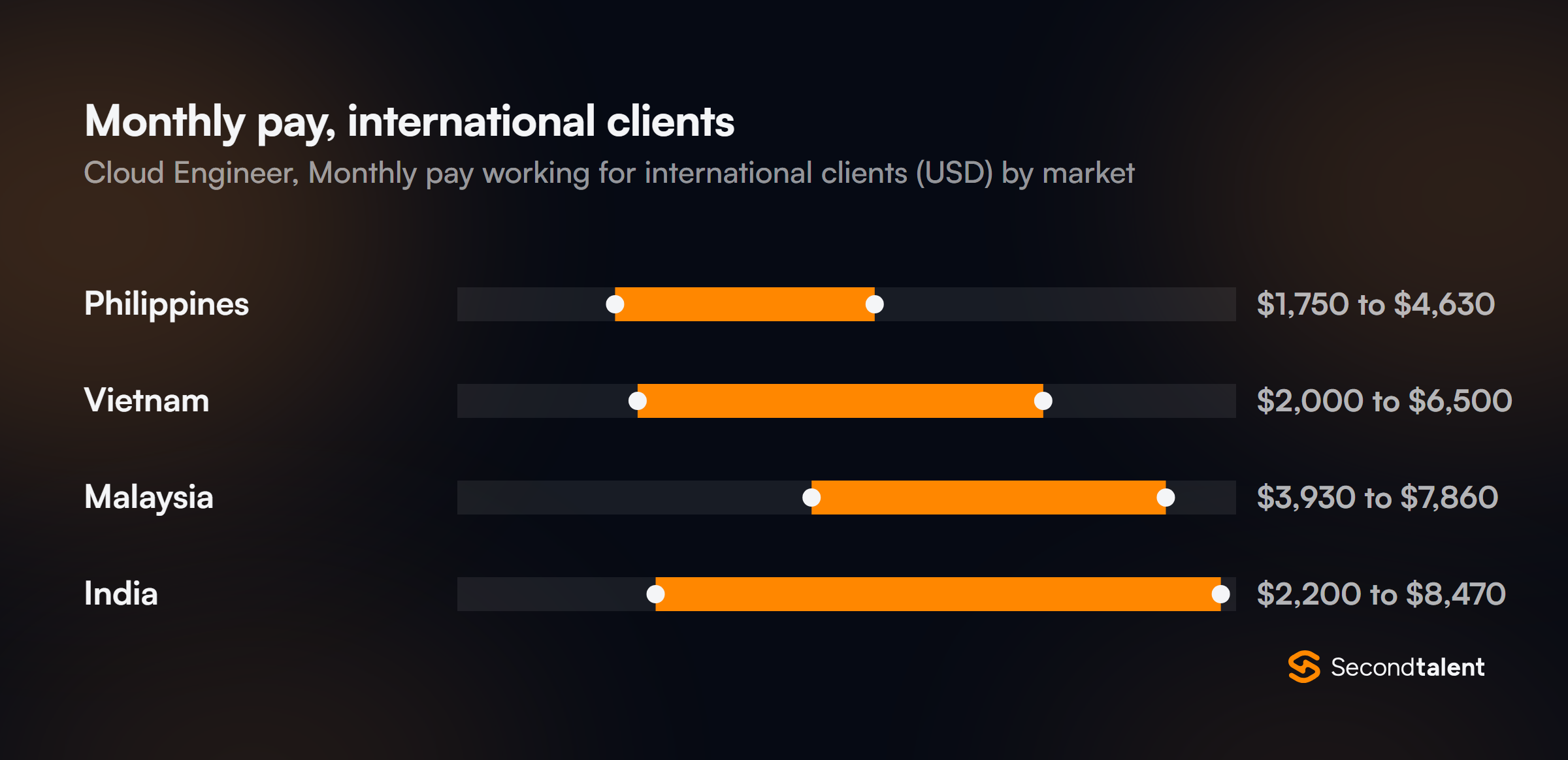
Monthly ranges from the Remote (Working for International Clients) figures on our rate cards for India, the Philippines, Vietnam and Malaysia, converted at ExchangeRate-API mid-market rates for 14 September 2026.
The India card quotes ₹210,000 to ₹810,000+ a month.
The title covers engineers who work tickets on an existing estate and engineers who design multi-account AWS setups. Decide which of the two you need before you compare offers.
Through Second Talent you pay one monthly fee that bundles salary, payroll taxes, statutory contributions and our service fee, quoted per role and market. Our pricing page explains the monthly subscription.
US Pay Benchmark for Cloud Engineers
BLS lists no cloud engineer occupation. We map the role to Computer Network Architects (15-1241), since designing VPCs, landing zones and the links between accounts is network design work. Engineers who patch and operate existing systems sit closer to Network and Computer Systems Administrators (15-1244).
| BLS OEWS, May 2025, national |
Computer Network Architects (15-1241) |
Network and Computer Systems Administrators (15-1244) |
| Median annual |
$134,050 |
$99,130 |
| 10th percentile, monthly |
$6,660 |
$5,220 |
| Median, monthly |
$11,170 |
$8,260 |
| 90th percentile, monthly |
$16,890 |
$12,920 |
Monthly figures are the annual wages on the BLS OEWS profiles for 15-1241 and 15-1244 divided by 12, rounded to the nearest $10.
Use the architects column for a hire who owns account structure and cluster design. The administrators column fits an operations seat on a pager.
Salary is only part of the US cost. In the BLS Employer Costs for Employee Compensation release for June 2026, wages and salaries made up 68.5% of employer compensation costs for full-time private industry workers, and benefits the other 31.5%.
Time Zone Overlap: Bengaluru Against ET, CT and PT
A Bengaluru engineer on a normal office day covers the whole US night. India keeps UTC+5:30 all year with no daylight saving, and US daylight time runs from 8 March to 1 November 2026, per NIST.
The arithmetic: 9:00 am in New York is 13:00 UTC under EDT (UTC-4), and 13:00 UTC is 6:30 pm in Bengaluru. Under EST it is 7:30 pm. Chicago's 9:00 am lands at 7:30 pm in summer, and San Francisco's at 9:30 pm.
| Bengaluru shift (UTC+5:30) |
ET overlap (EDT / EST) |
CT overlap (CDT / CST) |
PT overlap (PDT / PST) |
Hours between 10 pm and 6 am |
| 9:30 am-6:30 pm |
0 / 0 |
0 / 0 |
0 / 0 |
0 |
| 1:30 pm-10:30 pm |
4 / 3 |
3 / 2 |
1 / 0 |
0.5 |
| 3:30 pm-12:30 am |
6 / 5 |
5 / 4 |
3 / 2 |
2.5 |
| 6:30 pm-3:30 am |
8 / 8 |
8 / 7 |
6 / 5 |
5.5 |
Each shift is nine clock hours with a meal break, counted against a 9 am to 5 pm US day.
The first row is an on-call shift. From 9:30 am to 6:30 pm in Bengaluru it is midnight to 9:00 am in New York and 9:00 pm to 6:00 am in San Francisco, so the engineer takes US overnight pages in local daylight and hands over as your team logs on.
The 1:30 pm row suits change windows and design reviews with an East Coast team.
We fix the shift before the offer, which is how our placements get 4-6 hours of daily overlap with US hours.
Cloud Engineer Skills to Screen For
AWS runs two Regions in India, each with three Availability Zones, per its Regions list. Mumbai needs no opt-in; Hyderabad does. A candidate who ran workloads in both should know which Region an account owner had to switch on, and why a service control policy might block it.
Incident logging under CERT-In
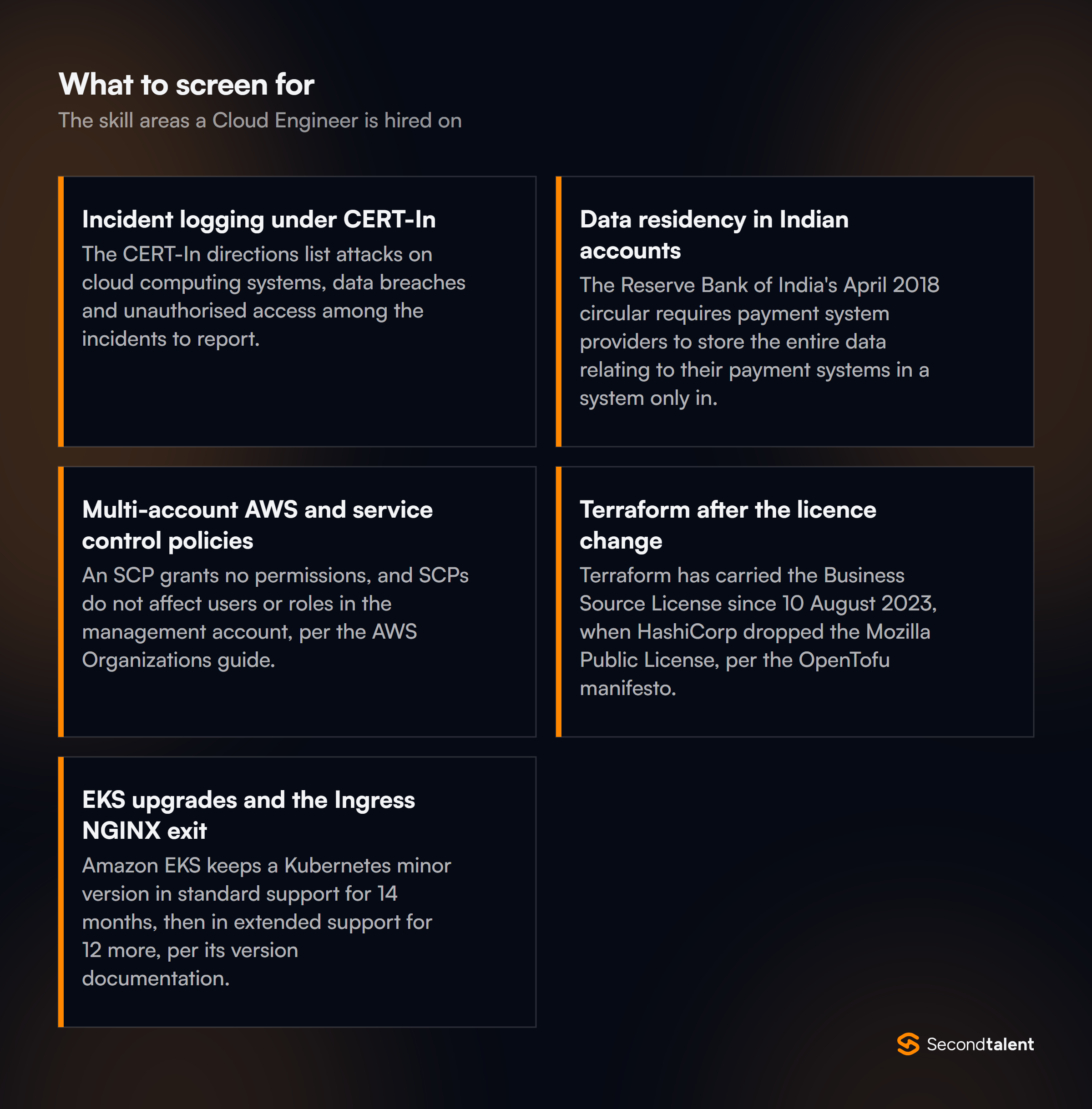
The CERT-In directions list attacks on cloud computing systems, data breaches and unauthorised access among the incidents to report.
They also require clocks synced to the NTP servers of the National Informatics Centre or the National Physical Laboratory, or to a source that does not deviate from them. Ask a candidate from an Indian company where their logs lived, how long they kept them and who filed the report.
Data residency in Indian accounts
The Reserve Bank of India's April 2018 circular requires payment system providers to store the entire data relating to their payment systems in a system only in India. Ask a candidate from an Indian payments team how they kept backups, replicas and log pipelines inside the country, and how they proved to an auditor that no copy left it.
Multi-account AWS and service control policies
An SCP grants no permissions, and SCPs do not affect users or roles in the management account, per the AWS Organizations guide. Both facts decide where workloads may run. Give the candidate an organisation with production inside the management account and ask for the migration plan.
Terraform after the licence change
Terraform has carried the Business Source License since 10 August 2023, when HashiCorp dropped the Mozilla Public License, per the OpenTofu manifesto. The OpenTofu fork reached a stable release under the Linux Foundation on 10 January 2024. Ask which tool the candidate's last team chose, where they kept state, how they locked it and how they caught drift.
EKS upgrades and the Ingress NGINX exit
Amazon EKS keeps a Kubernetes minor version in standard support for 14 months, then in extended support for 12 more, per its version documentation. The EKS pricing page puts standard support at $0.10 per cluster per hour and extended support at $0.60.
The Kubernetes project retired Ingress NGINX in March 2026 with no further releases or security fixes. Ask for the candidate's last minor-version upgrade and their plan to move an Ingress NGINX cluster to Gateway API.
Contractor or Employer of Record in India
Software is not one of the nine categories of commissioned work that can be "work made for hire" under 17 U.S.C. § 101, and a transfer must be in writing and signed under § 204(a).
India's Copyright Act, 1957 counts computer programmes as literary works. The author is first owner, and section 17(c) hands that to the employer only for work made under a contract of service, so a contractor keeps the copyright in your modules until they assign it. Section 19 requires the assignment in writing and signed, naming the work, the rights, the term and the territory.
Leave the term out and the Act deems it five years. Leave the territory out and it presumes India. Rights you do not exercise within a year lapse unless the assignment says otherwise, so state the term, a worldwide territory and a no-lapse clause.
IRS Publication 515 says the place where services are performed determines the source of the income, so an engineer working from Bengaluru or Pune earns foreign-source income. A foreign individual gives the payer Form W-8BEN to certify foreign status.
India's Supreme Court treats control as an important test of employment but not the only one. In Ram Singh v. Union Territory, Chandigarh it called for weighing integration into the business, who organises the work and who supplies the tools. An engineer on your pager with standing admin access to production, working only for you, looks integrated.
Our Employer of Record overview explains how an EOR employs a hire through its own local entity. This is a summary, not legal advice.
|
Independent contractor |
Employer of Record |
| Legal employer |
None; the engineer invoices you |
The EOR's Indian entity |
| US paperwork |
Form W-8BEN from the engineer |
Service agreement with the EOR |
| IP |
Section 19 assignment naming modules, pipelines and runbooks, worldwide and for the full term |
Employer first owner under section 17(c), passed on through your EOR agreement |
| Local labor law |
Employment finding if the engineer is integrated into your operations |
Indian employment and social security rules apply |
| Pay currency |
Agreed in the contract, often USD |
Local payroll in rupees run by the EOR |
English Level and Working Norms in India
Bengaluru scores 569 on the EF English Proficiency Index 2025, 67 points above Pune at 502, per EF's India page. India's national score is 484, 74th of 123 countries and regions against a global average of 488, and its IT job-function score is 487.
A city average says little about one engineer. Cloud work runs on written English: the incident update, the change request, the postmortem your US team reads at the start of its day. Hand finalists a raw incident timeline and ask for the customer-facing status update.
India's central government list for 2026, set by a DoPT office memorandum of 3 July 2025, puts Dussehra on Tuesday 20 October and Guru Nanak's Birthday on Tuesday 24 November. Diwali falls on Sunday 8 November, and central government offices in some states close the day before instead. Private employers publish their own lists, so collect the engineer's calendar before you build the on-call rota.
Thanksgiving on 26 November 2026 is a working day in India, so an engineer there can hold the pager while your US team is off.
Cloud Engineer Hiring Process in India
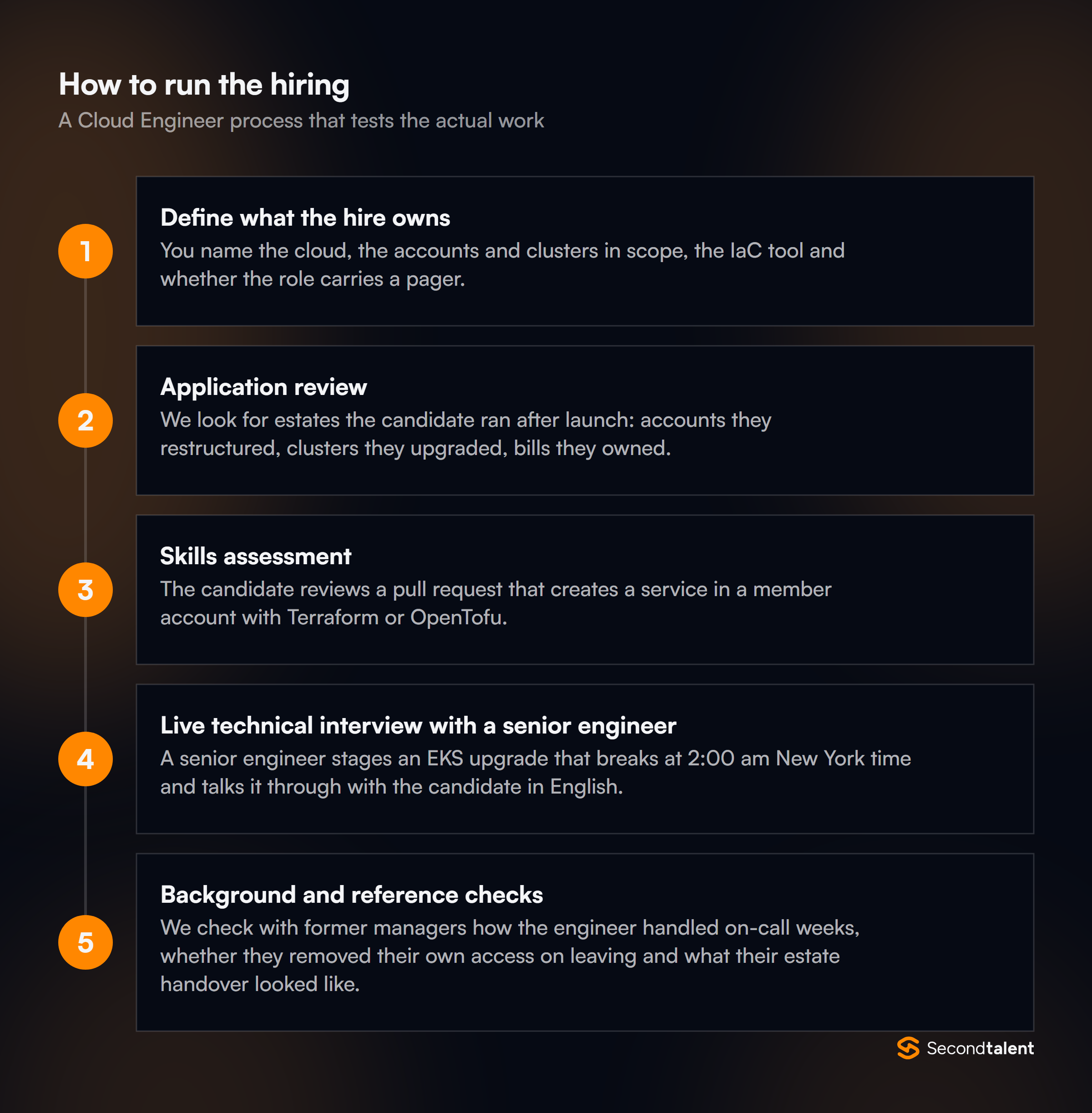
Second Talent's vetting covers stages 2 to 5 before you see a profile.
Stage 1: Define what the hire owns
You name the cloud, the accounts and clusters in scope, the IaC tool and whether the role carries a pager. Add the Bengaluru shift from the table above and any data that has to stay in an Indian Region.
Stage 2: Application review
We look for estates the candidate ran after launch: accounts they restructured, clusters they upgraded, bills they owned. Scale comes in plain numbers, such as account counts, node counts or monthly spend. A certification list with no production story does not pass.
Stage 3: Skills assessment
The candidate reviews a pull request that creates a service in a member account with Terraform or OpenTofu. We plant an over-broad IAM policy and a hardcoded account ID in the module. We score the plan review and the pull request note along with the code.
Stage 4: Live technical interview with a senior engineer
A senior engineer stages an EKS upgrade that breaks at 2:00 am New York time and talks it through with the candidate in English. We watch which logs they open first, whether they roll back, and how they word the note to your team.
Stage 5: Background and reference checks
We check with former managers how the engineer handled on-call weeks, whether they removed their own access on leaving and what their estate handover looked like. You then choose the contractor or EOR route above.
Hire Cloud Engineers from India with Second Talent
We shortlist 6-8 candidates within 24 hours from 100,000+ pre-vetted engineers, accepting only the top 1% of applicants. Cloud engineers from India come with $0 upfront, no lock-in and 4-6 hours of daily overlap with US hours. We handle contracts, payroll and equipment.
Our pricing page covers the subscription, and for CI/CD and release work we also staff DevOps engineers in India.