TL;DR: Machine learning engineers in India earn $2,410 to $9,410+ a month working for international clients on our rate card. The closest US benchmark, the BLS median for software developers, was $135,980 a year in May 2025.
Section 17(1)(d) of India's data protection law lifts most of its duties when someone based in India processes data on people outside India under a contract with a foreign company. A contractor in Pune who trains your model on US customer records fits that description, though the security safeguards still apply.
Key takeaways
- AWS has closed SageMaker Model Monitor to new customers and points them to open-source monitoring built on MLflow and Evidently AI.
- MLflow has deprecated model registry stages, so promotion now runs on aliases and tags.
- A 2 pm to 11 pm shift in Bengaluru gives a New York team four and a half live hours while US daylight time lasts.
- India's R&D job-function score on the EF English Proficiency Index 2025 is 592, the highest of its job functions.
What Machine Learning Engineers Earn in India Working for International Clients
India's floor sits $210 above Indonesia's, and its open-topped ceiling of $9,410+ trails only Malaysia's $11,300+ among the five markets. The figures are what machine learning engineers in each market earn working directly for foreign companies, before any employer or platform costs.
| Market |
Monthly pay working for international clients (USD) |
| India |
$2,410-$9,410+ |
| Indonesia |
$2,200-$8,500 |
| Philippines |
$2,500-$6,000 |
| Vietnam |
$2,500-$7,000 |
| Malaysia |
$3,930-$11,300+ |
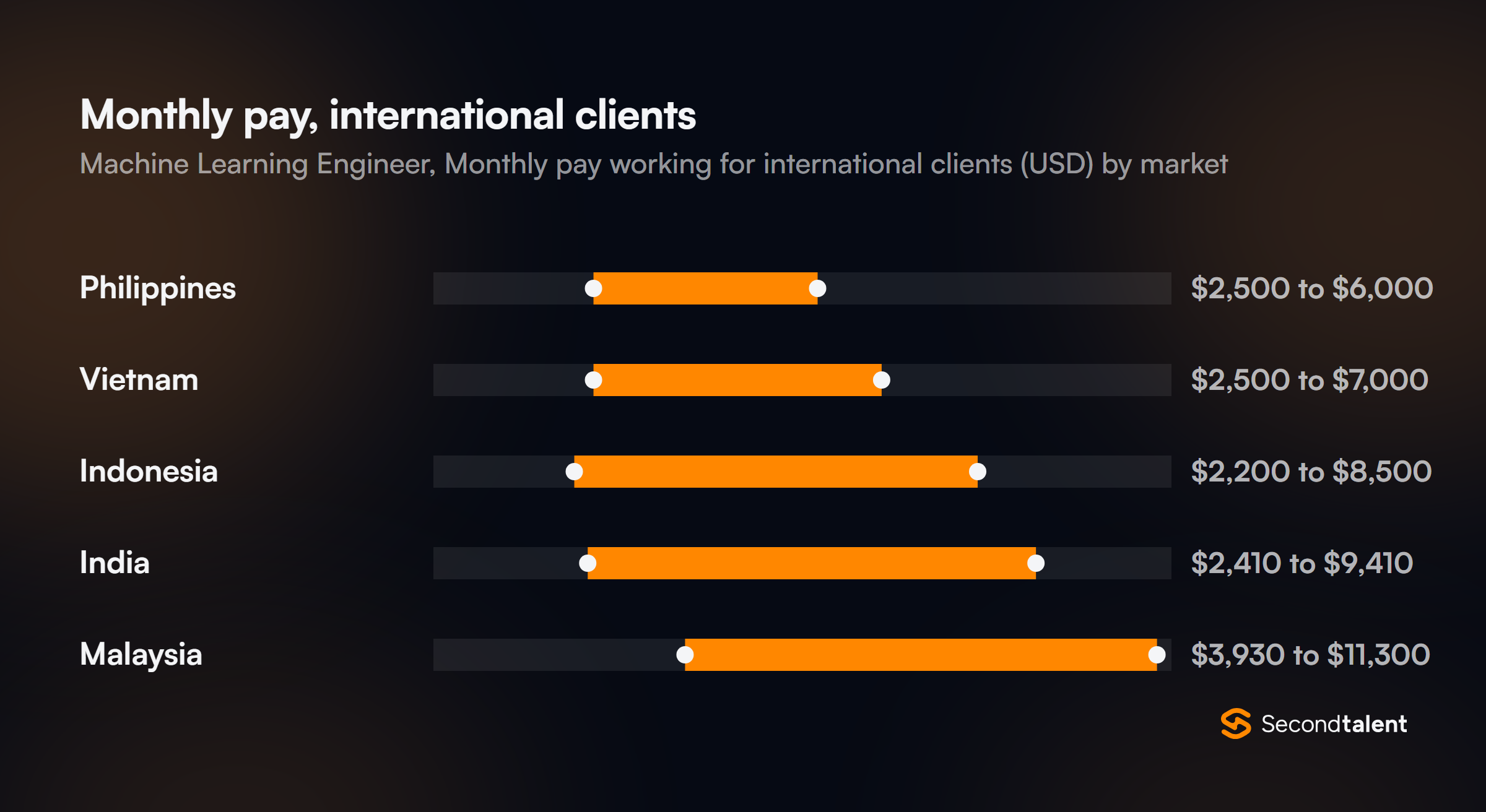
Monthly ranges from the Remote (Working for International Clients) figures on our rate cards for India, Indonesia, the Philippines, Vietnam and Malaysia, converted at ExchangeRate-API mid-market rates for 14 September 2026.
The Indonesia, Philippines and Vietnam cards publish US dollar ranges with a fixed top. The India card quotes ₹230,000 to ₹900,000+ a month, converted at ₹95.61 to the dollar, and the Malaysia card quotes ringgit.
A brief built around product features on hosted models sits closer to our India AI engineer card, at $2,610 to $10,150+. A brief that ends at analysis, with no deployed model, fits data scientists in India.
Through Second Talent you pay one monthly fee that bundles salary, payroll taxes, statutory contributions and our service fee, quoted per role and market. Our pricing page explains the subscription.
Training compute sits outside that fee. India's government onboarded more than 38,000 GPUs under the IndiaAI Mission for Indian start-ups and academia, so plan your hire's GPU hours on your own cloud account.
US Pay Benchmark for Machine Learning Engineers
BLS publishes no machine learning engineer occupation. Engineers who put models into production map to Software Developers (15-1252). Engineers who invent methods and run research experiments sit next to Computer and Information Research Scientists (15-1221).
| BLS OEWS, May 2025, national |
Software Developers (15-1252) |
Computer and Information Research Scientists (15-1221) |
| Median annual |
$135,980 |
$140,300 |
| 10th percentile, monthly |
$6,870 |
$6,850 |
| Median, monthly |
$11,330 |
$11,690 |
| 90th percentile, monthly |
$17,890 |
$19,220 |
Monthly figures are the annual wages on the BLS OEWS profiles for 15-1252 and 15-1221 divided by 12, rounded to the nearest $10.
The two columns start within $20 of each other and split at the top, where research scientists earn $1,330 a month more. Use the research column only for a hire who will own experiments, not pipelines.
Salary is only part of the US cost. In the BLS Employer Costs for Employee Compensation release for June 2026, wages and salaries made up 68.5% of employer compensation costs for full-time private industry workers, and benefits the other 31.5%.
Time Zone Overlap: Bengaluru Against ET, CT and PT
Noon in Bengaluru is 2:30 am in New York in September. A retraining job an engineer starts after lunch in India can finish before your team's standup. India keeps UTC+5:30 all year, and US daylight time runs from 8 March to 1 November 2026, per NIST.
The arithmetic for Chicago: 9:00 am under CDT (UTC-5) is 14:00 UTC, which is 7:30 pm in Bengaluru. Under CST (UTC-6) it moves to 8:30 pm.
| Bengaluru shift (UTC+5:30) |
ET overlap (EDT / EST) |
CT overlap (CDT / CST) |
PT overlap (PDT / PST) |
Hours after 10 pm |
| 9:30 am-6:30 pm |
0 / 0 |
0 / 0 |
0 / 0 |
0 |
| 12 pm-9 pm |
2.5 / 1.5 |
1.5 / 0.5 |
0 / 0 |
0 |
| 2 pm-11 pm |
4.5 / 3.5 |
3.5 / 2.5 |
1.5 / 0.5 |
1 |
| 4:30 pm-1:30 am |
7 / 6 |
6 / 5 |
4 / 3 |
3.5 |
Each shift runs nine clock hours including a meal break, counted against a 9 am to 5 pm US day.
A noon start gives New York two and a half hours in summer and one and a half in winter, which covers a standup and little else. For model reviews and incident calls, the 2 pm row holds four and a half hours with New York while daylight time lasts.
San Francisco teams need the 4:30 pm row to get more than an hour and a half.
India's Labour Codes, in force since 21 November 2025, set double wages for overtime, so contract the late shift as the working day. We fix it before the offer, which is how our placements get 4-6 hours of daily overlap with US hours.
Machine Learning Engineer Skills to Screen For
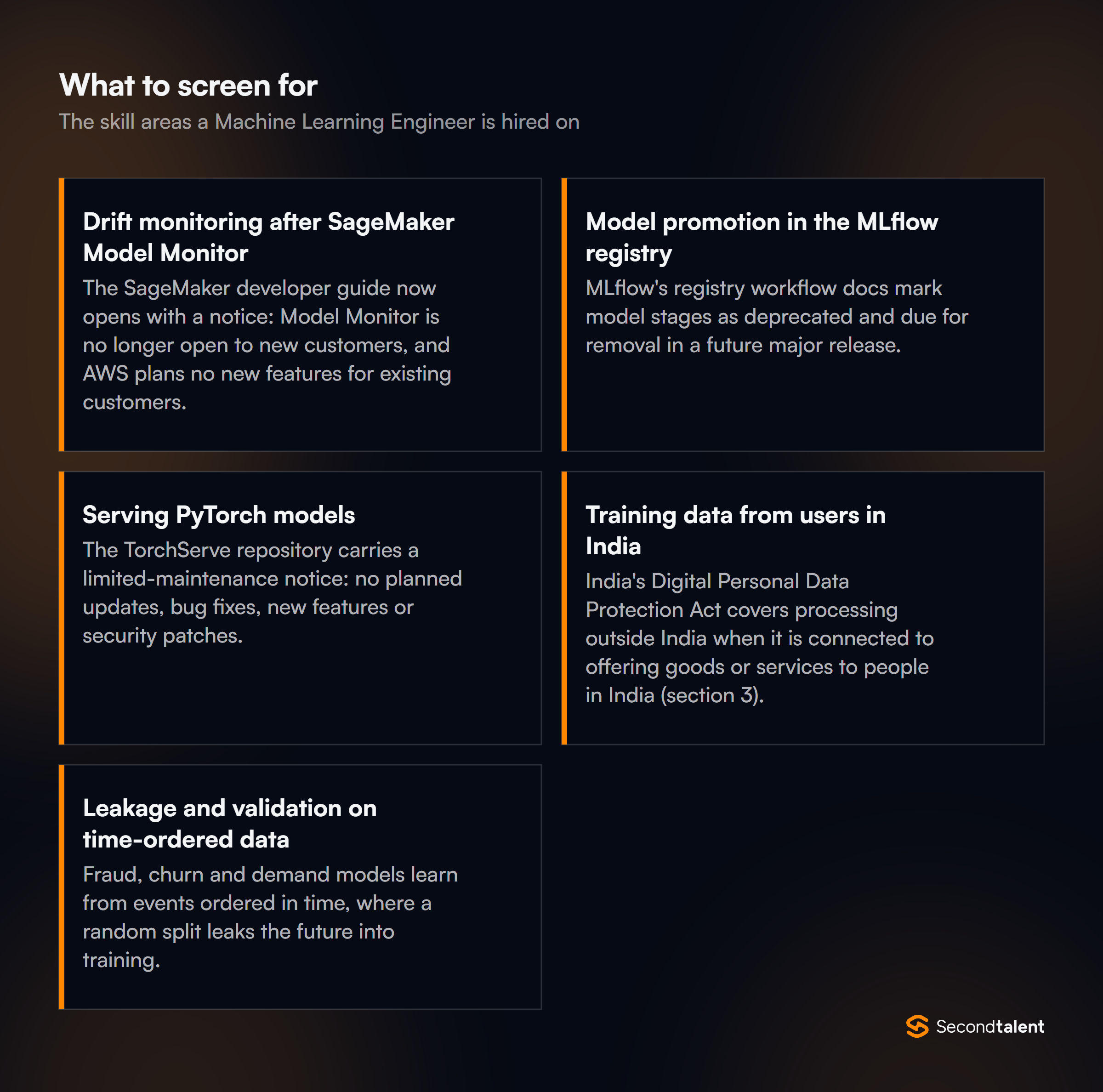
Three parts of a PyTorch, MLflow and SageMaker stack have changed status: SageMaker's drift monitor, MLflow's model stages and PyTorch's TorchServe. Screen for the replacement plan as well as the tool.
Drift monitoring after SageMaker Model Monitor
The SageMaker developer guide now opens with a notice: Model Monitor is no longer open to new customers, and AWS plans no new features for existing customers.
AWS's replacement guide combines open-source monitoring solutions built on SageMaker AI MLflow Apps and Evidently AI with QuickSight dashboards and CloudWatch.
Give the candidate a model whose input distribution shifted last month and whose labels arrive two weeks late. Ask which drift check fires first and what they would alert on while ground truth is missing.
Model promotion in the MLflow registry
MLflow's registry workflow docs mark model stages as deprecated and due for removal in a future major release. Aliases, such as a "champion" pointer on one version, and tags now do that job. Ask the candidate to promote a challenger model with an alias and roll it back in under a minute, then show how the serving code resolves the alias.
Serving PyTorch models
The TorchServe repository carries a limited-maintenance notice: no planned updates, bug fixes, new features or security patches. A PyTorch model still served that way carries unpatched risk. Ask what the candidate replaced TorchServe with on their last deployment, or how they would move an existing endpoint, and what p99 latency they held before and after.
Training data from users in India
India's Digital Personal Data Protection Act covers processing outside India when it is connected to offering goods or services to people in India (section 3). Section 9 bars tracking, behavioural monitoring and targeted advertising directed at children, whom the Act defines as under 18. The DPDP Rules, notified in November 2025, set an 18-month phased timeline.
A recommender that personalises from Indian users' behaviour is where section 9 bites. Ask the candidate how they would keep under-18 accounts out of personalisation, and how they would show an auditor it worked.
Leakage and validation on time-ordered data
Fraud, churn and demand models learn from events ordered in time, where a random split leaks the future into training. Hand the candidate a transactions table with a label that arrives 30 days after the event. Score whether they split by time, respect the label delay and report a baseline before any model.
Contractor or Employer of Record in India
Software is not one of the nine categories of commissioned work that can be "work made for hire" under 17 U.S.C. § 101. A transfer must be in writing and signed under § 204(a).
Indian law leaves a contractor's code and notebooks with the contractor. Section 17(c) of the Copyright Act gives first ownership to the employer only for work made under a contract of service. Under section 19, the author has to sign a written assignment. If it states no term, the law reads five years; if it states no territory, India only. Rights left unexercised for a year lapse unless the deed provides otherwise.
IRS Publication 515 says the place where services are performed determines the source of the income, so ML work done in Bengaluru is foreign-source income. A foreign individual gives the payer Form W-8BEN to certify foreign status.
For employment status, the Supreme Court in Sushilaben Indravadan Gandhi v. New India Assurance (2020) rejected any single test. It weighed control, integration into the business and the other factors together on the facts. A full-time engineer who owns your retraining pipeline and joins your on-call rotation looks like an employee on that analysis.
Employment in India also carries Labour Code duties: appointment letters for every worker and, for IT and ITES staff, salary by the 7th of each month. An Employer of Record with an Indian entity takes those on as the legal employer. This is a summary, not legal advice.
|
Independent contractor |
Employer of Record |
| Legal employer |
None; the engineer invoices you |
The EOR's Indian entity |
| US paperwork |
Form W-8BEN from the engineer |
Service agreement with the EOR |
| IP |
Signed assignment of code, features, datasets and weights, stating territory and term (section 19) |
Employer first owner (section 17(c)), passed to you in the EOR agreement |
| Local labor law |
Employment finding if the facts, weighed together, point to service |
Appointment letter, salary by the 7th and double overtime wages apply |
| Pay currency |
Agreed in the contract, often USD |
Local payroll run by the EOR |
English Level and Working Norms in India
India's R&D score of 592 on the EF English Proficiency Index 2025 sits 105 points above its IT score of 487. The national score is 484, 74th of 123 countries and regions, against a global average of 488, per EF's India page. By city, Bengaluru scores 569 and Pune 502.
ML decisions travel as experiment write-ups and model cards. Ask finalists to write a one-page report on a model that lost to its baseline, and read it before the live interview.
India's central government holiday list for 2026 has Gandhi Jayanti on Friday 2 October, Dussehra on Tuesday 20 October and Diwali on Sunday 8 November. Private employers publish their own lists, so fix the dates in the contract and schedule retraining around them.
Thanksgiving on 26 November 2026 is a working day in India, so an engineer there can watch a model release while your US team is off.
Machine Learning Engineer Hiring Process in India
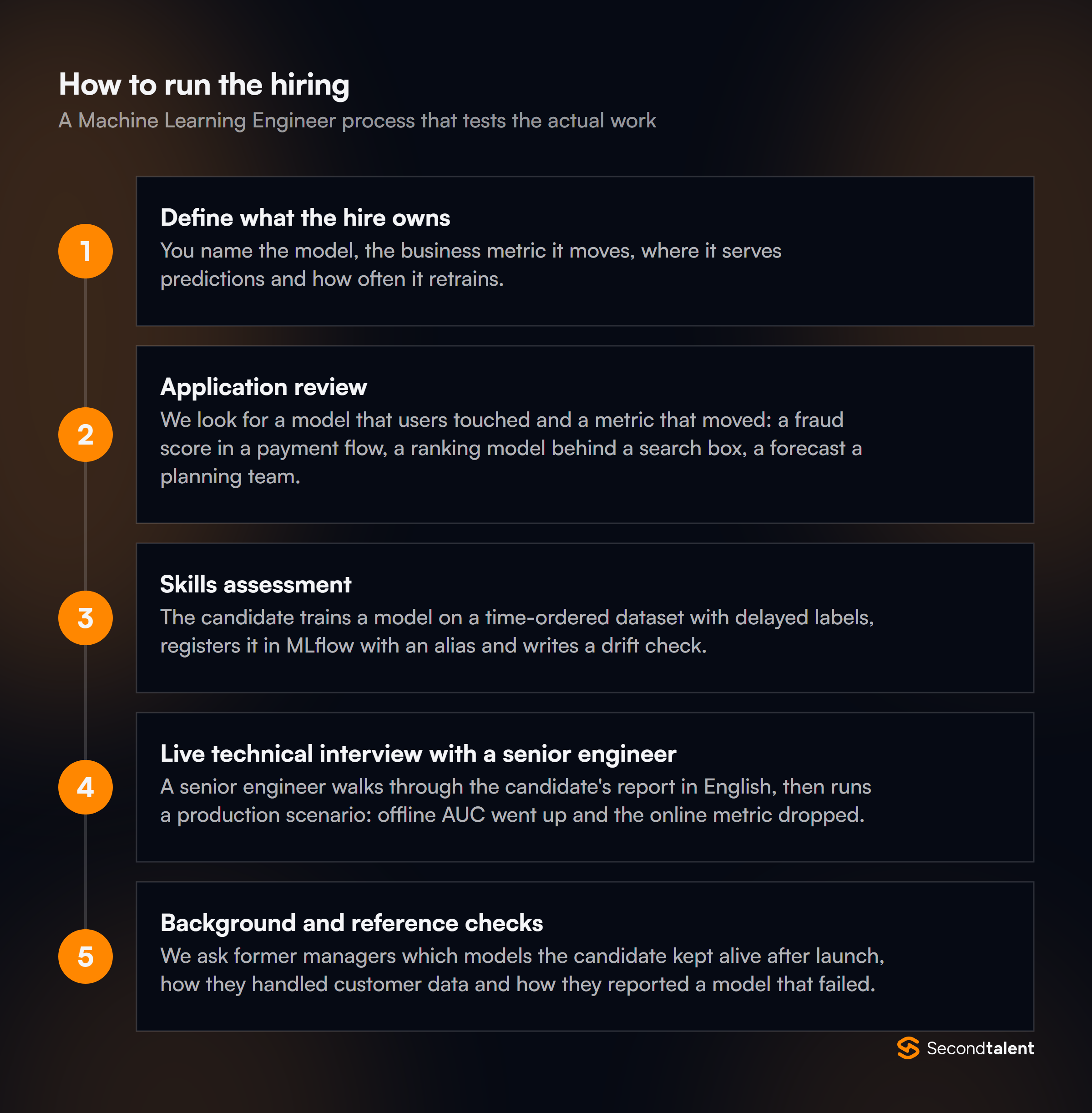
Second Talent's vetting covers stages 2 to 5 before you see a profile.
Stage 1: Define what the hire owns
You name the model, the business metric it moves, where it serves predictions and how often it retrains. Add the data it trains on, including whether any of it comes from users in India, and the Bengaluru shift from the table above.
Stage 2: Application review
We look for a model that users touched and a metric that moved: a fraud score in a payment flow, a ranking model behind a search box, a forecast a planning team used. A Kaggle notebook with no deployment does not pass.
Stage 3: Skills assessment
The candidate trains a model on a time-ordered dataset with delayed labels, registers it in MLflow with an alias and writes a drift check. We score the validation split and the baseline before the model.
Stage 4: Live technical interview with a senior engineer
A senior engineer walks through the candidate's report in English, then runs a production scenario: offline AUC went up and the online metric dropped. The candidate talks through skew, drift and rollback.
Stage 5: Background and reference checks
We ask former managers which models the candidate kept alive after launch, how they handled customer data and how they reported a model that failed. You then choose the contractor or EOR route above.
Hire Machine Learning Engineers from India with Second Talent
We shortlist 6-8 candidates within 24 hours from 100,000+ pre-vetted engineers, accepting only the top 1% of applicants. Machine learning engineers from India come with $0 upfront, no lock-in and 4-6 hours of daily overlap with US hours. We handle contracts, payroll and equipment.
Our pricing page sets out the monthly subscription, and our MLOps engineer profile covers the platform side of the role.