TL;DR: Java developers in Singapore earn $8,680 to $20,130+ a month working for international clients on our rate card. We shortlist 6-8 candidates within 24 hours. The BLS median for US software developers was $135,980 a year in May 2025.
Oracle plans to ship JDK 21 updates released after September 2026 under its OTN licence, which is free only for personal, development and other permitted users, per its support roadmap. A Java developer from a Singapore bank should already have a plan for that date.
Key takeaways
- Spring Boot 3.5 lost open-source support on 30 June 2026, so a 3.x codebase needs a 4.x upgrade plan or a commercial support contract.
- In Singapore a contractor owns the code they write for you until a written assignment, signed by them, transfers it.
- Singapore's statutory hours and overtime rules stop at S$2,600 in monthly basic salary for non-manual employees. A Java developer's shift terms come from the contract.
- EF's English Proficiency Index publishes no Singapore page, so test written English in the assessment instead.
What Java Developers Earn in Singapore Working for International Clients
Singapore's range tops out $2,280 above Hong Kong's, although its floor sits $880 lower. The figures are what developers in each market earn working directly for foreign companies, before any employer or platform costs.
| Market |
Monthly pay working for international clients (USD) |
| Singapore |
$8,680-$20,130+ |
| Philippines |
$2,500-$7,500 |
| Malaysia |
$2,950-$6,270+ |
| Hong Kong |
$9,560-$17,850+ |
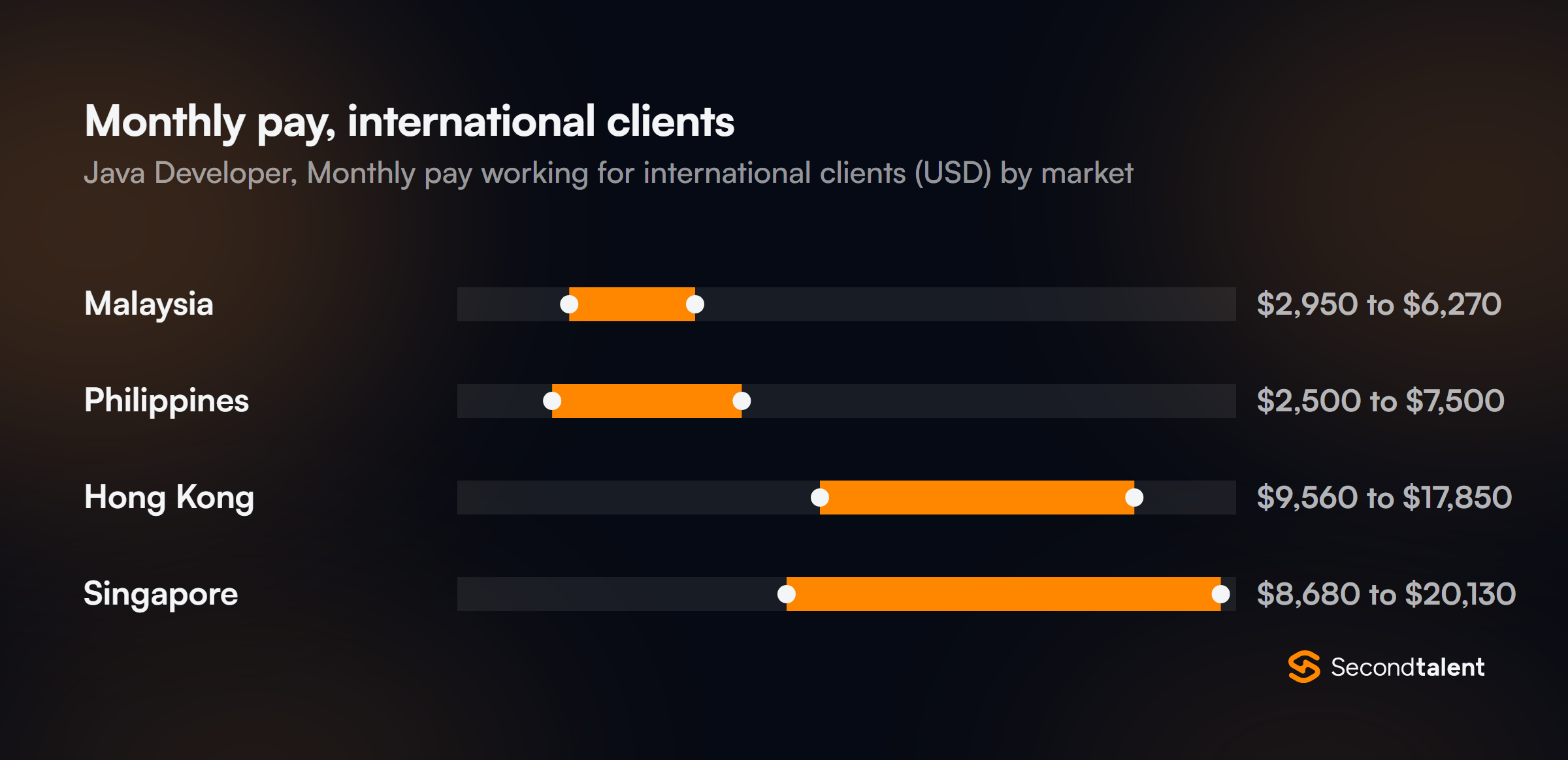
Monthly ranges from the Remote (Working for International Clients) figures on our rate cards for Singapore, the Philippines, Malaysia and Hong Kong, converted at ExchangeRate-API mid-market rates for 14 September 2026.
The Singapore card quotes S$11,000 to S$25,500+ a month, and its open top leaves room above the table for lead developers. Put the seniority in the brief before you compare this row with the others.
Through Second Talent you pay one monthly fee that bundles salary, payroll taxes, statutory contributions and our service fee, quoted per role and market. Our pricing page explains the subscription, and our Java developer cost-to-hire page sets out US freelance rates for the contract route.
US Pay Benchmark for Java Developers
Java developers map to Software Developers (SOC 15-1252), the occupation for engineers who design and build application and system software.
| BLS OEWS, May 2025, national |
Software Developers (15-1252) |
| Median annual |
$135,980 |
| 10th percentile, monthly |
$6,870 |
| 25th percentile, monthly |
$8,770 |
| Median, monthly |
$11,330 |
| 75th percentile, monthly |
$14,330 |
| 90th percentile, monthly |
$17,890 |
Monthly figures are the annual wages on the OEWS profile for 15-1252 divided by 12, rounded to the nearest $10.
Salary is only part of the US cost. In the BLS Employer Costs for Employee Compensation release for June 2026, wages and salaries made up 68.5% of employer compensation costs for full-time private industry workers, and benefits the other 31.5%.
Time Zone Overlap: Singapore Against ET, CT and PT
A release that a Singapore developer ships at 10 am local time lands at 10 pm the previous evening in New York while US daylight time lasts. Singapore keeps UTC+8 all year with no daylight saving, and US clocks stay on daylight time from 8 March to 1 November 2026, per NIST.
The arithmetic: 9:00 am in New York is 13:00 UTC under EDT (UTC-4), which is 9:00 pm in Singapore. Under EST (UTC-5) it is 10:00 pm. Chicago's 9:00 am lands one hour later than New York's, and Los Angeles's three hours later, at midnight in September.
| Singapore shift (UTC+8) |
ET overlap (EDT / EST) |
CT overlap (CDT / CST) |
PT overlap (PDT / PST) |
Hours between 10 pm and 6 am |
| 9 am-6 pm |
0 / 0 |
0 / 0 |
0 / 0 |
0 |
| 2 pm-11 pm |
2 / 1 |
1 / 0 |
0 / 0 |
1 |
| 5 pm-2 am |
5 / 4 |
4 / 3 |
2 / 1 |
4 |
| 8 pm-5 am |
8 / 7 |
7 / 6 |
5 / 4 |
7 |
Each shift is nine clock hours, including a meal break, counted against a 9 am to 5 pm US day.
For an East Coast team, the 5 pm to 2 am row puts code review and incident calls in the shared hours. Batch jobs and deployments then finish before your team logs on.
The Ministry of Manpower's hours of work rules apply only to employees covered by Part 4 of the Employment Act. A developer on the salaries above sits outside Part 4, so working hours follow the employment contract. Write the shift and any late-hours allowance into the offer.
We agree the shift before the offer, which is how our placements get 4-6 hours of daily overlap with US hours.
Java Developer Skills to Screen For
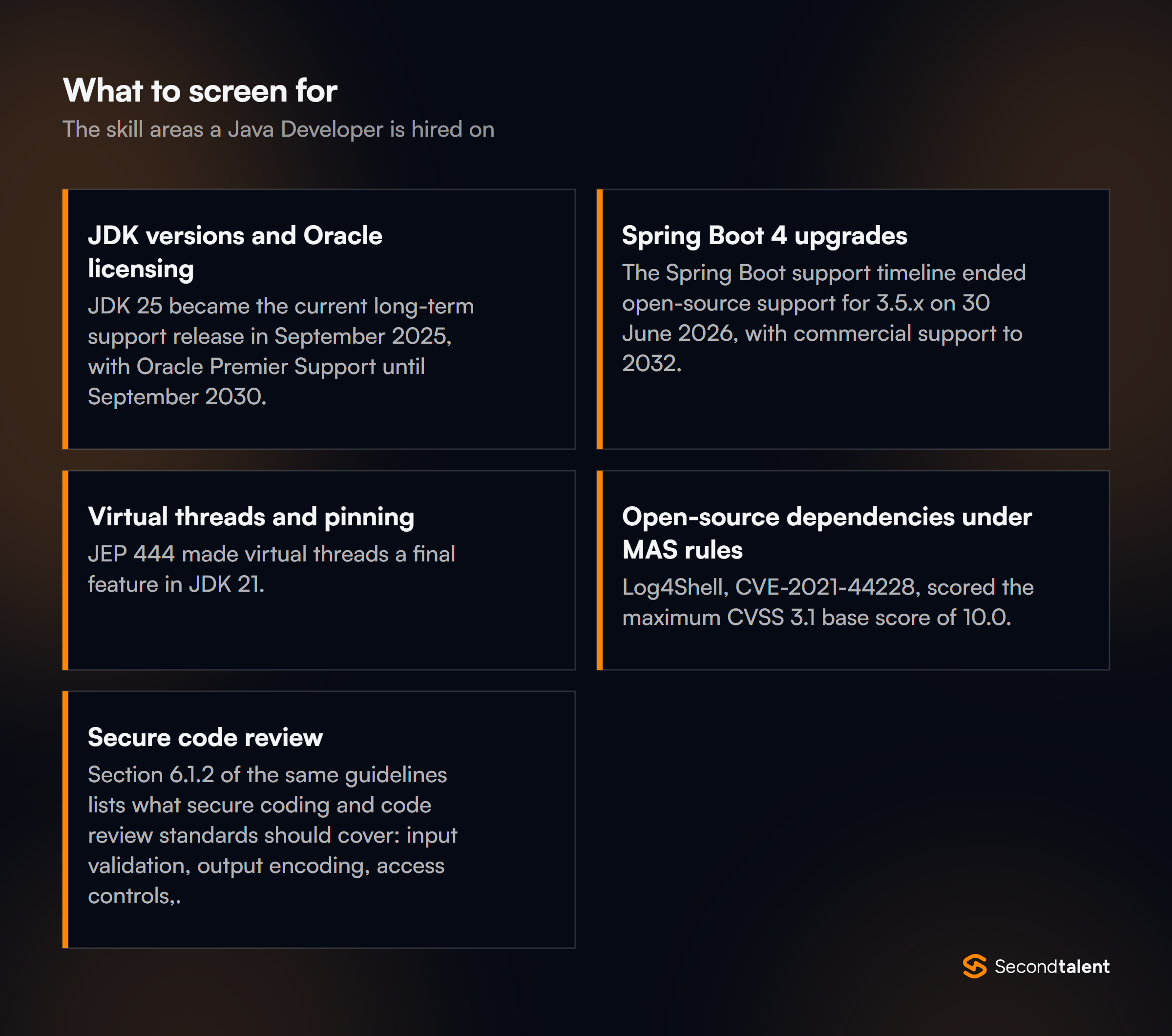
Java was used by 29.4% of all respondents to Stack Overflow's 2025 Developer Survey, and Spring Boot by 14.7% in the web frameworks question. In Singapore, much of that Java runs in regulated finance, so the screen below leans on version discipline and code review as much as on framework knowledge.
JDK versions and Oracle licensing
JDK 25 became the current long-term support release in September 2025, with Oracle Premier Support until September 2030. JDK 21 keeps Premier Support until September 2028, but Oracle plans to ship its updates after this month under the OTN licence.
Ask the candidate which JDK distribution their last employer ran in production and who paid for it. Then ask what breaks when a Spring service moves from 21 to 25, and how they would prove it in a staging run.
Spring Boot 4 upgrades
The Spring Boot support timeline ended open-source support for 3.5.x on 30 June 2026, with commercial support to 2032. Spring Boot 4.0.x has open-source support until 31 December 2026 and 4.1.x until 31 July 2027. The system requirements page says Spring Boot 4.1.1 needs Java 17 or later and works with versions up to Java 26.
A strong candidate has already moved one service to 4.x and can list what failed first: a starter, a test library, a configuration property. Ask for that list.
Virtual threads and pinning
JEP 444 made virtual threads a final feature in JDK 21. JEP 491, delivered in JDK 24, stopped virtual threads blocking inside synchronized methods from pinning their platform threads. Before that change, pinning capped how many virtual threads an application could run.
Hand the candidate a service that switched to virtual threads on JDK 21 and stopped scaling under load. Ask where they would look first, and whether moving to JDK 25 or rewriting the locks is the cheaper fix.
Open-source dependencies under MAS rules
Log4Shell, CVE-2021-44228, scored the maximum CVSS 3.1 base score of 10.0. CISA added it to its exploited-vulnerabilities catalogue on the day NVD published it, with a two-week remediation deadline for federal agencies.
MAS's Technology Risk Management Guidelines ask financial institutions to review and test third-party and open-source code before integrating it (6.1.3). They also ask them to track updates and reported vulnerabilities in that code (6.1.4), and to monitor end-of-support dates so they avoid running unsupported software (7.3.1). That last clause is why a bank's Java team plans JDK moves years ahead.
Ask the candidate how they would find the services on your estate that pull a vulnerable library in through another dependency, and how long that search took at their last job.
Secure code review
Section 6.1.2 of the same guidelines lists what secure coding and code review standards should cover: input validation, output encoding, access controls, authentication, cryptographic practices, and error and exception handling. Section 6.1.7 asks institutions to fix major defects before production deployment.
Give the candidate a Spring controller with a missing authorisation check, a string-built SQL query and a stack trace returned to the client. Score what they find in 20 minutes and how they rank the fixes.
Contractor or Employer of Record in Singapore
Software is not one of the nine categories of commissioned work that can be "work made for hire" under 17 U.S.C. § 101, and a copyright transfer must be in writing and signed under § 204(a).
Singapore's rule points the same way. The Intellectual Property Office of Singapore says the author owns copyright in a commissioned work, unless both sides agree in writing that someone else will. An employer owns the works an employee creates during employment. Under section 138 of the Copyright Act 2021, an assignment is valid only in writing, signed by or on behalf of the assignor.
IRS Publication 515 says the place where services are performed determines the source of the income, so work done in Singapore produces foreign-source income. A foreign individual gives the payer Form W-8BEN to certify foreign status.
The Ministry of Manpower says there is no single conclusive test for telling a contract of service from a contract for service. It looks at control over the timing and method of work, who provides tools and workplace, and whether the worker shares in profit or risk of loss.
The Employment Act covers local and foreign employees under a contract of service. Its Part 4 applies only to workmen earning up to S$4,500 and other employees earning up to S$2,600 in monthly basic salary. A foreign national living in Singapore needs an Employment Pass, and MOM's qualifying salary for financial services starts at S$6,200 a month, rising with age. For Singapore Citizens and permanent residents, the employer pays CPF contributions.
A developer on your sprint board and your incident rota fits the control side of that test. Our Employer of Record service employs that developer in Singapore, and our Singapore EOR page covers the details. This is a summary, not legal advice.
|
Independent contractor |
Employer of Record |
| Legal employer |
None; the developer invoices you |
The EOR's Singapore entity |
| US paperwork |
Form W-8BEN from the developer |
Service agreement with the EOR |
| IP |
Signed written assignment of source code, build scripts and schemas (section 138) |
Employer owns work made in employment, passed on through your EOR agreement |
| Local labor law |
Employment finding if you control hours, tools and methods |
Employment Act, contract hours above the Part 4 threshold, CPF for citizens and permanent residents |
| Pay currency |
Agreed in the contract, often USD |
Local payroll run by the EOR |
English Level and Working Norms in Singapore
EF's English Proficiency Index 2025 publishes no page for Singapore, so there is no EF score to quote. Test the English your team needs: ask finalists to write the upgrade note a US product manager would read before a Spring Boot 4 release.
Singapore's Tripartite Guidelines on Flexible Work Arrangement Requests came into effect on 1 December 2024. They count staggered hours as flexi-time, and an employer should give a written decision on a formal request within two months. Agree the US-facing shift in the offer, so any later request starts from hours both sides signed.
The Ministry of Manpower lists 11 public holidays for 2026. Deepavali falls on Sunday 8 November, so Monday 9 November is a holiday for employees whose rest day is that Sunday. Christmas Day is a Friday.
In 2027, Chinese New Year falls on Saturday 6 and Sunday 7 February, so plan release freezes around that weekend and the Monday after. Thanksgiving on 26 November 2026 is a working day in Singapore, so a developer there can watch a production release while your US team is off.
Java Developer Hiring Process in Singapore
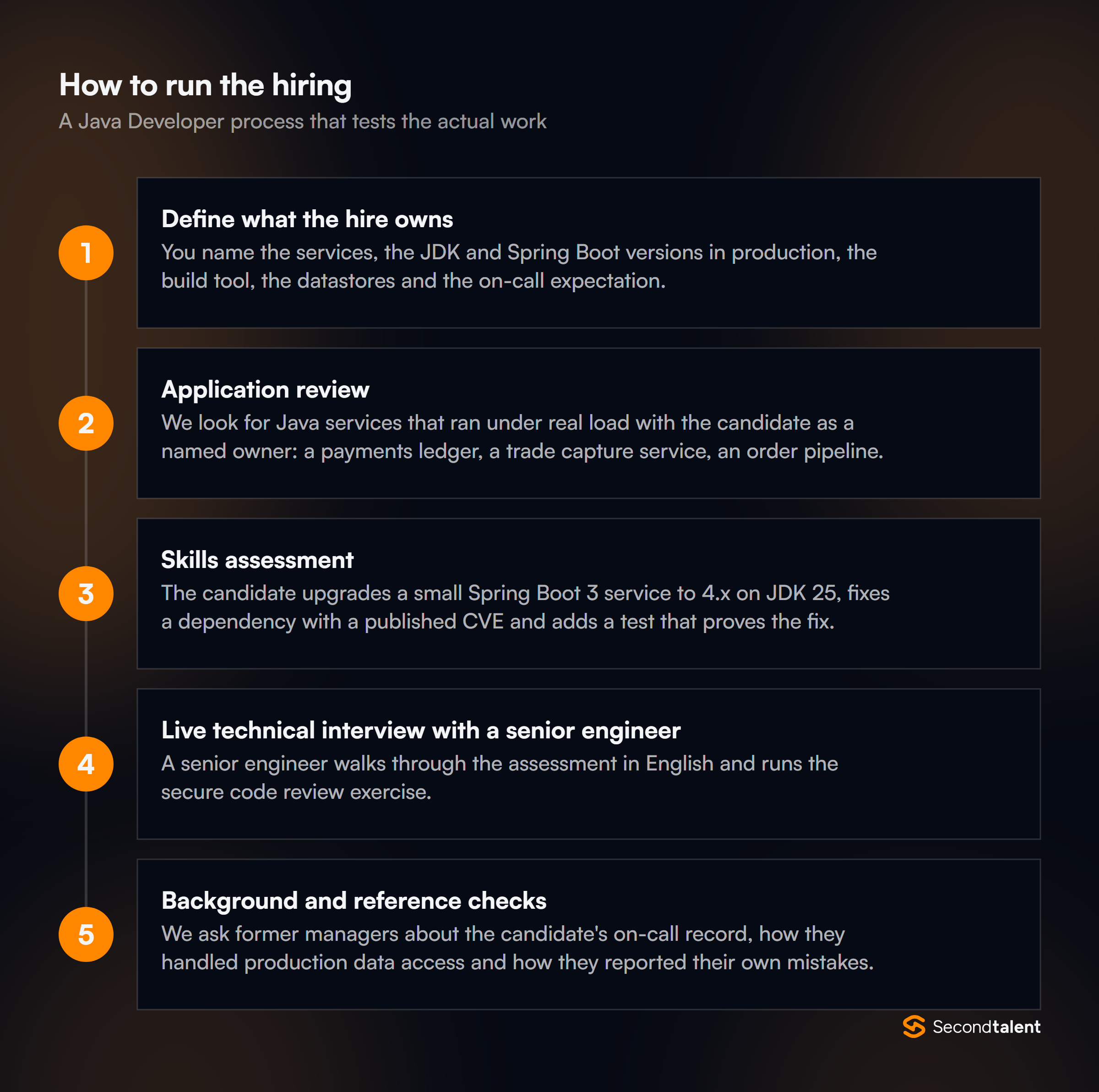
Second Talent's vetting covers stages 2 to 5 before you see a profile.
Stage 1: Define what the hire owns
You name the services, the JDK and Spring Boot versions in production, the build tool, the datastores and the on-call expectation. Add the upgrade you need done in the first quarter and pick a shift from the table above.
Stage 2: Application review
We look for Java services that ran under real load with the candidate as a named owner: a payments ledger, a trade capture service, an order pipeline. A candidate should state the traffic, the JDK version and the worst incident they handled.
Stage 3: Skills assessment
The candidate upgrades a small Spring Boot 3 service to 4.x on JDK 25, fixes a dependency with a published CVE and adds a test that proves the fix. We score the diff, the test and the upgrade note.
Stage 4: Live technical interview with a senior engineer
A senior engineer walks through the assessment in English and runs the secure code review exercise. The design question is a payment service that must stay up while the team patches a library across 30 instances.
Stage 5: Background and reference checks
We ask former managers about the candidate's on-call record, how they handled production data access and how they reported their own mistakes. You then choose the contractor or EOR route above.
Hire Java Developers from Singapore with Second Talent
We shortlist 6-8 candidates within 24 hours from 100,000+ pre-vetted engineers, accepting only the top 1% of applicants. Java developers from Singapore come with $0 upfront, no lock-in and 4-6 hours of daily overlap with US hours. We handle contracts, payroll and equipment, with compliant EOR contracts in Singapore.
Our pricing page sets out the monthly subscription, and for a wider search we also staff Java developers from across Asia and back-end developers in Singapore.