Most roles in artificial intelligence are judged on work that can be inspected. A model trained, a system shipped, a benchmark moved.
A Head of AI Research is judged on a portfolio of bets whose outcomes will not be legible for a year. The compute behind them could have been spent on something safer, and the team running them gets recruiter messages every week.
This guide covers what the role owns, how it differs from the titles it is confused with, what it pays, and what to look for when you hire one.
What is a Head of AI Research?
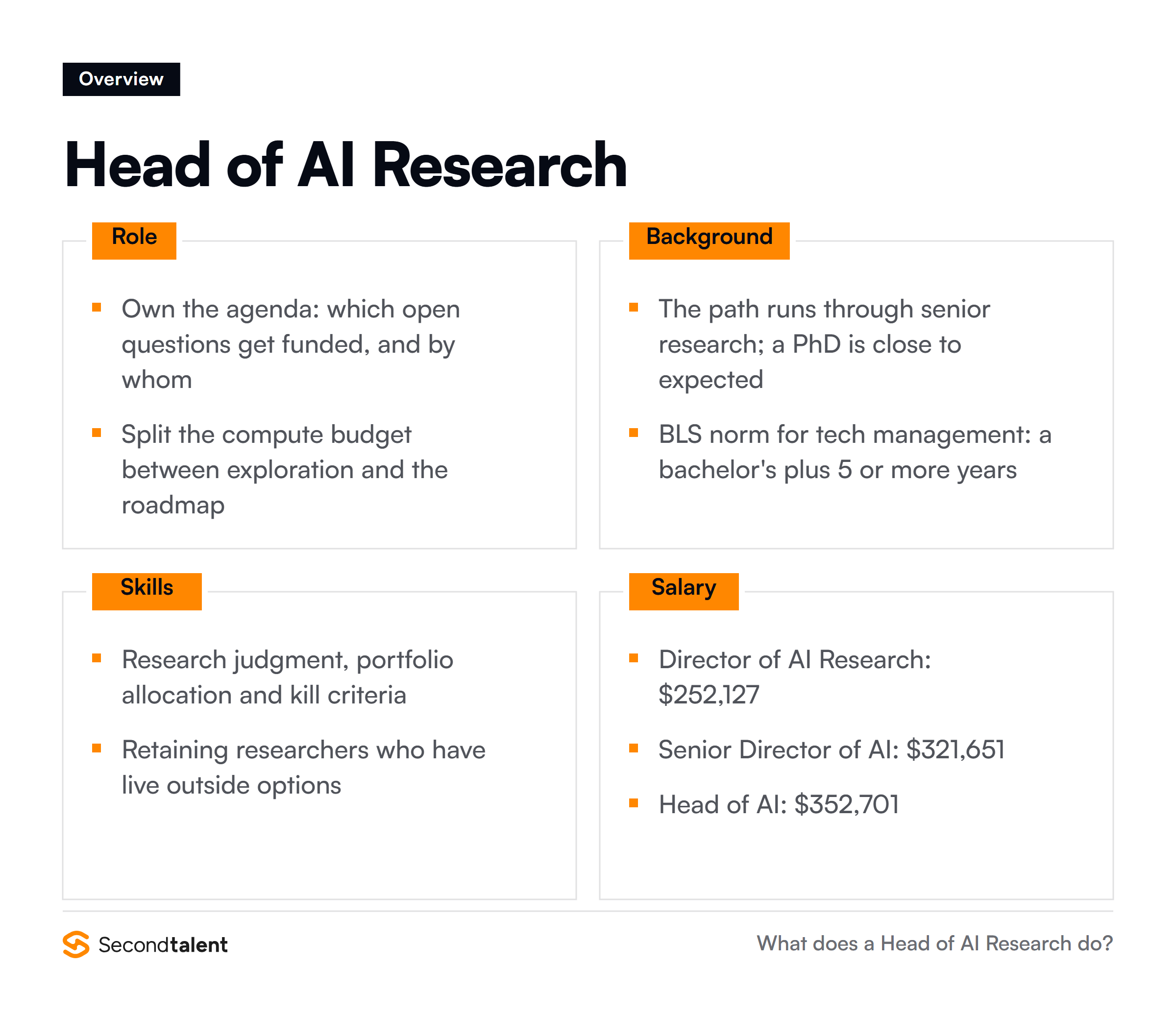
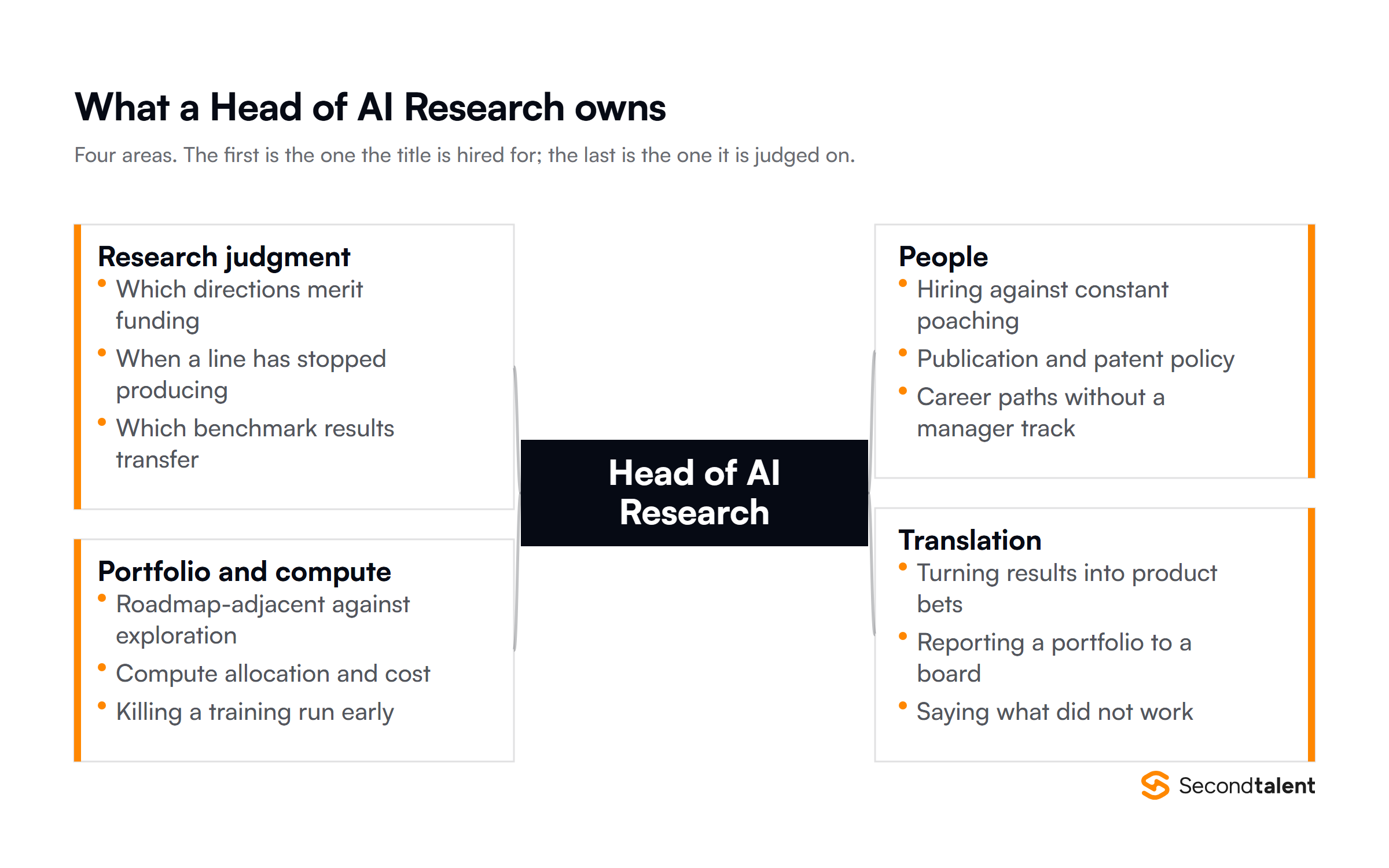
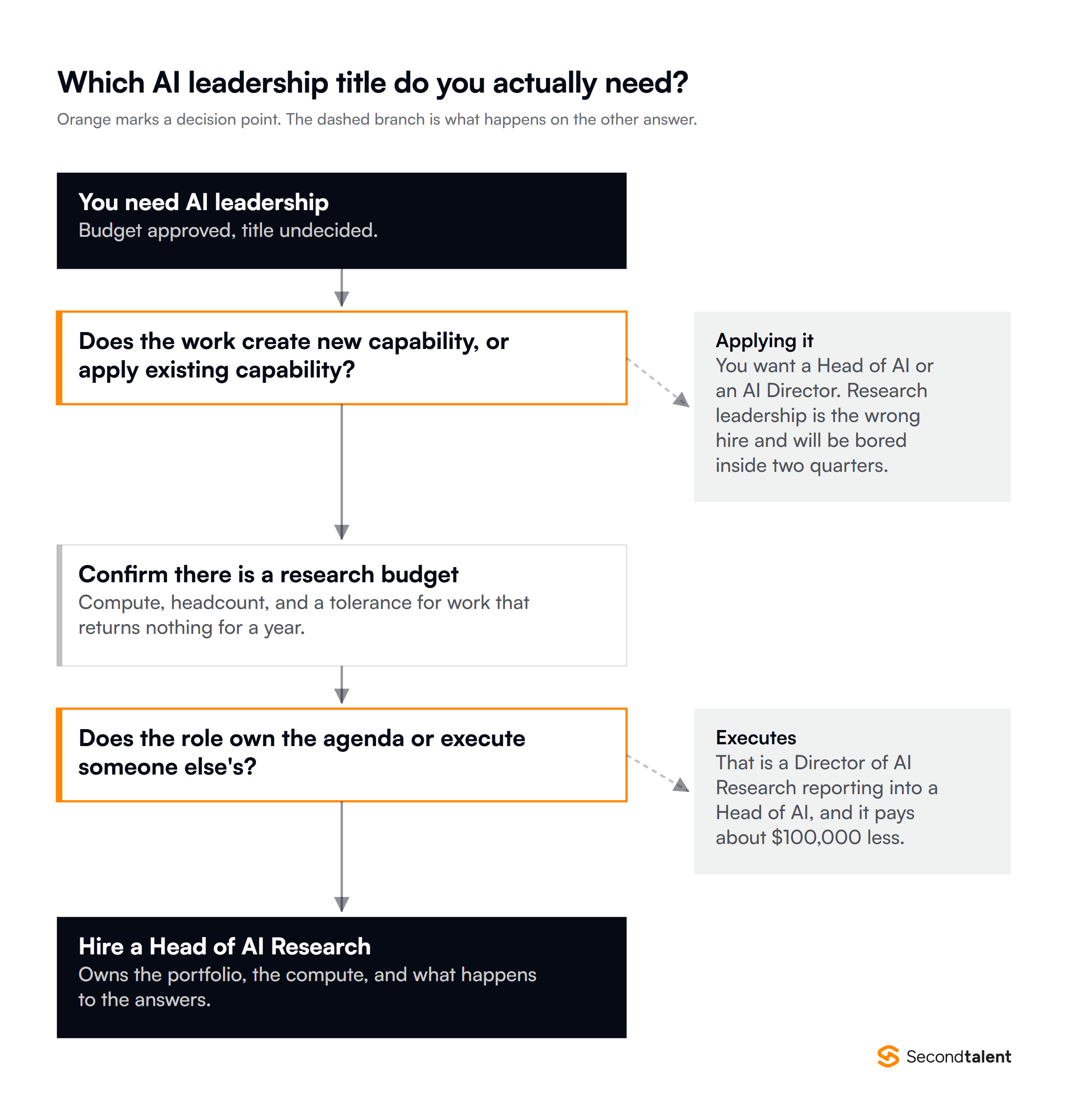
A Head of AI Research owns the research agenda. That means which open questions the company will fund, who answers them, and what happens to the answers. The role sits above the individual contributor track, and below or alongside the executive who owns AI overall. It is the first rung where the work is a portfolio rather than a project.
Head of AI Research Job Market and Salary Ranges
The market for research leadership follows the money going into research, and that money grew sharply. Stanford HAI’s 2026 AI Index reports that private AI investment grew 127.5 percent and now accounts for 60 percent of total corporate AI investment. Generative AI grew more than 200 percent and took nearly half of all private AI funding. Newly funded AI companies rose 71 percent. Each of those companies eventually needs someone to decide what its researchers work on.
Demand for the underlying skill base shows up in postings. Lightcast’s April 2026 analysis found AI skills in 2.5 percent of all US job postings, up 55 percent in a year.
Its country ranking is the part worth noticing. Singapore leads every market at 4.8 percent of postings, followed by Hong Kong at 3.5 percent, with the United States at 2.6 percent. The US appears as 2.5 and 2.6 percent in the two measures because they count slightly different things; both are Lightcast’s own figures.
Average Salary Ranges (US market):
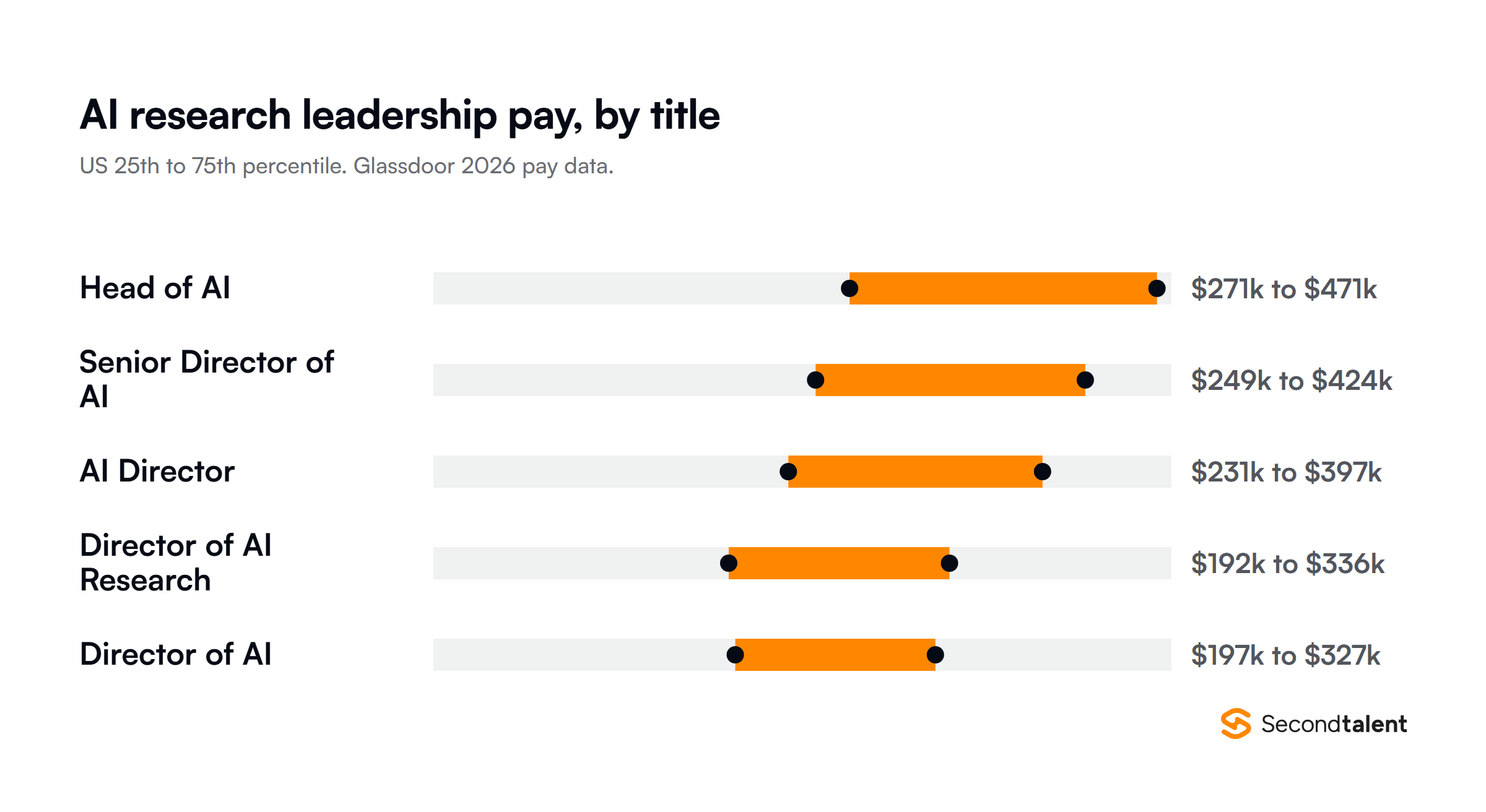
- Director of AI Research average: $252,127, ranging from $192,240 to $335,990
- Director of AI average: $250,779, with a 25th percentile of $196,513 and a 75th of $326,814
- AI Director average: $300,089, from $231,058 at the 25th percentile to $396,558 at the 75th
- Senior Director of AI average: $321,651, from $248,820 to $424,397
- Head of AI average: $352,701, from $270,940 at the 25th percentile to $471,065 at the 75th
Figures come from Glassdoor’s 2026 pay data. Two things are worth reading off that spread. Scope drives the number more than the word “research” does. The gap between a director and a head is roughly $100,000, which is the price of owning the agenda rather than executing it.
For a wider frame, the US Bureau of Labor Statistics reports a median of $175,140 for computer and information systems managers as of May 2025. It projects 16 percent growth from 2025 to 2035, with about 53,500 openings a year.
AI research leadership sits well above that median. The frontier premium shows up again at the management layer.
Hiring across Asia reaches research leaders with real lab experience at a fraction of the US bands. The posting data above puts Singapore and Hong Kong ahead of the United States on AI-skill density. Second Talent recruits across nine markets in the region, with vetting, compliance, and payroll handled for you.
Essential Head of AI Research Skills and Qualifications
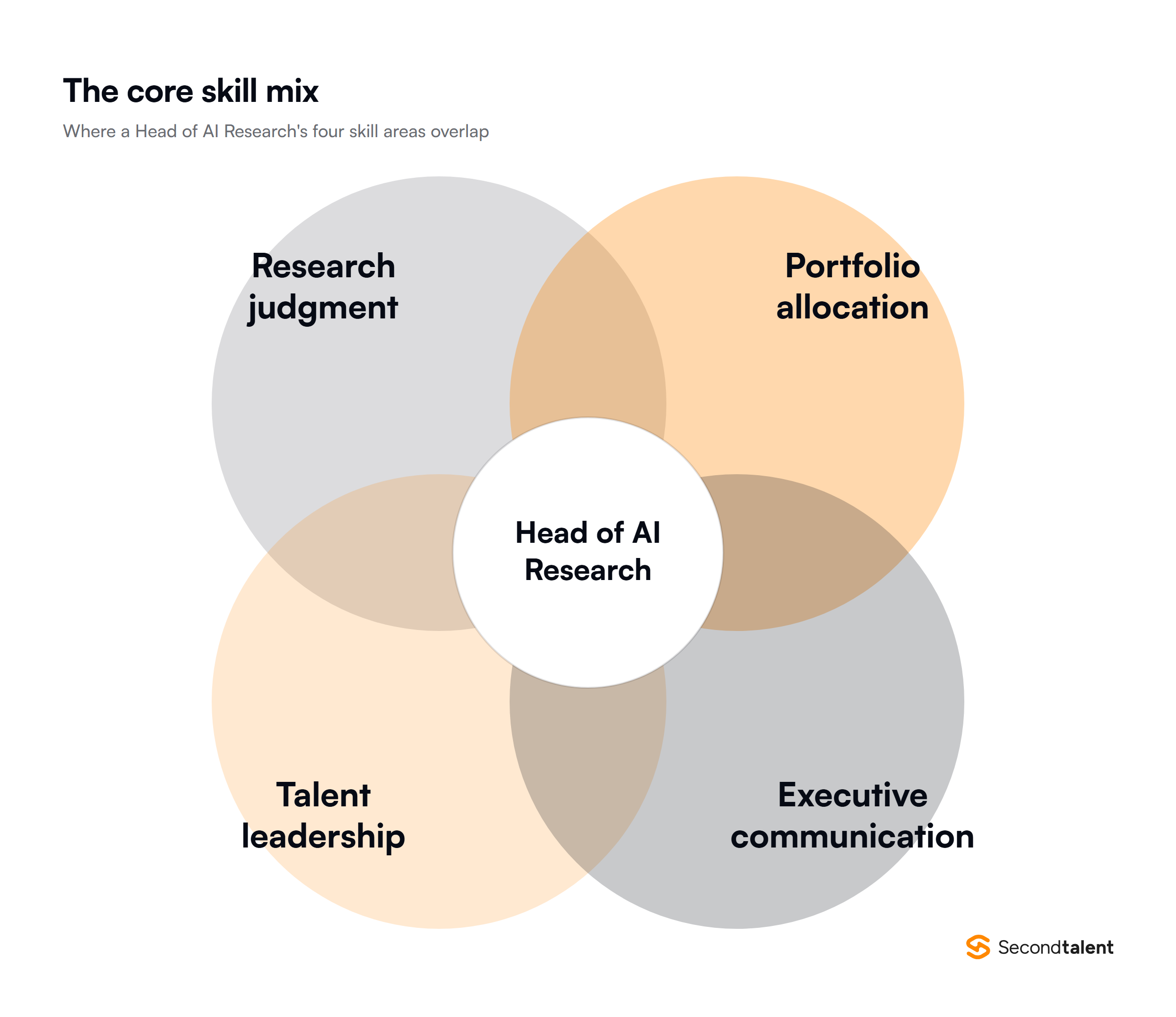
Research Judgment:
- Evaluating a research direction on its merits rather than on how well it was pitched
- Recognizing when a promising line has stopped producing and saying so before the team does
- Reading primary literature fast enough to know what has already been answered elsewhere
- Distinguishing a benchmark result that will transfer from one that will not, which is the most expensive judgment error available to the role
Portfolio and Resource Management:
- Running a portfolio with an explicit split between roadmap-adjacent work and genuine exploration
- Compute allocation and cost modeling, including the discipline to kill a training run that is not earning its budget
- Setting review checkpoints that catch a dead direction early without turning research into quarterly delivery
- Making the case for a research budget to a finance function that cannot inspect the output
Talent Leadership:
- Recruiting researchers who have competing offers, which means selling the problem and the environment rather than the package
- Retention through the levers that actually work in this field: problem choice, compute access, publishing freedom, and colleagues
- Growing researchers into senior individual contributors, and protecting that track so management is not the only way up
- Handling the departure of a key researcher without the agenda collapsing with them
Organizational Interface:
- Translating research progress into terms an executive team can act on, including the uncertainty
- Negotiating the handoff to engineering so results reach production without the research team becoming a delivery function
- Deciding what gets published, what gets patented, and what stays internal, which is a strategy question rather than a legal one
- Working with governance and safety functions early rather than at review time
Background: The path almost always runs through senior individual contributor research. A PhD is common and close to expected at frontier labs, alongside a publication record that earns credibility with the people being led. The Bureau of Labor Statistics lists a bachelor’s degree plus five or more years of experience as typical for technology management. AI research leadership is a more credentialed corner of that field.
Head of AI Research Career Paths and Progression
Career Progression:
- AI Research Scientist → Senior or Staff Research Scientist → Research Manager or Team Lead → Head of AI Research or Director of AI Research → VP of AI or Chief AI Officer
The step that catches people is the first one into management. Research leadership is a change of profession rather than a promotion for the strongest scientist. The skills that made someone a great researcher transfer only partially. The most common failure is a new head of research who keeps the best problem for themselves. The rest of the portfolio then gets managed at arm’s length.
Where the Role Varies:
- Frontier Lab: A large team, a long horizon, publishing as a recruiting instrument, and compute as the dominant constraint
- Applied Corporate Lab: A research function inside a product company, where the hardest part is protecting exploration from the roadmap and proving value to finance
- Startup Head of Research: Often three to eight people, no separation between research and shipping, and the role includes recruiting, fundraising support, and technical strategy
- Academic or Institute Lead: Grant funding, publication as the primary output, and a different set of incentives around openness
- Domain Research Lead: Health, finance, robotics, or another field where domain constraints and regulation shape the agenda as much as the methods do
Movement back to individual contributor work is more common than the org chart implies and carries no real stigma in this field. A number of the strongest researchers have taken a leadership role, run it for a few years, and returned to the bench deliberately.
Head of AI Research Tools and Operating Cadence
Portfolio and Planning:
- A written research agenda that states the open questions, the bets, and what would cause each to be abandoned
- A compute budget with allocation visible per project, reviewed on a fixed cycle rather than by whoever asks loudest
- Research review forums where directions are challenged on evidence, with the leader modeling how to take that challenge
- A kill criteria practice, agreed at the start of a direction rather than argued about at the end
Technical Infrastructure:
- Cluster scheduling and GPU utilization reporting, since idle capacity is the most common invisible waste in a research org
- Experiment tracking used across the team rather than per person, so results are comparable and reproducible
- Shared evaluation harnesses and internal benchmarks, which are the closest thing a research function has to a source of truth
- Internal publication of negative results, which is the highest return knowledge management practice available here
Talent and Communication:
- A named recruiting pipeline for senior researchers, run continuously rather than opened when someone leaves
- A dual career ladder written down and actually used, with senior individual contributor levels that pay competitively
- A regular briefing to the executive team that reports uncertainty honestly and does not oversell an early result
- A publishing policy that says what can go out and how fast, agreed with legal and product before it is needed
- Head of AI Research vs Head of AI: Head of AI is broader and usually includes deployment, platform, and applied teams as well as research. It is also the better paid title, averaging $352,701 against $252,127 for Director of AI Research, which reflects the wider scope rather than a deeper research mandate. If the role owns production AI systems as well as the research agenda, it is a Head of AI job whatever the posting says.
- Head of AI Research vs Chief AI Officer: The chief officer title is an executive one, accountable for AI strategy, governance and risk across the whole company. It frequently has no research organization underneath it. IBM’s 2026 CEO Study found 76 percent of surveyed organizations now have one, against 26 percent a year earlier. A Head of AI Research reports into that function in companies that have both. Where a CAIO exists without research staff, the job is mostly adoption and governance, which is a different discipline.
- Head of AI Research vs AI Enablement Lead: Enablement is about getting an existing organization to use AI tools well: workflow redesign, adoption, and measurable productivity gains. It creates no new capability and owns no research agenda. The two roles are complements, and a company that confuses them ends up asking researchers to run training sessions.
- Head of AI Research vs AI/ML Product Manager: Product management owns what gets built and for whom, scoped by customer value and a roadmap. Research owns what becomes possible, scoped by an open question. The healthy relationship is adversarial in a productive way, with the product side pulling for certainty and the research side protecting the exploration budget.
- Head of AI Research vs Principal AI Research Scientist: Both are senior, and at some labs they are paid comparably. The principal scientist advances the field through their own work and by raising the standard of everyone near them. The head of research advances it by choosing which questions get funded. Companies that force strong principals into management to keep progressing lose good scientists and gain mediocre managers.
Building Your Head of AI Research Track Record
What Hiring Committees Look For:
- A Research Record: Publications, released models, or a documented technical contribution substantial enough that senior researchers will respect the judgment behind it
- A Portfolio You Owned: Evidence you set a direction, funded it, and can explain both what worked and what you killed. The killed projects are the more informative half
- People You Grew: Named researchers who advanced under you, and ideally one who now leads something themselves
- A Research to Product Transfer: One concrete case where work from your team reached production, with the handoff described honestly including what went wrong
- Retention Through a Hard Period: Keeping a team together through a reorganization, a funding change, or an aggressive competitor is the single most predictive signal for this role
The interview question that separates candidates is what they stopped funding and why. Anyone can describe the bets that paid off. Ask for a direction they killed and the evidence that convinced them. A leader who cannot name one has not been making real allocation decisions.
Head of AI Research Methodology and Best Practices
Write the agenda down. An unwritten research agenda becomes whatever the loudest researcher is currently interested in. Stating the questions, the bets, and the reasoning makes the portfolio arguable, which is the point.
Set kill criteria before the work starts. Agreeing in advance what evidence would end a direction removes the sunk cost argument later, and it is far easier to negotiate before anyone is invested.
Protect the exploration budget explicitly. An unprotected share of the portfolio gets consumed by the roadmap within two quarters. Naming the percentage and defending it is a large part of the job.
Allocate compute like a budget, not a favor. Ad hoc GPU access rewards whoever is most persistent rather than whichever direction is most promising, and researchers notice quickly which one is happening.
Make internal negative results first class. Every direction abandoned quietly gets re-explored by the next person who joins. Writing up what did not work is the cheapest compounding asset a research function has.
Sell the problem, not the package. Compensation gets a candidate to a conversation. What keeps a strong researcher is the problem, the compute, the freedom to publish, and the people at the next desk. The leader controls all four.
Getting Started as a Head of AI Research
Practical Steps:
- Build the research record first. Credibility with the team is not optional in this role and cannot be acquired after the fact
- Lead a project before leading people: own a direction end to end, including the decision to stop it
- Take a small team and learn the management craft properly, particularly the parts that have nothing to do with research
- Practice writing an agenda. Producing a document that states questions, bets, and kill criteria is a skill, and most first attempts are a list of interests instead
- Learn to model compute cost, because a leader who cannot reason about the budget will lose the argument for it
- Get experience of a research to production handoff from both sides, since the interface is where most research functions fail
- Recruit and retain deliberately while still an individual contributor. Bringing one strong person in and keeping them is the smallest version of the whole job
Candidates arriving from a pure research background usually need to build organizational skill, particularly the ability to make a case to people who cannot evaluate the work directly. Candidates arriving from engineering management need to build research judgment. It is harder to acquire late, and a research team tests it in the first month.
If you are hiring rather than applying, Second Talent recruits AI research leaders and the teams they build across Asia. Related hiring pages cover machine learning engineers, LLM engineers, and data scientists, with vetting, contracts, compliance, and payroll handled for you.
Frequently Asked Questions
What does a Head of AI Research do?
A Head of AI Research owns the research agenda. That covers which open questions the company funds, who works on them, how compute splits between exploration and the roadmap, and what happens to the results. The four recurring decisions are agenda setting, resource allocation, talent retention, and managing the interface between research and the rest of the business. It is a portfolio job rather than a project job, which is what separates it from senior individual contributor research.
What is the difference between a Head of AI Research and a Head of AI?
Head of AI is the broader title and usually covers deployment, platform, and applied teams as well as research. Glassdoor’s 2026 data puts Head of AI at an average of $352,701 against $252,127 for Director of AI Research, and the gap reflects scope rather than research depth. If the role owns production AI systems as well as the agenda, it is a Head of AI job regardless of the posting title.
How much does a Head of AI Research earn?
Glassdoor’s 2026 data puts Head of AI at an average of $352,701, ranging from $270,940 at the 25th percentile to $471,065 at the 75th. Director of AI Research averages $252,127 with a range of $192,240 to $335,990, and Senior Director of AI averages $321,651. For a wider frame, the Bureau of Labor Statistics reports a $175,140 median for computer and information systems managers as of May 2025.
Do you need a PhD to become a Head of AI Research?
It is close to expected at frontier labs, because the role requires credibility with researchers who mostly hold one and the judgment to evaluate directions on the merits. Applied corporate research functions and startups are more flexible, where a strong record of shipped technical work and demonstrated portfolio judgment can substitute. The path almost always runs through senior individual contributor research either way.
Is a Head of AI Research the same as a Chief AI Officer?
No. Chief AI Officer is an executive role accountable for AI strategy, governance and risk across the whole company. Many companies have one with no research organization at all. A Head of AI Research owns a research agenda and the team executing it, and reports into the executive function where both exist. Where a CAIO has no research staff, the job is mostly adoption and governance work.
How much does it cost to hire a Head of AI Research through Second Talent?
Cost depends on scope, team size, and whether the mandate is frontier research or applied. Hiring across Asia reaches leaders with real lab experience well below US bands. Lightcast puts Singapore and Hong Kong ahead of the United States on AI-skill density. Get in touch for a current rate breakdown.
How quickly can Second Talent place a Head of AI Research?
Leadership searches run longer than individual contributor placements because the shortlist is smaller and the interview process is deeper. We can usually present pre-vetted candidates within a couple of weeks, with placements completed in several weeks depending on your process and notice periods.
Related Roles
Explore related roles you can hire on Second Talent: AI Scientist, AI Research Scientist, Applied Scientist, AI Enablement Lead, AI/ML Product Manager, AI Governance Specialist, AI Alignment Researcher, Neural Network Architect, Chief AI Officer.