Job titles in artificial intelligence describe a layer of the stack. AI Scientist describes a method. The role belongs to whoever answers the questions a model card cannot. Whether this architecture holds at ten times the data. Whether the evaluation everyone trusts measures the right thing. Whether a result that looked decisive was an artifact of one random seed.
What is an AI Scientist?
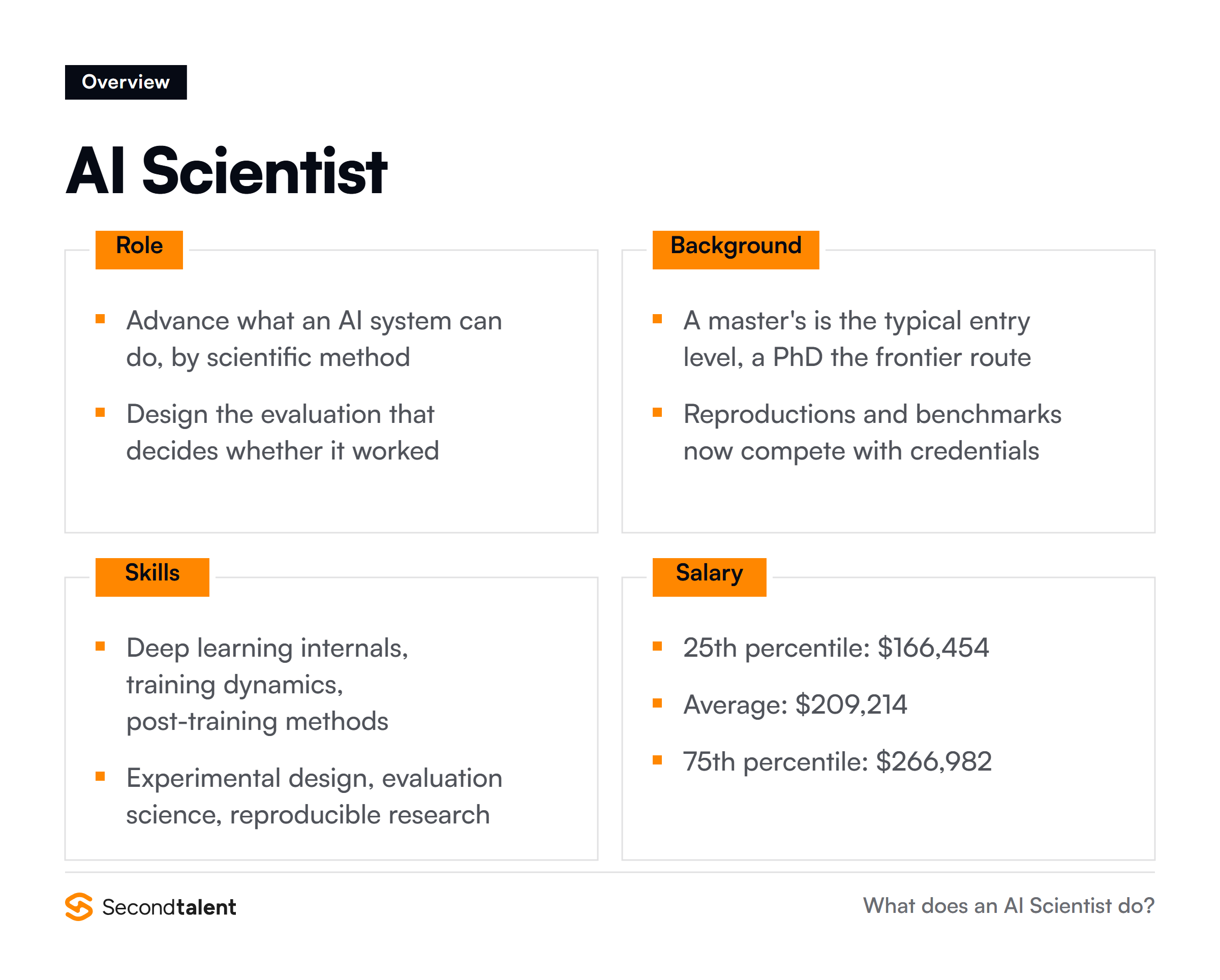
An AI Scientist advances what an artificial intelligence system can do, using the scientific method rather than engineering convention. The work starts with a question the organization cannot yet answer. It runs through experiments designed to answer it, and ends with a defensible claim about what is true. Whether that claim becomes a paper or a production system depends on where the person works, not on what the job is.
Three activities make up most of the role. The first is method development: designing an architecture, a training objective, or a data strategy that does something the existing recipe cannot. The second is evaluation design, now the harder half of the job. Models produce open-ended output, and the old accuracy metrics no longer say anything useful. The third is analysis, meaning the work of establishing why a system behaves as it does rather than accepting that it does.
What separates an AI Scientist from a strong machine learning engineer is the relationship to uncertainty. An engineer is given a target and finds a way to hit it. A scientist is given an ambiguity and is expected to resolve it, including the possibility that the answer is no.
AI Scientist vs Adjacent AI Roles
“AI Scientist” is an umbrella term in some organizations and a specific title in others. Candidates and hiring managers therefore talk past each other. The distinctions below are the ones that hold up in practice.
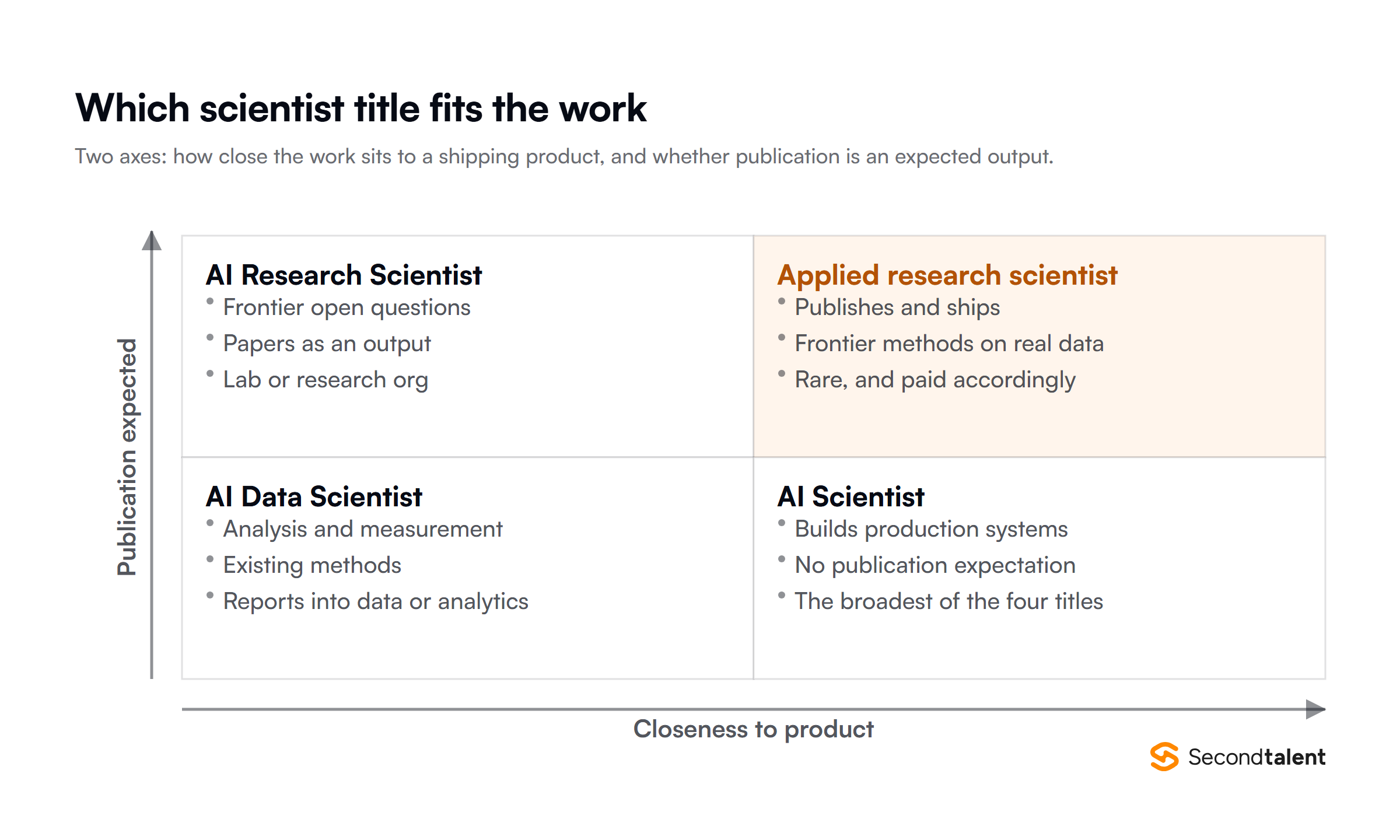
AI Scientist vs AI Research Scientist: The research scientist title implies publication as an output and a frontier problem as the subject. AI Scientist is broader and does not carry that expectation. Every AI Research Scientist is an AI Scientist; the reverse is not true. Glassdoor’s separate band for AI Research Scientist averages $198,304, below the $209,214 AI Scientist figure, which reflects how many senior industrial roles now carry the shorter title.
AI Scientist vs Applied Scientist: Applied science is scoped by a product metric. The question is always in service of something a customer will use, and the result is judged by whether the metric moved. An AI Scientist may work that way or may work on a capability question with no product attached to it yet. If your requirement is “make this recommendation system better and prove it”, the applied science title describes the job more accurately.
AI Scientist vs Machine Learning Engineer: The engineering title owns reliability, throughput, and cost of a system that is already understood. Serving infrastructure, retraining pipelines, and latency budgets belong to ML infrastructure engineers and MLOps engineers, not to scientists. Teams that hire a scientist to run their pipelines waste the hire and usually lose them within a year.
AI Scientist vs Data Scientist: Data science answers business questions from data, mostly with statistics and mostly to inform a decision. AI Scientists build and interrogate learning systems. The overlap is real at the analytical end, which is why the behavioral data scientist and AI scientist paths sometimes cross, but the day to day work is different.
AI Scientist vs AI Alignment Researcher or AI Ethics Researcher: Both are AI scientists with a fixed subject. Alignment work asks whether a system does what was intended under adversarial conditions. Ethics work asks whether the intent and its consequences are defensible. Neither is a subset of general capability research, and neither should be staffed by borrowing someone from it part time.
AI Scientist Job Market and Salary Ranges
Demand for the skill set behind this title is measurable in job postings rather than in the title itself, because employers label the same work half a dozen ways. Lightcast data published in the 2026 Stanford AI Index found that 2.5 percent of all US job postings now mention AI skills. That is up 55 percent in a year, 72 percent since 2022, and close to 300 percent over the decade.
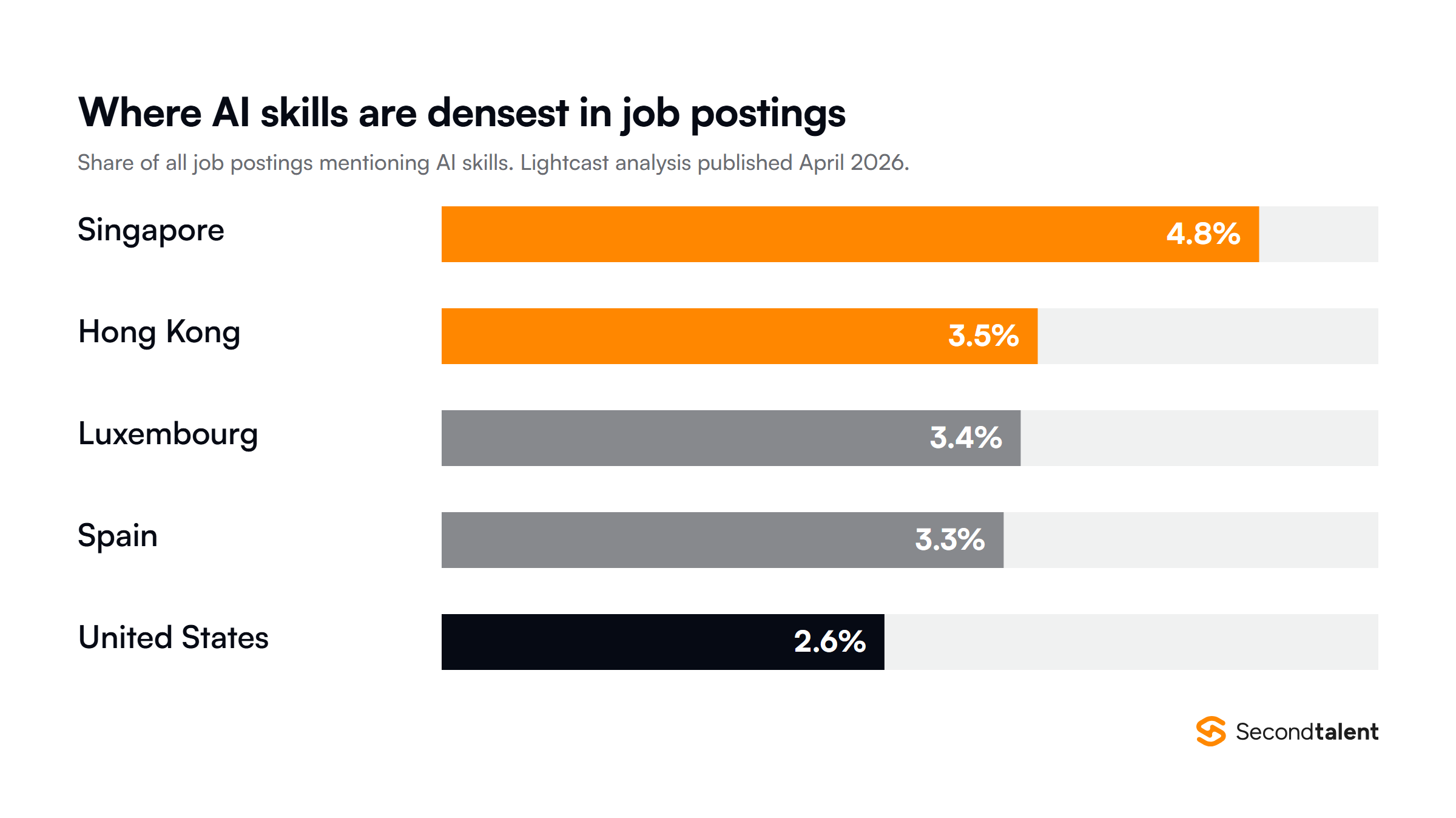
The geography of that demand is the part worth noticing. Singapore leads every market at 4.8 percent of postings mentioning AI skills, followed by Hong Kong at 3.5 percent, with the United States at 2.6 percent. The US shows as 2.5 and 2.6 percent in Lightcast’s two measures, which count slightly different things. Two of the three densest AI labor markets on the planet are in Asia, which is the opposite of what most hiring plans assume.
Average Salary Ranges (US market):
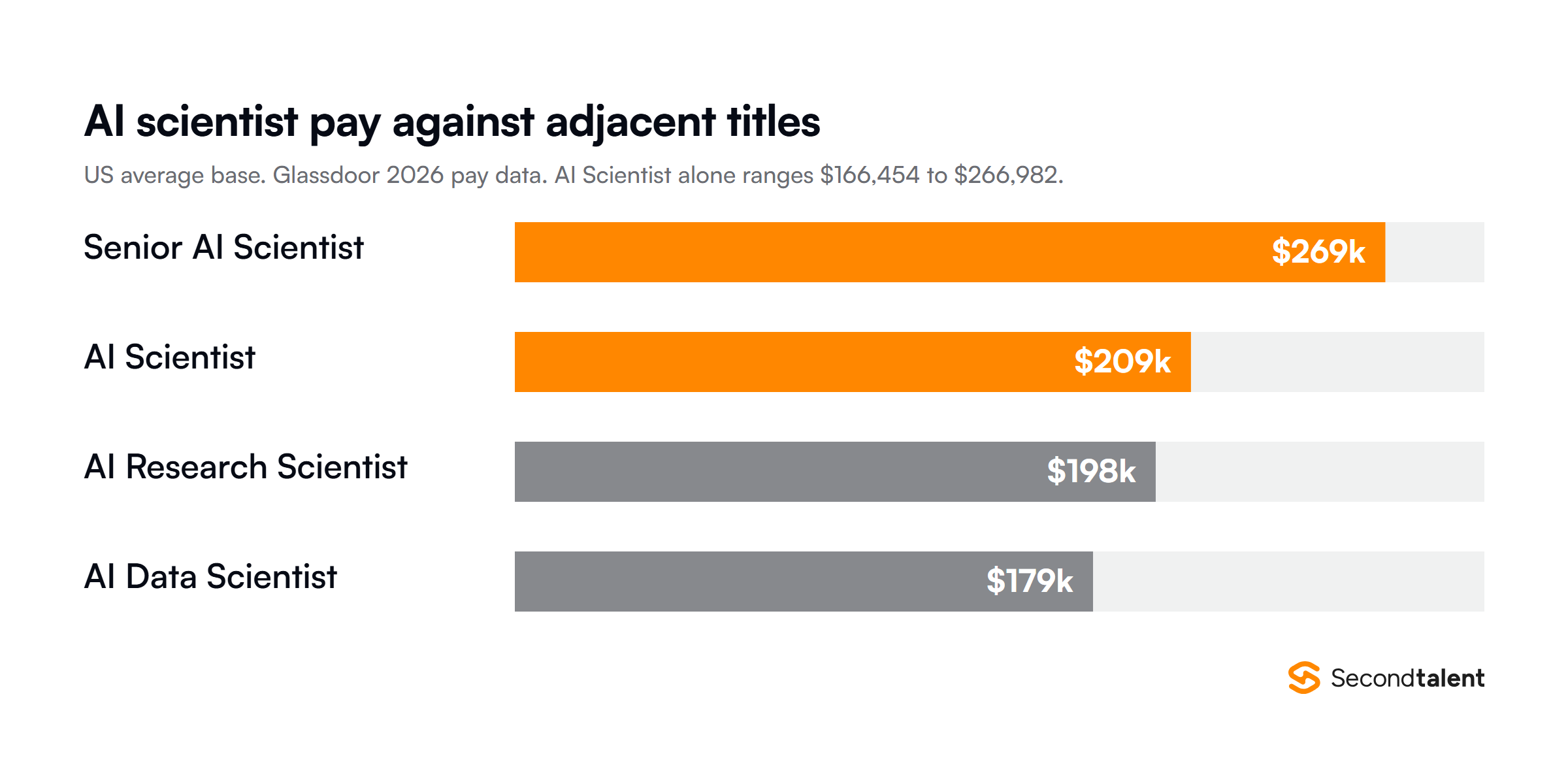
- 25th percentile AI Scientist: $166,454
- Average AI Scientist: $209,214
- 75th percentile AI Scientist: $266,982
- Senior AI Scientist average: $269,362
- AI Research Scientist average, for comparison: $198,304
- AI Data Scientist average, for comparison: $178,913
Salary figures come from Glassdoor’s 2026 pay data. For a wider frame, the US Bureau of Labor Statistics reports a median of $140,300 for computer and information research scientists as of May 2025. It projects 22 percent growth from 2025 to 2035, with roughly 2,900 openings a year. The gap between that median and the Glassdoor bands is the frontier AI premium, and it is unusually wide right now.
Hiring across Asia reaches research-trained candidates from strong quantitative programmes at a fraction of those bands. The posting data above shows the supply is real rather than theoretical. Second Talent places AI scientists and other AI-native specialists across nine markets in the region, with vetting, compliance, and payroll handled for you.
Essential AI Scientist Skills and Qualifications
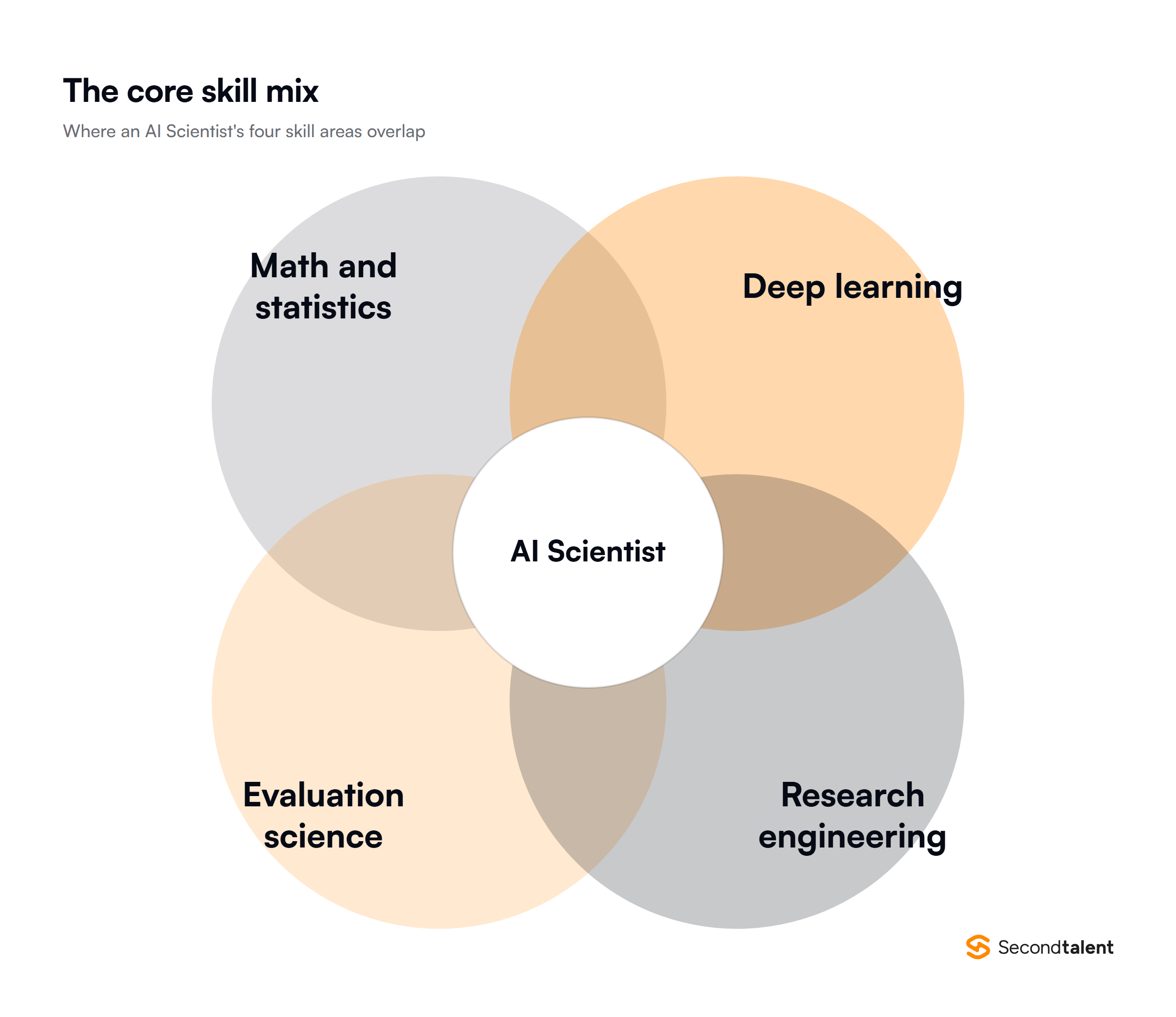
Mathematical and Statistical Foundations:
- Linear algebra, multivariate calculus, and optimization theory at the level needed to reason about why a training run diverges
- Probability and statistical inference, including the discipline to separate a real effect from a favorable random seed
- Information theory as it applies to representation learning, compression, and objective design
- Experimental design: power, variance, confounders, and what a result does and does not license you to claim
Deep Learning and Modern Architectures:
- Transformer internals in detail, including attention variants and the trade-offs each one buys
- Training dynamics at scale: learning rate schedules, initialization, instability, and how to diagnose a run that is quietly failing
- Post-training methods, including supervised fine-tuning, preference optimization, and reinforcement learning from feedback
- Efficiency techniques such as quantization, distillation, and sparsity, and honest accounting of what each one costs in quality
Evaluation and Measurement:
- Designing evaluations for open-ended output, where a single scalar metric usually hides more than it reveals
- Building golden datasets and holdout sets that survive contact with a shifted distribution
- Calibrating automated scoring against human judgment, and knowing when the automated scorer has been gamed
- Benchmark contamination awareness, since a headline result on a leaked test set is worse than no result at all
Engineering Capability:
- Research-grade Python with PyTorch or JAX, written well enough that another person can re-run the experiment
- Distributed training across multiple GPUs and nodes, and a working understanding of where the time actually goes
- Data pipeline work, including deduplication, filtering, and the curation decisions that dominate final model quality
- Reproducibility practice: seeds fixed, data versioned, configuration recorded as part of the experiment rather than after it
Scientific Communication:
- Writing a result clearly enough that a reader can find the flaw in it, which is the point
- Reading and reproducing primary literature quickly, including the parts authors leave out
- Presenting uncertainty to non-technical stakeholders without either overclaiming or hedging into uselessness
- Reviewing colleagues’ work adversarially and taking the same treatment in return
Educational Background: The Bureau of Labor Statistics lists a master’s degree as the typical entry-level requirement for computer and information research scientists. A PhD in computer science, machine learning, statistics, physics or mathematics is the common route into frontier research roles. Applied AI science roles now accept a strong record of published reproductions, open-source work and shipped systems in place of the credential.
AI Scientist Career Paths and Specializations
Career Progression:
- ML Engineer or PhD candidate → AI Scientist → Senior AI Scientist → Staff or Principal AI Scientist → Research Lead or Head of AI Research
The individual contributor track runs unusually deep in this field. Principal and distinguished scientist roles at major labs pay at or above the engineering management ladder. Moving into management is a choice rather than the only way to keep progressing.
Specialization Areas:
- Foundation Model Research: Pretraining, scaling behavior, architecture, and data strategy, overlapping with the Neural Network Architect role
- Post-Training and Adaptation: Preference optimization, instruction tuning, and domain adaptation, the specialty nearest the Fine-Tuning Engineer title
- Evaluation Science: Benchmark design, contamination detection, and human evaluation methodology, currently the scarcest specialty in the market
- Interpretability: Establishing why a model produces a given output, which underpins both safety work and debugging at scale
- Multimodal and Language: Vision, audio, and text systems, adjacent to the NLP Engineer path
- Agents and Reasoning: Tool use, planning, and long-horizon reliability, the area feeding the AI Agent Developer and RAG Engineer roles
- Efficiency: Quantization, distillation, and inference cost, shading into AI Inference Engineer territory
Movement between the scientist and engineering tracks happens in both directions and carries no stigma. Scientists who develop strong systems instincts often end up owning a model’s full lifecycle, and engineers who develop experimental rigor often end up owning the questions.
AI Scientist Tools and Technologies
Research Stack:
- Python with PyTorch, and JAX where the work is closer to the frontier
- Hugging Face libraries for models, datasets, and tokenizers
- Distributed training frameworks such as DeepSpeed, FSDP, or Megatron style parallelism
- Experiment tracking with Weights and Biases, MLflow, or an internal equivalent, used from the first run rather than retrofitted
Evaluation and Analysis:
- Evaluation harnesses and golden datasets built for the specific capability under test
- Statistical tooling for significance, confidence intervals, and power
- Interpretability libraries for probing, attribution, and activation analysis
- Human evaluation workflows with annotator agreement measured rather than assumed
Data and Compute:
- Large-scale data processing with Spark, Ray, or equivalent distributed tooling
- Deduplication and filtering pipelines, where most of the real quality gains hide
- GPU cluster scheduling with Slurm or Kubernetes, and enough cost literacy to justify a training run
- Synthetic data generation, which brings the Synthetic Data Curator discipline into scope
Literature and Collaboration:
- arXiv, OpenReview, and conference proceedings from NeurIPS, ICML, ICLR, and ACL
- Reproduction repositories and model weights released alongside papers
- LaTeX for writing, and version control used for papers as well as code
- Internal research notes that record failed directions, which are the artifacts teams most often fail to keep
Building Your AI Scientist Portfolio
Portfolio Components:
- A Reproduction: Take a published result, reproduce it, and document what the paper omitted. That record shows more than most original projects, because it proves you can read carefully and debug someone else’s claim
- An Original Investigation: One question you formed, tested properly, and answered, with the experimental design visible and the limitations stated
- An Evaluation Artifact: A benchmark, golden dataset, or scoring method you built, plus evidence of how you validated that it measures what you claim
- A Negative Result: A promising approach you tested and rejected, written up honestly. Rare enough to be memorable and the clearest available signal of scientific maturity
- Open-Source Contribution: Work merged into a research library, which shows your code holds up under review by people who did not have to be polite about it
Publications at major venues remain the strongest single credential for frontier roles, but they are no longer the only entry route. A public record of careful reproductions and well-designed evaluations competes credibly at most companies outside the largest labs. It is the faster path for candidates without a research degree.
One thing hiring managers probe hardest: whether you can state what would have falsified your own conclusion. Candidates who cannot answer that have usually been doing engineering with a scientific vocabulary.
AI Scientist Methodology and Best Practices
State the hypothesis before the experiment. Writing down what you expect and what would disprove it, in advance, is the cheapest guard against reading a story into noise after the fact.
Build the baseline honestly. A weak baseline manufactures a result. The comparison has to be against the best version of the alternative, tuned with the same effort you gave your own method.
Run enough seeds. A single run is an anecdote. Variance across seeds is frequently larger than the improvement being claimed, and reporting it costs nothing but credibility gained.
Check the test set for contamination. Benchmarks leak into pretraining corpora constantly. A result on a contaminated set is not merely wrong, it points the roadmap in the wrong direction for months.
Design the evaluation before the method. If you cannot say how you will know whether an approach worked, you are not yet ready to build it. For open-ended systems this step now takes longer than the modelling.
Keep the failure log. Directions that did not work are institutional knowledge. Teams that record only their successes re-explore the same dead ends every time someone new joins.
Make the work reproducible by someone else. Fixed seeds, versioned data, and recorded configuration. If a result cannot be regenerated in six months, it was never a result.
Future of AI Scientist Careers
The most direct pressure on this role comes from automation of research itself. Stanford HAI’s 2026 AI Index reports private AI investment grew 127.5 percent in 2025. Sakana AI’s system, confusingly also called The AI Scientist, generates ideas, reads literature, runs experiments through agentic tree search, and writes the paper. Its second version produced the first fully AI-generated paper to pass human peer review, at the ICLR 2025 ICBINB workshop, with an average reviewer score of 6.33. The authors withdrew the paper before publication by prior agreement with the organisers, so it is a workshop acceptance rather than a published result. The methodology was published in Nature in March 2026.
The honest reading is that this changes the ratio of the job rather than the existence of it. Running an experiment is becoming cheap. Deciding which experiment is worth running, and judging whether its result means anything, is not. Expect AI Scientists to supervise larger volumes of automated experimentation and to spend proportionally more of their time on problem selection and on verification.
Expect evaluation to keep rising in status. Systems now produce output that no scalar metric captures. Whoever can build a trustworthy measurement of quality holds more leverage than whoever can train another model. This is already the hardest position to fill in most AI organizations.
Expect interpretability to move from a research luxury to a requirement. Regulatory pressure and simple operational necessity both push toward explaining model behavior rather than observing it, which links this role directly to the AI Safety Auditor and AI Governance Specialist functions.
Expect the talent map to keep widening. Singapore and Hong Kong now carry a higher density of AI-skilled job postings than the United States. The assumption that frontier-capable scientists have to be hired in the Bay Area is out of date.
Getting Started as an AI Scientist
Practical Steps:
- Build the mathematical foundation properly. Linear algebra, probability, and optimization are not background knowledge in this role, they are the working tools
- Implement a transformer from scratch, train it on a small corpus, and understand every line. The exercise is standard because it works
- Reproduce a published result end to end and write up what the paper left out
- Learn experimental design and statistics to the point where you can defend a claim against a hostile reviewer
- Pick one specialization and go deep, since generalist profiles compete poorly for scientist roles
- Publish something, whether a paper, a reproduction, a benchmark, or a negative result, and make it findable
- Strengthen your distributed training and data engineering, because a scientist who cannot run their own experiments at scale depends on someone else’s queue
Candidates arriving from a PhD usually need to build engineering throughput and the judgment to abandon an elegant direction that will not ship. Candidates arriving from machine learning engineering usually need to build experimental rigor, particularly around evaluation design and the honest reporting of variance. Both routes are well travelled.
If you are hiring rather than applying, Second Talent recruits AI Scientists and adjacent specialists across Asia. Related hiring pages cover machine learning engineers, LLM engineers, and data scientists, with vetting, contracts, compliance, and payroll handled for you.
Frequently Asked Questions
What does an AI Scientist do?
An AI Scientist develops and evaluates AI systems using scientific method. That means forming a hypothesis about what a model or training approach can do, designing experiments that would disprove it, and establishing what is true. The three core activities are method development, evaluation design, and analysis of why a system behaves as it does. It is distinct from machine learning engineering, which owns the reliability and cost of systems that are already understood.
What is the difference between an AI Scientist and an AI Research Scientist?
AI Research Scientist implies publication as an output and a frontier problem as the subject. AI Scientist is the broader term and carries no publication expectation, which is why it now covers many senior industrial roles. Glassdoor’s 2026 data puts the AI Scientist average at $209,214 against $198,304 for AI Research Scientist. In practice, read the job description rather than the title.
How much does an AI Scientist earn?
Glassdoor’s 2026 data puts the US average at $209,214, ranging from $166,454 at the 25th percentile to $266,982 at the 75th, with senior AI scientists averaging $269,362. The US Bureau of Labor Statistics reports a $140,300 median for computer and information research scientists as of May 2025, which is the broader occupational category. Hiring across Asia reaches research-trained candidates well below the US bands.
Do you need a PhD to become an AI Scientist?
Not universally. The Bureau of Labor Statistics lists a master’s degree as the typical entry-level requirement for the occupational category. A PhD remains the common route into frontier research roles at major labs. Applied AI science roles accept a strong public record of reproductions, benchmarks, open-source work and shipped systems instead.
Is AI Scientist a good career in 2026?
The demand signal is strong. AI skills now appear in 2.5 percent of all US job postings, up 55 percent year on year. The Bureau of Labor Statistics projects 22 percent growth for computer and information research scientists between 2025 and 2035. Automated research systems are changing the balance of the work toward problem selection and verification rather than removing the role.
How much does it cost to hire an AI Scientist through Second Talent?
Cost depends on seniority and specialization, with evaluation science and interpretability commanding more than general modelling work. Hiring across Asia reaches strong research-trained candidates well below US bands. Lightcast puts Singapore and Hong Kong ahead of the United States on AI-skill density. Get in touch for a current rate breakdown.
How quickly can Second Talent place an AI Scientist?
We can usually present a shortlist of pre-vetted candidates within days, with placements typically completed in a few weeks depending on your interview process and start-date requirements.
Related Roles
Explore related roles you can hire on Second Talent: AI Research Scientist, Applied Scientist, AI Alignment Researcher, Neural Network Architect, Fine-Tuning Engineer, Machine Learning Infrastructure Engineer, AI Ethics Researcher, Natural Language Processing (NLP) Engineer, Head of AI Research.