In 2025, a quarter of organizations had a Chief AI Officer. A year later, three quarters did. IBM’s 2026 CEO Study puts it at 76 percent, up from 26 percent. It surveyed 2,000 CEOs across 33 geographies and 21 industries between February and April 2026.
Few executive roles have scaled that fast. A jump that steep usually means two different things are being counted under one title.
That is the practical problem with hiring one. The title is common enough that boards expect it, and new enough that no two companies mean the same thing by it. This guide covers what the mandate is, how it differs from the roles it overlaps, and what the evidence says it is worth.
What is a Chief AI Officer?
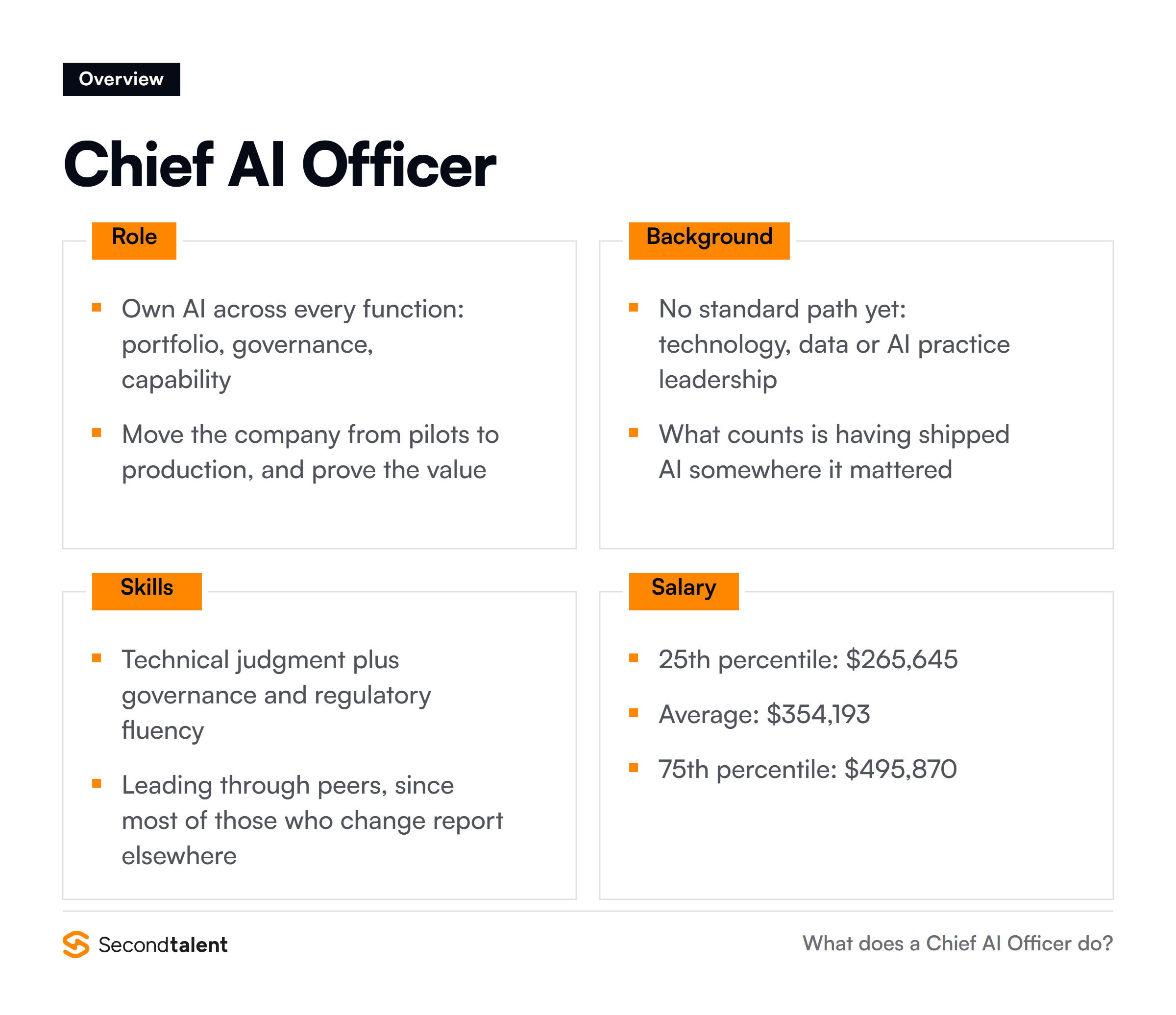
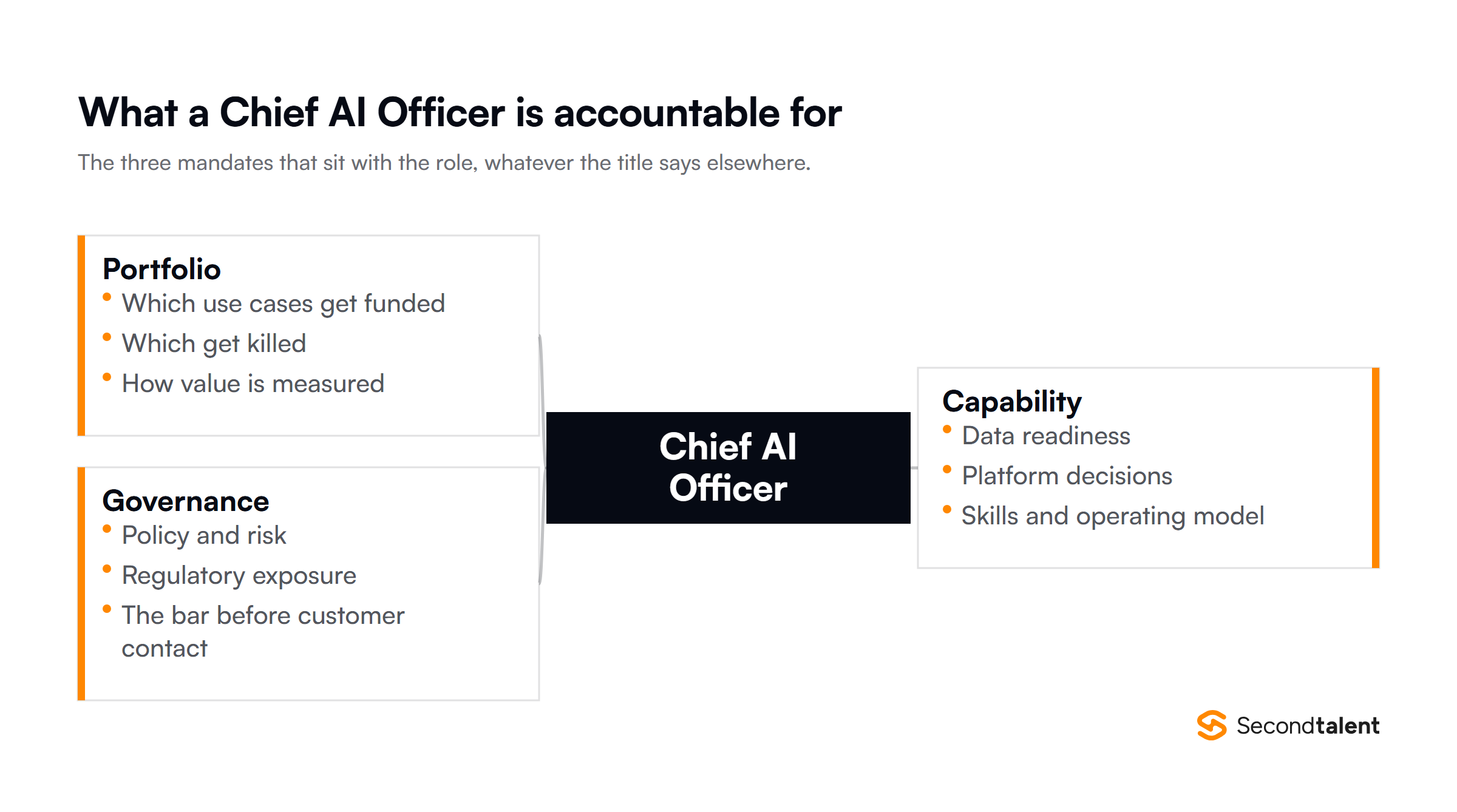
A Chief AI Officer is the executive accountable for how a company uses artificial intelligence. That means where it is applied, what it is allowed to do, and whether the investment returns anything. The role is enterprise-wide by design. It is not the head of an AI team, and its authority comes from the mandate rather than from the size of the organization reporting to it.
Chief AI Officer Job Market and Salary Ranges
The demand signal is clean. IBM’s 2026 study found 76 percent of surveyed organizations had a Chief AI Officer, against 26 percent the year before. Companies with one reported 5 percent higher return on their AI investments.
Read that number carefully. A 5 percent ROI difference is real but modest, and CEOs reported it about their own organizations rather than an auditor measuring it.
Average Salary Ranges (US market):
- 25th percentile: $265,645
- Average Chief AI Officer: $354,193
- 75th percentile: $495,870
- 90th percentile: $648,173
Figures come from Glassdoor’s 2026 data. One caveat belongs with them. The estimate rests on a small number of self-reported salaries because the title is new, so treat the bands as an order of magnitude rather than a benchmark. Equity matters more than base at this level.
Stanford HAI’s 2026 AI Index reports private AI investment grew 127.5 percent, and it now accounts for 60 percent of total corporate AI investment. Newly funded AI companies rose 71 percent. The same report puts generative AI adoption at 61 percent of the population in Singapore against 28.3 percent in the United States.
The hiring signal points the same way. Lightcast’s April 2026 analysis found AI skills in 2.5 percent of all US job postings, up 55 percent in a year. Singapore leads every market at 4.8 percent, followed by Hong Kong at 3.5 percent, with the United States at 2.6 percent. The market for AI leadership is not concentrated where the funding is.
Second Talent recruits AI leadership and the teams beneath it across nine Asian markets, with vetting, compliance, and payroll handled for you.
Essential Chief AI Officer Skills and Qualifications
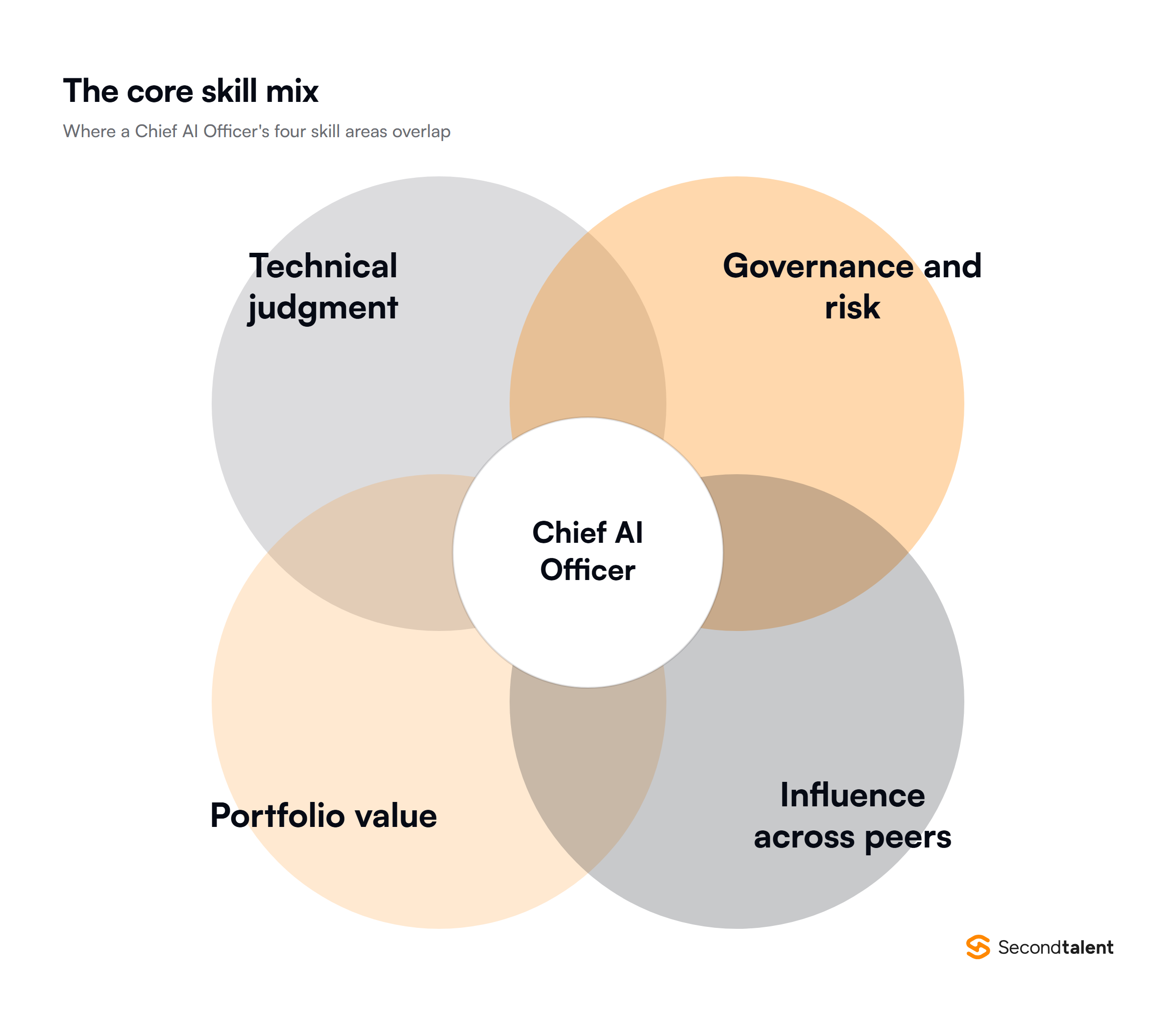
Technical Judgment:
- Enough depth to evaluate a vendor claim, a build-versus-buy case, or an internal proposal without relying on the person making it
- A working grasp of what current systems can and cannot do reliably, which is the single most common gap in executives who arrive from general management
- Understanding of data readiness, because most stalled AI programs are data problems wearing an AI costume
Governance and Risk:
- Building policy that engineers can actually follow, rather than a document that gets acknowledged and ignored
- Regulatory fluency across the jurisdictions you operate in, and the judgment to act before the rules are final
- Incident response for AI-specific failures, which look nothing like traditional outages
- Working with AI governance specialists and safety auditors as a standing function, not a review gate
Business and Portfolio:
- Framing AI investment in terms a CFO accepts, including honest accounting of what has not paid off
- Ruthless use case selection, since the scarce resource is organizational attention rather than compute
- Killing projects publicly and early, which sets the standard for everyone else’s portfolio hygiene
Organizational Influence:
- Leading through peers, because most of the people who must change report to someone else
- Communicating capability and risk to a board without either hype or hedging
- Building the operating model that lets teams ship within guardrails instead of queuing for approval
Background: There is no standard path yet. Most CAIOs arrive from technology leadership, data leadership, or senior AI practice, and the strongest candidates have run something with a real budget and a real failure behind them. Advanced technical degrees are common but not decisive; what is decisive is having shipped AI into production somewhere it mattered.
Why the title spread so fast
Part of the jump is regulation rather than fashion. US federal agencies were required to designate a Chief AI Officer under OMB Memorandum M-24-10, published in March 2024, with a deadline of 31 May that year. The same memo set up a Chief AI Officers Council across government.
A mandate on that scale normalises a title quickly. It also explains part of the gap between how many companies have the role and how many have given it real authority.
Chief AI Officer Career Paths and Progression
Common Routes In:
- From technology leadership: CTO, CIO, or VP of Engineering who owned an AI program and grew the mandate around it
- From data leadership: Chief Data Officer expanding into AI, the most frequent single path, and the one most at risk of governance crowding out delivery
- From AI practice: Head of AI Research or VP of AI stepping up, strong on capability and usually needing to build commercial and board fluency
- From consulting or transformation: Strong on change management and stakeholder work, and needs to prove technical judgment quickly or lose the engineering organization
Where It Leads: The role is too new to have a settled next step. In practice it runs toward COO or CEO in AI-native companies, and toward a wider technology remit in larger ones. For those who have done it once, it leads back into board and advisory work. The 2026 IBM study found 77 percent of respondents saying talent and technology leadership roles are converging, so the boundaries around this seat will keep moving.
One caution for candidates. A CAIO role without budget authority, without a direct line to the CEO, or without the power to stop a project is a title rather than a job. Ask which of the three you get before accepting.
Chief AI Officer vs Adjacent Executive Roles
Many companies added AI to an existing executive’s remit rather than creating the role. The same job therefore appears under several titles. The distinctions that hold up in practice:
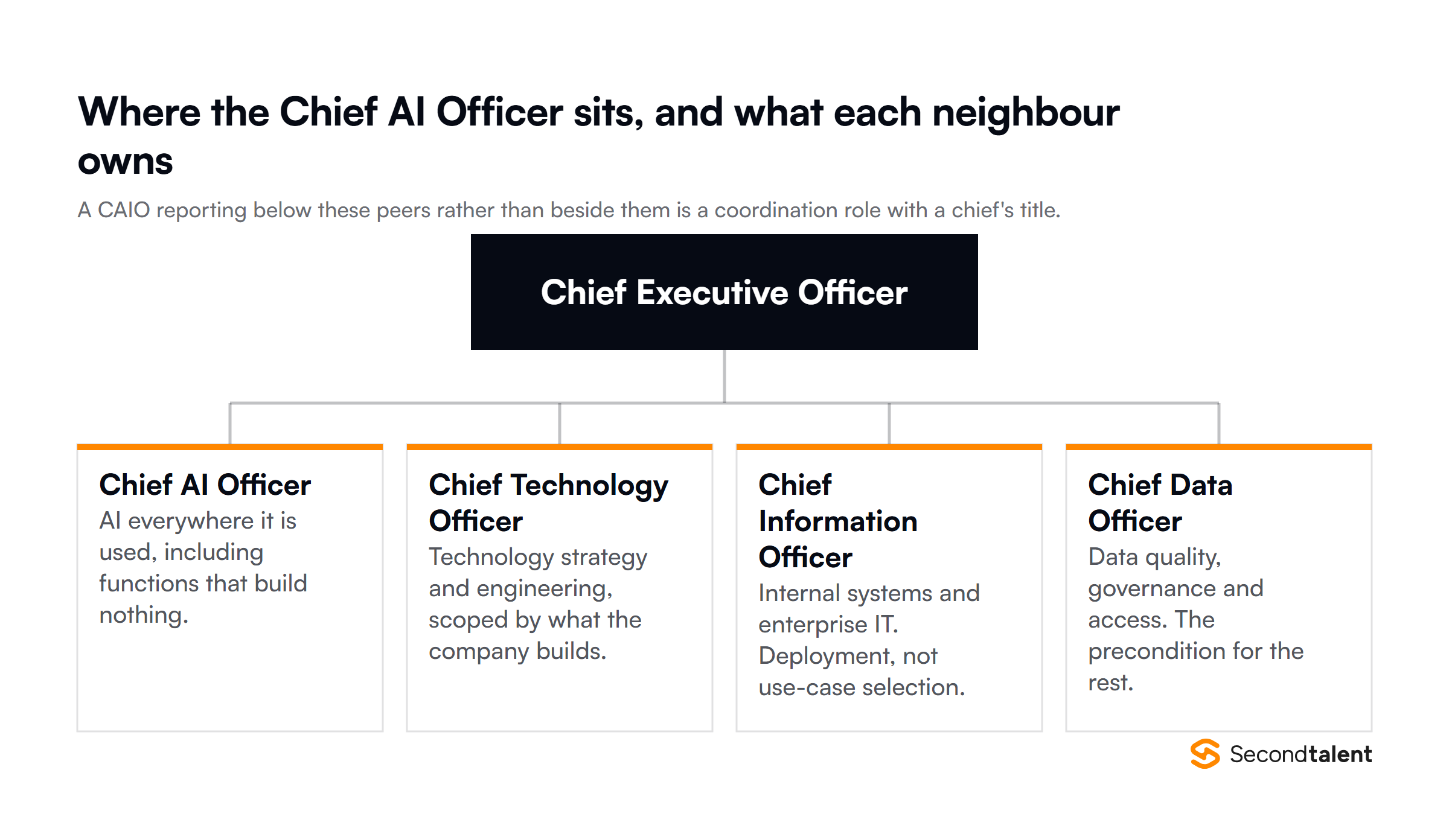
CAIO vs CTO: The CTO owns technology strategy and engineering, scoped by what the company builds. The CAIO owns AI across every function, including the ones that build nothing. Where a CTO holds the AI mandate, AI tends to be treated as a product capability, which works until legal, HR, and operations need it too.
CAIO vs CIO: The CIO owns internal systems, infrastructure, and enterprise IT. That covers deployment but rarely covers whether a use case is worth pursuing or defensible. The two roles are complements, and the CIO is usually the CAIO’s most important internal partner.
CAIO vs Chief Data Officer: Data leadership owns quality, governance, and access, which is the precondition for everything the CAIO wants to do. Some companies merge the roles, and it works when the combined leader genuinely has both skill sets. It fails when data governance quietly consumes all the attention and no AI ships.
CAIO vs Head of AI Research: Research owns what becomes possible, scoped by an open question and a compute budget. The CAIO owns what the company does about it, scoped by business outcomes and risk. Where both exist, the research function reports into the CAIO. Where a CAIO has no research staff at all, which is most companies, the job is adoption, governance, and vendor strategy rather than capability creation.
CAIO vs AI Enablement Lead: Enablement executes adoption: workflow redesign, training, and measured productivity gains. It is a delivery role reporting into the AI function, not a peer of it. Companies that hire an enablement lead and call it a CAIO get adoption without governance, and find out at the first incident.
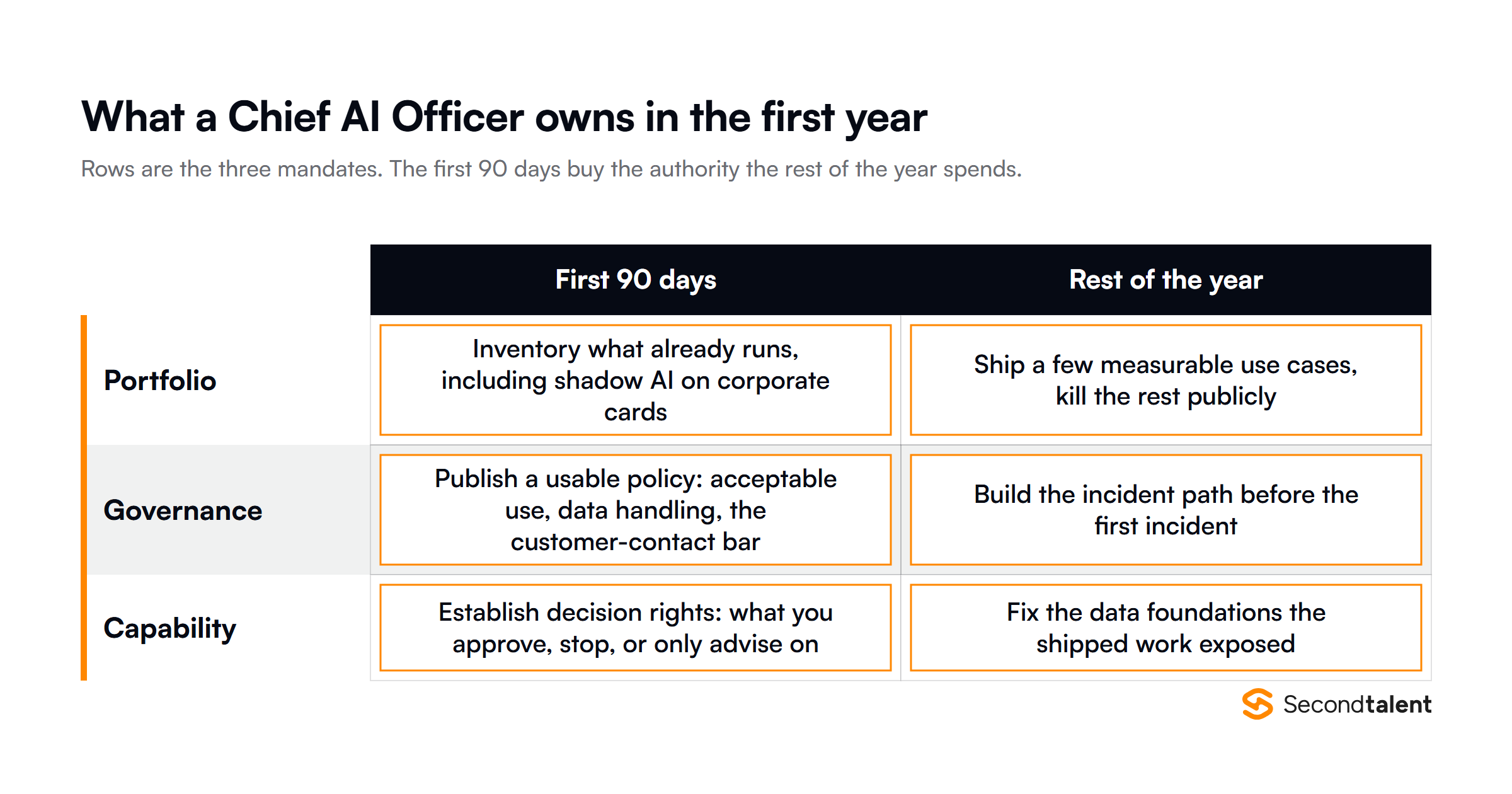
What a Chief AI Officer Owns in the First Year
First 90 days:
- Inventory what already exists, including the shadow AI running on corporate cards that nobody has told you about
- Establish the decision rights: what you approve, what you can stop, and what you merely advise on
- Publish a usable policy covering acceptable use, data handling, and the bar a system must clear before customer contact
The rest of the year:
- Pick a small number of use cases with measurable value and see them into production, because credibility comes from shipping rather than from strategy documents
- Kill the pilots that are not going anywhere, publicly, so the portfolio has a visible standard
- Fix the data foundations that the shipped use cases exposed, which is easier to fund once something real depends on them
- Build the operating model: platform choices, review paths, and the skills plan that stops every team solving the same problem separately
- Report value honestly to the board, including what did not work, which is what buys the second year’s budget
Chief AI Officer Best Practices
Ship something early. A CAIO who spends two quarters on strategy has spent the credibility they arrived with. One production use case is worth more than a complete roadmap.
Write policy engineers can follow. Governance that cannot be applied at a keyboard gets routed around, and the routing is invisible until an incident makes it visible.
Measure value, not activity. Model count, pilot count, and adoption rate are inputs. If nobody can name the business number that moved, the program has not produced one.
Kill projects visibly. Stopping work is the clearest signal that the portfolio is being managed on the merits, and it is the practice most often avoided.
Own the failures. AI incidents are a question of when. A CAIO who has built the response path in advance keeps the mandate; one who is still writing it during the incident does not.
Treat data readiness as your problem. It is the most common cause of a stalled program and the easiest thing to hand to someone else and then be blamed for.
Future of the Chief AI Officer Role
Whether the role is permanent is still open. One case says it is transitional. Once AI is ordinary infrastructure, the mandate distributes back to the CTO, CIO and functional leaders, the way no company now employs a Chief Electricity Officer. A three-times jump in a single year is also consistent with a title spreading faster than the substance behind it.
The case for permanence is regulation and risk. Those do not distribute easily, they require a named accountable executive, and they get heavier rather than lighter. Where that is true, the role consolidates around governance and portfolio value rather than around technology.
Either way, expect two near-term shifts. The measurement bar will rise, because a role adopted this quickly will be asked to justify itself within a couple of budget cycles. And the talent map will widen. Population-level AI adoption is already higher in Singapore than in the United States. The assumption that this leadership has to be hired in one or two markets is out of date.
Frequently Asked Questions
What does a Chief AI Officer do?
A Chief AI Officer is the executive accountable for how a company uses AI across every function. That covers which use cases get funded and killed, what governance and risk standards apply, and whether the investment returns anything. IBM describes the role as an orchestrator of organizational change rather than a technical specialist, focused on moving companies from pilots to production. It is enterprise-wide by design and is not the same as running an AI team.
What is the difference between a Chief AI Officer and a CTO?
The CTO owns technology strategy and engineering, scoped by what the company builds. The CAIO owns AI everywhere it is used, including functions that build nothing, such as legal, HR, and operations. Many companies add AI to an existing CTO or CIO remit instead of creating the role, which works until non-engineering functions need AI too.
How much does a Chief AI Officer earn?
Glassdoor’s 2026 data puts the US average at $354,193, ranging from $265,645 at the 25th percentile to $495,870 at the 75th, with the 90th percentile at $648,173. That estimate rests on a small number of self-reported salaries because the title is new, so treat it as an order of magnitude. Equity typically matters more than base at this level.
How many companies have a Chief AI Officer?
IBM’s 2026 CEO Study found 76 percent of surveyed organizations had a CAIO, up from 26 percent a year earlier. It covered 2,000 CEOs across 33 geographies and 21 industries between February and April 2026. Estimates vary widely between surveys depending on company size and methodology, and self-reported adoption of a fast-spreading title should be read with some caution.
Is a Chief AI Officer worth hiring?
IBM found companies with a CAIO achieved 5 percent higher return on AI investments. That is a modest, self-reported figure, so treat it as a signal rather than a business case. The role earns its cost where AI touches regulated decisions, customer outcomes, or many functions at once. Where AI sits inside one product team, a CTO can hold the mandate.
How quickly can Second Talent place AI leadership?
Executive searches run longer than individual contributor placements because the shortlist is small and the process is deeper. We can usually present pre-vetted candidates within a couple of weeks, with placements completed in several weeks depending on your process and notice periods. Get in touch for a current rate breakdown.
Related Roles
Explore related roles you can hire on Second Talent: Head of AI Research, AI Enablement Lead, AI Governance Specialist, AI Safety Auditor, Ethical AI Compliance Officer, AI/ML Product Manager, AI Scientist.