There is a job between research and engineering that neither title describes well. It is not writing papers, and it is not shipping someone else’s model. It is owning an open scientific question that a product depends on, running the experiments to answer it, and then building the answer into something customers use.
That job is Applied Scientist. The title is standard at Amazon, Microsoft, and a widening set of technology companies, and it carries an average US salary of roughly $200,000. Applied Scientists are measured on whether a product metric moved, not on publication count, which is the cleanest way to separate them from research scientists.
What is an Applied Scientist?
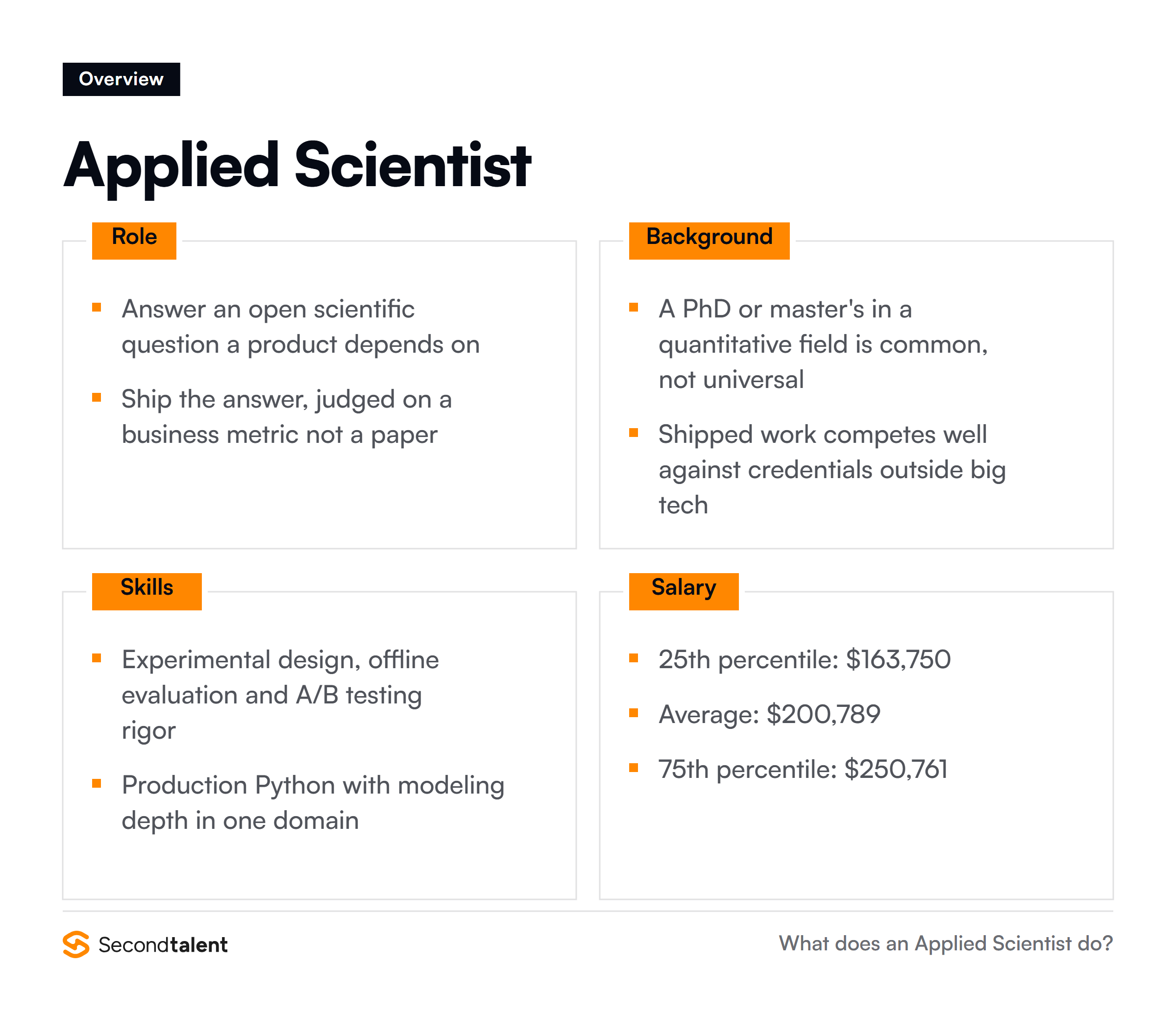
An Applied Scientist develops and ships machine learning systems that solve a specific business problem, using research methods but judged on product outcomes. The work begins where an off-the-shelf model is not good enough: a ranking problem with unusual constraints, a forecasting task where the standard approach breaks, a domain where the available data is too sparse for a conventional recipe.
The distinguishing feature is experimental rigor applied to a product question. An Applied Scientist frames a hypothesis, designs an offline evaluation that predicts online behavior, runs the experiment, and defends the result against the obvious objections before anyone else raises them. That last habit is what separates the role from general machine learning engineering, where a model that performs well in validation is often considered done.
Applied Scientist Job Market and Career Opportunities
Applied Scientist is an established title with real depth of demand, not an emerging one. Amazon, Microsoft, and their peers hire the role at scale, and it has spread to companies whose products depend on ranking, forecasting, personalization, pricing, fraud detection, or any other problem where a percentage point of accuracy translates directly into revenue.
Demand has shifted since generative AI arrived, but not downwards. A large share of applied science work now involves adapting foundation models to a domain, designing evaluations for systems whose output is text, and answering whether a fine-tuned model actually beats a well-configured prompt, which is a question few teams can answer rigorously.
Average Salary Ranges (US market):
- 25th percentile: $163,750
- Average Applied Scientist: $200,789
- 75th percentile: $250,761
- Applied Machine Learning Scientist average: $203,538
- Machine Learning Research Scientist average, for comparison: $227,975
Figures come from Glassdoor’s 2026 salary data. A PhD carries a $20,000 to $50,000 premium at entry level in research-oriented roles, and less of one in applied roles, where demonstrated shipping experience competes well against credentials.
Hiring across Asia reaches strong applied science candidates, particularly from quantitative and research-trained backgrounds, at rates well below the US bands above. Screening should focus on experimental judgment and shipped outcomes rather than publication lists.
Essential Applied Scientist Skills and Qualifications
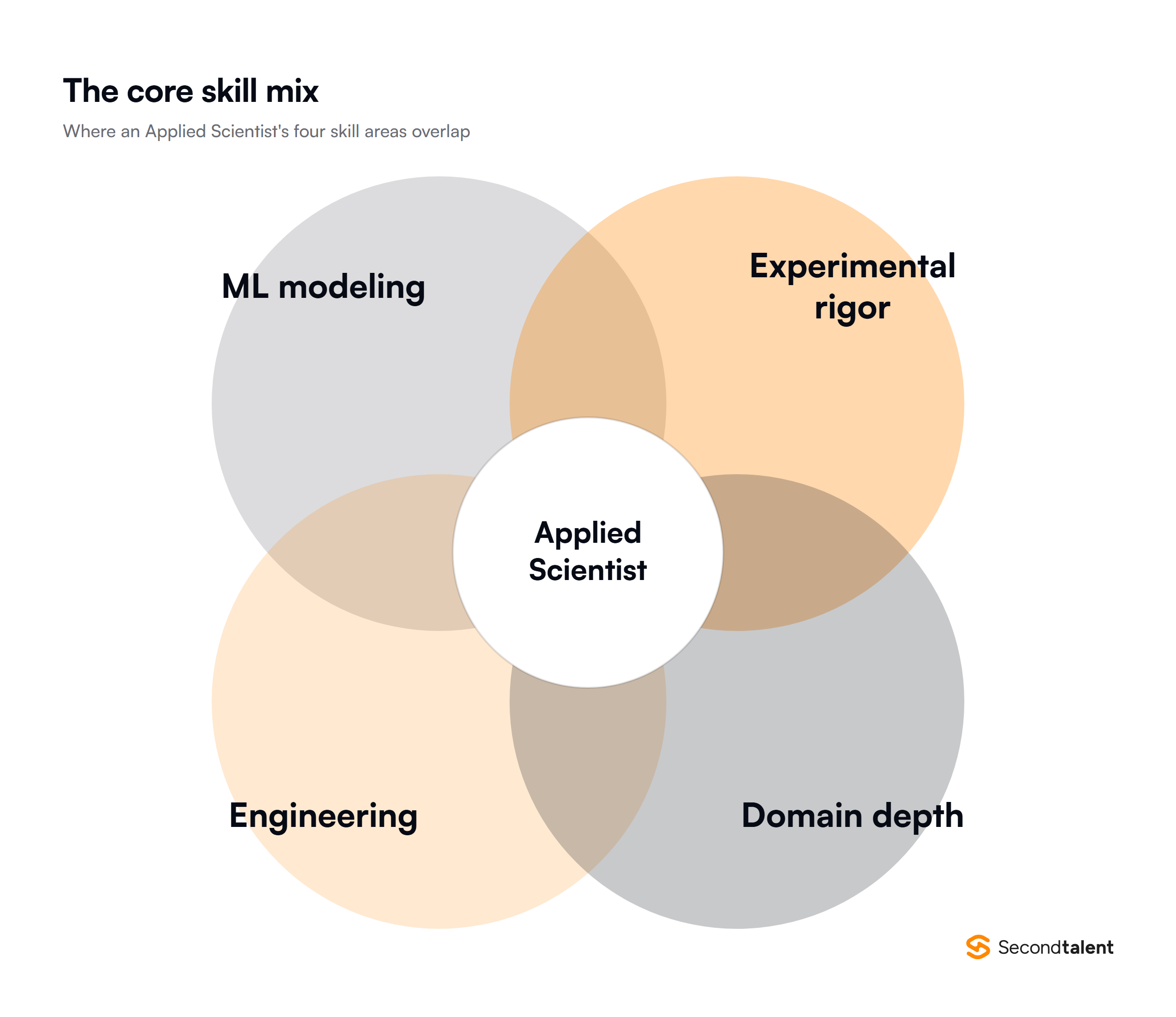
Machine Learning Depth:
- Strong foundations across supervised learning, representation learning, and the model families relevant to your domain
- Modern deep learning practice, including transfer learning and adapting foundation models to a specific task
- Knowing when the simple baseline is the correct answer, which is one of the most valuable and least common instincts in the field
- Understanding why a model fails, not just that it did, and being able to attribute that to data, objective, or evaluation
Experimental Rigor:
- Designing offline evaluations that actually predict online behavior, and knowing when they will not
- Statistical fluency: significance, variance, power, and the discipline to distinguish a real gain from a lucky split
- A/B test design, including interference effects and the failure modes of common metric choices
- Building holdout sets and validation protocols that survive contact with a real distribution shift
Engineering Capability:
- Production Python and the ability to write code another engineer can maintain
- Training pipelines, feature stores, and the reality that the feature you used offline may not exist at serving time
- Latency, cost, and memory awareness, since a result that cannot be served is not a result
- Version control, testing, and reproducibility, so an experiment can be re-run six months later and give the same answer
Domain and Communication:
- Deep familiarity with the problem domain, whether that is search relevance, demand forecasting, fraud, or another specialty
- Translating a business question into a measurable machine learning objective, which is where most projects succeed or fail
- Writing results clearly for engineers, product managers, and executives, including the negative results
- Defending a finding under scrutiny without overstating what the evidence supports
Educational Background: A PhD or master’s in computer science, statistics, mathematics, physics, or a related quantitative field is common, and required by some employers for the title. Strong applied portfolios do compete successfully against credentials, particularly outside the largest technology companies.
Applied Scientist Career Paths and Specializations
Career Progression:
- Data Scientist or ML Engineer → Applied Scientist → Senior Applied Scientist → Principal Applied Scientist → Head of Applied Science or Research
Specialization Areas:
- Search and Ranking: Relevance, retrieval quality, and learning to rank
- Personalization: Recommendation and targeting, overlapping directly with the Recommender Systems Engineer role
- Forecasting and Optimization: Demand prediction, pricing, inventory, and supply chain problems
- Applied NLP and Generative AI: Domain adaptation, evaluation design, and deciding between prompting, retrieval, and fine-tuning
- Risk and Fraud: Adversarial settings where the data distribution changes because you deployed a model against it
Movement between applied and research tracks is common in both directions, and the boundary is often organizational rather than intellectual. Applied Scientists at large companies publish; research scientists ship. The difference is which one they are evaluated on.
Applied Scientist Tools and Technologies
Modeling Stack:
- Python with PyTorch, and JAX in research-adjacent environments
- scikit-learn and gradient boosting libraries, still the correct answer for a large share of tabular problems
- Hugging Face libraries for adapting pretrained models
- Experiment tracking with Weights and Biases, MLflow, or an internal equivalent
Data and Infrastructure:
- SQL and distributed processing with Spark or an equivalent
- Feature stores and training data pipelines
- Cloud training infrastructure and GPU scheduling
- Notebook environments for exploration, with production code kept outside them
Evaluation and Experimentation:
- A/B testing platforms and sequential testing methods
- Offline evaluation harnesses aligned to online metrics
- Statistical libraries for significance and power analysis
- Model monitoring for drift once a system is live
For Generative Work:
- LLM evaluation frameworks and golden datasets
- Fine-tuning toolchains, including parameter-efficient methods
- Retrieval pipelines, where grounding often outperforms further training
- Human evaluation workflows, calibrated against automated scoring
Building Your Applied Scientist Portfolio
Portfolio Components:
- An End-to-End Project: A real problem framed, baselined, improved, and evaluated, with the business metric stated up front
- An Evaluation Design: Evidence you can build an offline metric that predicts online behavior, including where it broke down
- A Negative Result: A hypothesis you tested and rejected, written up honestly, which signals scientific maturity more than another success story
- A Baseline Comparison: A case where the simple approach won, and the analysis that showed the complex one was not worth it
Publications help but do not substitute. The evaluation work is what hiring managers probe hardest, because a candidate who cannot design an offline metric that survives contact with production will generate expensive false positives for years.
Applied Scientist Methodology and Best Practices
Start with the metric, not the model. If nobody can state what number should move and by how much, no modeling choice can be evaluated. The framing conversation is the highest-leverage hour of any project.
Build the dumb baseline first. A logistic regression or a heuristic sets the bar honestly, and it is uncomfortably often good enough. Skipping it means never knowing whether the complex model earned its cost.
Trust online results over offline ones. Offline evaluation is a prediction about online behavior, and it is frequently wrong. Design for the gap rather than being surprised by it.
Check serving feasibility early. Latency budgets, feature availability at inference time, and infrastructure cost should be checked while the approach is still cheap to change.
Report negative results. An experiment that rejects an approach saves the organization real money. Teams that only report wins accumulate a backlog of untested assumptions nobody wants to touch.
Make experiments reproducible. A result that cannot be re-run in six months is a rumor. Fix seeds, version data, and record configuration as part of the experiment, not afterwards.
Future of Applied Scientist Careers
Foundation models changed the work without removing it. Many problems that once required a custom model can now be solved with a well-configured general one, which moved applied science upstream: the valuable question is now which approach to use, and how to prove it, rather than how to train from scratch.
Expect evaluation to become the core skill. As systems produce open-ended output, deciding whether one is better than another stops being a metric lookup and becomes a design problem. Applied Scientists who can build trustworthy evaluations for generative systems are the scarcest people in this job family.
Expect the applied and research titles to keep converging in practice. The gap between publishing a method and shipping one has narrowed to months in some areas, and organizations increasingly ask the same person to do both.
Expect domain depth to hold its value. The problems where a company genuinely needs a scientist rather than an off-the-shelf model are the ones with unusual constraints, proprietary data, or adversarial dynamics, and all three reward someone who knows the domain rather than only the methods.
Getting Started as an Applied Scientist
Practical Steps:
- Take one real problem end to end: framing, baseline, improvement, evaluation, and a written result
- Learn experimental design properly, including statistical power and the common ways an A/B test misleads
- Practice building an offline metric and then checking whether it predicted the online outcome
- Pick a domain and go deep, because generalist portfolios compete poorly against specialists in this role
- Write up a negative result publicly, which is rare enough to be memorable and signals real scientific judgment
- Strengthen your engineering, since the applied half of the title means your work has to reach production
Candidates arriving from research usually need to build engineering and product judgment. Candidates arriving from data science or machine learning engineering usually need to build experimental rigor, particularly the discipline around evaluation design. Both routes are common, and neither requires a PhD outside of the most credential-driven employers.
If you are hiring rather than applying, Second Talent places Applied Scientists and other AI-native talent across Asia, with vetting, compliance, and payroll handled for you.
Frequently Asked Questions
What is the difference between an Applied Scientist and a Research Scientist?
A research scientist produces novel methods, usually published at venues such as NeurIPS, ICML, or ICLR, and is evaluated on the contribution itself. An applied scientist uses research methods to move a product metric and is evaluated on the shipped outcome. Research scientists earn roughly $24,000 to $28,000 more on average, and people move between the two tracks regularly.
What is the difference between an Applied Scientist and a Data Scientist?
Data science is broader and often centers on analysis, measurement, and decision support. Applied science centers on building machine learning systems that go into a product, with heavier modeling depth and stronger engineering requirements. The pay difference reflects that: applied science roles typically sit above general data science bands.
Do I need a PhD to become an Applied Scientist?
It helps and some employers require it, particularly the largest technology companies. A PhD carries a $20,000 to $50,000 entry premium in research-oriented roles and less in applied ones. Strong shipped work and demonstrated experimental rigor compete well against credentials at most other companies.
How much does it cost to hire an Applied Scientist through Second Talent?
Cost depends on seniority and domain, and specialists in ranking, forecasting, or generative evaluation command more than generalists. Hiring across Asia reaches strong quantitative and research-trained candidates well below US bands. Get in touch for a current rate breakdown.
How quickly can Second Talent place an Applied Scientist?
We can usually present a shortlist of pre-vetted candidates within days, with placements typically completed in a few weeks depending on your interview process and start-date requirements.
Related Roles
Explore related roles you can hire on Second Talent: AI Research Scientist, Behavioral Data Scientist, Neural Network Architect, Recommender Systems Engineer, Fine-Tuning Engineer, Natural Language Processing (NLP) Engineer.