Most organizations bought AI tools before they had any plan for using them. Licenses were issued, a handful of enthusiasts built genuinely useful workflows, most people tried a chatbot twice and went back to what they were doing, and the renewal conversation arrived with nobody able to say what the spend achieved.
An AI Enablement Lead exists to close that gap. The role turns scattered individual tool use into a coordinated organizational capability: finding the workflows worth changing, building the training and templates that make adoption stick, and measuring whether anything actually improved. It is a change management role with enough technical literacy to be credible, and it has become one of the most common non-engineering AI hires.
What is an AI Enablement Lead?
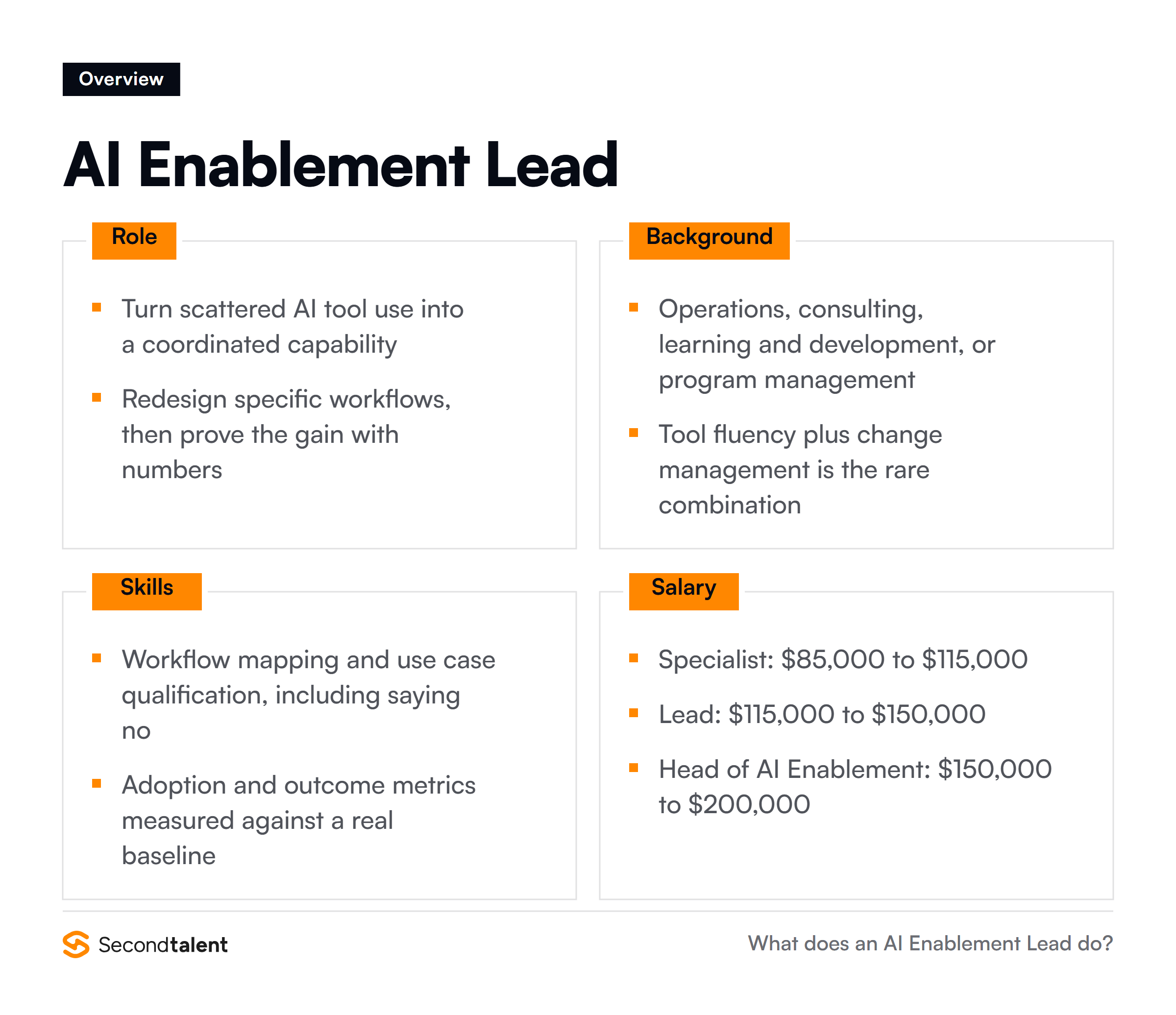
An AI Enablement Lead drives adoption of AI tools and workflows across an organization, usually focused on the teams that do not build software: finance, legal, marketing, operations, support, and HR. The mandate is capability, not deployment. Getting the tool licensed is procurement’s job. Getting a hundred people to change how they work is this one.
The title is inconsistent across companies. The same function appears as AI Enablement Lead, AI Integration Manager, AI Adoption Manager, or AI Workflow Lead, and reports variously into a transformation office, IT, operations, or a Chief AI Officer. The work is recognizably the same wherever it sits.
Day to day, that means running an intake process for use cases and being willing to reject most of them, redesigning a specific workflow rather than exhorting people to use AI generally, building prompt libraries and templates that encode what works so every employee does not rediscover it alone, training teams in their own context rather than in the abstract, and reporting adoption and outcome metrics that survive scrutiny.
The role is deliberately non-technical in delivery and technically literate in judgment. An AI Enablement Lead does not need to build the integration, but does need to recognize when a proposed use case will fail because the underlying data is a mess, and to say so before the pilot is funded.
AI Enablement Job Market and Career Opportunities
This role appears on nearly every 2026 list of emerging AI jobs, and the reason is uniform across sources: organizations adopted AI tools without adopting AI workflows. Individual employees use assistants inconsistently, the gains stay trapped in a few power users, and leadership cannot demonstrate a return. Enablement is the function created to fix that.
Hiring is concentrated in large enterprises and mid-market companies past their first wave of licenses, plus consultancies staffing the same capability for clients. Staffing firms including Experis now list the role by name, and remote listings for AI enablement leadership run into the hundreds.
Average Salary Ranges (US market):
- AI Enablement Specialist: $85,000 to $115,000
- AI Enablement Lead: $115,000 to $150,000
- Head of AI Enablement or Chief AI Adoption Officer: $150,000 to $200,000
- Reported average across AI enablement roles: $108,612
ZipRecruiter’s July 2026 data shows an unusually wide spread, from around $51,000 at the 25th percentile to $141,500 at the 75th, because the same search captures both hourly enablement support work and senior leadership roles. A named AI Enablement Lead posting in Raleigh listed $130,000, and head-of-function roles in London run £90,000 to £130,000.
Read those numbers with care when benchmarking. The title covers everything from a coordinator running training sessions to an executive owning enterprise-wide AI adoption, and the two are not the same hire.
Essential AI Enablement Skills and Qualifications
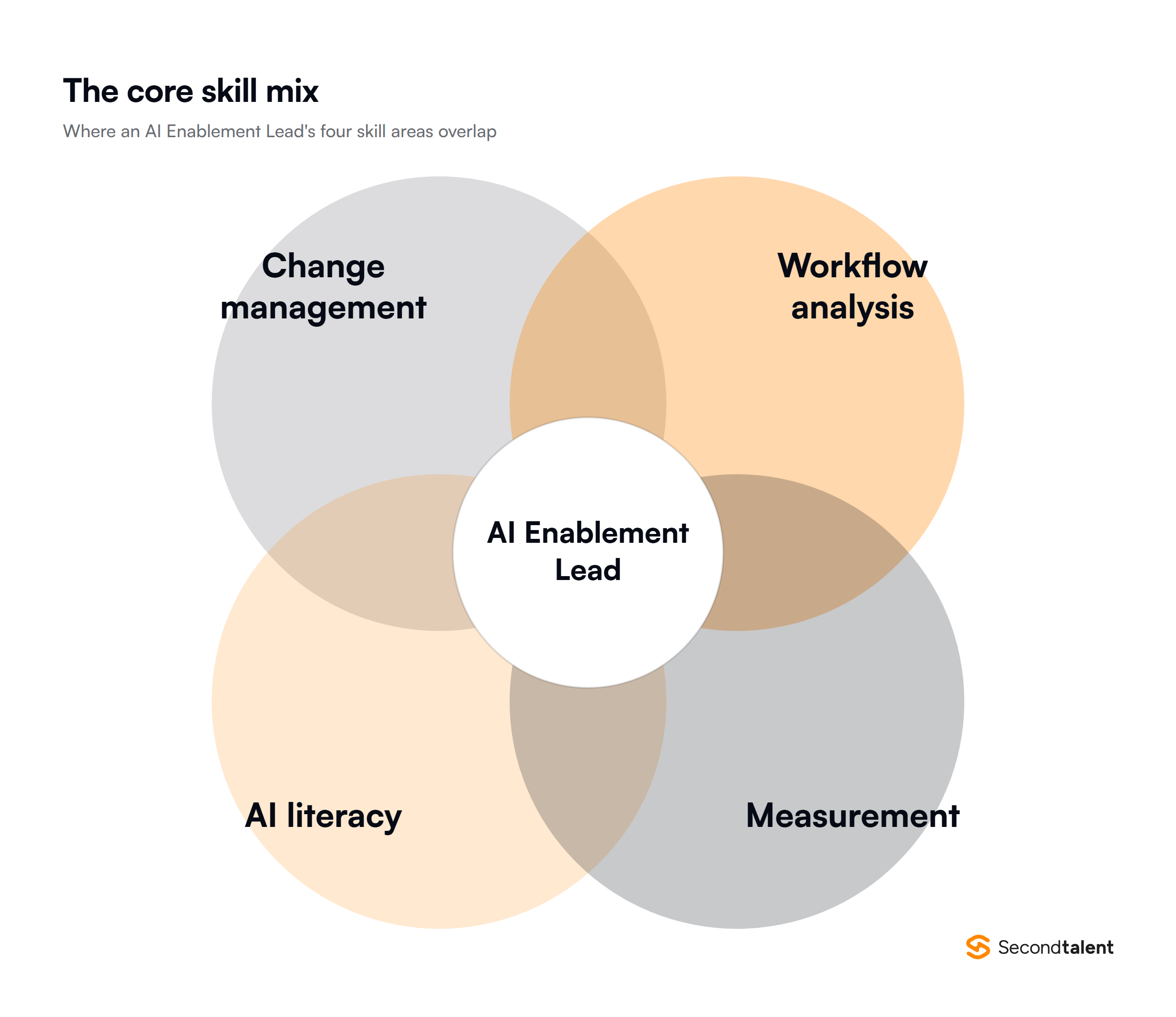
Change Management:
- Adoption program design: pilots, champions, phased rollout, and the sequencing that gets a skeptical team to a second attempt
- Stakeholder management across functions with different incentives and different levels of enthusiasm
- Training design for non-technical audiences, taught in the audience’s own workflow rather than as a generic tool demo
- Handling resistance honestly, including the job-security concerns that go unspoken in most rollout meetings
Workflow Analysis:
- Process mapping to find where time actually goes, which is rarely where people assume
- Use case qualification: separating tasks a model genuinely does well from tasks that merely sound automatable
- Redesigning a workflow around AI rather than bolting a tool onto an unchanged process, which is the difference between a real gain and a rounding error
- Cost and benefit estimation credible enough to survive a finance review
Practical AI Literacy:
- Fluent hands-on use of the assistants and tools being rolled out, because credibility here is earned by demonstration
- Prompt and template design, packaged so a non-technical colleague gets a reliable result without understanding why
- Realistic understanding of model limitations, particularly hallucination and the tasks where verification costs more than the work saved
- Enough awareness of data sensitivity and governance to know which use cases need a review before they start
Measurement:
- Adoption metrics beyond license counts: active use, workflow penetration, and repeat use after week four
- Outcome metrics tied to something the business already tracks, such as cycle time or cost per case
- Honest baselining before a rollout, without which no claimed improvement is defensible
- Reporting that distinguishes enthusiasm from evidence, which is what protects the program when the budget is questioned
Educational Background: Backgrounds vary widely: operations, consulting, learning and development, product, and program management all feed this role. What matters is the combination of change management experience and genuine hands-on fluency with the tools, and that combination is scarcer than either half alone.
AI Enablement Career Paths and Specializations
Career Progression:
- Operations, L&D, Consulting, or Program Manager → AI Enablement Specialist → AI Enablement Lead → Head of AI Enablement → Chief AI Adoption Officer or Chief AI Officer
Specialization Areas:
- Function-Specific Enablement: Deep focus on one area such as legal, finance, or customer support, where domain knowledge makes use case selection far more accurate
- Training and Curriculum: Building the internal learning program, certification, and champion network
- Workflow Automation: Hands-on redesign work, overlapping with the AI Workflow Automation Specialist role
- Measurement and Value Realization: Owning the metrics and the business case, which is what senior leadership actually asks for
- Governance Partnership: Working alongside AI Governance Specialists so adoption and compliance move together rather than in opposition
Function-specific enablement is where the strongest results come from. A generalist running a company-wide program produces broad shallow adoption; someone who knows how a claims team or a legal department actually works finds the two workflows worth changing and changes them properly.
AI Enablement Tools and Platforms
Assistant and Productivity Platforms:
- Enterprise AI assistants and their admin, analytics, and data controls
- Copilot-style integrations inside the productivity suite the organization already uses
- Custom internal assistants and knowledge bases built on company data
- Meeting, document, and research tools that fit an existing workflow rather than replacing it
Workflow and Automation:
- No-code and low-code automation platforms, which is where most enablement work becomes concrete
- Workflow automation tools connecting AI steps to existing systems
- Template and prompt libraries maintained as a shared internal asset
- Integration with the systems of record a team already lives in
Enablement Infrastructure:
- Internal learning platforms and curriculum tooling
- Champion and community programs, usually run in the company’s existing chat platform
- Use case intake and prioritization tracking
- Documentation of approved patterns, so a good solution spreads instead of being rebuilt
Measurement:
- Usage analytics from the AI platforms themselves
- Survey instruments for perceived value and friction
- Business system metrics for cycle time, volume, and quality
- Before and after baselines captured at the workflow level, not the organization level
Building Your AI Enablement Portfolio
Portfolio Components:
- A Workflow Redesign: One process mapped, redesigned around AI, and measured, with the baseline stated
- An Adoption Program: The structure of a rollout you ran, including how you handled the teams that did not want it
- A Prompt or Template Library: Reusable assets built for non-technical colleagues, with evidence they were actually used
- A Value Case: A business case with honest numbers, including the use cases you recommended against
The recommendations against are the strongest signal. Anyone can advocate for AI adoption. Someone who can identify which proposed use cases will waste money, and say so before the pilot starts, is far more valuable and considerably rarer.
AI Enablement Methodology and Best Practices
Start with workflows, not tools. Rolling out a license and hoping for adoption produces a spike in logins and no change in how work is done. Pick a specific workflow, redesign it, and prove the gain there first.
Baseline before you begin. Without a measurement of how long something took beforehand, every claimed improvement is an anecdote, and anecdotes do not survive a budget review.
Find and equip the champions. Every organization already has people quietly using these tools well. Finding them and giving them a platform works better than any top-down training program.
Be honest about what does not work. Overselling costs credibility that takes months to rebuild. Naming the tasks where the tool is unreliable makes people trust your recommendations on the tasks where it is not.
Address the job-security question directly. It is the real reason for most quiet resistance. Programs that pretend the concern does not exist get polite compliance and no behavior change.
Partner with governance early. An adoption program that runs ahead of policy eventually collides with it, and the collision usually stops the program rather than the policy.
Future of AI Enablement Careers
The immediate driver of this role is a measurement problem: organizations spending on AI tools without evidence of return. That pressure is intensifying rather than easing, which keeps demand strong through the current adoption cycle.
Expect the role to shift from tool adoption to workflow redesign. The first phase is teaching people to use an assistant. The second, harder, and more valuable phase is redesigning how work flows through a team when parts of it are automated, and that skill set is closer to operations design than to training delivery.
Expect agents to raise the difficulty. Enabling a person to use a tool is a training problem. Deploying an agent that performs part of a workflow autonomously changes roles, accountability, and controls, which is organizational design work rather than enablement in the current sense.
Expect some consolidation. In organizations that reach mature adoption, enablement tends to fold into operations, learning, or a permanent AI function rather than persisting as a standalone role indefinitely. The skills remain valuable; the standalone title may not be permanent everywhere.
Getting Started as an AI Enablement Lead
Practical Steps:
- Become genuinely fluent with the tools yourself, since credibility in this role is demonstrated rather than claimed
- Map and redesign one workflow end to end, with a measured before and after
- Build a template library for a specific function and watch where colleagues get stuck using it
- Learn change management fundamentals, because the hard part of this job is people, not technology
- Practice writing a value case with honest numbers, including the costs and the things you would not recommend
- Study a function deeply, since domain knowledge is what turns generic enablement into results
Candidates arriving from operations or consulting usually need to build hands-on AI fluency. Candidates arriving from a technical background usually need to build change management and communication skills for non-technical audiences. The second gap is the more common reason a promising candidate does not succeed in the role.
If you are hiring rather than applying, Second Talent places AI Enablement Leads and other AI-native talent across Asia, with vetting, compliance, and payroll handled for you.
Frequently Asked Questions
What is the difference between an AI Enablement Lead and an AI Product Manager?
An AI Product Manager owns an AI product or feature built for customers. An AI Enablement Lead owns internal adoption: helping employees change how they work using AI tools the company has bought or built. One is outward-facing product work, the other is inward-facing capability building, and they need different skills.
Is AI Enablement a technical role?
It is technically literate rather than technical. You do not need to build integrations, but you do need hands-on fluency with the tools, a realistic understanding of model limitations, and enough judgment to recognize when a proposed use case will fail because of data quality or verification cost. The delivery skills are change management, training, and measurement.
What does an AI Enablement Lead actually measure?
Adoption depth rather than license counts: active weekly use, how many workflows have genuinely changed, and whether use persists past the first month. Alongside that, outcome metrics the business already tracks, such as cycle time or cost per case, measured against a baseline captured before the rollout began.
How much does it cost to hire an AI Enablement Lead through Second Talent?
Cost depends on scope, since the title spans coordinator-level enablement work through head-of-function roles. Hiring across Asia reaches strong operations, consulting, and program management talent with real AI fluency at rates well below US bands. Get in touch for a current rate breakdown.
How quickly can Second Talent place an AI Enablement Lead?
We can usually present a shortlist of pre-vetted candidates within days, with placements typically completed in a few weeks depending on your interview process and start-date requirements.
Related Roles
Explore related roles you can hire on Second Talent: AI Workflow Automation Specialist, AI Product Manager, AI Governance Specialist, Agile Coach, Forward Deployed Product Manager, Automation Engineer.