Every company shipping an AI feature now carries legal exposure it did not have two years ago. The EU AI Act, state-level US rules, and a growing pile of internal risk policies all need someone who can translate “the law says” into “the engineering team can actually implement this.” That person is the AI Governance Specialist.
AI Governance Specialists classify AI systems by risk, document how those systems were built and tested, and give legal, engineering, and leadership a shared, defensible record that an AI system was governed the way regulators expect. It is one of the fastest-growing job categories in the current AI hiring cycle, and one of the hardest to fill.
What is an AI Governance Specialist?
An AI Governance Specialist is the person inside an organization responsible for making sure AI systems are built, deployed, and monitored in line with regulation, internal policy, and risk tolerance. The role typically reports into legal, risk, or a dedicated Responsible AI function, sometimes under a Chief AI Officer.
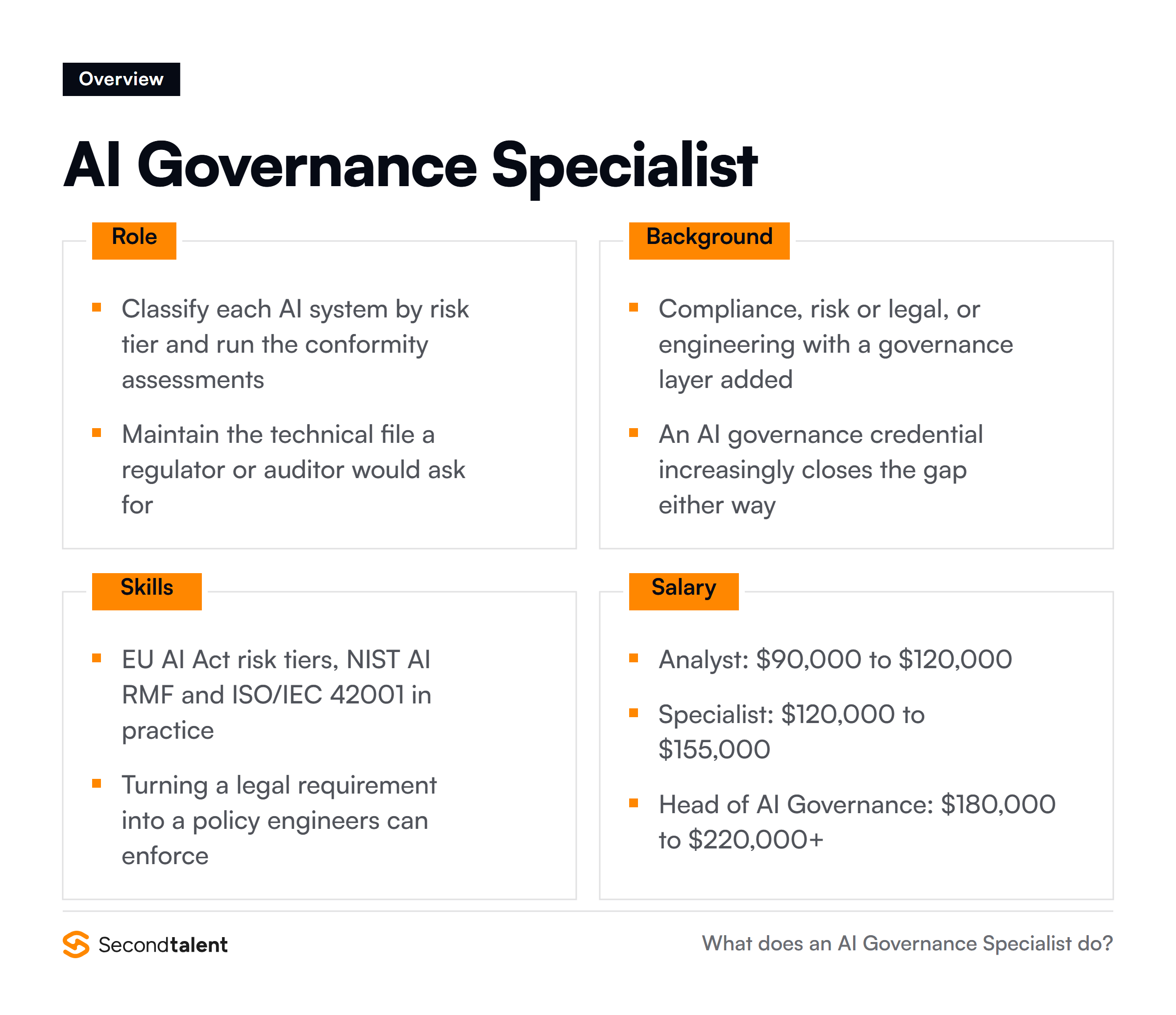
Day to day, that means classifying each AI system by risk tier (for example, under the EU AI Act’s prohibited, high-risk, limited-risk, and minimal-risk categories), running and documenting conformity assessments for anything high-risk, maintaining the technical file a regulator would ask for, and coordinating with auditors when one comes knocking.
The job sits deliberately between three groups that do not naturally speak the same language: engineers who need a concrete checklist, not a legal memo; lawyers who need evidence the checklist was followed; and executives who need a plain answer to “are we exposed here.” An AI Governance Specialist is the translation layer between all three.
AI Governance Job Market and Career Opportunities
Demand for this role has outpaced almost every other AI-adjacent title. Postings for AI governance roles are up 150% year over year, according to LinkedIn’s 2026 Skills on the Rise report, and over 14,000 open roles carried an AI governance title as of late 2025. Roughly 71 new AI governance postings appear in the US each week, holding steady rather than spiking around model release cycles.
The gap between demand and supply is unusually wide even for AI hiring: the IAPP’s AI Governance Profession Report found 77% of organizations are actively building AI governance programs, but only 1.5% say they are satisfied with their current governance headcount. Forrester expects 60% of Fortune 100 companies to appoint a head of AI governance by the end of 2026.
Average Salary Ranges (US market):
- Entry-level AI Governance Analyst: $90,000 – $120,000
- Mid-level AI Governance Specialist: $120,000 – $155,000
- Senior AI Governance Specialist: $155,000 – $180,000
- Head of AI Governance / AI Compliance Director: $180,000 – $220,000+
AI governance work carries a 25-35% salary premium over comparable generalist compliance or risk roles, reflecting how scarce the specific EU AI Act and AI risk-classification expertise still is. Hiring across Asia typically brings the same skill set in well under US rates, without a multi-month search.
Essential AI Governance Skills and Qualifications
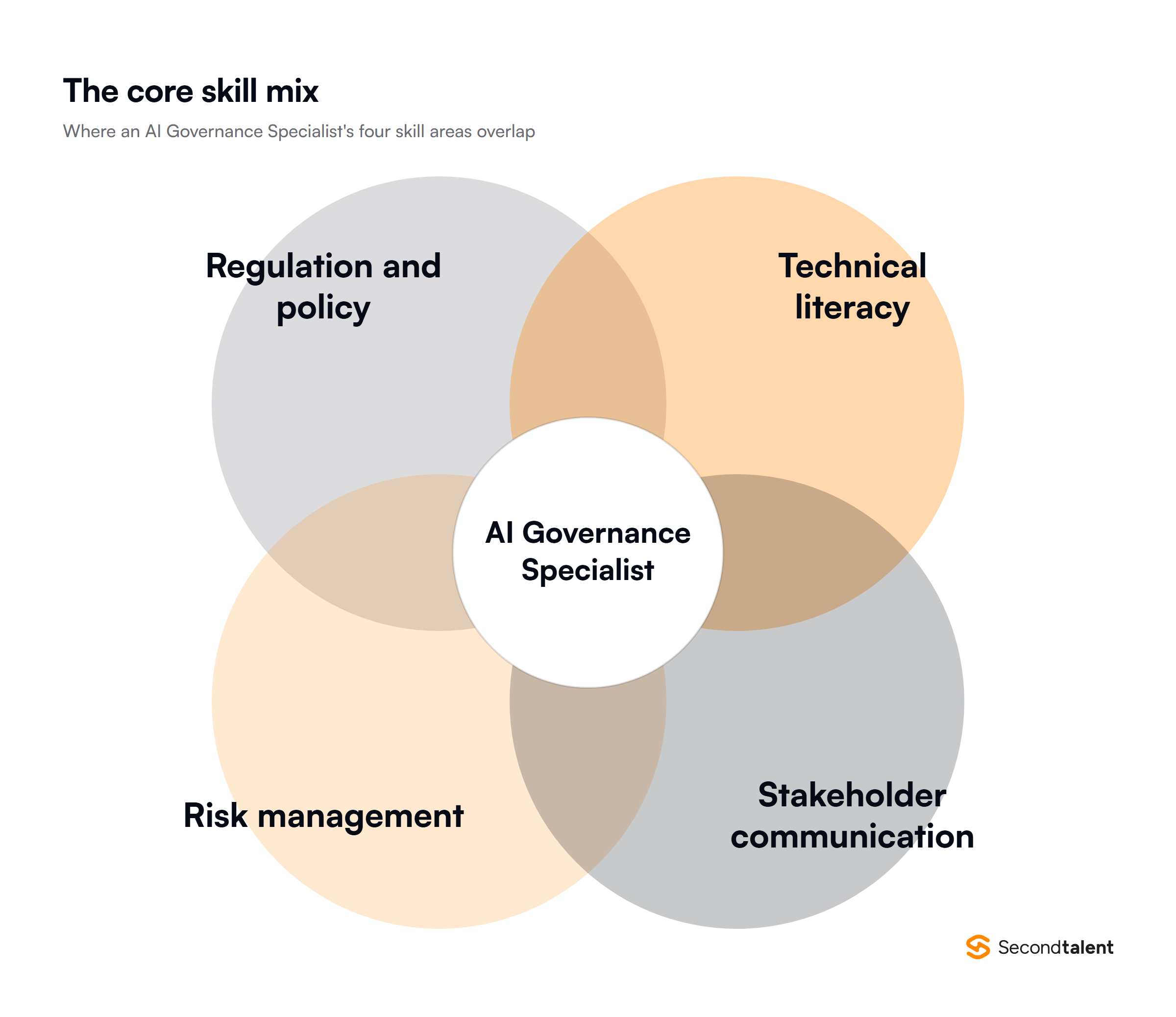
Regulatory and Framework Skills:
- Working knowledge of the EU AI Act’s risk tiers and its intersection with GDPR
- Familiarity with NIST’s AI Risk Management Framework and ISO/IEC 42001
- Ability to run and document a conformity assessment for a high-risk AI system
- Tracking regulatory change: the EU AI Act’s own 2026 Digital Omnibus amendment is a live example of how fast these deadlines move
Technical Literacy:
- Enough understanding of AI architectures and permission models to assess risk without needing to write the code
- Ability to read a model card, an evaluation report, or a data lineage diagram
- Comfort translating a legal requirement into a runtime policy an engineering team can actually enforce
Risk and Communication Skills:
- Cross-functional communication with legal, engineering, and executive stakeholders who each want a different level of detail
- Documentation discipline: a governance program is only as good as the paper trail behind it
- Comfort saying no to a launch date, and defending that call with a specific risk
Educational Background: Backgrounds vary more than in most technical roles: some come from compliance, risk, or legal; others from data science or engineering with an added governance layer. A specific AI governance credential increasingly closes that gap either way.
AI Governance Career Paths and Specializations
Career Progression:
- Compliance Analyst / Risk Analyst / ML Engineer → AI Governance Analyst → AI Governance Specialist → Senior AI Governance Specialist → Head of AI Governance, AI Compliance Director, or Chief AI Officer
Specialization Areas:
- Regulatory Compliance: EU AI Act, GDPR, and sector-specific rules (financial services, healthcare, public sector)
- Model Risk Management: Risk classification, conformity assessments, and technical-file maintenance
- AI Ethics and Responsible AI: Bias auditing, fairness reviews, and use-case approval boards
- Vendor and Third-Party Risk: Auditing outsourcing and staffing partners’ own AI governance posture
- Certification and Standards: ISO/IEC 42001 implementation and audit readiness
Unlike many governance-adjacent titles, this one has real entry and mid-career paths, not just senior leadership openings — lateral moves from compliance, risk, or analyst roles are common and don’t require a “Director” title first.
AI Governance Tools and Frameworks
Regulatory Frameworks:
- EU AI Act (risk tiers, conformity assessment, technical documentation requirements)
- NIST AI Risk Management Framework
- ISO/IEC 42001 (AI management systems)
- GDPR, where AI processing touches personal data
Certifications:
- IAPP’s AIGP (AI Governance Professional) — updated to a 2.1 body of knowledge in February 2026, restructured around four domains and weighted heavily toward the EU AI Act, NIST AI RMF, and ISO/IEC 42001
- ISO/IEC 42001 Lead Implementer / Lead Auditor
Governance and Documentation Tooling:
- AI model registries and inventories
- Risk-classification and conformity-assessment templates
- Model cards, data lineage, and evaluation-report review tooling
- Policy and audit-trail management platforms
Building Your AI Governance Portfolio
Portfolio Components:
- A Risk Classification Writeup: Take a real or hypothetical AI system and classify it under the EU AI Act’s risk tiers, showing your reasoning
- A Conformity Assessment Template: Build a reusable checklist for documenting a high-risk system’s testing and controls
- A Policy Translation Example: Show a legal requirement rewritten as a concrete engineering control
- A Vendor Audit Framework: Three questions you’d ask any outsourcing or staffing partner to assess their AI governance readiness
Hiring managers weight the translation work most heavily. Anyone can summarize a regulation; the signal is whether you can turn it into something an engineering team can actually ship against.
AI Governance Methodology and Best Practices
Classify before you build. Know a system’s risk tier before development starts, not after — retrofitting governance onto a shipped system costs far more than designing it in.
Document as you go. A technical file assembled after the fact, under audit pressure, is never as convincing as one built alongside development.
Track the deadline, not just the law. Regulatory timelines move: the EU AI Act’s high-risk obligations were pushed back sixteen months by a 2026 Digital Omnibus amendment even as its content-labeling rules stayed on schedule. A governance program built around a fixed date breaks the moment that date moves.
Audit vendors, not just internal systems. Outsourcing a workload does not outsource legal responsibility for it — a vendor’s own AI governance posture is now a real part of your risk surface.
Write for the reader, not the regulation. An engineer needs a checklist; an executive needs a one-page risk summary. The same underlying work should produce both.
Future of AI Governance Careers
This role exists because AI regulation is moving faster than most organizations’ internal processes. That gap is not closing soon: new jurisdictions are drafting their own AI rules, and the EU AI Act itself is still being amended years after it entered into force.
Expect specialization to deepen. Today’s generalist “AI Governance Specialist” is likely to fragment the same way “AI Engineer” has, into risk-classification specialists, conformity-assessment auditors, and vendor-governance reviewers, each owning a narrower, deeper slice of the work.
Expect demand outside the EU to catch up too. US state-level AI rules and sector-specific requirements in finance and healthcare are pulling governance expertise into industries that historically never needed it.
Getting Started as an AI Governance Specialist
Practical Steps:
- Read the EU AI Act’s risk-tier definitions directly, not just a summary of them
- Pursue the IAPP’s AIGP certification, or an equivalent, to establish baseline credibility
- Practice writing one governance artifact end to end: a risk classification, a conformity assessment, or a vendor audit checklist
- Follow the EU AI Act’s amendment history so you can speak to how the timeline has already changed
- Look for roles labeled Compliance Analyst, Risk Analyst, or Responsible AI if a governance-specific title isn’t yet open — this field has real lateral entry points
Candidates arriving from legal or compliance backgrounds usually need to build technical literacy; those arriving from engineering usually need to build regulatory depth. Both routes are common and both work.
If you are hiring rather than applying, Second Talent places AI Governance Specialists and other AI-native talent across Asia, with vetting, compliance, and payroll handled for you.
Frequently Asked Questions
What is the difference between an AI Governance Specialist and a Data Privacy Officer?
A Data Privacy Officer focuses on personal-data handling under laws like GDPR. An AI Governance Specialist covers a broader surface: risk classification, conformity assessment, and technical documentation for AI systems generally, whether or not personal data is involved. The two roles overlap heavily where AI systems process personal data, and often collaborate directly.
Do I need a law degree to become an AI Governance Specialist?
No. Many AI Governance Specialists come from technical or risk-management backgrounds rather than law. What matters more is the ability to read a regulation and translate it into something an engineering team can implement, which is a skill you can build through certification and practice rather than a law degree.
How is AI Governance different from AI Ethics work?
AI Ethics tends to focus on fairness, bias, and the “should we” question behind a use case. AI Governance is broader and more procedural: it covers the documented, defensible process an organization follows to build and monitor any AI system, ethics included, so a regulator or auditor can verify it happened.
How much does it cost to hire an AI Governance Specialist through Second Talent?
Cost depends on seniority and location, but hiring across Asia typically comes in well below US market rates for equivalent experience. Get in touch for a current rate breakdown for your specific requirements.
How quickly can Second Talent place an AI Governance Specialist?
We can usually present a shortlist of pre-vetted candidates within days, with placements typically completed in a few weeks depending on your interview process and start-date requirements.
Related Roles
Explore related roles you can hire on Second Talent: Ethical AI Compliance Officer, AI Safety Auditor, AI Alignment Researcher, AI Ethics Researcher, IT Compliance Analyst, AI Evaluator & Trainer.