An AI/ML Product Manager owns the strategy, roadmap, and delivery of products powered by machine learning. Unlike a traditional product manager, the AI/ML product manager must reason about data, model behavior, and probabilistic outcomes, translating messy model capabilities into reliable user value.
As machine learning moves from research into core product experiences, companies need product leaders who understand both the customer and the model. The AI/ML product manager has become one of the highest-leverage roles in modern technology organizations.
What is an AI/ML Product Manager?
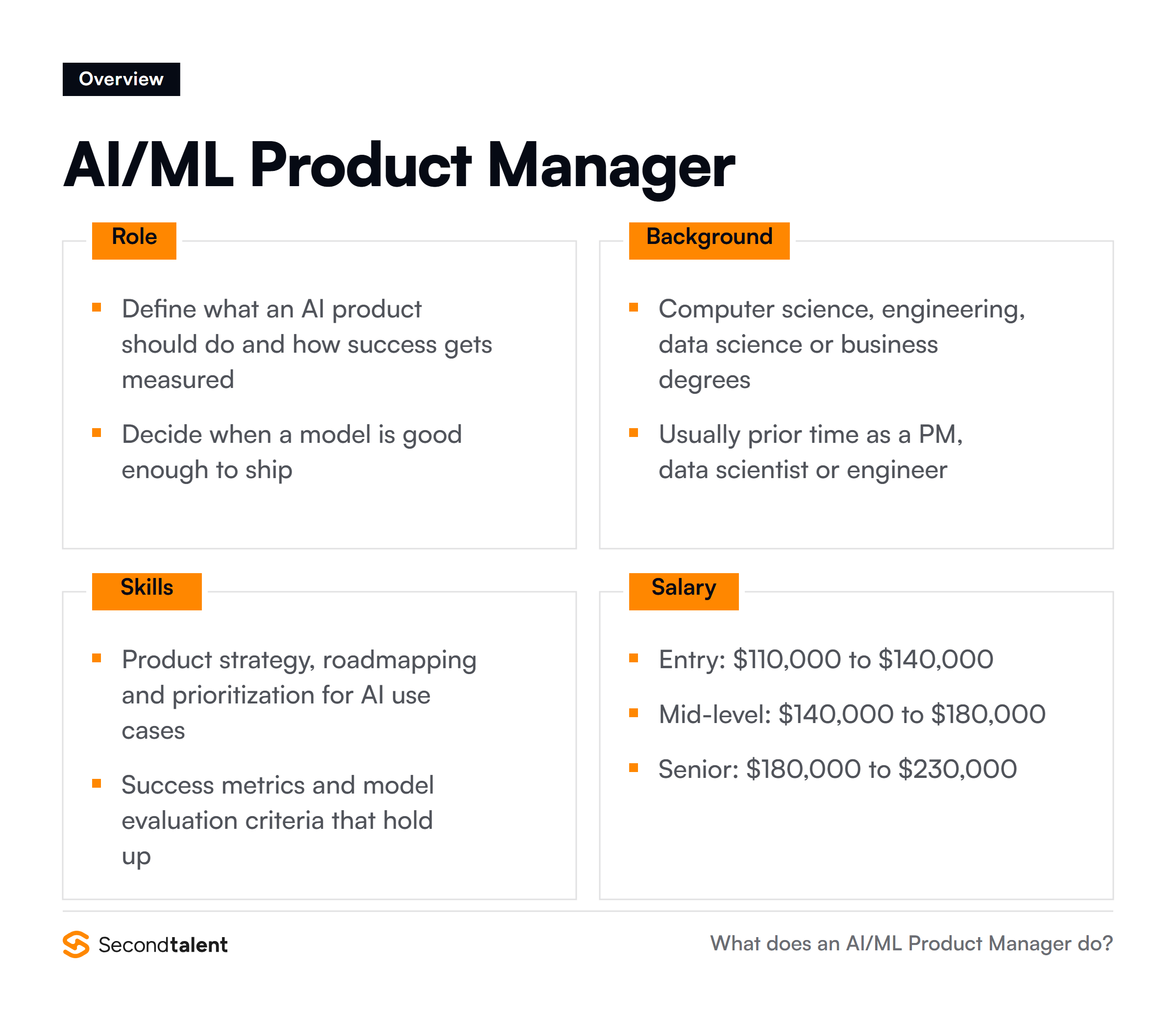
An AI/ML Product Manager defines what an AI-powered product should do, why it matters to users, and how success will be measured. They partner with data scientists and machine learning engineers to scope models, define training data needs, set evaluation metrics, and decide when a model is good enough to ship.
The role requires fluency in the realities of machine learning: that models are probabilistic, that data quality determines outcomes, and that user trust depends on handling errors gracefully. An effective AI/ML product manager balances technical feasibility, business value, and responsible AI practices while keeping the roadmap grounded in customer problems.
AI/ML Product Manager Job Market and Salary
Demand for AI and ML product managers has grown sharply as organizations embed machine learning and generative AI into their products. The global AI market is projected to surpass $1.8 trillion by 2030, and product leaders who can operationalize AI are in short supply.
Average Salary Ranges (US market):
- Entry-level AI/ML Product Manager: $110,000 – $140,000
- Mid-level AI/ML Product Manager: $140,000 – $180,000
- Senior AI/ML Product Manager: $180,000 – $230,000
- Principal / Group AI Product Manager: $230,000 – $300,000+
Employers include AI-first startups, large technology companies, financial services, healthcare, and any enterprise building machine learning into its products. Hiring experienced AI product talent remotely across Asia can substantially reduce cost while widening the candidate pool.
Essential AI/ML Product Manager Skills and Qualifications
Core Product Skills:
- Product strategy, roadmapping, and prioritization
- User research and problem discovery for AI use cases
- Defining success metrics and model evaluation criteria
- Stakeholder management across data, engineering, and business
- Go-to-market planning for AI-powered features
AI and Technical Competencies:
- Solid understanding of machine learning fundamentals and model lifecycle
- Familiarity with training data, labeling, and evaluation
- Knowledge of LLMs, prompt design, and generative AI patterns
- Understanding of model risk, bias, and responsible AI
- Comfort reading experiment results and interpreting metrics
Educational Background: Many AI/ML product managers hold degrees in computer science, engineering, data science, or business, and often bring prior experience as a product manager, data scientist, or engineer.
AI Product Management Career Paths and Specializations
Career Progression:
- Associate PM → AI/ML Product Manager → Senior AI Product Manager → Principal / Group PM → Director of AI Product / VP Product
Specialization Areas:
- Generative AI Products: LLM-powered assistants and copilots
- ML Platform Products: Internal tooling for data and ML teams
- Recommendation and Personalization: Ranking and relevance systems
- Computer Vision or NLP Products: Domain-specific model products
- Responsible AI: Safety, governance, and trust
AI/ML Product Manager Tools and Technologies
Product and Analytics:
- Jira, Linear, and Productboard for roadmapping
- Amplitude and Mixpanel for product analytics
- SQL and notebooks for self-serve data analysis
AI and ML Platforms:
- Experiment tracking such as Weights & Biases and MLflow
- LLM platforms including OpenAI, Anthropic, and Hugging Face
- Evaluation and observability tools for model quality
- Feature stores and data pipelines
Building Your AI Product Management Portfolio
Portfolio Components:
- AI Product Case Studies: Show how you shipped a model into production
- Metric Definition: Demonstrate how you measured model and product success
- Tradeoff Decisions: Document how you balanced accuracy, latency, and cost
- Responsible AI: Show how you handled risk, bias, and user trust
Hiring managers want evidence that you can move an AI feature from prototype to reliable, measurable production value.
Future of AI Product Management
The AI/ML product manager role is expanding as generative AI reshapes nearly every product category. The most valuable product leaders will pair deep customer empathy with a realistic understanding of what models can and cannot do.
- Agentic and multi-step AI workflows
- Evaluation-driven product development
- AI governance, safety, and compliance
- Cost and latency optimization as first-class product concerns
How to Hire an AI/ML Product Manager
Strong candidates can explain a model-powered product decision end to end: the user problem, the data, the evaluation, and the tradeoffs. Probe for how they handled model errors and measured real user impact.
Second Talent connects you with pre-vetted, senior AI/ML product managers across Asia in as little as 24 hours, with no upfront cost. Browse, shortlist, and hire on one platform.