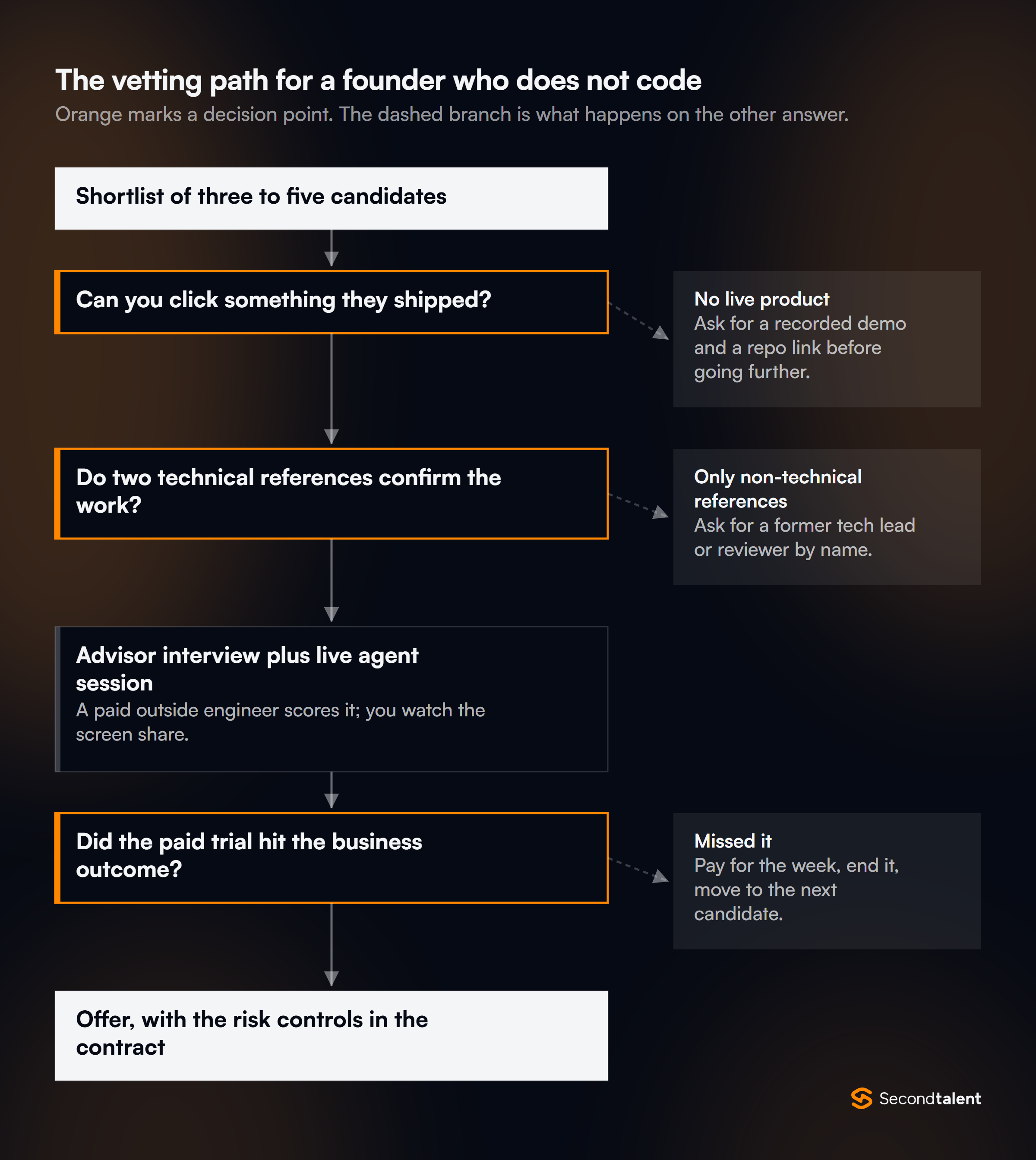
TL;DR: A non-technical founder can vet an AI-native engineer without reading code: click through work they shipped, pay an outside engineer to run one technical interview, and make the final call on a paid trial scored against a business outcome. Watch the candidate build with a coding agent on a live screen share before the trial starts. Then put the offshore risk in the contract: the repo and IP in your name from day one, a replacement window, set overlap hours and access you can revoke in one click.
Only the top 1% of engineers who apply to Second Talent end up listed, and the step that decides most of it is a live technical interview with one of our senior engineers. A founder who cannot code cannot run that interview.
Most of the evidence that decides an AI-native hire needs no code reading at all. You can borrow the rest from an outside engineer or write it into the contract.
- 1Jyve's CTO told TechCrunch he pays technical friends $200 to $500 per candidate to run an interview and write up a verdict.
- 2GitHub shows only public-repo activity by default, so a quiet contribution graph proves nothing about an engineer whose work sits in private company repos.
- 3The FBI warned in January 2025 that North Korean IT workers use AI face-swapping in video job interviews.
- 4Employers in a 2017 CareerBuilder survey put the average cost of one bad hire at $14,900.
What can a non-technical founder check without reading code?
Four things: work you can click, what technical people say about that work, the shape of the candidate's commit history, and whether they can explain their work in plain English.
None of them needs code literacy, and together they cut a long list to three or four names before you spend money on anyone's time.
Shipped work you can click
Ask for a link to an AI feature real users touch: a support bot, a search box that answers from documents, an internal agent that files tickets.
Use it yourself, then ask what it costs to run per thousand requests and how they know the answers are right.
An engineer who built it will answer both with numbers. An engineer who watched someone else build it will describe the framework.
Commit history, read by a tool
Paste a public repo into a coding agent and ask for a plain summary: how often commits land, how big they are, whether tests change with the code, and who else contributed.
Small, steady commits with tests read better than one giant upload the week before an interview.
Do not punish an empty profile. GitHub's documentation says the contribution graph shows activity from public repositories only, unless the user opts in to show private work in anonymized form.
Most paid work lives in private company repos, so ask the candidate to switch that setting on rather than reading silence as inactivity.
References from technical people
A reference from a former CEO tells you the engineer was pleasant.
Ask for one from a tech lead or a reviewer who merged their code, and ask that person two things: did you trust their pull requests without rewriting them, and would you hire them for an AI feature with no senior engineer above them?
Score all four signals on one sheet so the comparison between candidates stays honest:
| Signal | How you check it | Pass | Fail |
|---|---|---|---|
| Shipped AI feature | Click the link, ask cost and accuracy | Live users, a cost figure, a test set | Demo only, no numbers |
| Commit history | Coding agent summary of a public repo | Small commits, tests change with code | One bulk upload, no tests |
| Technical reference | Call a former tech lead | "I merged their PRs as written" | Only non-technical referees offered |
| Plain-English explanation | Ask them to explain one design choice to you | You could repeat it to an investor | Jargon, or "it's complicated" |
| Live agent session | Screen share with a coding agent | Writes context, runs tests, rejects bad output | Accepts every suggestion unread |
What should "AI-native" mean in the engineer you hire?
An AI-native engineer does most of their building through coding agents, measures AI output with evals rather than by eye, and knows what each model call costs. Using AI tools is no longer the filter.
In JetBrains' 2025 developer survey of 24,534 developers in 194 countries, reported by InfoWorld, most respondents already used AI tools in their work:
With 85% of the market using AI, "experience with AI tools" on a résumé filters nothing. Three habits separate the engineer you want, and you can see each one on a 45-minute screen share without following the code:
- They brief the agent before it writes. Watch for a context file (often called AGENTS.md or CLAUDE.md) listing the project's rules, and a task cut small enough to check.
- They run the tests before they accept. The agent proposes a change, the tests run, and the engineer throws away at least one plausible change and says why.
- They can price a request. Ask what one answer from their last feature cost. Anthropic's prompt caching documentation bills cache reads at 10% of the base input price on most models, so an engineer who knows the bill tends to know that trick too.
The full skill list for the role (retrieval, agents, evals) is in our guide to hiring AI engineers, and the working habits we screen for are on the AI-native engineer page.
A founder only needs the three above to tell a candidate who works with agents from one who has them installed.
Borrow the technical judgment for one interview
Sam Purtill, CTO at Jyve, described a cheap version of a fractional CTO to TechCrunch. He sends only his favorite candidates to technical friends, who set them a project and return a written assessment:
"I pay them like, anywhere between $200 to $500 per candidate and I only send them the candidates I really like."
Sam Purtill, CTO of Jyve, to TechCrunch, September 2020
For an AI-native role, brief the advisor on what you need answered: can this person ship an AI feature alone, does their eval work hold up, and would the advisor merge their code.
Ask for the answer in writing, in sentences you could forward to an investor. You are paying for that written verdict more than for the hour of interview.
Purtill also gave a test any founder can run alone. A technical hire who cannot tell non-technical colleagues "in plain English" what they are building is, in his words, "a huge red flag."
Ask each finalist to explain one design choice from their past work until you could repeat it.
Split the rest of the work by who can judge it:
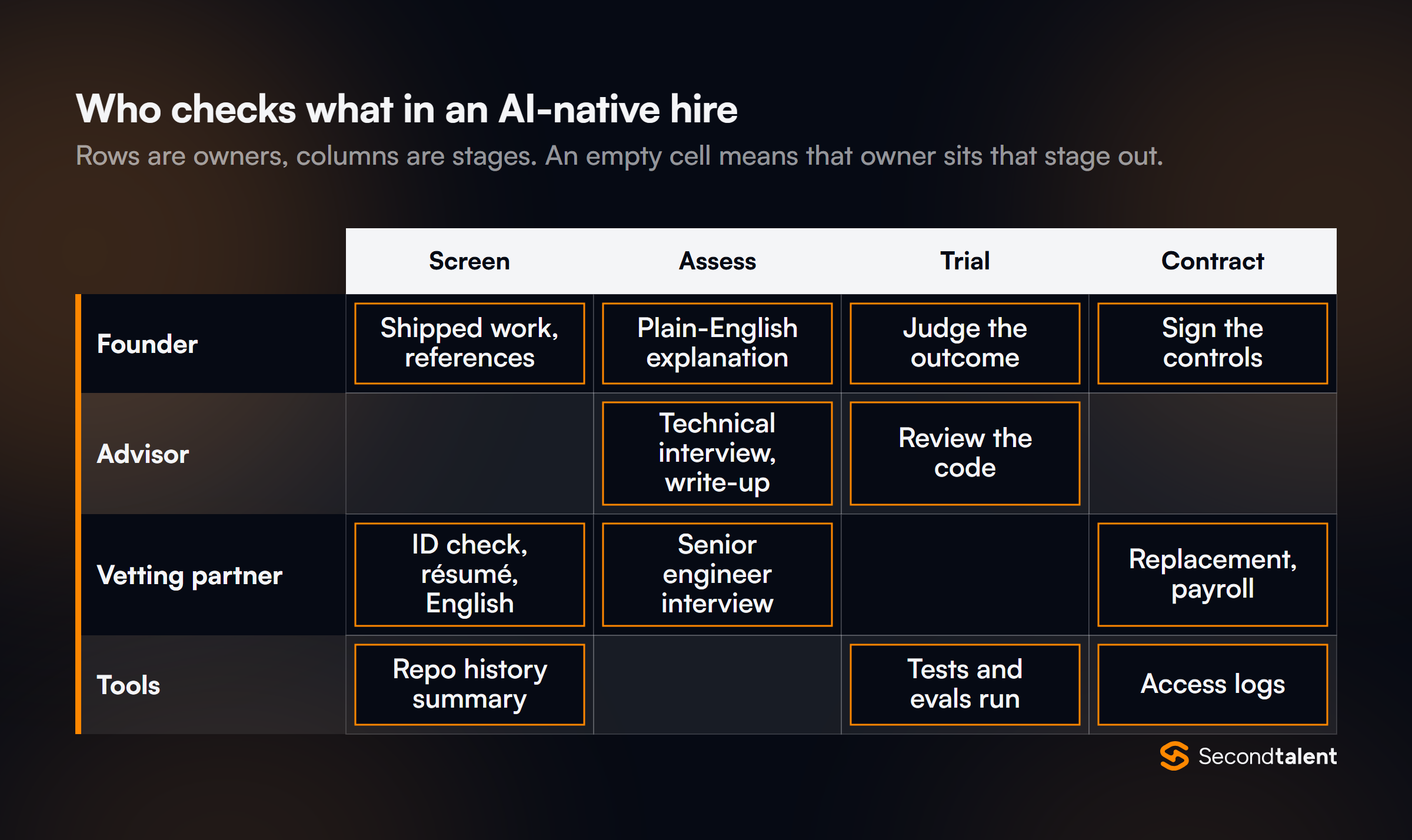
Nothing in the founder's row asks for code literacy. The advisor's row is short on purpose: two paid sessions, not a standing role.
Run a paid trial scored on a business outcome
A paid trial gives a non-technical founder the one signal they can judge with confidence: did the thing work for the business. PostHog runs a version for its engineering hires.
Its handbook calls the final stage a SuperDay, "a paid full day of work," built to be "too much work for one person to complete in a day" so the team sees how the candidate prioritizes.
A buddy runs a midday interview and reviews the output.
The advice holds outside companies PostHog's size.
In a Hacker News thread where non-technical founders asked how to hire a developer for an MVP, a consultant who works with them put it first: "pay them to work on a small project before tackling your MVP."
For a first AI hire, stretch the day to a week and write the goal as an outcome, not a task list:
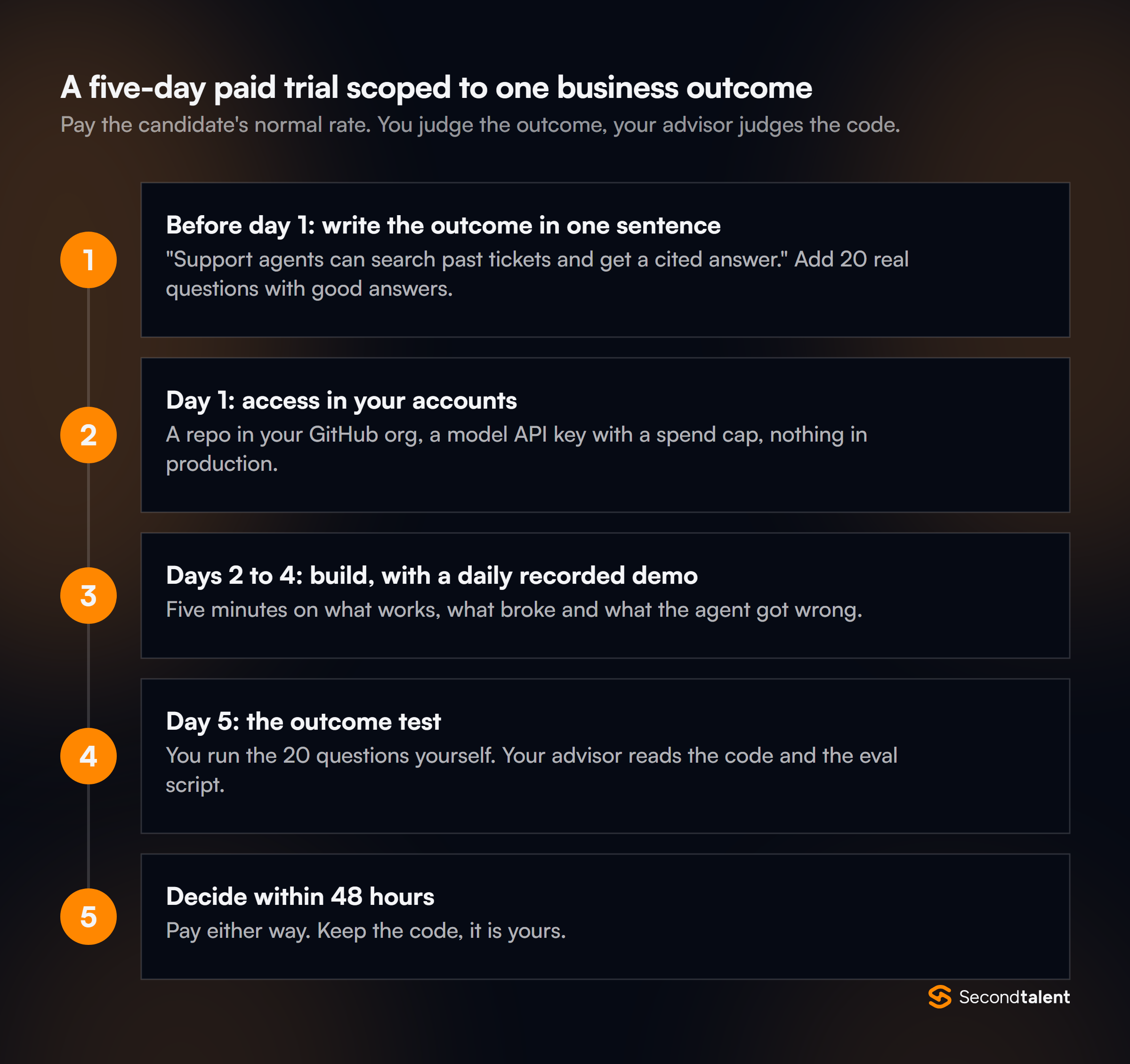
The 20 test questions turn the trial into something you can grade. You run them yourself on day 5 and count the good answers.
A candidate who also hands you a script that scores those questions on its own has built an eval unprompted, which is the AI-native habit in its clearest form.
A trial is a different test from a take-home. The take-home in our AI engineer interview loop is four hours, and an engineer scores it. You score the trial week yourself, on your data, inside your accounts.
How vetting partners and AI engineering accelerators vet
Most vetting partners run the same funnel: a résumé screen, a live English and communication check, a technical interview with a senior engineer, and sometimes a test project.
The useful difference between them is how much of that funnel they will show you. Toptal publishes its pass rate at each stage on its screening page:
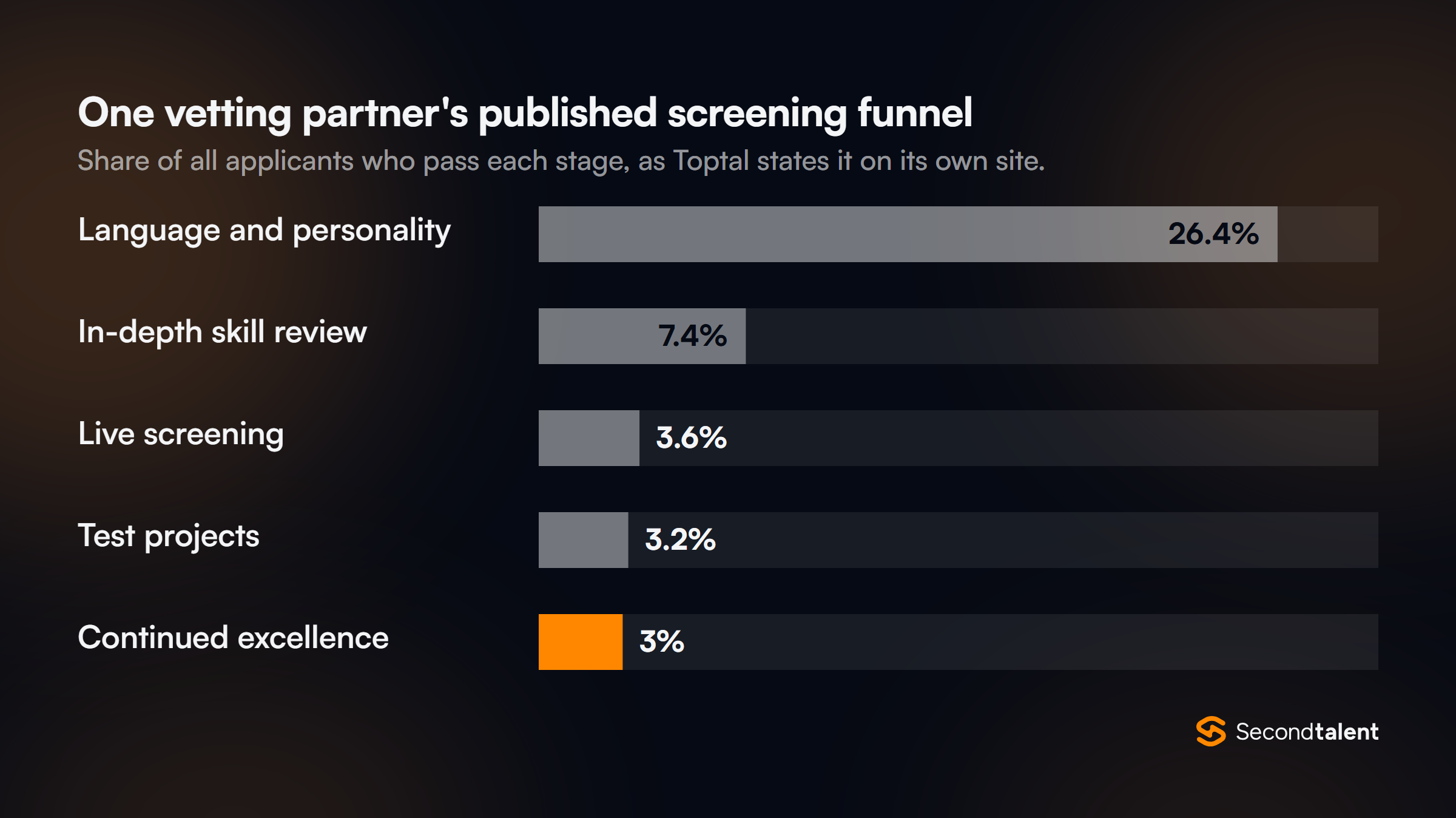
Our own stages are on the AI engineer hiring page: an application review that looks for AI features running in production, a skills assessment where the candidate builds a small retrieval feature and writes the eval that scores it, then a live technical interview with a senior engineer.
Only the top 1% of applicants make the list.
A low pass rate tells you little about the engineer in front of you. Ask questions whose answers you can check:
- Who ran the technical interview for this candidate, and can I read their scorecard? "Founder-led technical vetting" should mean a named senior engineer, not a quiz.
- How did you test AI-assisted work? Ask to see the exercise. If it never involved a coding agent, the "AI-native" label came from the résumé.
- Where in the process do you verify identity? The FBI's January 2025 alert tells employers to verify that third-party staffing firms "conduct robust hiring practices and routinely audit those practices," and warns of face-swapping in video interviews.
- What happens if the hire leaves or fails in month two? Get the replacement window and its conditions in writing.
Our AI staff augmentation guide carries a longer vendor checklist, and we compare ten options in the best platforms to hire AI engineers.
Put the offshore risk controls in the contract
In the same Hacker News thread, a software consultant described a non-technical client who had paid an agency in full and still had no access to the code. "We had to send legal notice to get access to the code," the consultant wrote.
That failure costs nothing to prevent if the repository sits in your company's GitHub organization from the first commit.
Most offshore risks have a contract clause or an account setting that covers them. The ones worth the most attention are common and costly at the same time:
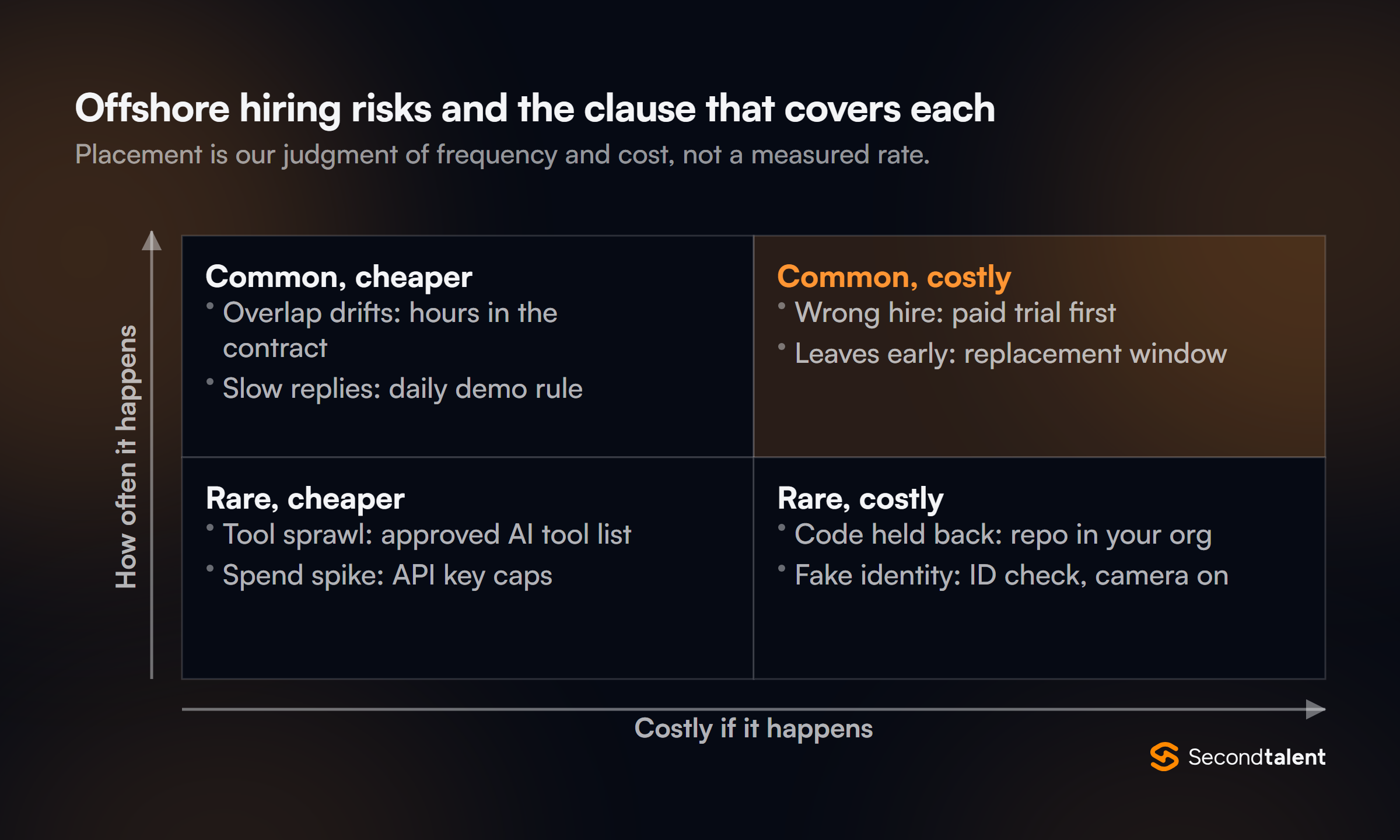
A wrong hire tops that corner for a reason. In CareerBuilder's 2017 survey of 2,257 US hiring managers, 74% said they had hired the wrong person for a role. The trial week and a replacement window are the two clauses that cap that cost.
The six clauses to have in writing before day one:
- IP assignment from the engineer to whoever employs them, and from that party to you. Ask to read both documents.
- Replacement guarantee with a stated window, such as the first 90 days.
- Trial period with a short notice term, so ending a bad fit costs a week, not a quarter.
- Overlap hours as a number, such as four hours inside your working day, with standup and review in that window.
- Access controls: company accounts and SSO, model API keys with spend caps, no production data in the trial.
- Who employs the engineer. See the comparison below.
- You sign with the individual and pay them across borders
- IP rests on the contract you drafted
- If they stop replying, you restart the search
- Local labor and tax rules are your problem to track
- A local entity employs the engineer and runs payroll
- IP passes through a two-step assignment chain
- A replacement clause covers an early exit
- You pay one monthly invoice
A direct contract can work for a short, scoped build.
For a seat you expect to keep, an employer of record moves payroll and local compliance off your desk, and a contract-to-hire arrangement lets you watch months of work before making the role permanent.
Hire a vetted AI-native engineer through Second Talent
We run the part of this a founder cannot: a senior developer interviews each engineer before we list them, and only the top 1% of applicants make it. You still get the parts you can judge yourself.
We match you with pre-vetted AI engineers from Asia in 24 hours, with 4 to 6 hours of US overlap, at 50% to 70% below US payroll.
If a hire does not work out in the first three months, we replace them at no cost, and our talent retention rate is 92%.
It costs nothing until you hire. Tell us what you are building and we will send the shortlist.
FAQ
Should a non-technical founder hire a fractional CTO instead?
Only if you need architecture decisions weekly. For vetting, a paid advisor for two sessions per finalist, the interview and the trial review, covers the gap at a fraction of a retainer.
How much time-zone overlap does an offshore AI engineer need?
Enough for a daily standup and same-day code review. Engineers in Asia can work 4 to 6 hours inside a US working day. Our US and Asia time zone guide lists working windows for each US coast.
Can I use an AI coding tool to review a candidate's code myself?
Use it to summarize a repository and list questions to ask, not to pass or fail anyone. A summary can tell you that tests exist; it takes an engineer to tell you whether they test the right things.