
TL;DR: Asia Pacific had 4.8GW of data center capacity under construction in the first half of 2026, about half of it in Southeast Asia. Worldwide, 53% of operators already struggle to fill open roles, with electrical and operations staff the scarcest. Employers in Southeast Asia plan 2027 salary rises of 4.1% to 6.7%, but data center specialists who change jobs are already getting far more.
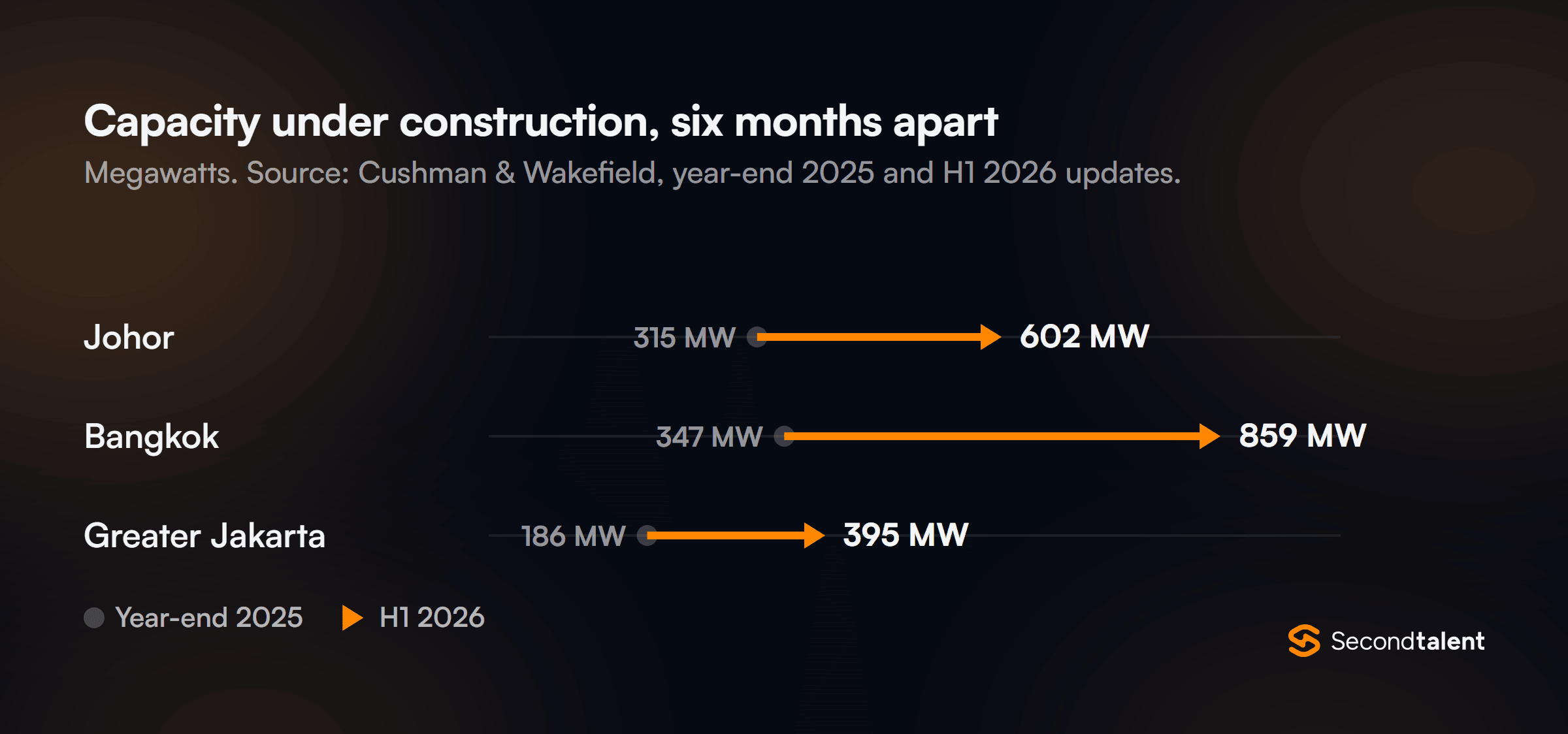
Johor had a colocation vacancy rate of 0.7% at the end of 2025, the tightest of the nine Asia Pacific markets Cushman & Wakefield tracks. Six months later, its capacity under construction had nearly doubled to 602MW.
Each of those halls needs electricians, commissioning engineers and operators before it can open.
- 1Most data centers in Malaysia create only 30 to 50 permanent jobs, so most of the hiring happens before the site opens.
- 2Singapore's data centre engineers earned a median basic wage of SGD 7,020 a month in June 2025.
- 3Singapore's Employment Pass salary floor rises to SGD 6,000 on January 1, 2027, months after Malaysia doubled its expatriate salary bands.
- 4In Japan, data center specialists who changed jobs in 2025 took raises of 15% to 20%.
Where Asia is building
Asia Pacific's data center pipeline reached a record 26.5GW in the first half of 2026, according to Cushman & Wakefield's H1 2026 update. Of that, 4.8GW was under construction and 21.7GW was planned.
About half of the capacity under construction sat in Southeast Asia, led by Malaysia at 1,039MW and Thailand at 859MW.
The operating base is still concentrated in a few cities. At the end of 2025, Greater Tokyo ran 1,179MW and Singapore 1,043MW, with Johor third at 897MW, ahead of Sydney and Mumbai.
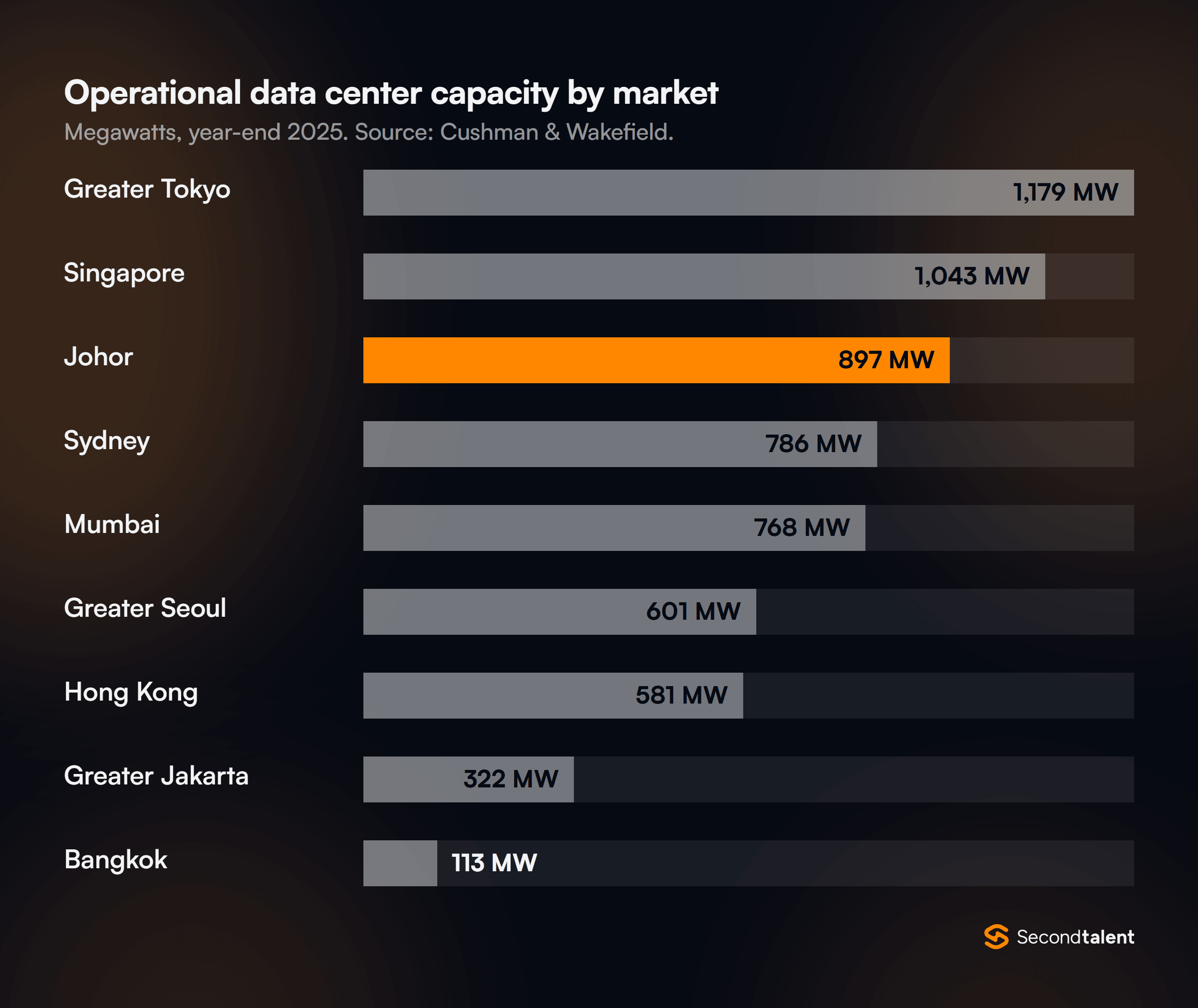
The ranking hides how differently each market is growing. Singapore had only 20MW under construction at the end of 2025, against 315MW in Johor and 347MW in Bangkok.
The cities with the most capacity today are not the ones that will need the most new staff in 2027.
The fastest build-outs are in markets with small operating bases. Bangkok's capacity under construction rose 148% in six months to 859MW, while only 134MW was operational. Greater Jakarta's construction pipeline grew 112% to 395MW.
JLL expects Asia Pacific to deliver 4.8GW of new supply by 2027, with 78% of it already preleased, according to its year-end 2025 Asia Pacific report. Preleased capacity has a customer and a deadline.
Its global outlook adds that more than half of projects in 2025 ran three months or more behind schedule, and equipment lead times averaged 33 weeks.
The workforce gap, measured
The Uptime Institute Global Data Center Survey 2026 found that 53% of operators have difficulty finding qualified candidates for open roles, up from 46% in 2025. Uptime called the rise statistically significant.
More than a quarter, 28%, said competitors had hired their staff away.
The gaps sit in the trades. Operators named electrical and junior or mid-level operations as their biggest skills gaps, each at 38%. Next came operations management at 35% and mechanical at 34%.
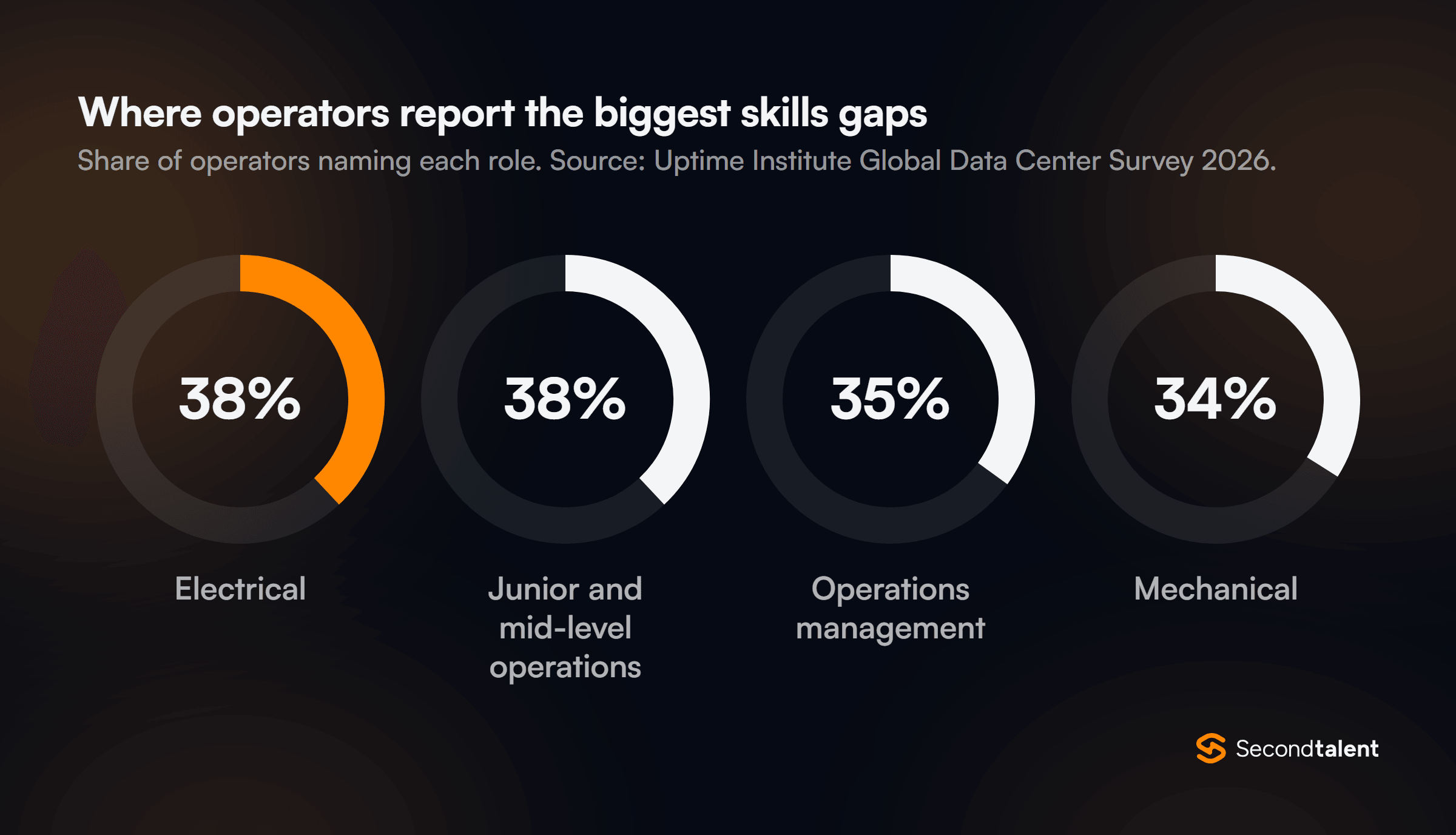
Uptime does not publish an Asian breakdown of these figures, and its 2025 staffing survey drew 19% of its owner and operator respondents from Asia Pacific outside China. The global numbers are the best available proxy.
The construction data above suggests the pressure is highest in Southeast Asia, though Uptime's figures cannot confirm it.
The workforce is also narrow. In the 2026 survey, 74% of operators said women make up around 10% of their data center staff. An industry recruiting mainly from one in ten of its potential candidates is drawing on a narrow pool.
Construction jobs now, a thin operations tail later
The hiring curve for a data center is front-loaded. The ASEAN+3 Macroeconomic Research Office found that "most data centers on average create only 30-50 permanent jobs" in its May 2026 analysis of Malaysia's data center boom.
The lion's share of jobs comes in the stages before a site opens.
That shapes what 2027 demand looks like. Johor and Bangkok each have hundreds of megawatts under construction at once.
A market like that needs electrical contractors, mechanical and HVAC engineers, project managers and commissioning engineers in large numbers at the same time.
The permanent operations team that follows is small, but it needs people who have run critical facilities before.
The hyperscalers driving the build state their own job numbers, which include the construction supply chain:
Company job estimates count indirect and supply-chain roles, so they are not data center headcount. They do show which markets the largest operators are betting on.
My reading is that 2027 is the year the construction wave and the first operations wave overlap in Johor, Bangkok and Jakarta.
The same electrical engineer can be pulled toward a contractor finishing one hall and an operator staffing the hall next door.
What data center roles pay
Singapore publishes the most detailed public pay data in the region. The Ministry of Manpower's Occupational Wages 2025 tables list "data centre engineer" as its own occupation.
Its median basic wage was SGD 7,020 a month in June 2025, and its 75th percentile SGD 11,296.
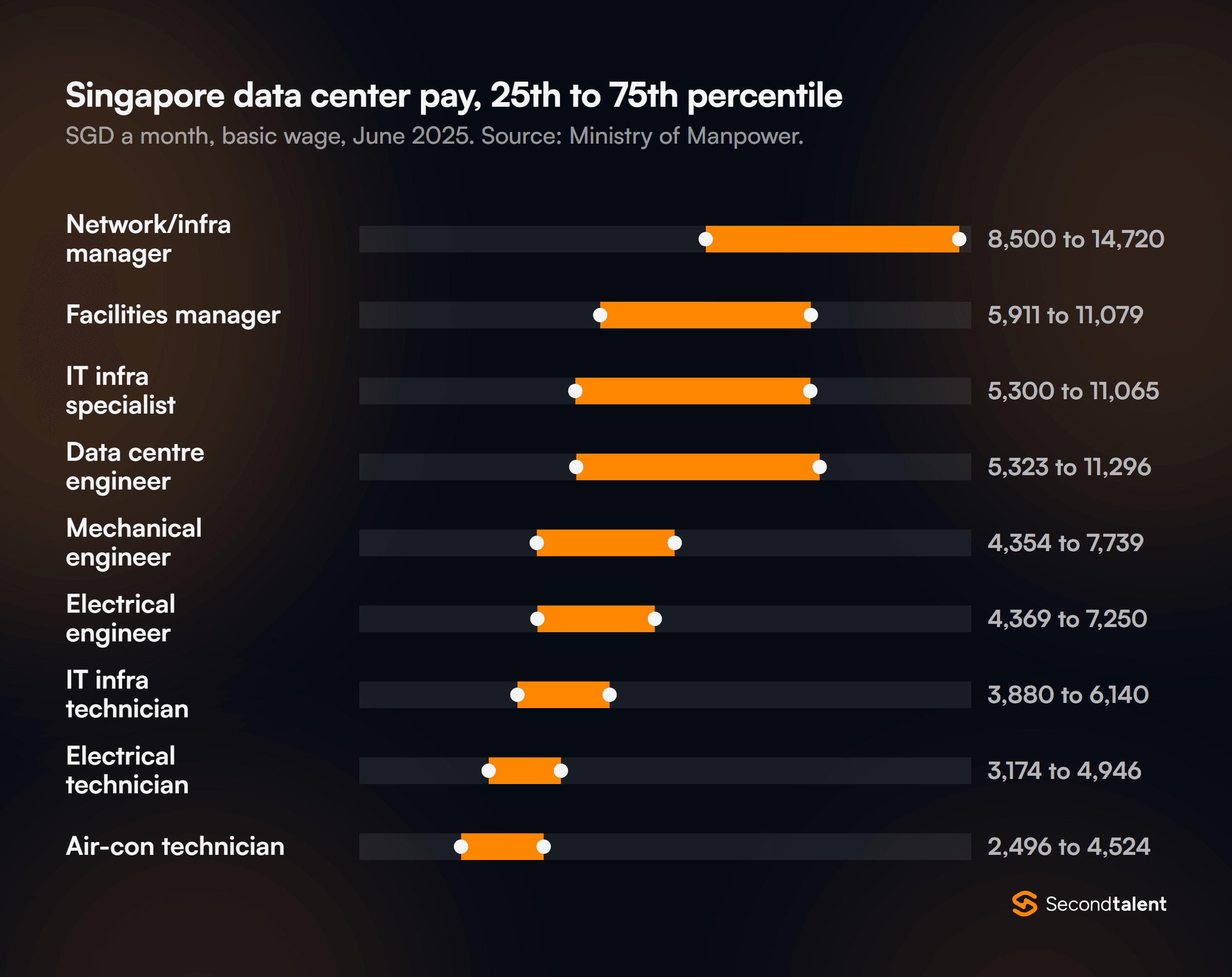
The spread between roles matters more than any single median. A network or infrastructure manager's middle band, SGD 8,500 to 14,720, sits above an electrical engineer's SGD 4,369 to 7,250.
An air-conditioning and refrigeration technician's runs SGD 2,496 to 4,524. The MOM tables cover full-time resident employees at private firms with 25 or more staff, and exclude bonuses and employer CPF contributions.
Data centre engineers also earn more at larger employers. MOM's table by firm size puts their median basic wage at SGD 6,198 in firms of 25 to 199 staff and SGD 7,742 in firms of 200 or more.
Japan's figures come from recruiters. The Robert Walters Japan Salary Survey 2026 puts a data centre engineer in the Tokyo region at ¥10m to ¥12m a year in base salary.
An infrastructure manager earns ¥10m to ¥15m, and an operations and maintenance manager ¥9m to ¥14m.
- SGD 7,020 median basic a month, data centre engineer
- All resident employees, every experience level
- Excludes bonuses and allowances
- ¥10m to ¥12m base a year, data centre engineer
- Drawn from roles the recruiter advertised
- Job changers took 15% to 20% raises in 2025
The two sources measure different things, so converting one currency into the other would mislead. Both show a premium for experience in live facilities.
Robert Walters reports that Japanese employers want holders of the Second-Class Chief Electrical Engineer and First-Class Electrical Construction Management Engineer licenses, and that sought-after candidates often weigh several offers.
Elsewhere, public data is thinner. The recruiter XPND's Indonesia Data Center Salary Benchmark 2026 starts at IDR 8.5 million a month in gross base pay for entry-level technicians.
At the top, a project or campus director earns IDR 150 million. In Johor, a state technician program launched in March 2025 offered RM3,500 to 4,000 a month to diploma holders, according to an ISEAS-Yusof Ishak Institute analysis.
Salary growth in 2027
Aon's Salary Increase and Turnover Study, published in September 2026, covers more than 1,200 companies. It projects average salary rises of 5.2% across Southeast Asia in 2027. Vietnam leads at 6.7% and Singapore sits at 4.1%.
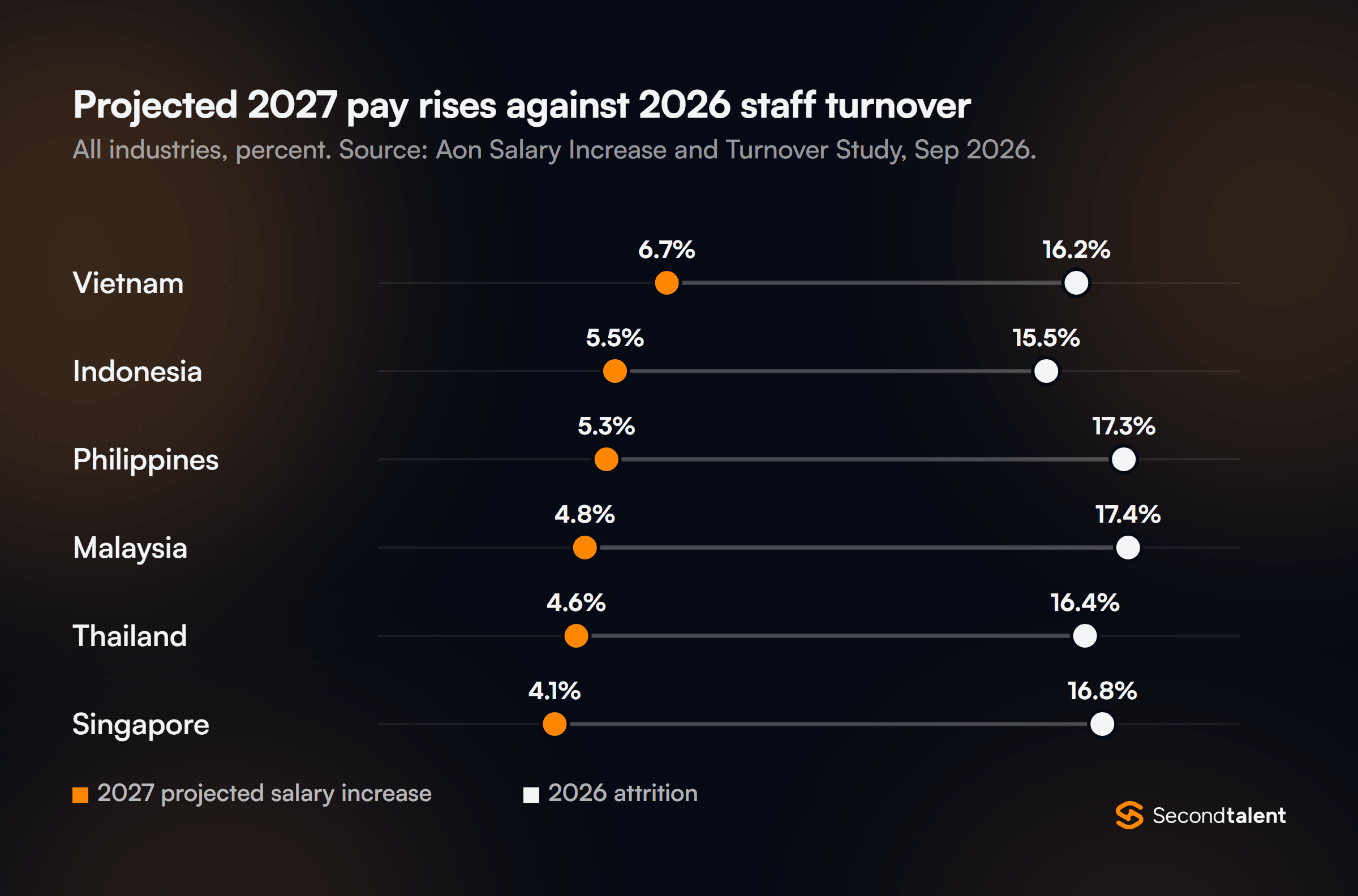
In every market Aon covers, 2026 attrition was between 2.4 and 4.1 times the projected 2027 raise, by my arithmetic. Malaysia's 2026 attrition rate was 17.4% against a projected 2027 raise of 4.8%; the Philippines' was 17.3% against 5.3%.
These are all-industry figures; I would expect data center roles, with their reported shortages, to run hotter.
India's pay growth is higher. Aon's India survey projects 9.1% for 2027 overall, 9.8% in real estate and infrastructure and 9.9% in energy, the two sectors closest to data center construction and power.
A budget figure is an average across the staff who stay. My rule of thumb is that it understates what a scarce specialist costs to hire.
The evidence points that way: Japan's 15% to 20% job-changer raises, and the 55% of operators in Uptime's staffing survey whose salary spend rose in 2025.
A hiring plan for 2027 that prices electrical and operations staff at the 4% to 7% budget line will lose candidates to whoever prices them at the market.
Policy is raising the cost of imported staff
The two markets at the center of the Johor and Singapore corridor are both tightening their work-pass rules.
Singapore's rules come from the Ministry of Manpower and Malaysia's from the Expatriate Services Division.
Singapore's shortage occupation list for 2026, which earns extra points under its COMPASS framework, names cloud and cybersecurity specialists but no data center facility roles.
Power is the other constraint. AMRO reports that applications for data center power supply in Malaysia had passed 11,000MW by December 2024, about 40% of Peninsular Malaysia's generating capacity.
In Johor, around 30% of applications made between June and October 2024 were turned down. Capacity that cannot get power does not hire anyone, so the pipeline numbers above are an upper bound.
For employers, the effect compounds. Importing an experienced engineer into Johor or Singapore costs more from 2027, which raises the value of training local staff and of sharing scarce specialists across sites.
If you employ people in these markets, our Malaysia payroll and tax guide and Singapore payroll and tax guide set out the statutory costs.
Training pipelines, by the numbers
Operators and universities have announced a run of training programs since 2025. The announced targets are large; the cohorts with published results are small.
- STT GDC, Philippines (March 2025): its first DC Power-Up cohort led to job offers for 9 participants, all accepted. The second cohort, in April 2026, trained 27 students.
- Nxera, Singapore (July 2025): Singtel's data center arm, with Singapore's polytechnics, ITE and SIT, plans to train and hire more than 500 people.
- Vertiv and IIT Madras Pravartak, India (October 2025): a 35-hour online program for more than 2,000 STEM students, plus a five-day campus course for 160.
- UTM, MDEC and The Asia Foundation, Malaysia (2025): data center foundation training for 150 participants across three cohorts, supported by Microsoft.
- STT GDC, Singapore (January 2026): agreements with ITE, Singapore Polytechnic, NTU and NUS for more than 8,000 internship, training and industry attachment opportunities over five years.
- DayOne, Malaysia (April 2026): plans to train more than 1,000 data center engineers at its Johor hub.
The gap between targets and results is the point. Programs that publish outcomes report dozens of hires, not thousands, while each new hall needs its operations team on day one.
In Uptime's staffing survey, 50% of operators named universities as a source of new hires and 13% named trade schools. The pipeline still depends on graduates who need years of site experience.
The adjacent software and infrastructure roles are easier to fill from a wider pool.
Data center operators also hire site reliability engineers, network engineers and infrastructure engineers, roles that run monitoring, automation and capacity planning and are not tied to one site.
Download the full report
The PDF carries every table in this article, the method notes on each tracker and the full source list. No email required.
Second Talent helps US startups hire vetted AI-native engineers from Asia, including the infrastructure, network and site reliability roles that sit around a data center.
Rates run from $23 to $39 an hour, candidates are matched in 24 hours, and every hire carries a 90-day, one-time replacement guarantee.
For on-site staff in Malaysia, our employer of record service handles payroll and compliance without a local entity.
FAQ
Which certifications do data center employers in Asia look for?
Operator training programs use them as entry credentials.
STT GDC's programs in the Philippines and Johor sponsor the EPI Data Centre Facilities Certificate, and Japanese employers seek electrical chief engineer licenses, according to Robert Walters.
Is Singapore still building data centers?
Yes, within tight limits. Singapore had 20MW under construction at the end of 2025, according to Cushman & Wakefield.
In August 2026 it allocated 200MW of new capacity, and the winning operators must draw at least half their power from green energy.