
TL;DR: Every Philippine contribution ceiling is low, so employer social contributions collapse from about 11.8% of salary at mid-level pay to about 5.2% on a senior package. The 13th month is statutory and adds a flat 8.33% regardless, which puts real employer cost near 20% and 13.5%.
We employ staff in the Philippines through our own entity, so these are the numbers we run every month. This guide covers what you owe, what your employee takes home, and why the headline contribution rate tells you almost nothing about a senior hire.
Key takeaways
- Budget about 20% at mid-level pay and about 13.5% on senior packages. Contributions fall, the 13th month does not.
- All three ceilings are low. Pag-IBIG’s caps below the Metro Manila minimum wage, so treat it as a flat PHP 200.
- The 13th month is statutory under PD 851 and due by 24 December, tax-exempt within PHP 90,000 of benefits.
- Metro Manila’s minimum rose to PHP 755 on 25 July 2026, with PHP 780 following in January 2027.
- Statutory leave is five days. The market expects 15 vacation plus 15 sick, so budget to the market, not the law.
What Employing Someone in the Philippines Costs
Budget about 20% on top of gross salary at mid-level pay. Roughly 11.8% is social contributions across three agencies, and the remaining 8.33% is the accrual for the statutory 13th month.
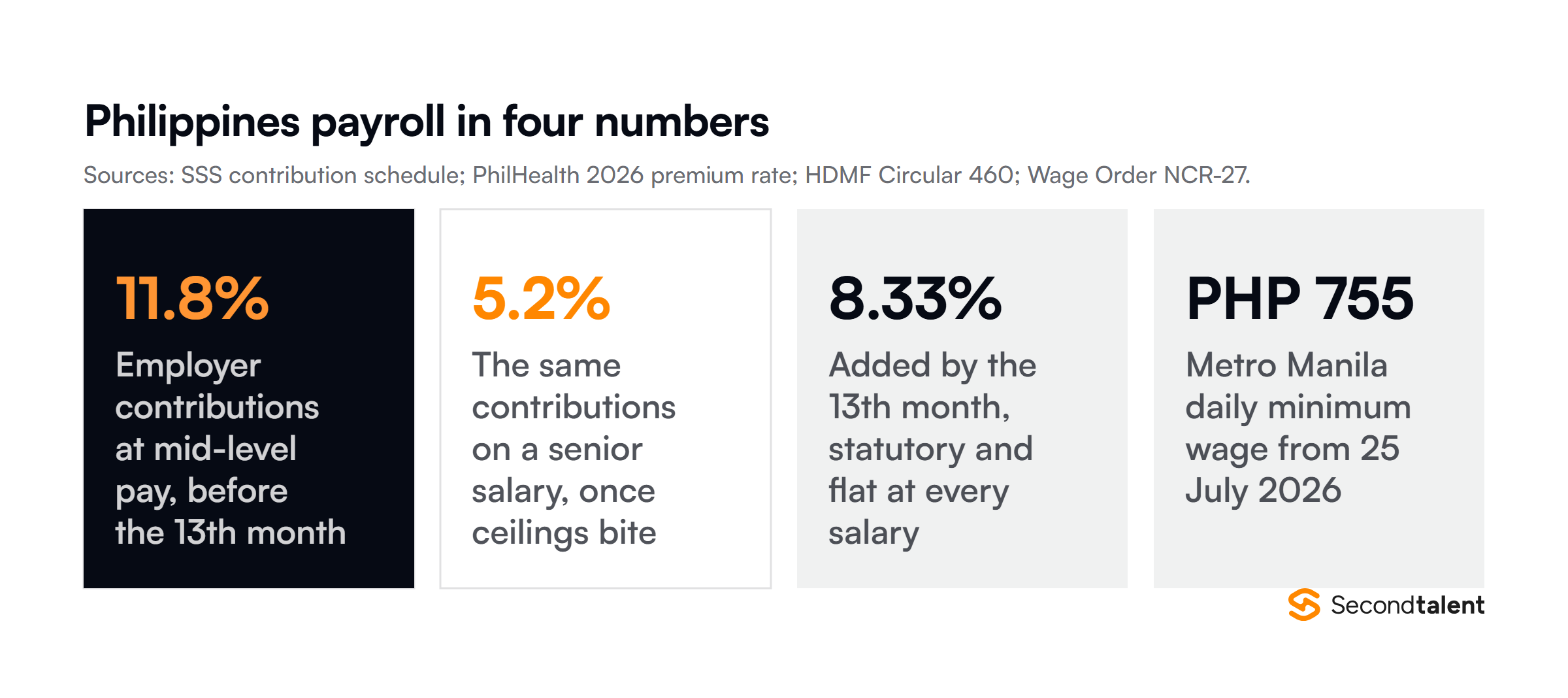
The ceilings are what make this market unusual. All three contributions cap at low absolute figures, and two of those figures have nothing to do with the salary you actually pay.
Pag-IBIG caps at a fund salary of PHP 10,000, which is below the minimum wage in Metro Manila. SSS caps at a salary credit of PHP 35,000. Only PhilHealth has a ceiling anywhere near a senior salary.
Three Agencies, Three Separate Ceilings
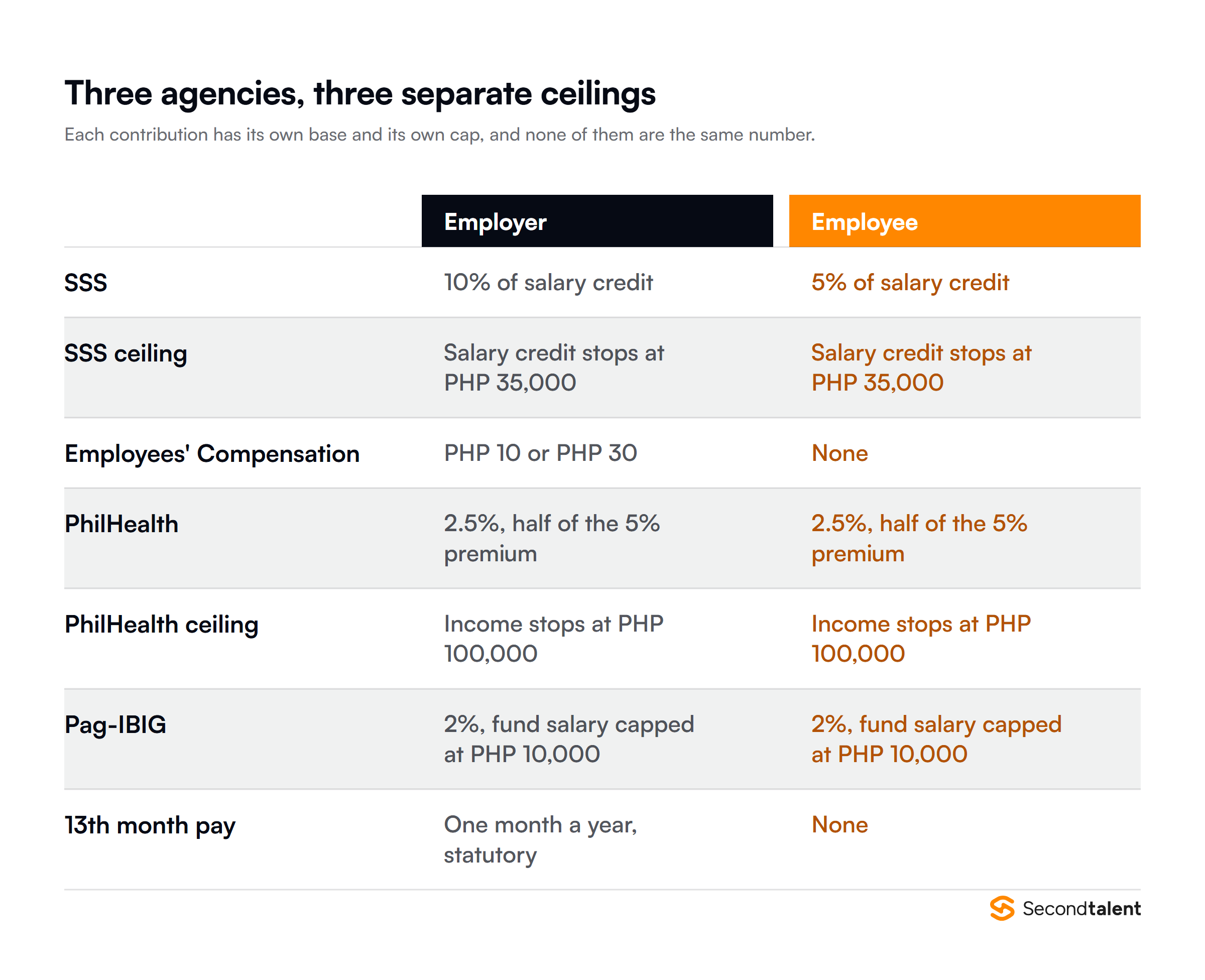
SSS is the largest of the three. The rate reached 15% of the monthly salary credit under the Social Security Act reform, split 10% from the employer and 5% from the employee, on a salary credit that stops at PHP 35,000.
Download this guide as a PDF
The full Philippines payroll, benefits and tax guide, including the three contribution ceilings, 13th month rules, the income tax schedule, leave, termination and both worked examples, formatted for sharing with your finance team.
Employees whose salary credit exceeds PHP 20,000 also contribute to the mandatory provident fund, which sits inside the same payment rather than being an extra line. The employer separately pays a small Employees’ Compensation premium of PHP 10 or PHP 30.
PhilHealth holds at 5% for 2026, shared equally between employer and employee, on income between PHP 10,000 and PHP 100,000. That produces a maximum of PHP 2,500 from each side.
Pag-IBIG’s ceiling is lower than the minimum wage
The maximum fund salary is PHP 10,000, doubled from PHP 5,000 by HDMF Circular 460 in February 2024. At 2% from each side that is PHP 200 each, and a full-time employee on the Metro Manila minimum already earns more than the ceiling. Treat Pag-IBIG as a fixed PHP 200 line, not a percentage.
13th Month Pay is a Legal Obligation
Presidential Decree 851 makes the 13th month mandatory for rank-and-file employees, and it must be paid on or before 24 December. Employees who worked part of the year receive a pro-rated amount.
The Philippines and Indonesia are the two markets in the region where this is law rather than custom. In Vietnam, Malaysia, Singapore and Hong Kong the extra month is convention, and withholding it is a retention problem rather than a legal one.
The amount is the total basic salary earned during the year divided by twelve. Allowances and overtime are generally excluded, so the figure is not simply one month of gross pay for everyone.
Tax treatment is generous. The 13th month and other benefits are exempt up to an aggregate PHP 90,000 a year, and only the excess is taxable.
What a Hire Actually Costs in the Philippines
Two worked examples for a single employee, showing contributions, the 13th month accrual and withholding tax.
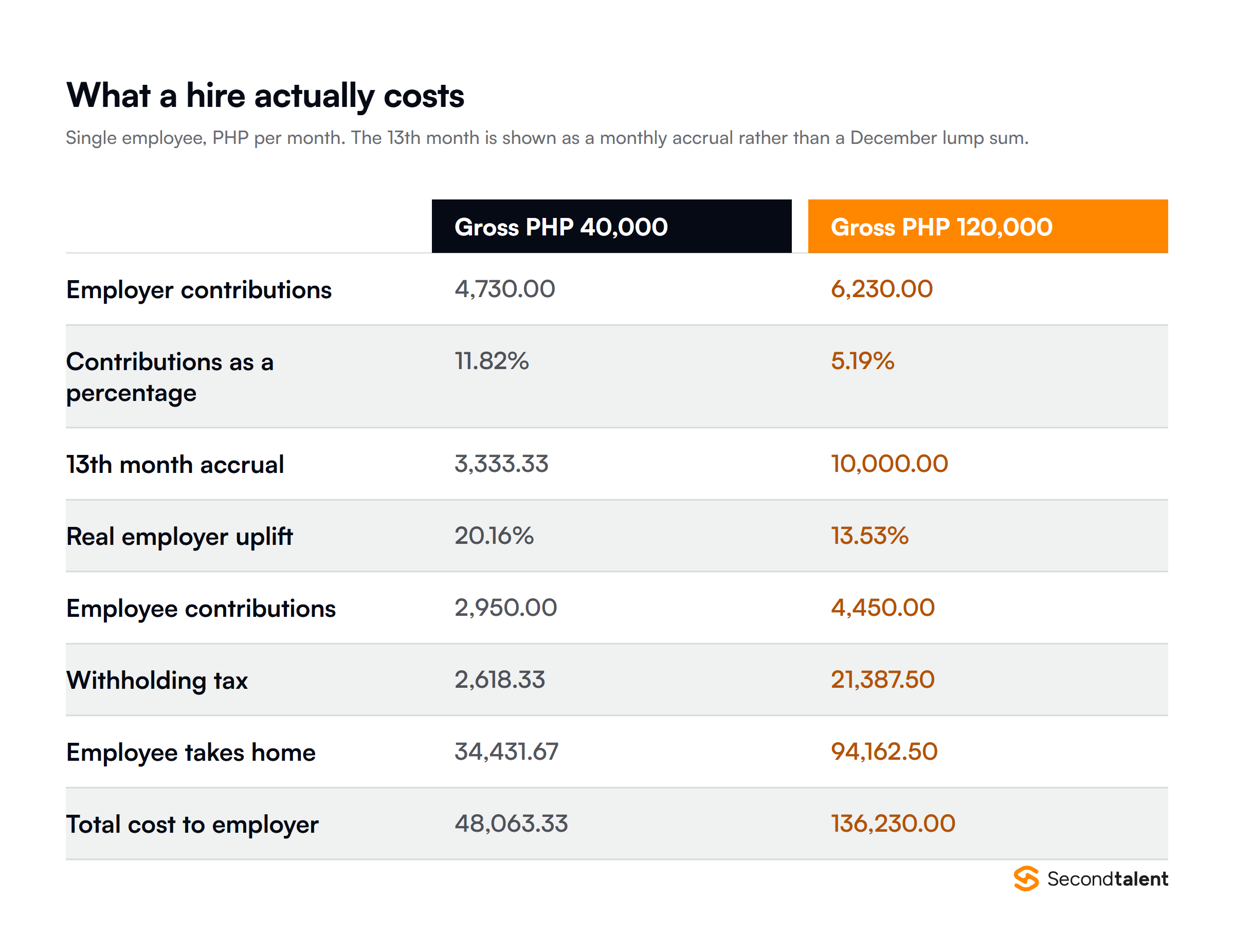
Contributions alone fall from 11.82% to 5.19% across the two salaries. That is the steepest drop of any market in the region, and it happens because all three ceilings are low in absolute terms.
The 13th month does not fall. It is a flat 8.33% of whatever you pay, so it becomes the larger share of employer cost as salary rises.
Our EOR cost calculator models the full stack, and the Philippines EOR guide covers what we handle on your behalf.
Income Tax
Residents pay progressive rates from 0% to 35% under the TRAIN law. The second-phase rates took effect in January 2023 and have not moved since, so the 2026 table is unchanged.
| Annual taxable income (PHP) | Rate |
|---|---|
| Up to 250,000 | 0% |
| 250,001 to 400,000 | 15% |
| 400,001 to 800,000 | 20% |
| 800,001 to 2,000,000 | 25% |
| 2,000,001 to 8,000,000 | 30% |
| Over 8,000,000 | 35% |
Statutory minimum wage earners are exempt from income tax on their basic wage, along with their holiday, overtime, night shift and hazard pay. That exemption is a real administrative distinction, not a rounding effect.
Employers withhold monthly and file BIR Form 2316 for each employee after year end. Substituted filing then removes the obligation for most employees to file their own return.
Minimum Wage Rose Sharply in July 2026
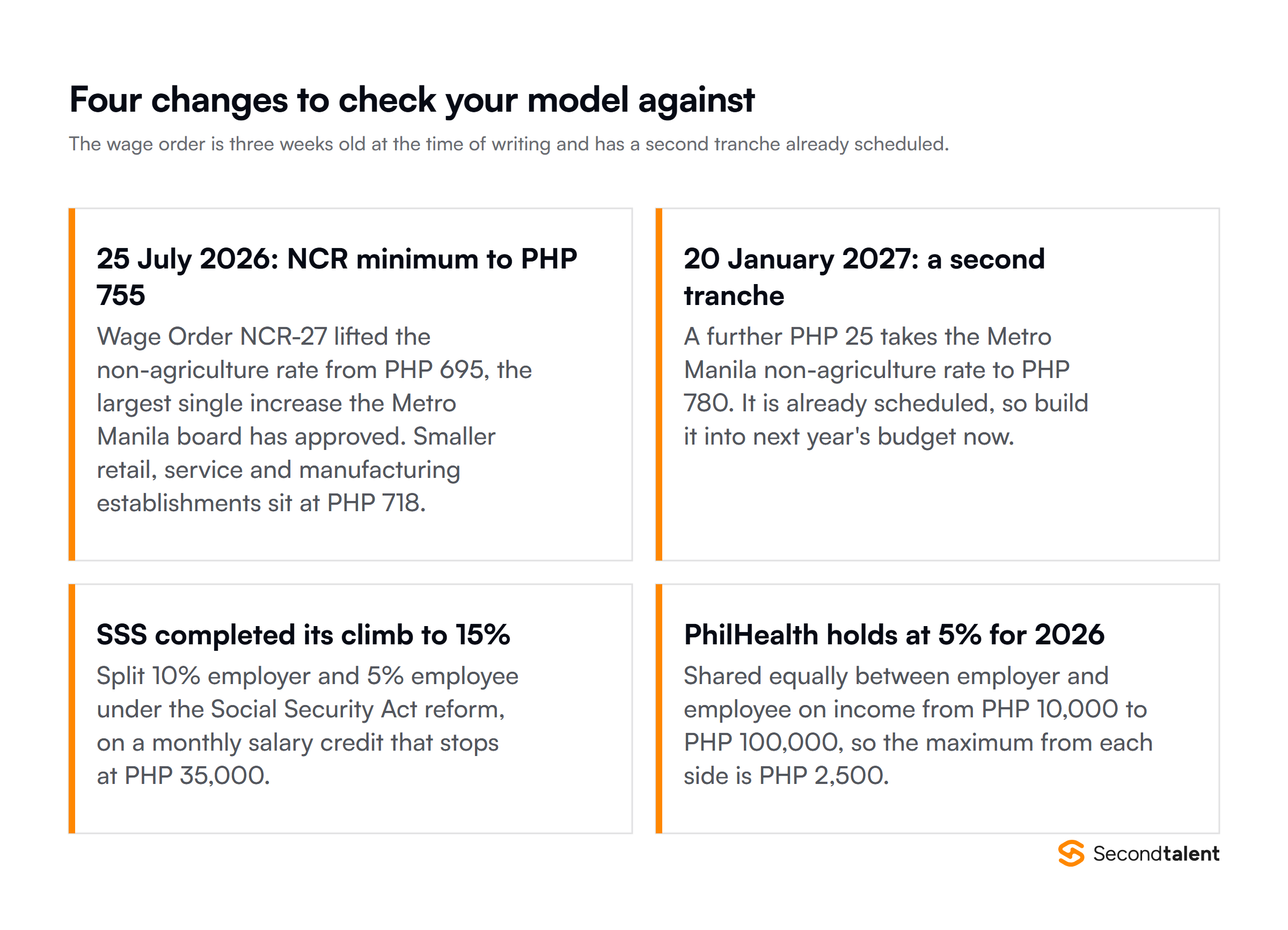
Wage Order NCR-27 raised the Metro Manila non-agriculture minimum from PHP 695 to PHP 755 a day on 25 July 2026. A second tranche of PHP 25 follows on 20 January 2027, taking it to PHP 780.
Smaller establishments in retail, service and manufacturing sit on a lower rate of PHP 718. Wages are set regionally, so a Cebu or Davao obligation is a different number entirely and moves on its own schedule.
Check the wage order for the region where the employee actually works. A national headline figure is meaningless here, and the boards do not move together.
Statutory Leave is Five Days
Service Incentive Leave is five days a year after twelve months of service, and it covers both vacation and sick leave. That is the thinnest statutory entitlement in the region by a wide margin.
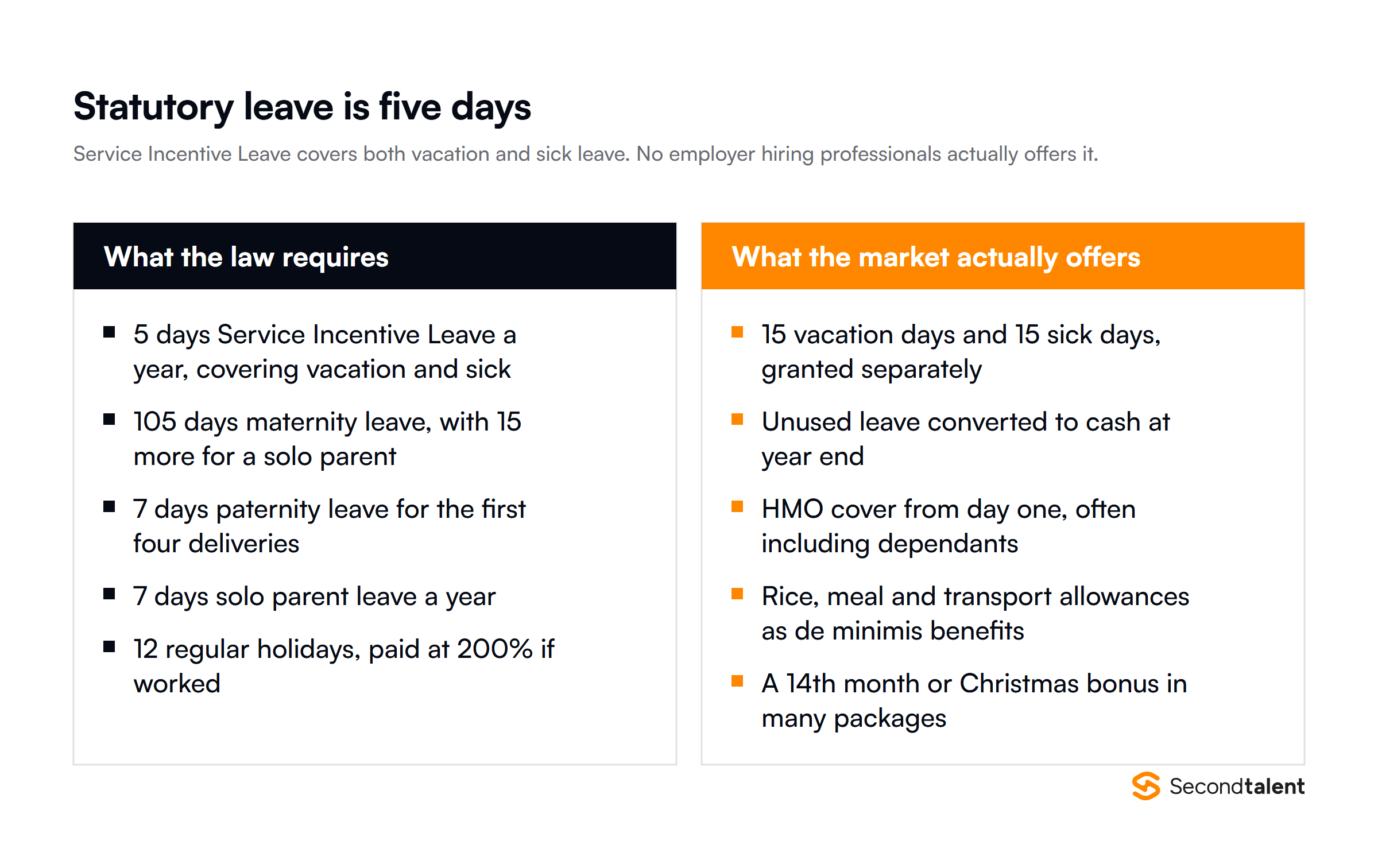
Generally, nobody hiring professionals actually offers five days. The market standard is 15 vacation days plus 15 sick days, granted separately, and an offer built on the statutory floor will not be competitive.
- Maternity leave: 105 days paid, with an additional 15 days for a solo parent, and an option to transfer 7 days to the father.
- Paternity leave: 7 days for married employees, for the first four deliveries.
- Solo parent leave: 7 days a year for qualified employees.
- Regular holidays: 12 a year, paid at 200% if worked, plus special non-working days paid at 130% if worked.
Holiday premium pay is where Philippine payroll gets genuinely complicated. Working a regular holiday that also falls on a rest day attracts a further premium on top of the 200%.
Termination: Just Cause and Authorised Cause
The Philippines has no at-will employment, and security of tenure is constitutionally protected. Dismissal must rest on a just cause relating to the employee’s conduct, or an authorised cause relating to the business.
- Just cause covers serious misconduct, wilful disobedience, gross neglect, fraud and similar grounds. No separation pay is due, but two written notices and a hearing are.
- Authorised cause covers redundancy, retrenchment, closure and disease. Separation pay is due, along with 30 days’ written notice to the employee and to the Department of Labor.
- Separation pay: one month per year of service for redundancy or closure, and half a month per year for retrenchment or disease, with a one-month minimum.
- Probation: a maximum of six months, and the standards for regularisation must be communicated at hiring or the employee is deemed regular from day one.
Procedural defects are expensive even where the ground is sound. An otherwise valid dismissal carried out without the two-notice process still attracts nominal damages.
Employing Foreign Nationals
A foreign national needs an Alien Employment Permit from the Department of Labor and a 9(g) pre-arranged employment visa from the Bureau of Immigration. The employer sponsors both.
The permit application includes a labour market test, published to allow Filipino applicants to object, and an understudy or skills transfer commitment for certain roles. Budget two to four months for the full sequence.
Benefits Beyond the Statutory Minimum
PhilHealth covers a share of hospital costs rather than the full bill, so private HMO cover is the single most expected benefit in the market. For technical roles in Metro Manila and Cebu it is effectively part of the base offer.
- HMO coverage: expected from day one for professional roles, and commonly extended to one or two dependants at senior grades.
- Leave above the statutory five days: 15 vacation plus 15 sick is the competitive baseline, often with unused leave converted to cash at year end.
- Rice, meal and transport allowances: widespread, and several qualify as de minimis benefits that are exempt from income tax within published limits.
- 14th month or Christmas bonus: not required, but common enough that candidates ask. It falls inside the same PHP 90,000 tax-exempt aggregate as the 13th month.
Structure allowances as de minimis benefits where they qualify. Doing so keeps them outside taxable compensation up to the published ceilings, which raises net pay at no extra cost to you.
Running Payroll Each Month
- Pay at least twice a month, at intervals not exceeding sixteen days. Monthly-only payment does not comply.
- Withhold income tax and the employee share of all three contributions at source.
- Remit SSS, PhilHealth and Pag-IBIG on their own separate schedules, each with its own portal.
- Remit withholding tax to the BIR and file the monthly and quarterly returns.
- Pay the 13th month on or before 24 December, and file the compliance report with the Department of Labor by 15 January.
The twice-monthly pay rule surprises employers arriving from markets that pay monthly. It is a statutory requirement rather than a convention, and it shapes how you configure payroll from the start.
Frequently Asked Questions
What is the total employer cost of hiring in the Philippines?
About 20% on top of gross salary at mid-level pay, falling to about 13.5% on a senior package. Roughly 11.8% is social contributions and 8.33% is the 13th month accrual. The contribution share falls because every ceiling is low.
Is 13th month pay mandatory in the Philippines?
Yes, under Presidential Decree 851, and it must be paid on or before 24 December. It equals total basic salary earned in the year divided by twelve, and it is tax-exempt within an aggregate PHP 90,000 of benefits.
How much is the SSS contribution in 2026?
15% of the monthly salary credit, split 10% employer and 5% employee, on a salary credit capped at PHP 35,000. That makes the maximum employer share PHP 3,500 a month, plus a small Employees’ Compensation premium.
What is the minimum wage in the Philippines?
It is set regionally, not nationally. Metro Manila’s non-agriculture rate rose to PHP 755 a day on 25 July 2026 under Wage Order NCR-27, with a second tranche to PHP 780 in January 2027. Other regions differ and move on their own schedules.
Can I pay a Philippine employee without a local entity?
Not directly. SSS, PhilHealth, Pag-IBIG and BIR registration all require a registered local employer. An employer of record in the Philippines holds the contract on its own entity and handles every filing.
Our EOR versus entity calculator models the crossover, and the Philippines EOR provider comparison covers the local market. For the wider picture, see our roundup of tech startups in the Philippines.
Hiring in the Philippines?
Second Talent employs staff in the Philippines on our own entity and handles contracts, SSS, PhilHealth, Pag-IBIG, BIR withholding and the 13th month, so the rules above become our problem rather than yours. We also source the candidates. Tell us the role and we will come back with candidates and a full employment cost.
This guide is general information, current as at the date of publication, and is not tax or legal advice. Regional wage orders and contribution tables change on their own schedules. Confirm your position with a qualified adviser before acting.

![How to Hire Developers in Asia Remotely. How to Hire Developers in Asia Remotely from the USA [2026], by Second Talent.](https://www.secondtalent.com/wp-content/uploads/2026/09/hire-developers-in-asia-remotely-featured-v2-768x403.jpg)
![AI Outsourcing in Singapore. Top 10 AI Outsourcing Companies in Singapore [2026], by Second Talent.](https://www.secondtalent.com/wp-content/uploads/2026/09/ai-outsourcing-companies-singapore-featured-v2-768x403.jpg)
![AI Outsourcing in India. Top 10 AI Outsourcing Companies in India [2026], by Second Talent.](https://www.secondtalent.com/wp-content/uploads/2026/09/ai-outsourcing-companies-india-featured-v2-768x403.jpg)
![AI Outsourcing in the Philippines. Top 10 AI Outsourcing Companies in the Philippines [2026], by Second Talent.](https://www.secondtalent.com/wp-content/uploads/2026/09/ai-outsourcing-companies-philippines-featured-v2-768x403.jpg)

![Software Development Outsourcing in Vietnam. Top 10 Software Development Outsourcing Companies in Vietnam [2026], by Second Talent.](https://www.secondtalent.com/wp-content/uploads/2026/09/software-development-outsourcing-companies-vietnam-featured-v2-768x403.jpg)