
TL;DR: AI roles now top the fastest-growing job lists in Singapore and India, and Singapore pays AI and machine learning engineers a median SGD 10,300 a month. Indonesia had the fastest relative growth in AI hiring of any country tracked in 2025. Salary budgets for 2027 run from 4.1% in Singapore to 9.1% in India, while AI roles carry premiums well above that.
AI engineers were the fastest-growing job in Singapore in LinkedIn's Jobs on the Rise 2026 list, ahead of heads of AI and machine learning researchers.
In India, AI roles took three of the top four places, with prompt engineer at number one.
- 1Singapore had the highest share of job postings requiring AI skills in 2025, at 4.69%, ahead of Hong Kong.
- 2Singapore added AI engineer and AI researcher or scientist to its work-pass shortage list from January 2026.
- 3India's employers reported the strongest hiring outlook of 42 countries for late 2026, a net 54%.
- 4Malaysia's national AI plan for 2026 to 2030 expects 300,000 to 500,000 new AI-related jobs.
The fastest-growing roles
LinkedIn builds its Jobs on the Rise 2026 lists from the jobs its members started between January 2023 and July 2025, so they measure hires and moves rather than job ads. In Asia, LinkedIn published 2026 lists only for Singapore and India.
- 1. AI engineers
- 2. Head of AI
- 3. Machine learning researchers
- 1. Prompt engineer
- 2. AI engineer
- 3. Software engineer
- 4. Manager of AI
The leadership titles matter as much as the engineering ones. A head of AI in Singapore and a manager of AI in India both appear in the top four.
I read that as a sign employers have moved from pilots to standing teams that need someone to run them.
The World Economic Forum's Future of Jobs Report 2025 points the same way from employer forecasts. Its fastest-growing jobs to 2030 are big data specialists, fintech engineers, and AI and machine learning specialists.
In its country notes, AI specialists lead projected job growth in Indonesia, and India's fastest-growing roles include big data and AI and machine learning specialists. In Japan, data analysts and scientists are among the top growing jobs.
Where demand is concentrated, and where it is growing
The Stanford AI Index 2026 measures AI demand three ways, and Asian countries top two of them.
Using Lightcast data, it found that 4.69% of Singapore's job postings required AI skills in 2025, the highest of any country tracked, with Hong Kong second at 3.48%. The United States was at 2.56%.
On LinkedIn's measure of AI talent concentration, the share of members who are AI talent, Singapore ranks second in the world at 1.82%, behind Israel.
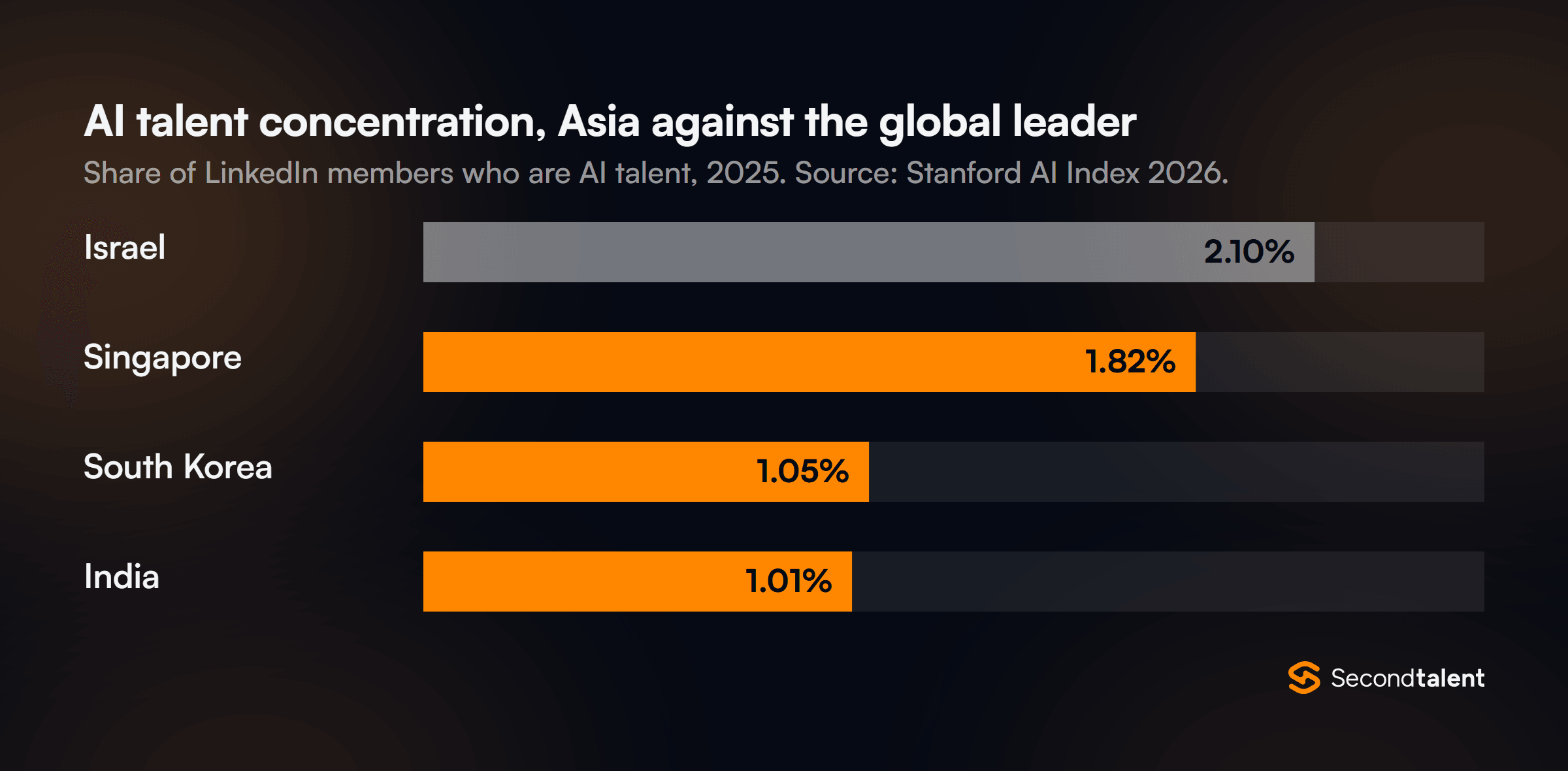
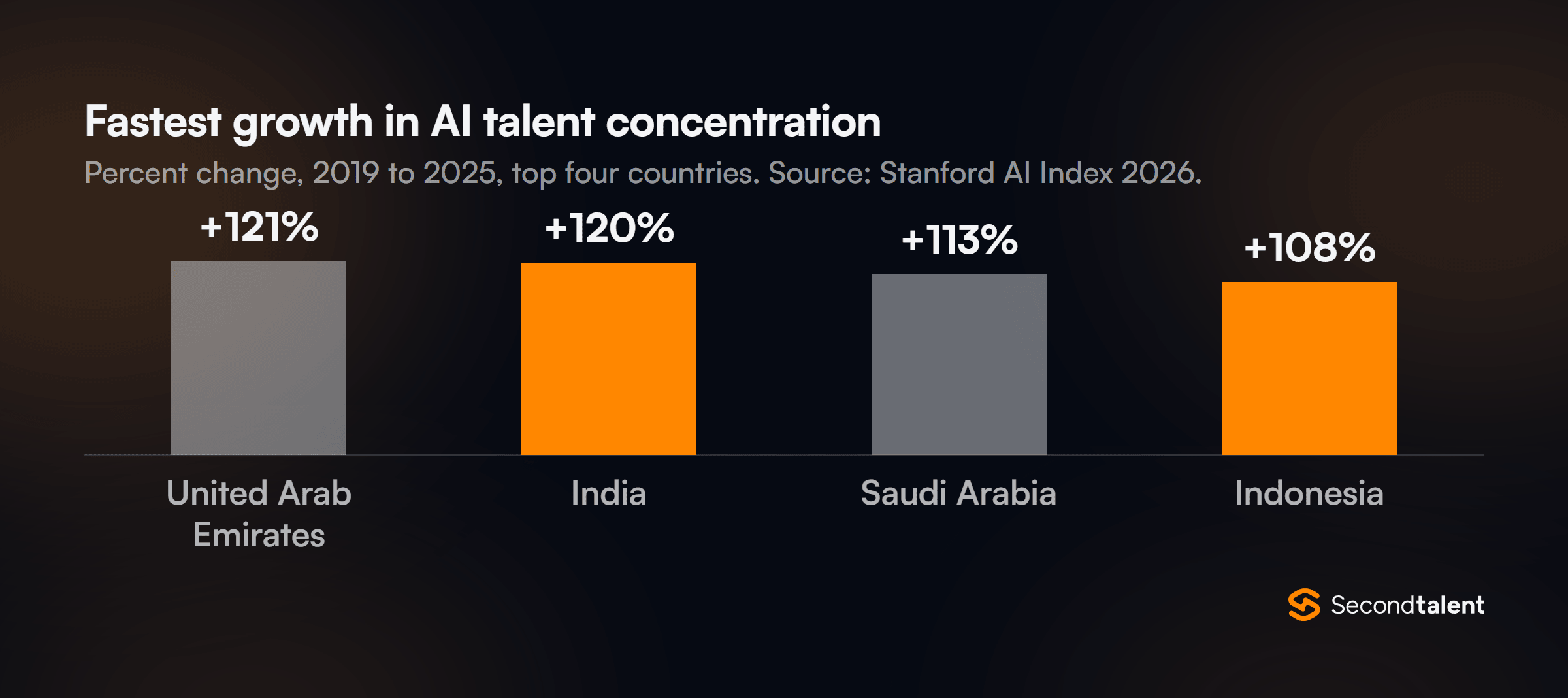
India and South Korea sit near 1%, but India's figure is moving fastest. Its AI talent concentration grew 120% between 2019 and 2025, and Indonesia's grew 108%. Only the United Arab Emirates grew faster.
Indonesia also recorded the highest relative AI hiring growth of any country in 2025, at 31.7%. That measure compares the growth of AI hiring with the growth of all hiring, so it shows where AI is taking a rising share of new jobs.
My reading is that Asia's AI market has two speeds. Singapore and Hong Kong already have dense AI workforces and heavy demand.
India and Indonesia are smaller in share but growing faster, which is where the competition for experienced staff is likely to tighten next.
Hiring intentions for the year ahead
ManpowerGroup's Employment Outlook Survey for the fourth quarter of 2026 asked almost 40,000 employers whether they plan to add or cut staff. India's net outlook of 54% was the strongest of the 42 countries surveyed.
The same survey records a cost of AI at the bottom of the ladder. Among the reasons employers gave for reducing entry-level hiring, "AI-driven automation has reduced early-career roles and tasks" ranked fourth worldwide.
AI is adding senior roles and removing some junior ones at the same time.
India's global capability centers, the in-house engineering and operations arms of foreign companies, employ a large share of its tech staff.
The Zinnov-Nasscom India GCC Landscape 2026 counts 2,117 of them employing 2.36 million people, and ranks India first among GCC markets for AI hiring intensity.
What AI roles pay
Singapore publishes the clearest public pay data for AI work.
The Ministry of Manpower's Occupational Wages 2025 tables list "artificial intelligence/machine learning engineer" as its own occupation, with a median basic wage of SGD 10,300 a month in June 2025.
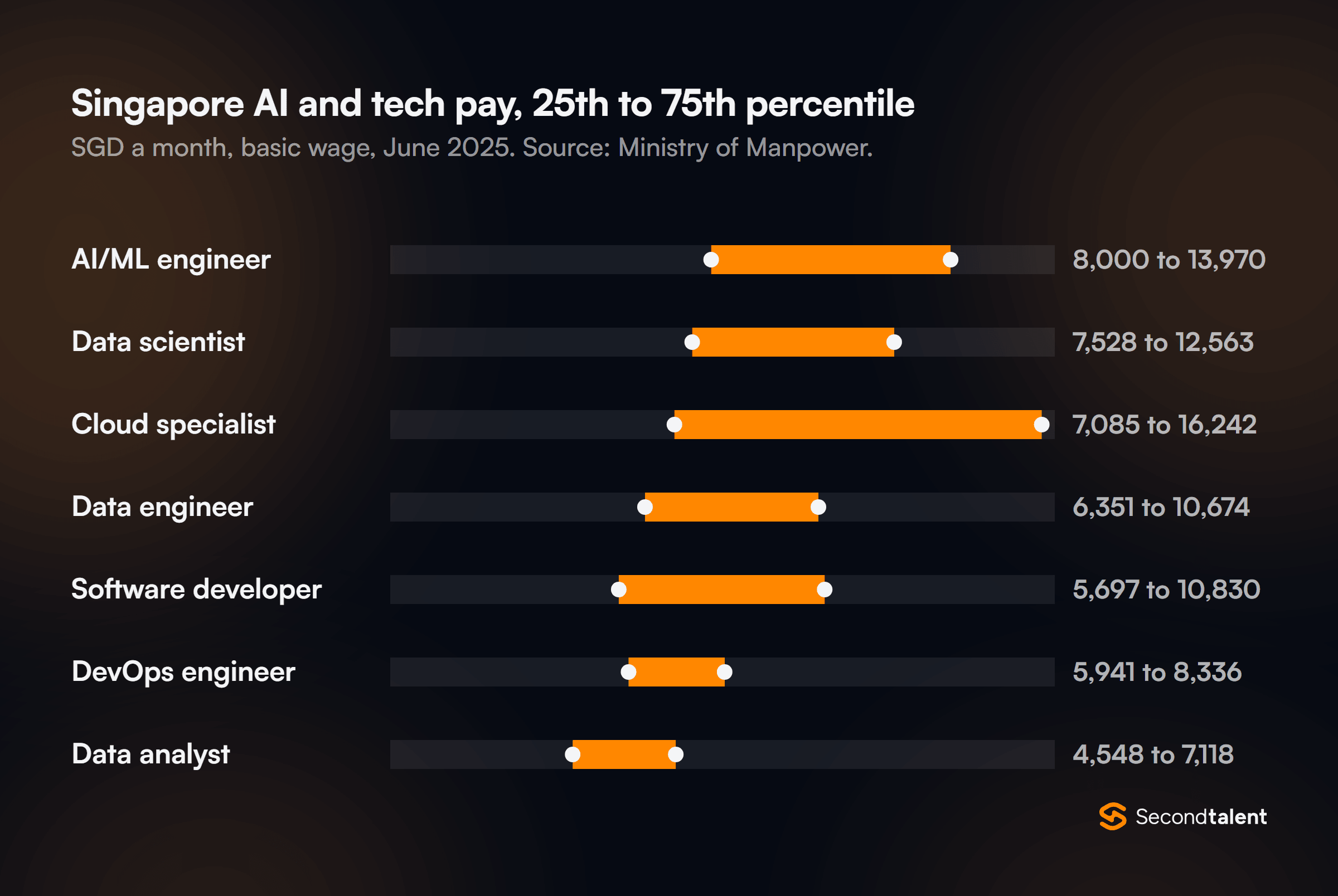
That median is about 35% above the SGD 7,605 median for a software developer in the same table, by my arithmetic. Data scientists earn a median SGD 9,522 and data engineers SGD 8,551.
The widest band belongs to cloud specialists, whose 75th percentile reaches SGD 16,242.
The MOM figures cover full-time resident employees and exclude bonuses. The 2024 tables used an older occupation code list with no AI engineer row, so they cannot show how fast AI pay is rising.
South Korea's software industry association publishes an official statistic on what software and AI staff cost employers.
The 2026 average wages, published by the Korea AI·Software Industry Association in December 2025, put the mean monthly labor cost of an IT planner, the group that includes AI service planners, at KRW 11.85 million.
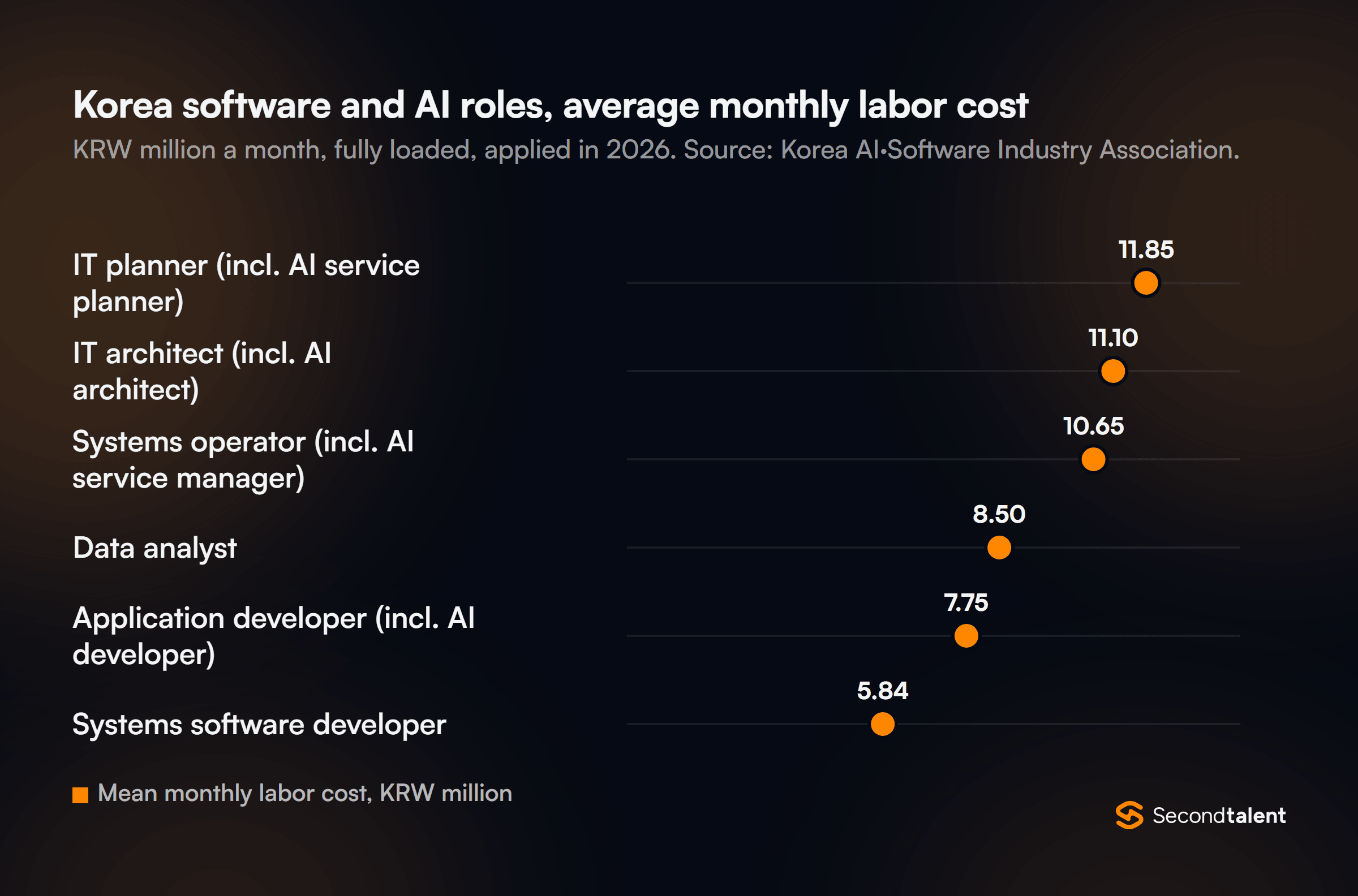
These Korean figures are fully loaded costs, including bonuses, severance accrual and employer social insurance, so they are not salaries.
AI roles are folded into wider groups: AI developers sit with application developers at KRW 7.75 million, while AI architects sit with IT architects at KRW 11.10 million.
In Japan, the Robert Walters Japan Salary Survey 2026 puts a machine learning engineer in one East Japan tech table at ¥8m to ¥15m a year in base salary, up from ¥8m to ¥14m in 2025.
The guide expects job changers at tech vendors to gain 10% to 20% in 2026, with some critical roles offering up to 30%.
The AI premium depends on how you measure it
Every source agrees that AI skills pay more. They disagree by a factor of several on how much, because they measure different things.
PwC's Singapore AI Jobs Barometer compares advertised salaries for AI and non-AI roles in the same sector. It found premiums of at least 32% in every sector, reaching 107% in government and the public sector.
PwC's global figure for workers with AI skills is 62%.
Employer surveys report smaller numbers. Aon's India study found that premiums for AI, machine learning and data science roles rose about 10% from 2025, which describes the growth of the premium rather than its size.
My reading is that the advertised figure is closer to what candidates expect, and the employer-survey figure is closer to what budgets allow. The gap between them is where offers fail.
Salary growth in 2027
Aon's Southeast Asia salary study, published in September 2026, projects average 2027 increases of 6.7% in Vietnam, 5.5% in Indonesia, 5.3% in the Philippines, 4.8% in Malaysia, 4.6% in Thailand and 4.1% in Singapore.
These cover all industries.
India runs higher. Aon's India survey projects 9.1% for 2027 overall, 9.5% at technology platform and product companies and 9.4% at global capability centers. Technology consulting and services sits lowest of all sectors at 6.6%.
Attrition across India reached 18% in 2026.
In Taiwan, the 104 Job Bank survey found software and internet companies planned the largest pay rises of any industry for 2026, at 7.1% on average.
For AI roles specifically, the budget lines are a floor.
A team that budgets 4% to 6% for an AI engineer in Singapore or Jakarta is pricing the role as if it were any other, while the job-changer data from Japan and the advertised premiums from PwC say the market will not.
The skills employers are asking for
LinkedIn's Skills on the Rise 2026 named the fastest-growing skills for India and Singapore without ranking them. The two lists lean in different directions:
- India: prompt engineering, workflow automation, LLMOps, AutoML and API skills lead the list, a mix weighted to building and running AI applications.
- Singapore: large language models, generative AI, computer vision, robotics, data engineering and data management, weighted toward model and data work.
The shortage data points to the same skills.
ManpowerGroup's Global Talent Shortage 2026 survey found that AI model and application development, named by 20% of employers, and AI literacy, named by 19%, now lead the global ranking of hard-to-find skills.
The supply is large in raw numbers. GitHub's Octoverse 2025 counted 21.9 million developers in India, adding more than 5.2 million in 2025, and projects 57.5 million by 2030.
The Stanford AI Index found AI skills appear in India's workforce at about three times the global average rate.
Supply targets and the policies behind them
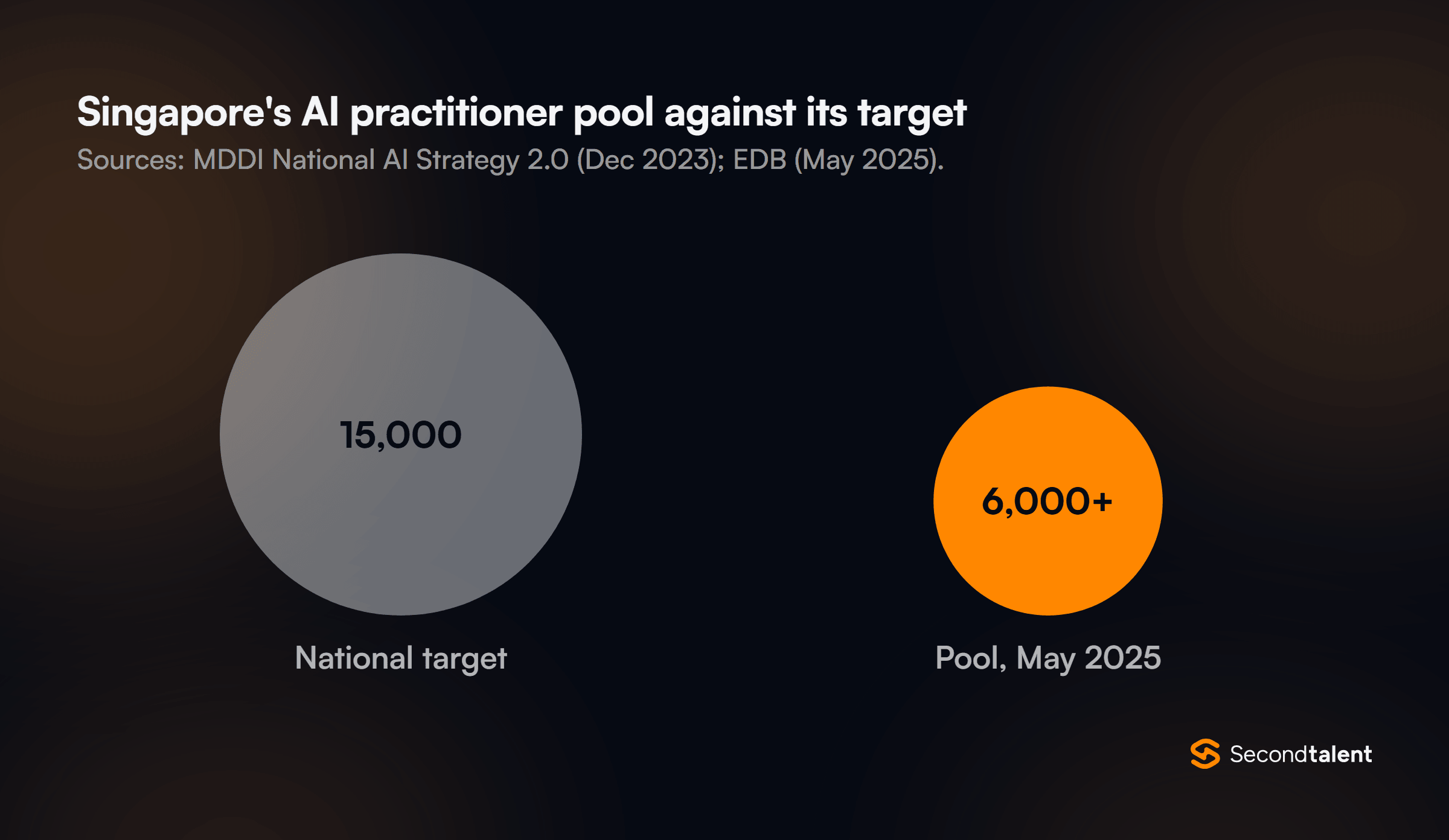
Governments across Asia have set AI talent targets. Singapore's National AI Strategy 2.0 aims to triple its AI practitioners to 15,000. The Economic Development Board put the pool at more than 6,000 in May 2025.
India's IndiaAI FutureSkills program was supporting 500 PhD scholars, 5,000 postgraduates and 8,000 undergraduates in AI as of December 2025, according to the government's Press Information Bureau.
Malaysia's National AI Action Plan 2026 to 2030 expects 300,000 to 500,000 new AI-related jobs.
Work-pass rules are moving in two directions at once: easier for AI specialists, more expensive for foreign hires in general.
The Ministry of Manpower's shortage list requires a relevant degree or at least three years in the role.
Japan's J-Skip route offers fast-track residency to researchers and engineers earning ¥20 million or more a year, and Thailand's Long-Term Resident visa for highly skilled professionals asks for an average income of USD 80,000 a year.
For a team hiring AI engineers into Singapore, the shortage-list points make the pass easier to get.
The 2027 floor of SGD 6,000 for younger applicants sits below the AI/ML engineer median, but it rises with age to SGD 11,500 at 45 and above.
For more on pay by market, see our Asia Tech Salary Index, and for the full role profile, the machine learning engineer guide.
Download the full report
The PDF carries every table in this article, the method notes on each measure and the full source list. No email required.
Second Talent helps US startups hire vetted AI-native engineers from Asia, from MLOps engineers to LLM specialists.
Rates run from $23 to $39 an hour, candidates are matched in 24 hours, and every hire carries a 90-day, one-time replacement guarantee. Our LLM engineer interview guide covers how to test candidates.
FAQ
Which Asian country has the most AI talent?
By share of the workforce, Singapore, at 1.82% of LinkedIn members in 2025. By raw numbers, India: the Stanford AI Index ranks it second only to the United States for top AI authors and inventors, in data that excludes China.
Is AI reducing entry-level tech hiring in Asia?
Some employers say so. In ManpowerGroup's Q4 2026 survey, AI automation of early-career tasks ranked fourth among the reasons employers worldwide gave for cutting entry-level hiring.