Before the Model Context Protocol, every company connecting an AI assistant to its own systems wrote the same glue twice: once for each model vendor, again for each internal tool. MCP replaced that with a single open protocol for exposing tools, data, and prompts to any compliant model, and by 2026 it had been donated to the Linux Foundation and become the default integration layer for production agent work.
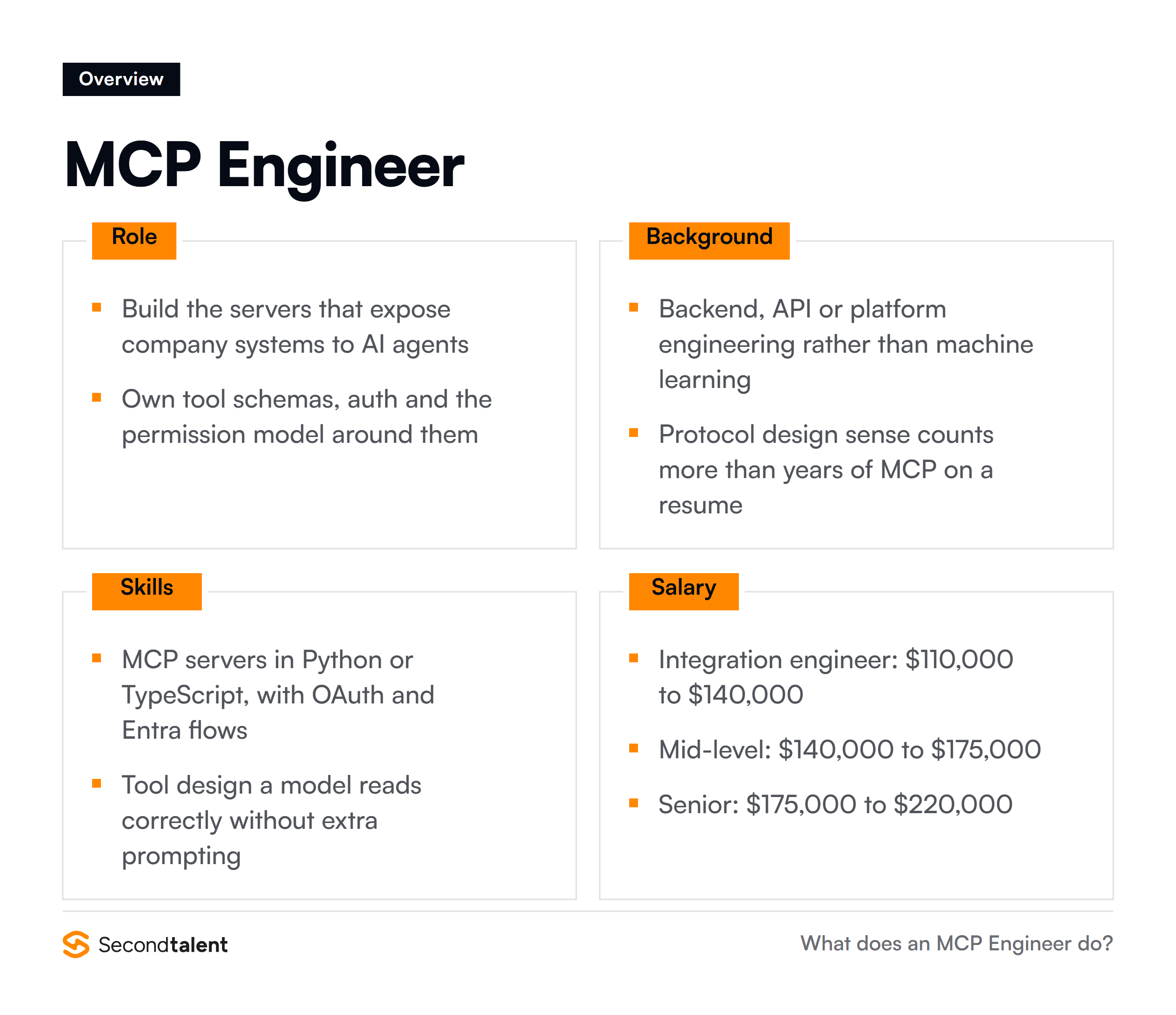
An MCP Engineer builds and operates that layer. They write the servers that expose a company’s databases, APIs, and internal services to AI agents, handle the authentication and permission model around them, and make sure a tool an agent calls a thousand times a day stays fast, safe, and correctly scoped.
What is a Model Context Protocol (MCP) Engineer?
An MCP Engineer designs, builds, and maintains Model Context Protocol servers: the standardized bridges between AI models and the systems those models need to act on. Where an earlier generation of AI integration work meant bespoke function-calling code per model and per tool, MCP defines one contract, and the engineer’s job is to implement it well.
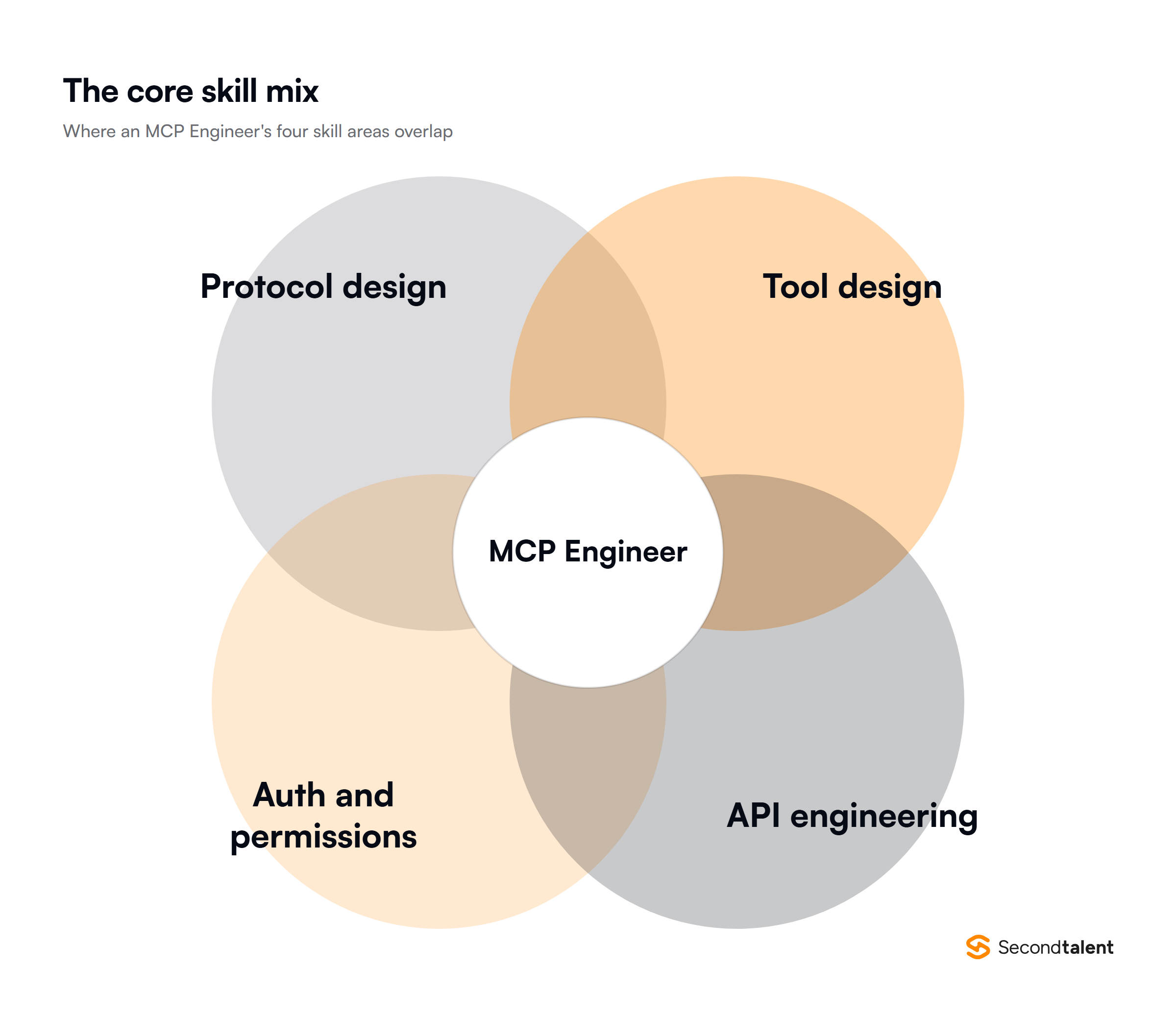
The work splits into three parts. First, server development: exposing a resource such as a CRM, a data warehouse, an internal API, or a filesystem through MCP tools, resources, and prompts. Second, the security and permission model: deciding which agent may call which tool on whose behalf, and wiring that into OAuth or an enterprise identity provider. Third, operations: schema versioning, rate limits, error semantics, and observability for tools that autonomous agents will invoke without a human watching.
Tool design is the part that separates a working integration from a good one. A tool description is not documentation for a human, it is the interface an agent reasons about, and a badly named tool with a vague description will be called at the wrong moment for the rest of its life. MCP Engineers spend real effort on naming, argument shape, and error messages that let a model recover instead of retrying blindly.
The role sits close to AI Integration Engineers and AI Agent Developers. The distinction is direction of travel: agent developers build the thing that decides what to do, MCP Engineers build and secure everything it is allowed to reach.
MCP Engineer Job Market and Career Opportunities
MCP moved from a vendor-specific protocol to industry infrastructure faster than almost any recent standard, and its donation to the Linux Foundation removed the last argument against adopting it. In 2026 MCP experience is one of the most differentiated screens in AI engineering interviews, and it now appears as a named requirement rather than a nice-to-have.
Hiring shows up in three places: enterprises connecting assistants to internal systems, including regulated employers such as Capital One and Bio-Rad Laboratories; software vendors shipping an official MCP server so their customers’ agents can use the product; and consultancies building integration layers for clients. The second category is growing fastest, because an MCP server has become a competitive requirement for any B2B SaaS product.
Average Salary Ranges (US market):
- Integration Engineer with MCP experience: $110,000 to $140,000
- Mid-level MCP Engineer: $140,000 to $175,000
- Senior MCP Engineer: $175,000 to $220,000
- Contract and freelance MCP development: $50 to $82 per hour
Contract rates come from ZipRecruiter’s 2026 listings for MCP developer roles. Note that raw salary aggregators for the acronym MCP are unreliable, because they mix in listings for an unrelated Microsoft certification, so treat any headline average for the three letters with suspicion and anchor instead to AI and integration engineering bands.
Because the protocol is barely two years old, nobody has a decade of MCP on their resume. Screen for protocol design sense, API and auth depth, and agent-tool judgment instead. Hiring across Asia gives access to strong backend and integration engineers who pick this up quickly, at a meaningful discount to US-anchored rates.
Essential MCP Engineering Skills and Qualifications
Protocol and Server Development:
- The MCP specification in practice: tools, resources, prompts, and sampling, and when each is the right primitive
- Building servers with the official SDKs, most commonly in Python or TypeScript
- Transport choices: stdio for local servers, streamable HTTP for remote ones, and the operational differences between them
- Schema design and versioning, so a tool change does not silently break every agent already calling it
Tool Design for Agents:
- Writing tool names and descriptions that a model interprets correctly without additional prompting
- Argument design that constrains the model into valid calls rather than relying on it to guess
- Error messages an agent can act on, since a generic failure string produces a retry loop instead of a recovery
- Keeping the exposed tool surface small: a server offering forty overlapping tools degrades agent accuracy
Security and Identity:
- OAuth flows and enterprise identity integration, including Microsoft Entra, for delegated agent access
- Scoping and least privilege: an agent should reach exactly the records its user could reach, and no more
- Prompt injection defense at the tool boundary, because untrusted content returned by one tool becomes input to the next decision
- Audit logging that records which agent invoked which tool on whose authority
Engineering Fundamentals:
- Strong Python or TypeScript, with FastAPI or an equivalent framework for HTTP-based servers
- API integration depth: pagination, rate limits, retries, idempotency, and partial failure
- Agentic workflow infrastructure: orchestration pipelines, tool-calling frameworks, and multi-agent coordination
- Observability, so tool latency and failure rates are visible before an agent’s accuracy quietly drops
Educational Background: Most MCP Engineers come from backend, API, or platform engineering rather than machine learning. The protocol work is ordinary distributed-systems engineering with an unusual consumer, and that consumer’s behavior is the part that needs learning.
MCP Engineer Career Paths and Specializations
Career Progression:
- Backend or API Engineer → Integration Engineer → MCP Engineer → Senior MCP Engineer → AI Platform Engineer or Agent Infrastructure Lead
Specialization Areas:
- Enterprise Connectors: Exposing large internal systems such as ERPs, CRMs, and data warehouses with permissions intact
- Product MCP Servers: Building and maintaining the official server a SaaS vendor ships to its customers
- Agent Security: Auth, scoping, injection defense, and audit for tool access, overlapping with the AI Security Engineer role
- Developer Tooling: MCP servers for coding agents, build systems, and internal developer platforms
- Registry and Governance: Running the internal catalog of approved servers, their versions, and who may use them
The governance specialization is newer and growing quickly. Once an organization has more than a handful of servers, the problem stops being how to build one and becomes which ones exist, who approved them, and what happens when a schema changes underneath a running agent.
MCP Tools and Technologies
Protocol and SDKs:
- Official MCP SDKs for Python and TypeScript
- FastMCP and similar higher-level server frameworks
- MCP Inspector and equivalent tooling for testing a server’s tool surface directly
- Public server registries, both for reference implementations and for governance of what is approved internally
Host and Client Environments:
- Coding agents and IDE integrations that consume MCP servers
- Desktop and chat assistants acting as MCP hosts
- Agent frameworks such as LangGraph that call MCP tools as part of a larger graph
- Custom hosts, where an internal application embeds the client itself
Backend and Security Stack:
- Python with FastAPI, or Node with TypeScript, for HTTP transport servers
- OAuth 2.1 and enterprise identity providers including Microsoft Entra
- API gateways and rate limiting in front of high-traffic tool endpoints
- Secret management, since MCP servers hold credentials for the systems they front
Observability:
- Tracing that ties an agent decision to the exact tool call and response
- Latency and error dashboards per tool, not just per server
- Audit trails suitable for a compliance review
Building Your MCP Engineering Portfolio
Portfolio Components:
- A Published MCP Server: One real server for a service you know well, with a clean tool surface and a written rationale for each tool boundary
- A Tool Design Writeup: Two versions of the same tool set, one naive and one refined, with evidence of how agent behavior changed between them
- An Auth Implementation: A server with real delegated access, showing how a user’s permissions constrain what the agent can reach
- A Failure Mode Study: A documented case where an agent misused a tool, and the schema or description change that fixed it
The tool design writeup carries the most weight. Building a server that responds correctly is straightforward; building one that a model uses correctly without hand-holding is the actual skill, and very few candidates can show evidence of it.
MCP Engineering Methodology and Best Practices
Design the tool surface for the model, not for the API. A one-to-one mapping of REST endpoints to MCP tools produces a sprawling, confusing surface. Group by intent instead: what will an agent actually try to accomplish.
Keep the tool count small. Every additional tool competes for the model’s attention and raises the odds of a wrong selection. A focused server with eight well-named tools outperforms one with forty.
Treat tool output as untrusted input. Content returned from a document, a ticket, or a web page becomes part of the next decision the agent makes. Injection defense belongs at the tool boundary, not only at the user prompt.
Version schemas explicitly. Agents in production hold assumptions about argument shape. Additive changes are safe; renamed or re-typed arguments need a version and a migration window.
Enforce least privilege at the server, not the prompt. Instructing a model not to touch certain records is not a control. The server must be incapable of returning what the user is not entitled to see.
Instrument per tool. Aggregate server metrics hide the one slow or flaky tool that is quietly degrading agent success rates across every workflow that touches it.
Future of MCP Engineering Careers
MCP’s move to the Linux Foundation matters more than it sounds. Neutral governance is what turned earlier protocols into durable infrastructure, and it removes the strategic risk that kept some enterprises on bespoke integrations. Expect adoption to keep widening rather than fragmenting into competing standards.
Expect the work to shift from building servers to governing them. The first phase of any integration standard is implementation; the second is cataloging, securing, and versioning what has already been built. Organizations that stood up twenty servers in 2026 will spend 2027 working out who owns them.
Expect security to become the highest-paid corner of this role. Agents with tool access are a genuinely new attack surface, and the engineers who can reason about delegated authority and injection at the tool boundary are already scarce.
Expect the title to remain fluid. Many organizations will hire this work under AI Engineer, Integration Engineer, or Platform Engineer headings. The protocol expertise is what gets screened for, whatever the requisition says.
Getting Started as an MCP Engineer
Practical Steps:
- Read the MCP specification directly, then build a minimal server with the official SDK before touching any higher-level framework
- Connect your server to a real host and watch how a model actually selects and calls your tools
- Rewrite your tool names, descriptions, and arguments based on what you observed, and measure whether selection improved
- Add authentication with a real identity provider, since almost every production deployment needs delegated access
- Study API integration fundamentals: pagination, retries, idempotency, and rate limits behave differently when the caller is an agent
- Publish one server publicly, which is currently the fastest way to establish credibility in a field with no long resumes
Candidates arriving from backend or API engineering usually need to build intuition for model behavior, which comes from watching real agent traces rather than reading about it. Candidates arriving from AI or prompt work usually need to build depth in auth, schema versioning, and operations.
If you are hiring rather than applying, Second Talent places MCP Engineers and other AI-native talent across Asia, with vetting, compliance, and payroll handled for you.
Frequently Asked Questions
What is the Model Context Protocol?
MCP is an open protocol that standardizes how AI models connect to external tools, data sources, and prompts. Instead of writing bespoke integration code for each model and each system, a team implements one MCP server per system and any compliant model can use it. The protocol was donated to the Linux Foundation and is now the default integration layer for production agent work.
What is the difference between an MCP Engineer and an AI Agent Developer?
An AI Agent Developer builds the reasoning layer: the agent that plans, decides, and acts. An MCP Engineer builds and secures the tools that agent can reach, including schemas, authentication, permissions, and operational reliability. On small teams one person does both. On larger teams they split, because tool infrastructure is shared across many agents.
Do I need a machine learning background to become an MCP Engineer?
No. This is primarily backend, API, and security engineering with an unusual consumer. What you do need is intuition for how a model interprets a tool description and selects between options, which comes from watching real agent traces rather than from ML theory.
How much does it cost to hire an MCP Engineer through Second Talent?
Cost depends on seniority and location, but hiring across Asia typically comes in well below US market rates for equivalent experience. Because the protocol is new, we screen on API depth, auth expertise, and demonstrated tool-design judgment rather than years of MCP on a resume. Get in touch for a current rate breakdown.
How quickly can Second Talent place an MCP Engineer?
We can usually present a shortlist of pre-vetted candidates within days, with placements typically completed in a few weeks depending on your interview process and start-date requirements.
Related Roles
Explore related roles you can hire on Second Talent: AI Integration Engineer, AI Agent Developer, Context Engineer, AI Security Engineer, API Integration Specialist, AI Agent Operations Engineer.