Behind every intelligent automation system that can reason, plan, and take action lies sophisticated agent architecture. But who builds the AI systems that can autonomously solve complex tasks, interact with tools, and make decisions?
AI Agent Developers are the specialized engineers who design and build autonomous AI systems that go beyond simple chatbots to create agents capable of multi-step reasoning, tool use, and goal-oriented behavior.
They’re the architects of the next generation of AI applications that can act independently to achieve user objectives.
What is an AI Agent Developer?
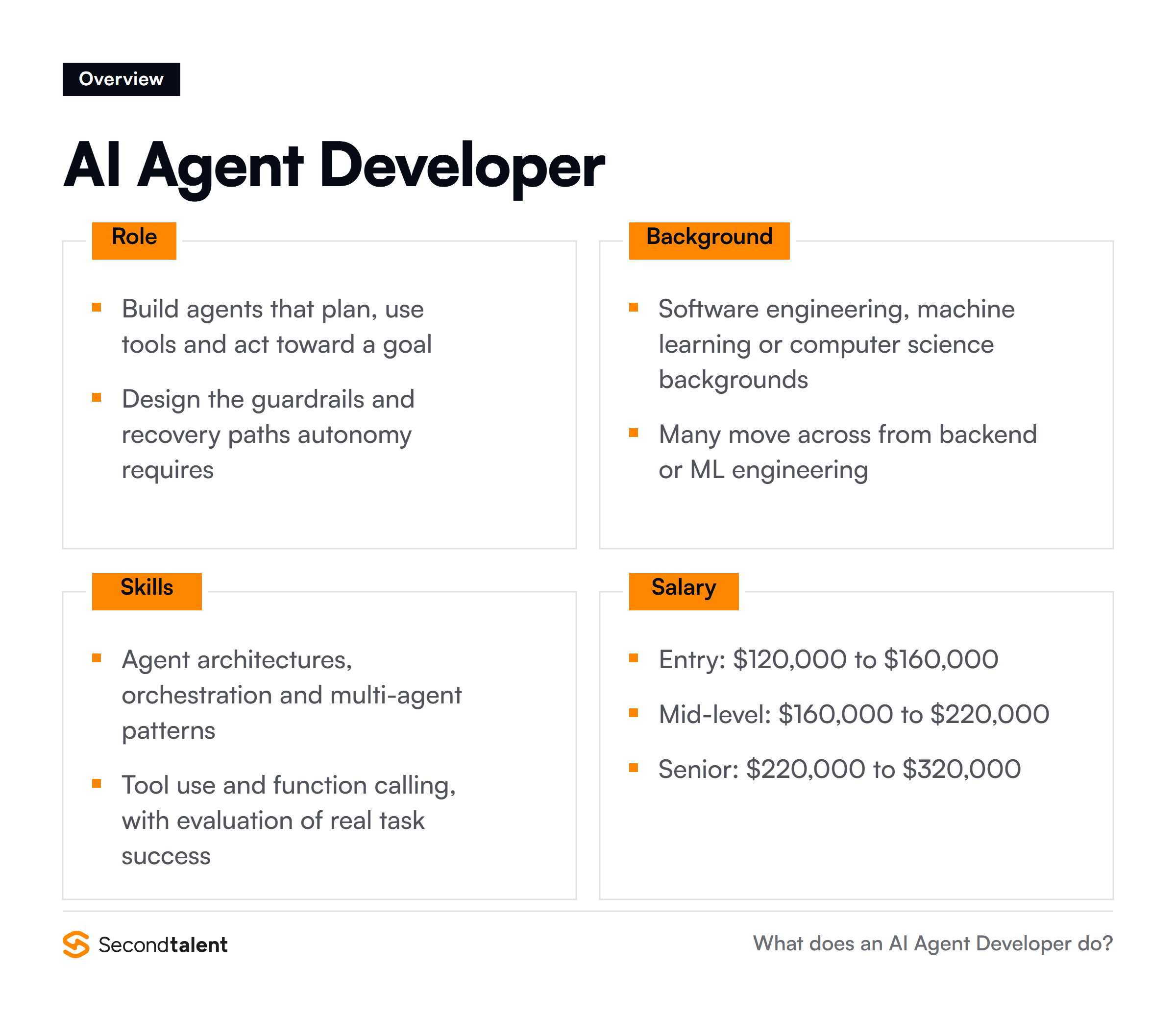
An AI Agent Developer specializes in building autonomous AI systems that can perceive their environment, make decisions, use tools, and take actions to achieve specific goals.
They combine expertise in large language models, software engineering, and systems design to create agents that can handle complex, multi-step tasks with minimal human intervention.
These professionals work on everything from simple task automation agents to sophisticated systems that can plan, reason, use external tools, maintain memory, and collaborate with other agents.
They focus on reliability, safety, and practical utility, building agents that integrate seamlessly into existing workflows and systems while maintaining appropriate guardrails and oversight.
AI Agent Development Job Market and Career Opportunities
The AI agent development field is experiencing explosive growth, with the agentic AI market projected to reach $47 billion by 2030.
The shift from simple chatbots to autonomous agents capable of taking actions is creating unprecedented demand for developers who can build reliable, production-ready agent systems.
Average Salary Ranges:
- Entry-level AI Agent Developer: $120,000 – $160,000
- Mid-level AI Agent Developer: $160,000 – $220,000
- Senior AI Agent Developer: $220,000 – $320,000
- Principal AI Agent Developer: $320,000 – $410,000+
Major employers include AI companies, enterprise software providers, productivity tool companies, financial services firms, healthcare technology companies, and consulting organizations.
The growing need for intelligent automation across all industries is creating opportunities in both startups and established enterprises.
Essential AI Agent Development Skills and Qualifications
Core Knowledge Areas:
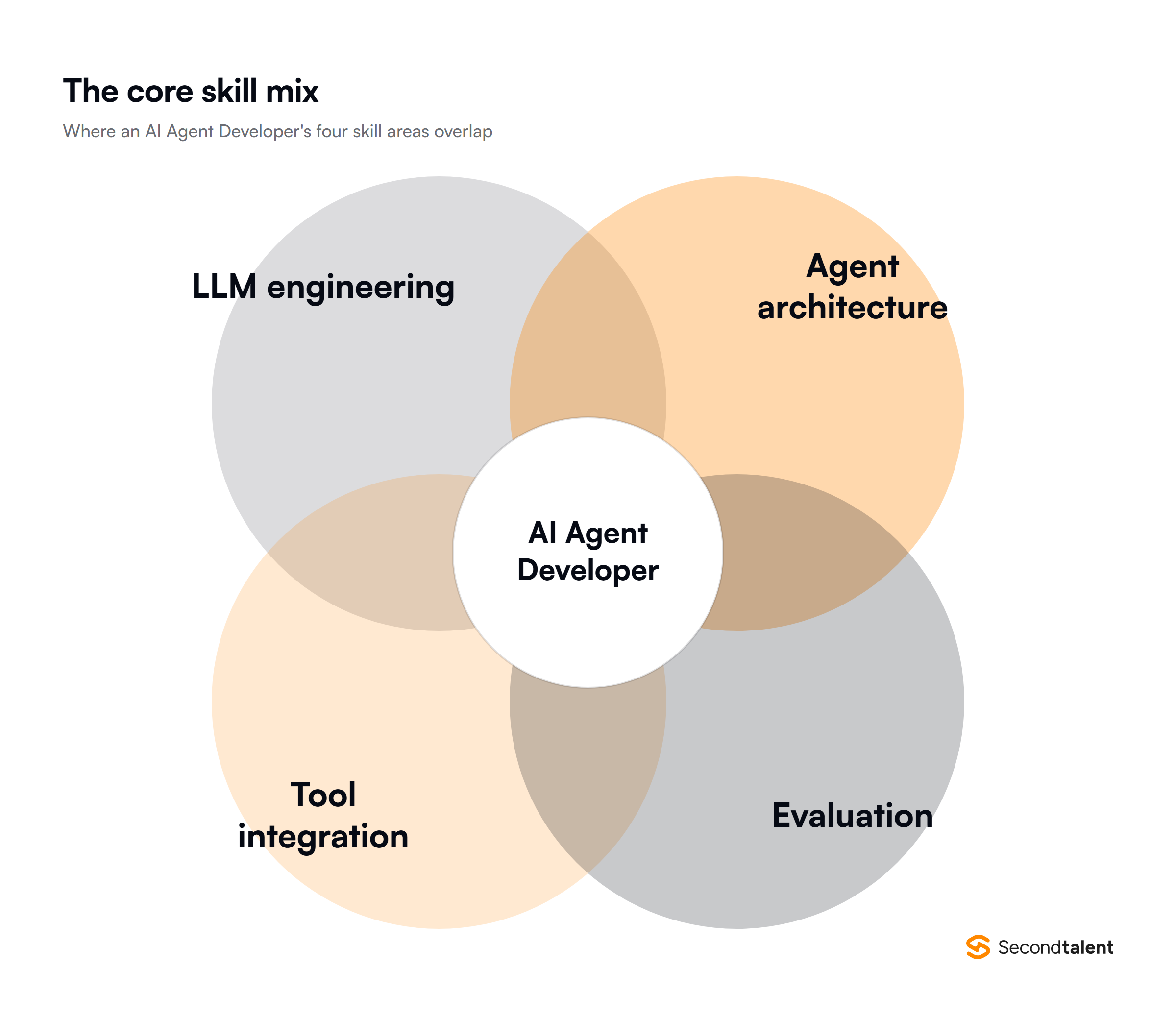
- Large language models and prompt engineering
- Agent architectures and design patterns
- Multi-agent systems and orchestration
- Tool use and function calling
- Memory systems and context management
- Planning and reasoning frameworks
Technical Competencies:
- Proficiency in Python and agent development frameworks
- Deep understanding of LLM APIs and capabilities
- Prompt engineering and output parsing
- Building reliable agentic workflows
- Error handling and failure recovery
- Monitoring and observability for agent systems
- Vector databases and semantic search
- API integration and tool creation
Educational Background: AI Agent Developers typically come from software engineering, machine learning, or computer science backgrounds.
Many are transitioning from traditional backend development, ML engineering, or full-stack roles as they specialize in agentic AI systems.
AI Agent Development Career Paths and Specializations
Career Progression: AI Agent Developer → Senior AI Agent Developer → Staff AI Agent Engineer → Principal Agent Architect → VP of AI Engineering
Specialization Areas:
- Enterprise Automation Agents: Building agents for business process automation and workflow optimization
- Customer Service Agents: Creating sophisticated support agents with knowledge bases and action capabilities. That is exactly what a customer support AI agent is built to do: pull from a knowledge base and actually take the action, not just describe it.
- Research & Analysis Agents: Developing agents for information gathering, analysis, and report generation
- Coding Agents: Building autonomous software development agents and code generation systems
- Multi-Agent Systems: Architecting systems where multiple specialized agents collaborate
- Agent Infrastructure: Focusing on platforms, frameworks, and tools for agent development
AI Agent Development Tools and Technologies
Agent Frameworks:
- LangChain for building LLM-powered applications
- LlamaIndex for data-aware agent systems
- AutoGPT and BabyAGI for autonomous agents
- CrewAI for multi-agent orchestration
- Semantic Kernel for enterprise agent development
- Haystack for production-ready AI pipelines
LLM Platforms:
- OpenAI API (GPT-4, GPT-4 Turbo)
- Anthropic Claude (Sonnet, Opus)
- Google Gemini
- Open-source models (Llama, Mistral)
- Function calling and structured outputs
- Embeddings and semantic search
Infrastructure & Tools:
- Vector databases: Pinecone, Weaviate, Qdrant, Chroma
- Workflow orchestration: Temporal, Prefect, Airflow
- Monitoring: LangSmith, Helicone, LangFuse
- Evaluation: RAGAS, TruLens, custom eval frameworks
- Message queues: Redis, RabbitMQ, Kafka
Development Tools:
- Python development environment
- Jupyter notebooks for prototyping
- Git and version control
- Testing frameworks (pytest, unittest)
- API development (FastAPI, Flask)
- Container orchestration (Docker, Kubernetes)
Building Your AI Agent Developer Portfolio
Essential Portfolio Components:
- Agent Projects: Fully functional agents solving real-world problems
- Architecture Documentation: Clear explanations of agent design decisions
- Tool Integration: Examples of agents using external tools and APIs
- Evaluation Results: Metrics demonstrating agent reliability and performance
- Open Source Contributions: Contributions to agent frameworks or agent-related projects
Project Ideas:
- Build a research agent that can gather information and create comprehensive reports
- Create a customer support agent with knowledge base integration and ticket creation
- Develop a coding agent that can understand requirements and generate working code
- Build a multi-agent system where specialized agents collaborate on complex tasks
- Create a personal assistant agent that can manage calendar, email, and tasks
- Develop an agent for automated data analysis and visualization
AI Agent Development Methodology and Best Practices
Agent Design Process:
- Define clear agent goals, capabilities, and boundaries
- Design appropriate tool interfaces and function schemas
- Implement robust error handling and failure recovery
- Build memory systems for context persistence
- Create evaluation frameworks for agent performance
- Implement human-in-the-loop for critical decisions
Prompt Engineering:
- Craft system prompts that define agent behavior clearly
- Use few-shot examples to guide agent reasoning
- Implement chain-of-thought for complex reasoning tasks
- Design prompts that encourage tool use appropriately
- Handle ambiguity and edge cases explicitly
- Iterate based on real-world agent behavior
Production Readiness:
- Implement comprehensive logging and observability
- Add rate limiting and cost controls
- Build monitoring for agent behavior and tool usage
- Create guardrails to prevent undesired actions
- Design fallback mechanisms for failures
- Implement security best practices for tool access
- Develop evaluation and testing pipelines
Future of AI Agent Development Careers
The AI agent development field is rapidly evolving as models become more capable and agent architectures mature. Key trends shaping the future include:
Emerging Opportunities:
- Agentic process automation replacing traditional RPA
- Vertical-specific agents for healthcare, legal, finance
- Personal AI assistants with deep integration across tools
- Enterprise knowledge agents that can navigate complex systems
- Collaborative multi-agent systems for complex workflows
- Agent marketplaces and agent-as-a-service platforms
Industry Growth Areas:
- Productivity software companies integrating autonomous agents
- Enterprise automation platforms building intelligent workflows
- Customer service companies deploying sophisticated AI agents
- Healthcare organizations creating clinical decision support agents
- Financial services firms automating research and analysis
- Software development tools incorporating coding agents
Getting Started as an AI Agent Developer
Immediate Action Steps:
- Learn prompt engineering and LLM fundamentals
- Experiment with agent frameworks like LangChain or LlamaIndex
- Build simple agents and gradually increase complexity
- Study agent architecture patterns and best practices
- Practice integrating agents with tools and APIs
- Join AI agent development communities and forums
Professional Development:
- Complete courses on LLM application development
- Attend AI agent conferences and workshops
- Contribute to open-source agent projects
- Build a portfolio of working agent applications
- Stay current with latest model capabilities and frameworks
- Learn evaluation and testing methodologies for agents
Learning Resources:
- Agent framework documentation (LangChain, LlamaIndex)
- Research papers on agent architectures (ReAct, AutoGPT)
- LLM provider documentation (OpenAI, Anthropic)
- Prompt engineering guides and best practices
- Blog posts and case studies from agent developers
- GitHub repositories of production agent systems
The AI agent development field offers an opportunity to work at the frontier of artificial intelligence, building systems that can autonomously solve complex real-world problems.
As organizations realize the potential of agentic AI to transform workflows and unlock new capabilities, skilled developers who can build reliable, production-ready agents will be in extremely high demand.
Whether you’re a software engineer looking to specialize in AI, an ML engineer wanting to build more practical applications, or a developer excited by autonomous systems, AI agent development provides an opportunity to shape how humans and AI systems collaborate while working with cutting-edge technology that’s redefining what’s possible with artificial intelligence.