Every enterprise wants AI inside its existing systems. Salesforce wants AI inside the lead flow. ServiceNow wants AI inside the ticketing workflow. Workday wants AI inside the people processes. Internal tools want AI inside the screens employees already use. The model is the easy part. The integration is where most projects die.
AI Integration Engineers are the specialists who bridge that gap. They wire AI capabilities into the enterprise systems that actually run the business, with authentication, permissions, audit trails, and the resilience that production integrations require.
What is an AI Integration Engineer?
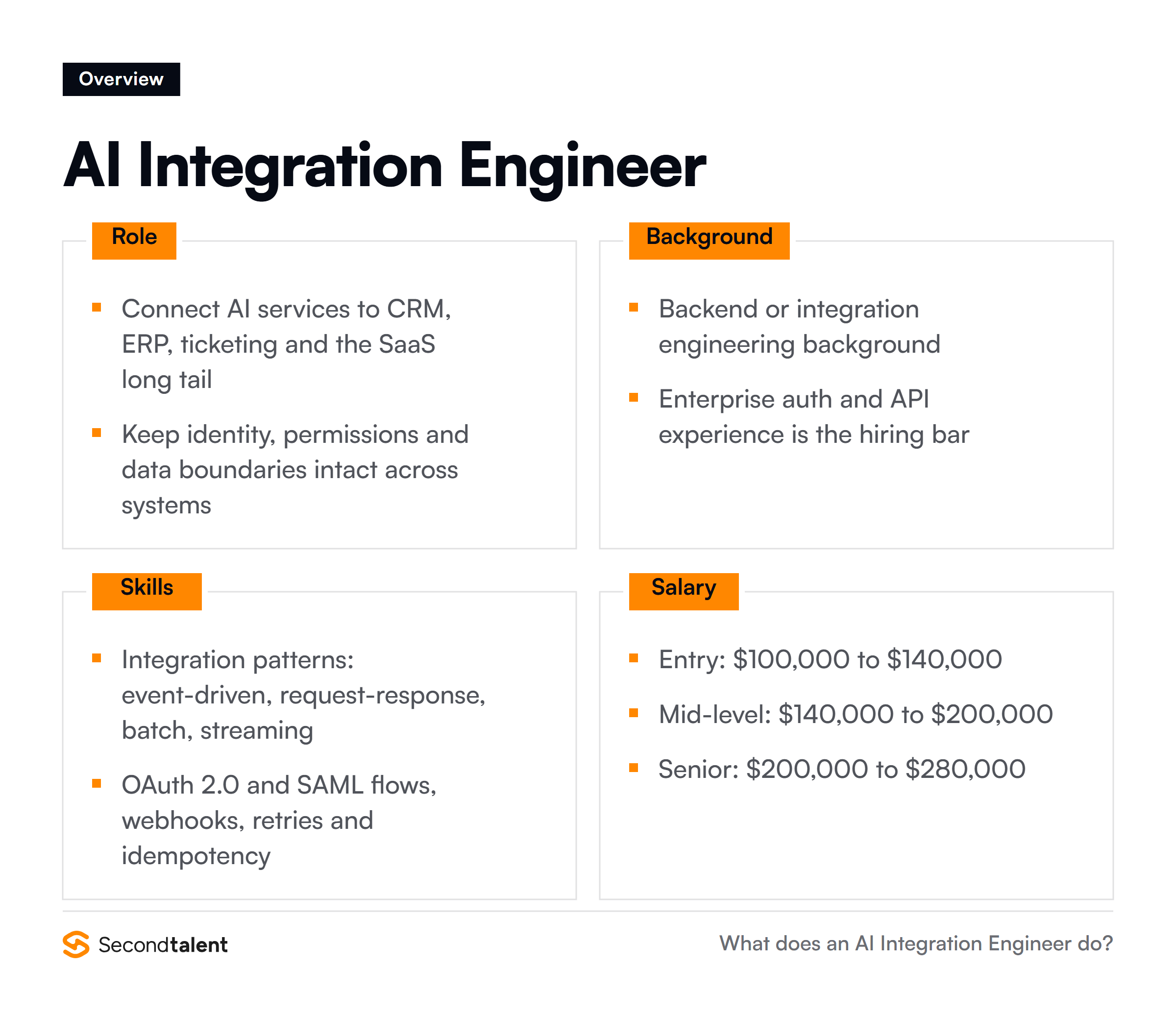
An AI Integration Engineer specializes in connecting AI services to the enterprise stack. The work covers everything from CRM and ERP integrations to internal tools, ticketing systems, knowledge platforms, and the long tail of SaaS that runs a modern business. The engineer is fluent in both AI APIs and traditional enterprise integration patterns.
The role overlaps with a traditional integration engineer but is distinct in several ways. AI integrations are non-deterministic, expensive per call, sensitive to latency, and need observability that traditional integrations do not. They also surface model output to end users in regulated contexts, which means audit, citation, and confidence indicators become part of the integration design.
AI Integration Engineer Job Market and Career Opportunities
Enterprise AI projects have shifted from proof-of-concept to embedded-in-production. Almost every Fortune 500 has at least one AI capability now wired into Salesforce, ServiceNow, or a homegrown internal tool. Independent research firms project the enterprise AI integration market to reach $40 billion by 2028, and the engineers who can ship these integrations safely are in extremely short supply.
Average Salary Ranges (US-equivalent):
- Entry-level AI Integration Engineer: $100,000 – $140,000
- Mid-level AI Integration Engineer: $140,000 – $200,000
- Senior AI Integration Engineer: $200,000 – $280,000
- Principal AI Integration Engineer: $280,000 – $380,000+
The strongest demand sits at enterprise SaaS vendors building AI features for their flagship products, at large enterprises rolling out AI across their core systems, at AI implementation partners and consultancies, and at the platform engineering teams responsible for internal AI infrastructure.
Essential AI Integration Skills and Qualifications
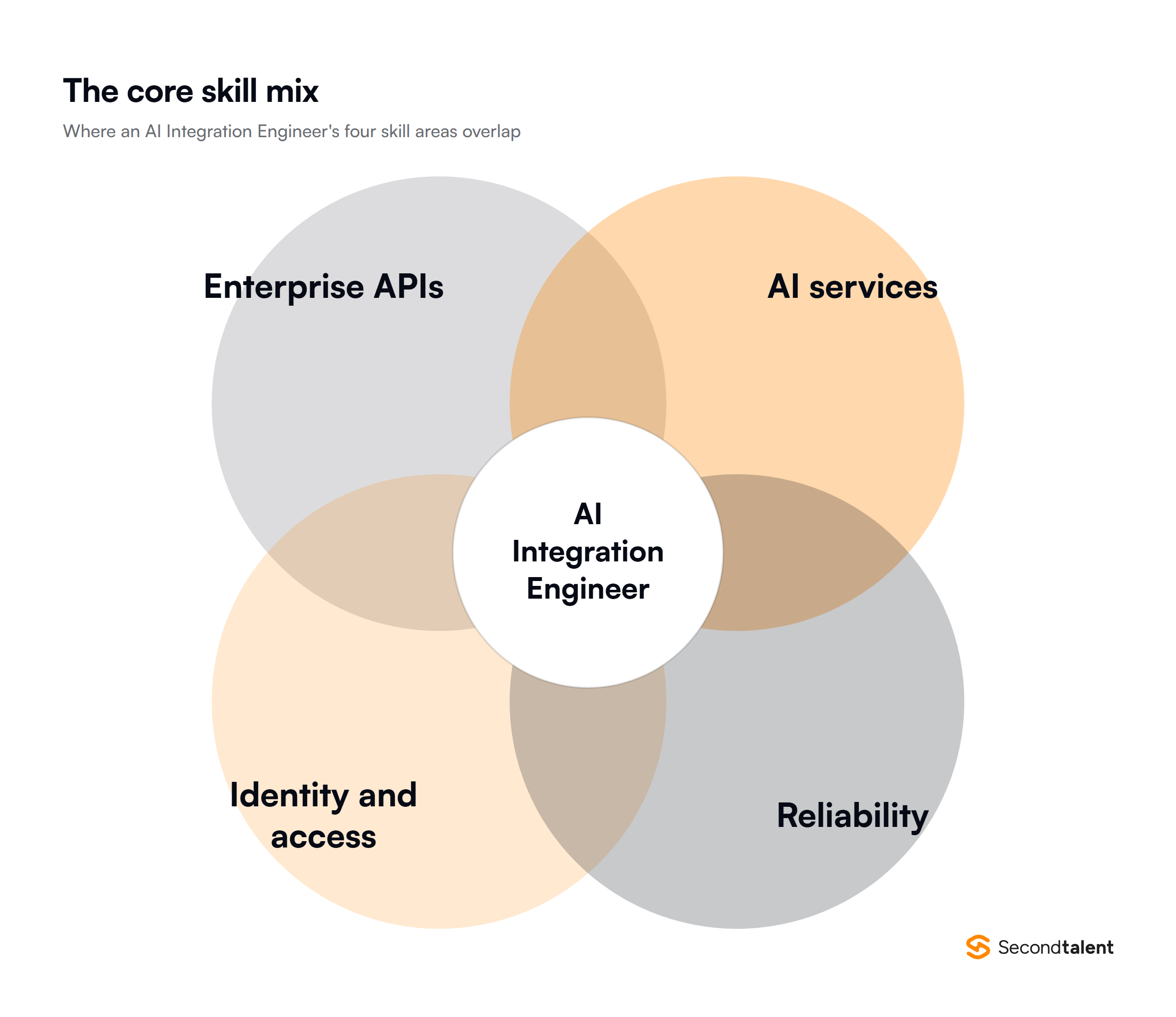
Core Knowledge Areas:
- Enterprise integration patterns (event-driven, request-response, batch, streaming)
- API design and consumption, including OAuth 2.0 and SAML flows
- Webhook design, retries, and idempotency
- Identity and permission propagation across systems
- LLM APIs and structured output patterns
- Audit logging and compliance requirements
- Error handling and graceful degradation when AI services fail
Technical Competencies:
- Strong fluency in Python or TypeScript for integration code
- Hands-on experience with platforms like HubSpot, Salesforce, ServiceNow, Workday, or comparable enterprise platforms
- LLM provider APIs (OpenAI, Anthropic, Google, Mistral)
- iPaaS platforms (Workato, Tray.io, Boomi, MuleSoft) and code-first orchestration
- Cloud platforms (AWS, Azure, GCP) and serverless patterns
- Authentication libraries and OAuth flow implementation
- Message queues and event streaming (SQS, Kafka, RabbitMQ)
Soft Skills:
- Patience with enterprise procurement, security review, and architecture board cycles
- Strong stakeholder communication across IT, security, and business owners
- Comfort reading legacy documentation and undocumented systems
- Pragmatic judgment on when to integrate at the API layer versus the data layer
AI Integration Career Paths and Specializations
The role specializes by platform, by domain, or by integration pattern.
CRM AI Integration: Embedding AI directly into Salesforce, HubSpot, Microsoft Dynamics with native integrations, custom Apex or LWC code, and AppExchange or AppSource distribution.
ITSM and Workflow AI Integration: Building AI capabilities into ServiceNow, Jira Service Management, Zendesk, with ticket triage, automated resolution, and knowledge retrieval.
HR and Workforce AI Integration: AI inside Workday, BambooHR, Greenhouse with resume screening, interview summarization, and people-analytics use cases.
Productivity Suite AI Integration: Embedding AI into Microsoft 365, Google Workspace, Slack, with extensions, add-ins, and bot platforms.
Internal Tooling AI Integration: Building AI into homegrown internal apps, admin consoles, and operations dashboards with API-first integration and custom UI layers.
iPaaS-Led AI Integration: Specialists who deliver most of their integrations through Workato, Tray.io, or MuleSoft, with deep platform fluency.
AI Integration Tools and Technologies
Enterprise Platforms and Their AI Extension Points:
- Salesforce Einstein, Apex Triggers, Flow, Platform Events
- ServiceNow Now Assist, Flow Designer, Integration Hub
- Microsoft 365 Copilot, Power Automate, Graph API, Teams bots
- Workday Studio and Integration Cloud for HR workflows
- Slack Block Kit and Slack Apps for conversational integrations
iPaaS and Orchestration:
- Workato for enterprise-grade integration with AI-aware connectors
- Tray.io for code-light orchestration with API depth when needed
- Boomi and MuleSoft for traditional enterprise integration estates
- n8n and Pipedream for code-first, self-hosted-friendly orchestration
AI Providers and Gateways:
- OpenAI, Anthropic, Google, and Mistral APIs with structured output
- Azure OpenAI and AWS Bedrock for enterprise-procured access
- Portkey and Kong AI Gateway for cross-provider routing inside the enterprise
Identity and Authentication:
- OAuth 2.0, SAML, OIDC implementation patterns
- Okta, Auth0, Azure AD as enterprise identity providers
- Service accounts, scoped tokens, and least-privilege access patterns
Observability and Compliance:
- Audit logging integrated with enterprise SIEM (Splunk, Sumo Logic, Datadog)
- LLM observability via Langfuse or Helicone alongside traditional APM
- Data residency controls for regulated jurisdictions
Building Your AI Integration Portfolio
Hiring managers want to see real systems wired together, not API echoes.
Project ideas that signal seriousness:
- A Salesforce-to-LLM integration that enriches leads with AI-generated research, with audit logging, error handling, and a clear cost model
- A ServiceNow ticket-triage integration that classifies, routes, and drafts responses, with human-in-the-loop review
- A Slack assistant that retrieves from a private knowledge base, citing sources and respecting per-channel permissions
- A Workato or Tray.io recipe that wires an AI step into a sales-ops flow, with proper credential handling and idempotency
- A self-hosted webhook gateway that fans out events to multiple AI services with retry, dead-letter, and observability
For each, document the security review, the cost analysis, and the failure-handling strategy. The depth of the operational thinking is what separates senior integration engineers from junior ones.
AI Integration Methodology and Best Practices
Treat AI calls like any other unreliable dependency. Timeouts, retries with exponential backoff, circuit breakers, and graceful fallback. The model will fail. The integration must not fail loudly when it does.
Propagate identity, do not collapse it. Enterprise integrations need to know which user triggered an action, and that identity needs to flow through to the AI call for audit and permission filtering on retrieval.
Design for revocability. Any AI-generated content that flows into a system of record should be revocable, attributable, and reviewable. Build the audit surface as part of the integration, not bolted on later.
Cache where the contract allows. Many enterprise AI workloads have high prompt repetition. A semantic cache or prompt cache layer can dramatically reduce both cost and latency without changing behavior.
Test the failure paths explicitly. Integration tests must include scenarios where the AI service is down, slow, or returning malformed output. Most integration incidents come from unhandled AI degradation.
Document the data flow. Enterprise security and privacy reviews require a clear picture of what data leaves the perimeter, to which AI service, with what residency guarantees. Build the diagram before the code.
Stage rollouts. Per-user, per-team, and per-region rollout controls let you catch integration regressions before they affect everyone. Feature flags are not optional.
Future of AI Integration Engineering Careers
The space is professionalizing in several directions.
Native AI capabilities are arriving inside every enterprise platform. Salesforce Einstein, ServiceNow Now Assist, and Microsoft Copilot are setting the bar for what users expect. Integration engineers will increasingly choose between using native capabilities and wiring custom ones, and judging that trade-off becomes a core skill.
Agentic integrations are emerging. Instead of integrations that move data between systems, the next generation will include short agent loops that reason about which system to act on next. The pattern is early but the trajectory is clear.
Compliance and audit requirements are tightening. Regulated industries are formalizing what AI-touched data flows need to look like. Engineers who internalize these requirements early will be the ones building the durable integration patterns.
Multi-vendor AI stacks are now the norm. Single-provider enterprise AI deployments are becoming rare. Integration engineers who can route across providers, abstract over them, and govern the spend will be the most valuable.
Getting Started as an AI Integration Engineer
Pick one enterprise platform and go deep. Salesforce, ServiceNow, Microsoft 365, or Workday. Build something nontrivial in their native development environment. Native fluency is the foundation everything else builds on.
Learn classical integration patterns before you reach for iPaaS. REST, webhooks, message queues, idempotency, eventual consistency. The iPaaS platforms hide these well, but the failures still come from misunderstanding them.
Build one AI integration end-to-end on your own infrastructure. Webhook in, LLM call, action out to a real third-party system, with retries, audit, and observability. The reps build the operational instincts.
Read the enterprise security playbooks. The way security teams evaluate AI integrations is becoming standardized. Engineers who can answer the standard questions in their sleep ship integrations far faster.
Get fluent with at least one iPaaS platform. Workato or Tray.io. The platforms shorten delivery time for 70 percent of common patterns and free up engineering hours for the genuinely hard cases.
Practice cross-functional translation. Most AI integration projects stall because business owners, IT, and security speak different languages. The engineers who can translate are the ones who get the projects shipped.
AI integration is one of the most underrated specializations in the modern AI stack. Every enterprise needs it, very few engineers do it well, and the engineers who get fluent in both the AI and the enterprise side are some of the most leveraged hires in the industry.