The fastest way to make a large language model fail is not a bad prompt. It is the wrong information sitting in its context window at the moment it answers. A Context Engineer is the person who fixes that, and the title has gone from a niche argument on developer forums in late 2025 to a formal Gartner definition and live job postings at companies like Adobe and Stripe inside a year.
If a model is the processor, its context window is working memory. Context Engineering is the discipline of deciding what gets loaded into that memory, in what order, from which system, and what gets evicted when the budget runs out. It is where retrieval, prompting, tool design, and memory architecture meet, and it is the layer most production AI failures actually trace back to.
What is a Context Engineer?
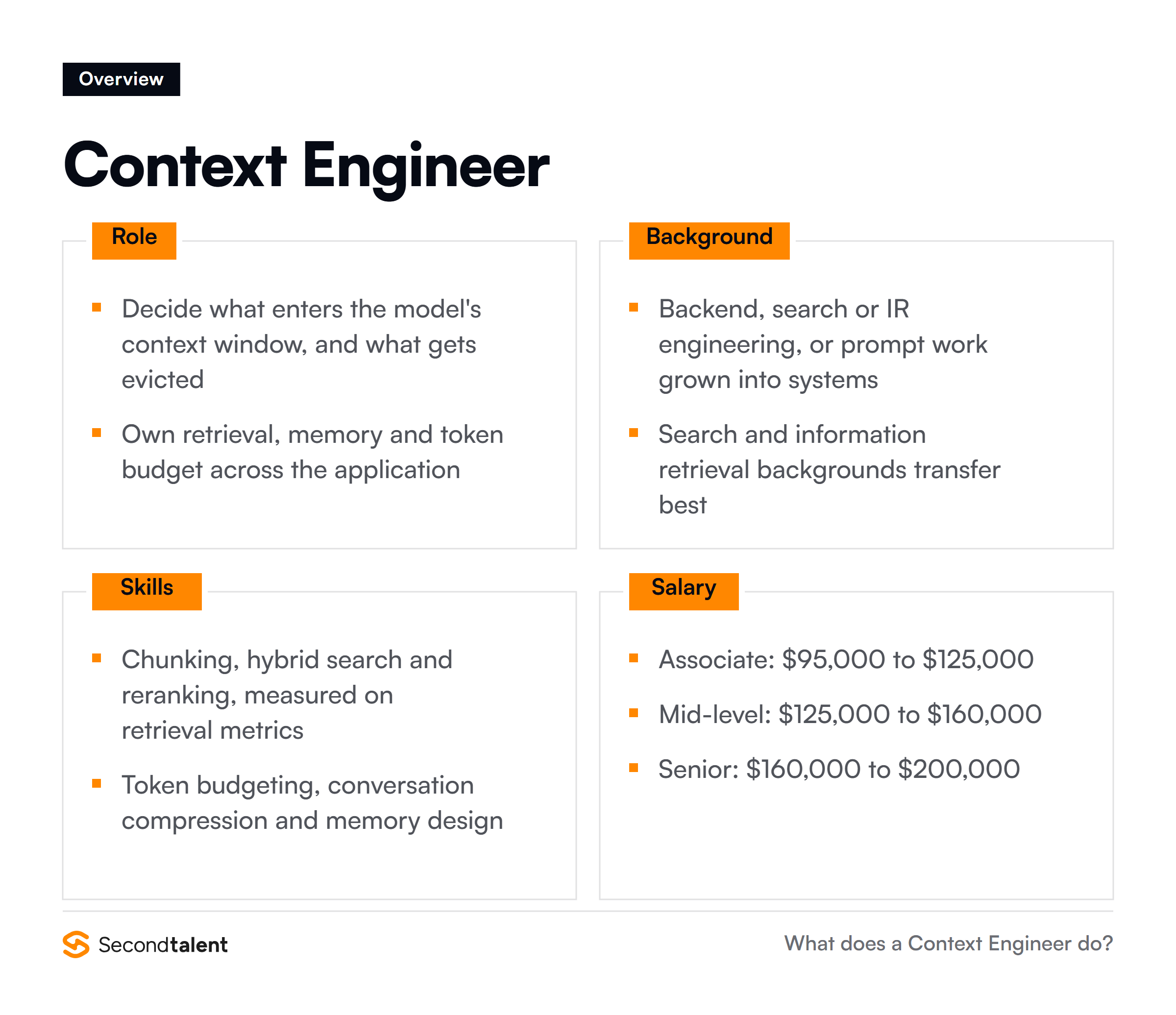
A Context Engineer designs the systems that deliver the right information to a language model at the right time. Where a Prompt Engineer optimizes the instruction, a Context Engineer owns everything around it: which documents get retrieved, how conversation history is compressed, which tool outputs are injected, what the model is allowed to remember between sessions, and how all of that fits inside a finite token budget.
The mental model that made the title stick is simple. The model is a CPU and the context window is RAM. You would not run a program by filling memory with whatever happened to be lying around, and you cannot expect reliable model behavior from a context window assembled by accident. Someone has to engineer what goes into it.
In practice the job looks like this: audit why a model gave a wrong answer, find that the retrieval step pulled three near-duplicate chunks and dropped the one that mattered, redesign the chunking and ranking, add a compression step for long conversations, and set a token budget per context section so a long tool response can never crowd out the system instructions. It is engineering work with a measurable output, not prompt tinkering.
The role usually sits inside an AI platform or applied AI team, alongside RAG Engineers and AI Agent Developers. On smaller teams one person covers all three. On larger ones the Context Engineer owns the shared context layer that every agent and feature draws from.
Context Engineer Job Market and Career Opportunities
Context Engineer is the fastest-rising AI job title of 2026. The term began circulating seriously in late 2025, Gartner published a formal definition in early 2026, and enterprise postings followed quickly. Adobe listed a role explicitly titled AI Context Engineer in April 2026, and listings now appear across enterprise software, fintech, healthcare AI, and large tech.
The hiring driver is failure rates. Companies that shipped their first LLM features in 2024 and 2025 discovered that accuracy problems rarely came from the model itself. They came from stale retrieval, bloated context, lost instructions, and memory that either forgot too much or remembered the wrong thing. Context Engineering exists because that class of problem needed an owner.
Average Salary Ranges (US market):
- Associate Context Engineer: $95,000 to $125,000
- Mid-level Context Engineer: $125,000 to $160,000
- Senior Context Engineer: $160,000 to $200,000
- Staff or Lead Context Engineer: $200,000 to $230,000+
ZipRecruiter data from May 2026 puts the US average for context engineering work at roughly $147,000, with most roles falling between $116,500 and $173,000. The mid-to-senior end reaches $140,000 to $230,000 at companies running large agent deployments.
Because the title is new, most people hired into it arrive from an adjacent role rather than a Context Engineer job history. That works in a candidate’s favor and it works in a hiring team’s favor too: the supply pool is larger than the title count suggests, as long as you screen on the underlying skills rather than the exact words on a resume. Hiring across Asia gives access to that same skill set well below US-anchored rates.
Essential Context Engineering Skills and Qualifications
Retrieval and Information Architecture:
- Chunking strategy: fixed-size, semantic, and hierarchical chunking, and knowing when each one breaks
- Embedding model selection, hybrid search, and reranking to get the right documents into the top results
- Query rewriting and expansion so a vague user question retrieves the document that actually answers it
- Evaluating retrieval quality separately from generation quality, because they fail for different reasons
Context Window Management:
- Token budgeting: allocating a fixed share of the window to instructions, retrieved context, history, and tool output
- Conversation summarization and rolling compression for long-running sessions
- Understanding attention behavior across long contexts, including the tendency for material in the middle to be used less reliably than material at the edges
- Context pruning and eviction policy: deciding what leaves memory when the budget is exceeded
Memory and State Design:
- Short-term session memory versus long-term persistent memory, and the write policy for each
- Structured state (user profile, entitlements, preferences) versus unstructured recall
- Preventing memory poisoning, where one bad stored fact degrades every future response
Engineering Fundamentals:
- Python, plus fluency with at least one orchestration framework such as LangChain, LlamaIndex, or a bespoke equivalent
- Vector database operations: indexing, filtering, metadata design, and refresh strategy
- Evaluation harnesses and regression suites, so a context change can be proven better rather than assumed better
- Cost and latency awareness, since every additional token in the window is paid for on every single call
Educational Background: A computer science or engineering degree is common but not required. The most credible candidates arrive from backend engineering, search and information retrieval, data engineering, or a prompt engineering role that grew into system design. Search and IR backgrounds are especially strong here, because the underlying problem is a ranking problem in new clothes.
Context Engineering Career Paths and Specializations
Career Progression:
- Backend Engineer, Search or IR Engineer, or Prompt Engineer → Context Engineer → Senior Context Engineer → Staff Context Engineer or AI Platform Lead → Head of Applied AI
Specialization Areas:
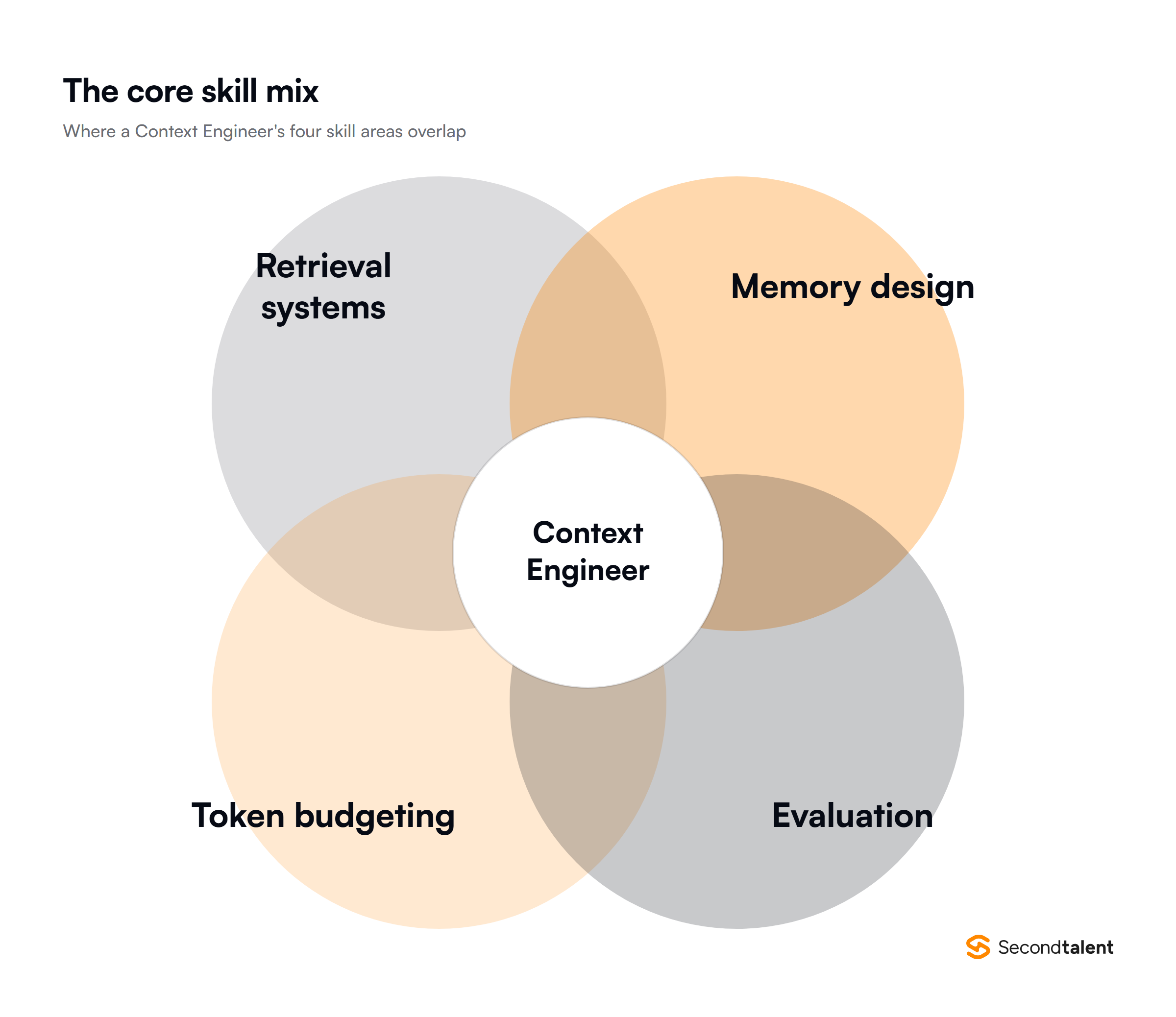
- Retrieval Systems: Deep focus on chunking, hybrid search, reranking, and retrieval evaluation, overlapping heavily with the RAG Engineer role
- Agent Context: Managing context across multi-step agent runs where tool outputs, sub-agent results, and plans all compete for the same window
- Memory Architecture: Long-term memory, user profiles, and persistent state across sessions and products
- Enterprise Knowledge: Permissions-aware context assembly, where what a model may retrieve depends on who is asking
- Context Evaluation: Building the harnesses that measure whether a context change improved anything, which is the fastest-growing sub-specialty
The enterprise knowledge specialization deserves particular attention. Once context assembly has to respect row-level permissions, data residency, and audit requirements, the role stops being an AI problem and becomes a systems problem, and the salary band moves accordingly.
Context Engineering Tools and Technologies
Orchestration and Framework Layer:
- LangChain and LangGraph for chain and graph-based context assembly
- LlamaIndex for document indexing and retrieval pipelines
- Model Context Protocol (MCP) servers, now the standard way to expose tools and data sources to a model
- Custom orchestration, which large teams often prefer once framework abstractions get in the way
Retrieval and Storage:
- Vector databases such as Pinecone, Weaviate, Qdrant, Milvus, and pgvector
- Hybrid search engines including Elasticsearch and OpenSearch for keyword plus vector retrieval
- Reranking models for second-stage precision
- Knowledge graphs, where relationship structure matters more than text similarity
Evaluation and Observability:
- Retrieval metrics: recall at k, precision at k, and mean reciprocal rank
- End-to-end eval frameworks such as RAGAS, DeepEval, and Braintrust
- Tracing tools including LangSmith, Langfuse, and Arize Phoenix for inspecting exactly what was in the window on a failed call
- Token accounting dashboards, since context bloat shows up as a cost line before it shows up as a quality complaint
Model Platforms:
- Long-context models and their prompt caching features, which change the economics of a large static context
- Structured output and tool-calling APIs
- Embedding model families, chosen for domain fit rather than benchmark position
Building Your Context Engineering Portfolio
Portfolio Components:
- A Before and After Retrieval Study: Take a document set, build a naive retrieval pipeline, measure it, then improve chunking and reranking and show the measured difference
- A Token Budget Design: Document how you allocated a context window across instructions, retrieval, history, and tool output for a real application, and what you cut first under pressure
- A Memory Implementation: A working example of session memory plus long-term recall, with an explicit policy for what gets written and what gets forgotten
- A Failure Analysis: One case where a model gave a wrong answer, the trace showing what was actually in the window, and the fix
The failure analysis is the strongest single artifact. It proves you can debug a context problem rather than guess at it, and debugging is most of the job. Hiring managers see plenty of tutorial RAG demos; they see very few write-ups of a real regression that was diagnosed and closed.
Context Engineering Methodology and Best Practices
Measure retrieval separately from generation. If you only measure the final answer, you cannot tell whether the model reasoned badly or was handed the wrong material. Two different metrics, two different fixes.
Treat the context window as a budget, not a bucket. Assign each section a token allowance in advance. Without one, a verbose tool response will silently push your system instructions out of the effective attention span on exactly the request that mattered.
Less context often beats more. Stuffing every plausibly relevant document into the window reliably degrades precision and raises cost. Retrieval quality is about excluding the near-misses, not including everything.
Log the assembled context, not just the prompt template. When a call goes wrong, the only useful evidence is the exact text the model actually received. Teams that log templates and inputs separately end up unable to reconstruct the failure.
Version the context pipeline like code. A chunking change, an embedding model swap, or a reranker upgrade can shift behavior across every feature at once. Ship those behind evaluation gates, not on a Friday.
Design for permissions from the start. Retrofitting access control onto a retrieval layer that already indexes everything into one shared collection is a rebuild, not a patch.
Future of Context Engineering Careers
The obvious question is whether longer context windows make this role unnecessary. They have not so far, and the reason is instructive: larger windows raised the cost and latency of a careless context and did nothing to fix precision. Being able to fit a million tokens does not mean it is a good idea to send them.
Expect the discipline to formalize the way DevOps did. Context evaluation, versioning, and observability are already becoming standard practice, and the tooling around them is maturing fast. What is currently craft knowledge held by a handful of practitioners will be a documented engineering pipeline within a few years.
Expect agents to be the main growth driver. A single-turn chatbot has a simple context problem. A multi-step agent that calls tools, spawns sub-agents, and runs for hundreds of turns has a hard one, and that is the direction production AI is moving.
Expect the title itself to keep shifting. Some organizations will fold this work into AI Engineer or Applied AI Engineer job descriptions rather than hiring a distinct title. The skills are what hold value; the exact label on the requisition is likely to keep moving for another year or two.
Getting Started as a Context Engineer
Practical Steps:
- Build a retrieval pipeline over a document set you know well, then deliberately break it and study how it fails
- Learn to read traces: instrument an application so you can see the exact assembled context behind every response
- Study information retrieval fundamentals, including BM25, hybrid search, and reranking, rather than starting at the framework layer
- Practice token budgeting on a real constraint, such as fitting a useful assistant into a small context window
- Build one evaluation harness end to end, with a golden set and a regression check you can run on every change
- Learn MCP, since tool and data integration is increasingly how context reaches the model in production
Candidates arriving from backend or search engineering usually need to build fluency with model behavior and evaluation. Candidates arriving from prompt engineering usually need to build systems depth: retrieval infrastructure, storage, and evaluation tooling. Both routes are well trodden, and the search and IR route is currently the most underrated.
If you are hiring rather than applying, Second Talent places Context Engineers and other AI-native talent across Asia, with vetting, compliance, and payroll handled for you.
Frequently Asked Questions
What is the difference between a Context Engineer and a Prompt Engineer?
A Prompt Engineer optimizes the instruction sent to a model. A Context Engineer owns the entire information payload around that instruction: what is retrieved, how history is compressed, which tool outputs are included, and how the token budget is allocated. Prompt engineering is one component of context engineering, and the broader role carries a materially higher salary band because it involves system design rather than wording.
Is Context Engineer just a new name for RAG Engineer?
They overlap but they are not the same. A RAG Engineer focuses on the retrieval pipeline that grounds a model in a document set. A Context Engineer covers retrieval plus memory, conversation compression, tool output handling, and token budgeting across an entire application. On a small team one person does both; on a larger team the Context Engineer owns the shared context layer that multiple RAG pipelines feed into.
Do longer context windows make this role obsolete?
No, and the evidence so far points the other way. Larger windows increase the cost and latency of an unfiltered context without improving precision, and models still use material at the edges of a long window more reliably than material buried in the middle. Bigger windows raised the value of deciding what goes in them, rather than removing the need to decide.
How much does it cost to hire a Context Engineer through Second Talent?
Cost depends on seniority and location, but hiring across Asia typically comes in well below US market rates for equivalent experience. Because the title is new, we screen on the underlying retrieval, evaluation, and systems skills rather than on the exact job title a candidate previously held. Get in touch for a current rate breakdown.
How quickly can Second Talent place a Context Engineer?
We can usually present a shortlist of pre-vetted candidates within days, with placements typically completed in a few weeks depending on your interview process and start-date requirements.
Related Roles
Explore related roles you can hire on Second Talent: Prompt Engineer, RAG Engineer, Model Context Protocol (MCP) Engineer, AI Agent Developer, AI Integration Engineer, Knowledge Graph Engineer.