In 2026 AI agents stopped being demos. They resolve IT incidents, execute financial workflows, process claims, and call other agents, all without a human approving each step. The moment that happened, someone had to be on call for them.
An AI Agent Operations Engineer, commonly shortened to AgentOps Engineer, owns the reliability, cost, and operational health of agents running in production. The discipline is to agents what DevOps is to software and what SRE is to distributed systems: monitoring, release management, incident response, and rollback, adapted for a system whose failures are probabilistic rather than deterministic.
What is an AI Agent Operations Engineer?
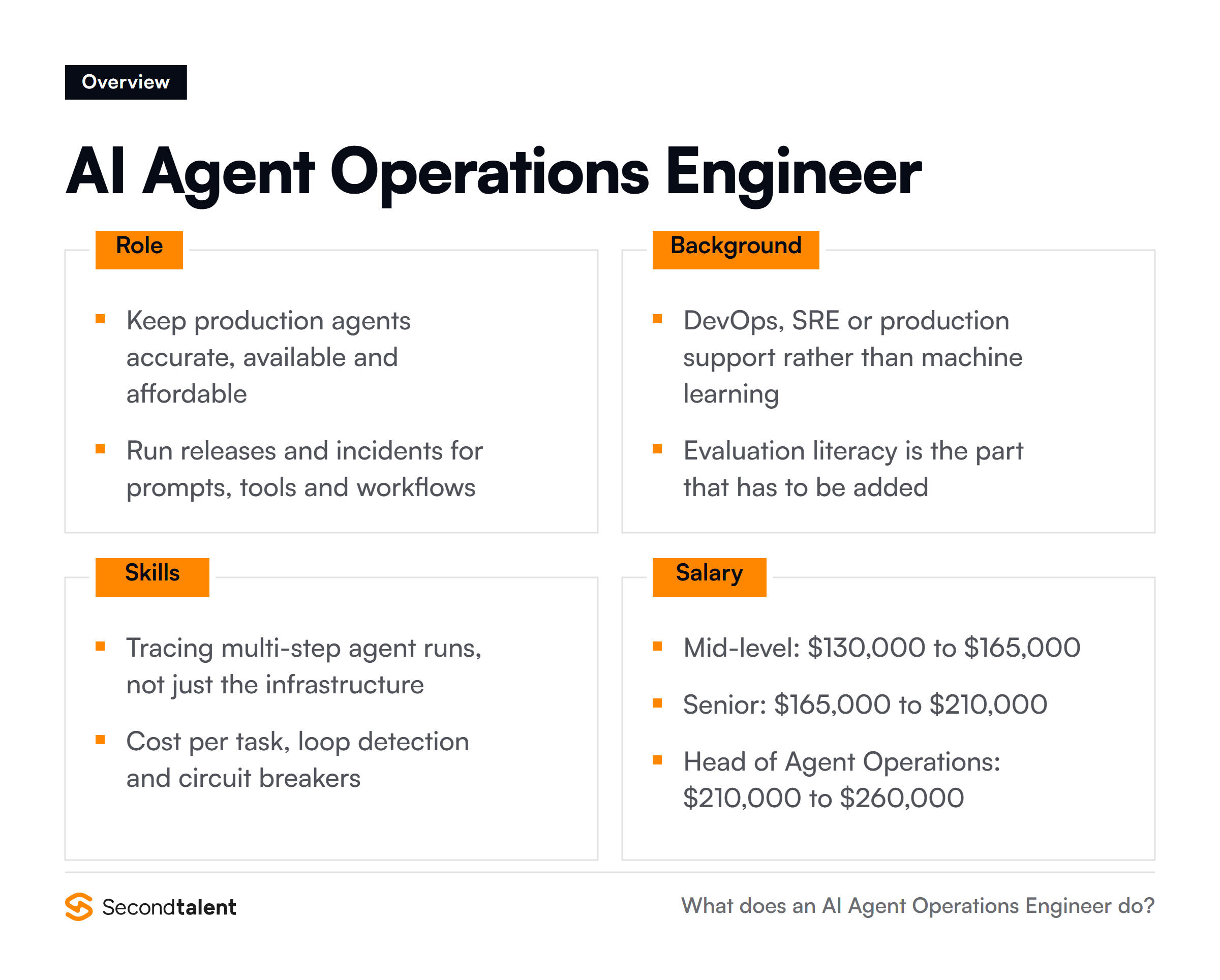
An AI Agent Operations Engineer keeps deployed AI agents accurate, available, affordable, and safe after go-live. The role exists because agents fail in ways traditional monitoring does not catch. A service can be up, latency can be normal, error rates can be zero, and the agent can still be quietly wrong on twenty percent of requests. Uptime is not correctness.
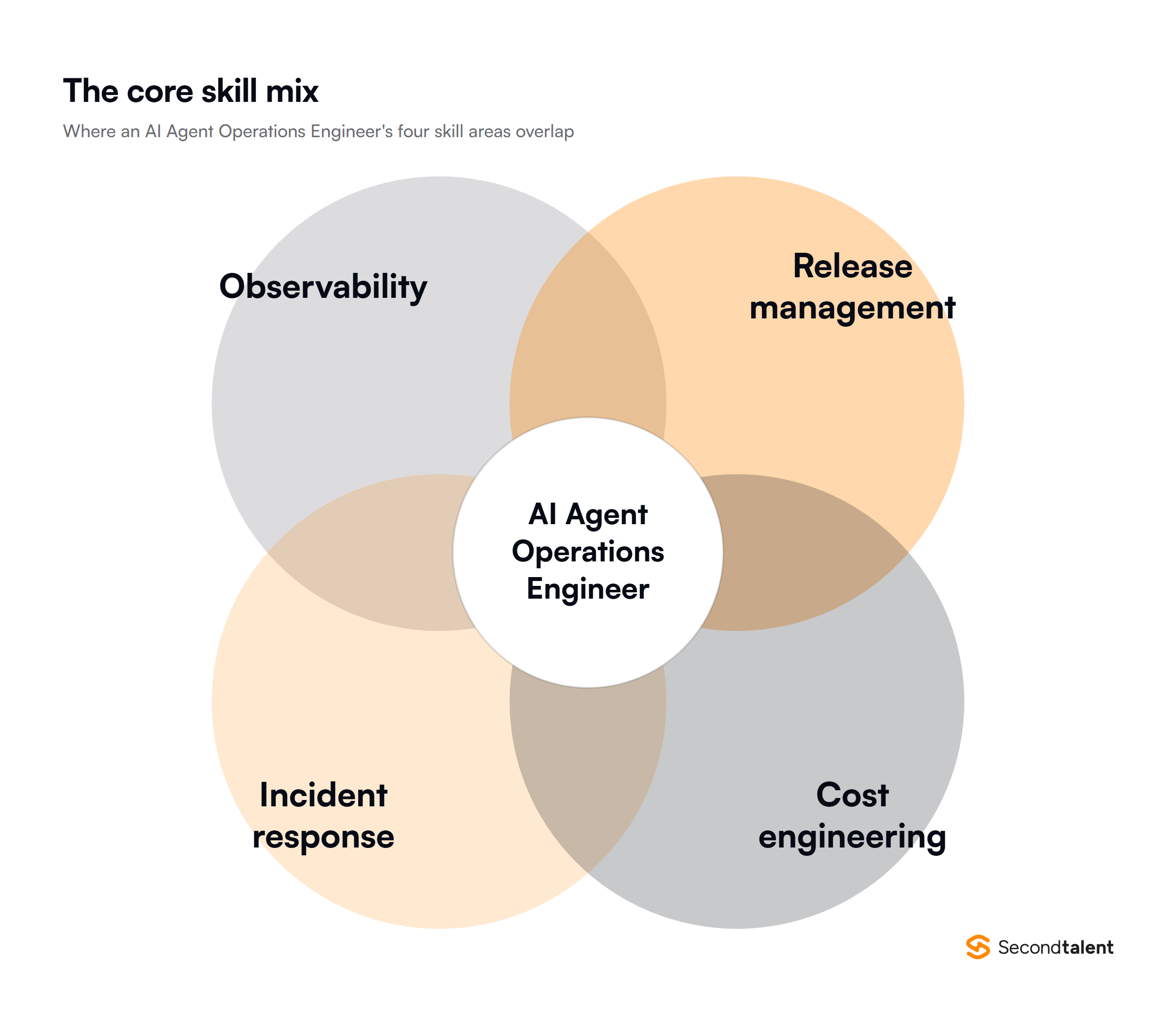
Day to day that means designing observability for agent behavior, not just agent infrastructure: tracking accuracy, latency, availability, exception rates, user feedback, and token consumption together, because a change in one usually explains a change in another. It means owning releases of prompts, workflows, tools, and model versions, with readiness checks and a rollback path for each. And it means running incidents when an agent starts looping, escalating cost, or taking actions it should not.
Release management is the part most teams underestimate. An agent’s behavior can change because someone edited a prompt, because a tool schema shifted, because a retrieval index was rebuilt, or because the model provider updated a version underneath you. All four are production changes, and only one of them looks like a deploy in a normal pipeline.
The role draws directly on Site Reliability Engineering and DevOps practice, and sits alongside LLMOps Engineers. The distinguishing focus is the agent itself: multi-step, tool-using, and capable of taking real actions in real systems.
AI Agent Operations Job Market and Career Opportunities
The hiring signal is clearest in enterprise services. Accenture, for example, lists an AgentOps Engineer role within its AI Managed Services practice, responsible for the reliability, performance, and operational health of enterprise AI agents in production, including observability, incident response, release management, and cost optimization. Where the large services firms build a job family, enterprise demand usually follows within a year or two.
The underlying driver is that agent deployments have crossed from pilots into workflows the business depends on. A pilot that misbehaves is an experiment. A production agent that misbehaves is an outage, a compliance event, or an unexpected invoice, and organizations respond by staffing an operations function around it.
Average Salary Ranges (US market):
- Mid-level AI Agent Operations Engineer: $130,000 to $165,000
- Senior AgentOps or Agent Reliability Engineer: $165,000 to $210,000
- Lead or Head of Agent Operations: $210,000 to $260,000
These bands track site reliability engineering compensation with the premium that AI-adjacent skills currently carry. Treat published averages for the exact title with caution: it is new enough that salary aggregators have thin and noisy samples, and most people doing the work today were hired under an SRE, DevOps, or platform engineering requisition.
That last point matters for hiring. The candidate pool is much larger than the title count, because the core skills are operational rather than exotic. An experienced SRE who understands evaluation and token economics is an AgentOps hire. Hiring across Asia reaches deep SRE and platform engineering talent well below US-anchored rates.
Essential AI Agent Operations Skills and Qualifications
Observability for Agents:
- Tracing multi-step agent runs: every model call, tool invocation, and decision point in one connected view
- Behavioral metrics beyond infrastructure: task success rate, tool selection accuracy, loop and retry rates, and escalation rates
- Token consumption and cost per task, tracked per agent, per workflow, and per customer
- Feedback capture, so user thumbs-down signals and support escalations feed the same dashboard as latency
Release and Change Management:
- Versioning prompts, workflows, tool schemas, and model selections as deployable artifacts
- Staged rollout, canary releases, and A/B comparison of agent versions on live traffic
- Readiness checks and evaluation gates that block a release which regressed on the golden set
- Rollback strategy for changes that are not code, including a fast path back to a known-good prompt or model version
Incident Response:
- Detecting silent failure: an agent that is confidently wrong rather than visibly broken
- Runaway detection for loops, recursive sub-agent spawning, and cost spikes, with automatic circuit breakers
- Kill switches and scoped degradation, so one failing capability does not take the whole assistant offline
- Postmortems for probabilistic systems, where the honest root cause is often a distribution shift rather than a single bug
Platform and Reliability Fundamentals:
- SRE practice: error budgets, service level objectives, on-call rotation, and alert design that does not page on noise
- Kubernetes, CI/CD, infrastructure as code, and the usual production toolchain
- Rate limiting, retries, timeouts, and graceful degradation when a model provider slows down or errors
- Security and permission awareness, since an agent acting with delegated authority is an operational risk as well as a technical one
Educational Background: Most people in this role come from DevOps, SRE, or production support rather than machine learning. The transferable core is operational judgment. What has to be added is evaluation literacy and an understanding of why a system can be healthy and wrong at the same time.
AI Agent Operations Career Paths and Specializations
Career Progression:
- DevOps, SRE, or Production Support Engineer → AI Agent Operations Engineer → Senior AgentOps Engineer → Agent Platform Lead → Head of AI Operations
Specialization Areas:
- Agent Observability: Building the tracing and metrics layer that makes agent behavior legible
- Cost Engineering: Token economics, model routing, and caching strategy, overlapping with Cloud FinOps practice
- Evaluation Operations: Running the continuous evaluation suites that gate releases and detect drift
- Agent Incident Response: On-call practice, circuit breakers, and containment for autonomous systems
- Governance Operations: Audit trails and control evidence for regulated deployments, alongside AI Governance Specialists
Cost engineering is the specialization with the clearest business case. Agents that reason in long chains consume tokens unpredictably, and an operations engineer who can cut cost per task without hurting success rate produces a number that finance can see immediately.
AI Agent Operations Tools and Technologies
Agent Observability Platforms:
- Langfuse and LangSmith for tracing agent runs end to end
- Arize Phoenix and Braintrust for evaluation-linked monitoring
- Purpose-built agent monitoring in general observability suites, including Datadog and Sentry
- OpenTelemetry with generative AI semantic conventions, for teams standardizing on one telemetry pipeline
Evaluation and Release Tooling:
- Golden datasets and regression suites run automatically on every prompt or model change
- LLM-as-judge scoring, calibrated against human review rather than trusted blindly
- Prompt and workflow version control, with diffs a reviewer can actually read
- Feature flags and canary routing for staged agent rollouts
Runtime and Infrastructure:
- Agent frameworks in production, including LangGraph and equivalents
- MCP servers as the tool layer agents call into
- Kubernetes, queues, and job runners for long-running agent tasks
- Model gateways and routers for failover, rate limiting, and per-team quota
Cost and Capacity:
- Token accounting per agent, workflow, and tenant
- Prompt caching and model routing to cheaper models where quality allows
- Budget alerts and hard spend caps, since an agent loop can spend a month of budget in an afternoon
Building Your AI Agent Operations Portfolio
Portfolio Components:
- An Agent Dashboard: A monitoring view combining success rate, latency, cost per task, and escalation rate, with a written rationale for each metric
- An Incident Writeup: A real agent failure, how it was detected, what contained it, and what changed afterwards
- A Release Process: Documented promotion of a prompt or workflow change through evaluation gates, canary, and rollback
- A Cost Optimization Case: A measured reduction in cost per completed task, with success rate shown to be unchanged
The incident writeup is the differentiator. Anyone can build a dashboard; being able to describe how you noticed an agent was confidently wrong, and how you stopped it, is evidence of the operational instinct this role is actually hired for.
AI Agent Operations Methodology and Best Practices
Monitor behavior, not just infrastructure. Uptime and latency dashboards will show a healthy system while the agent quietly fails a fifth of its tasks. Task success rate belongs on the same screen as availability.
Treat prompts as production artifacts. A prompt edit is a deploy. If it can change behavior for every user, it needs version control, review, an evaluation gate, and a rollback path.
Put a circuit breaker on cost and loops. Autonomous systems fail in expensive ways. Hard caps on steps, spend, and recursion depth are basic hygiene, not over-engineering.
Instrument the whole trace. When an agent takes the wrong action on step seven, the useful evidence is the full chain: what it retrieved, which tool it chose, and what that tool returned. Partial logging turns a diagnosis into a guess.
Alert on trends, not single events. One bad response is normal in a probabilistic system. A three-point drop in success rate over an hour is an incident. Alert thresholds copied from deterministic services will either page constantly or never.
Keep a human escalation path. The most reliable agent deployments are the ones that recognize when to hand off, and the handoff rate is a metric worth watching in both directions.
Future of AI Agent Operations Careers
AgentOps is following the arc DevOps took. It began as a set of practices that individual teams improvised, it is now acquiring named tooling and job titles, and it will end up as a standard function with expected practices and a recognized on-call rotation.
Expect multi-agent systems to raise the difficulty sharply. Debugging one agent’s decision chain is hard; debugging an interaction between three agents where the failure emerged from their coordination is a different class of problem, and the tooling for it barely exists yet.
Expect the boundary with security to blur. Agents with real permissions create an operational surface that is also an attack surface, and the containment work an operations engineer does overlaps directly with what an AI Security Engineer is defending against.
Expect this to become one of the more accessible routes into AI work. Unlike research or modeling roles, it rewards experience that thousands of existing operations engineers already have, with a learnable layer of evaluation knowledge on top.
Getting Started as an AI Agent Operations Engineer
Practical Steps:
- Deploy a small agent yourself and run it long enough to see it fail in production-like conditions
- Instrument it end to end, so every model call and tool invocation appears in one trace
- Build a golden set of tasks and wire it into a check that runs on every prompt change
- Define service level objectives for something other than uptime, such as task success rate and cost per completed task
- Practice an incident: cause a loop deliberately, then design the detection and circuit breaker that would have caught it
- Learn the token economics of your stack, since cost is the constraint most agent deployments hit first
Candidates arriving from SRE or DevOps usually need to build evaluation literacy and an understanding of why traditional health checks miss agent failures. Candidates arriving from AI engineering usually need to build operational discipline: on-call practice, alert design, and change management.
If you are hiring rather than applying, Second Talent places AI Agent Operations Engineers and other AI-native talent across Asia, with vetting, compliance, and payroll handled for you.
Frequently Asked Questions
What is AgentOps?
AgentOps is the practice of deploying, monitoring, governing, and optimizing AI agents in production, in the same way DevOps is the practice of running software and MLOps is the practice of running models. It covers observability of agent behavior, release management for prompts and workflows, incident response, and cost control for systems that act autonomously.
What is the difference between an AI Agent Operations Engineer and an LLMOps Engineer?
LLMOps centers on the model layer: deployment, versioning, prompt management, and evaluation of language model applications. Agent operations centers on autonomous, multi-step, tool-using systems, where the failure modes include loops, wrong tool selection, runaway cost, and unintended actions in real systems. The two overlap, and on smaller teams one person covers both.
Do I need a machine learning background for this role?
No. Most people in the role come from DevOps, SRE, or production support. What you need to add is evaluation literacy and an understanding of probabilistic failure, specifically why an agent can pass every infrastructure health check while being wrong on a significant share of tasks.
How much does it cost to hire an AI Agent Operations Engineer through Second Talent?
Cost depends on seniority and location, but hiring across Asia typically comes in well below US market rates for equivalent experience. Because the title is new, we screen strong SRE and platform engineers on evaluation and agent-specific operational judgment rather than requiring the exact job title. Get in touch for a current rate breakdown.
How quickly can Second Talent place an AI Agent Operations Engineer?
We can usually present a shortlist of pre-vetted candidates within days, with placements typically completed in a few weeks depending on your interview process and start-date requirements.
Related Roles
Explore related roles you can hire on Second Talent: LLMOps Engineer, AI Agent Developer, Site Reliability Engineer (SRE), MLOps Engineer, Model Context Protocol (MCP) Engineer, AI Security Engineer.