Zero-knowledge proofs have moved from cryptography paper to production infrastructure in a remarkably short time. Rollups now process billions of dollars of transactions every month using ZK proofs to compress execution. Privacy protocols use them to keep sensitive computation off-chain. Identity systems use them to prove statements about a user without revealing the underlying data. The engineering that turns these proofs into shipping products is its own discipline.
ZK Engineers are the rare engineers who can bridge cryptographic theory and production systems. They build circuits, prover infrastructure, and the application-layer code that makes zero-knowledge proofs usable by ordinary developers and end users. The talent supply is thin, the compensation is some of the highest in software engineering, and the demand keeps growing.
What is a ZK Engineer?
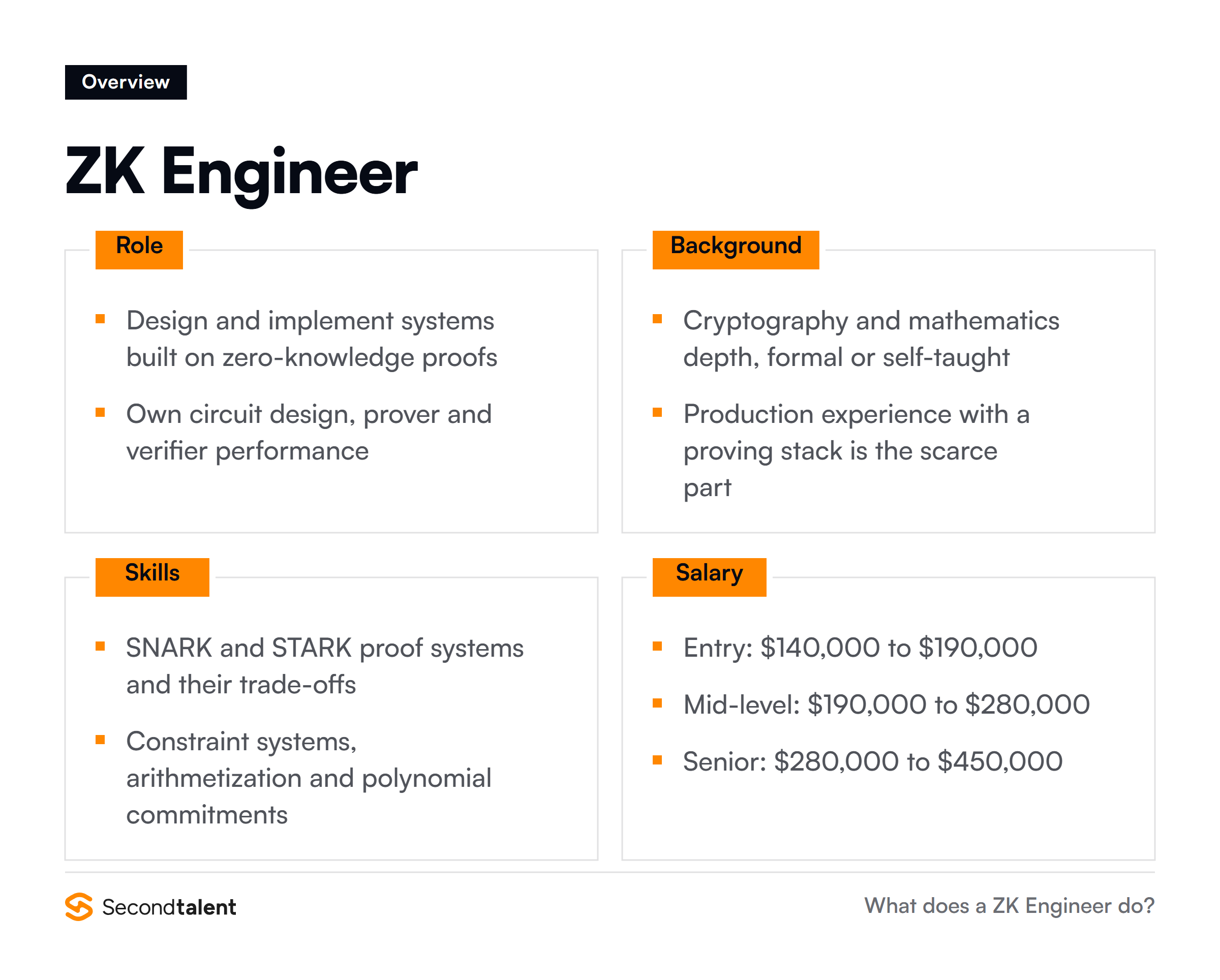
A ZK Engineer designs, implements, and operates systems that use zero-knowledge proofs. The work spans cryptographic primitive selection, circuit design in domain-specific languages, prover and verifier implementation, and the application-level integration that wraps proofs into something product teams can use.
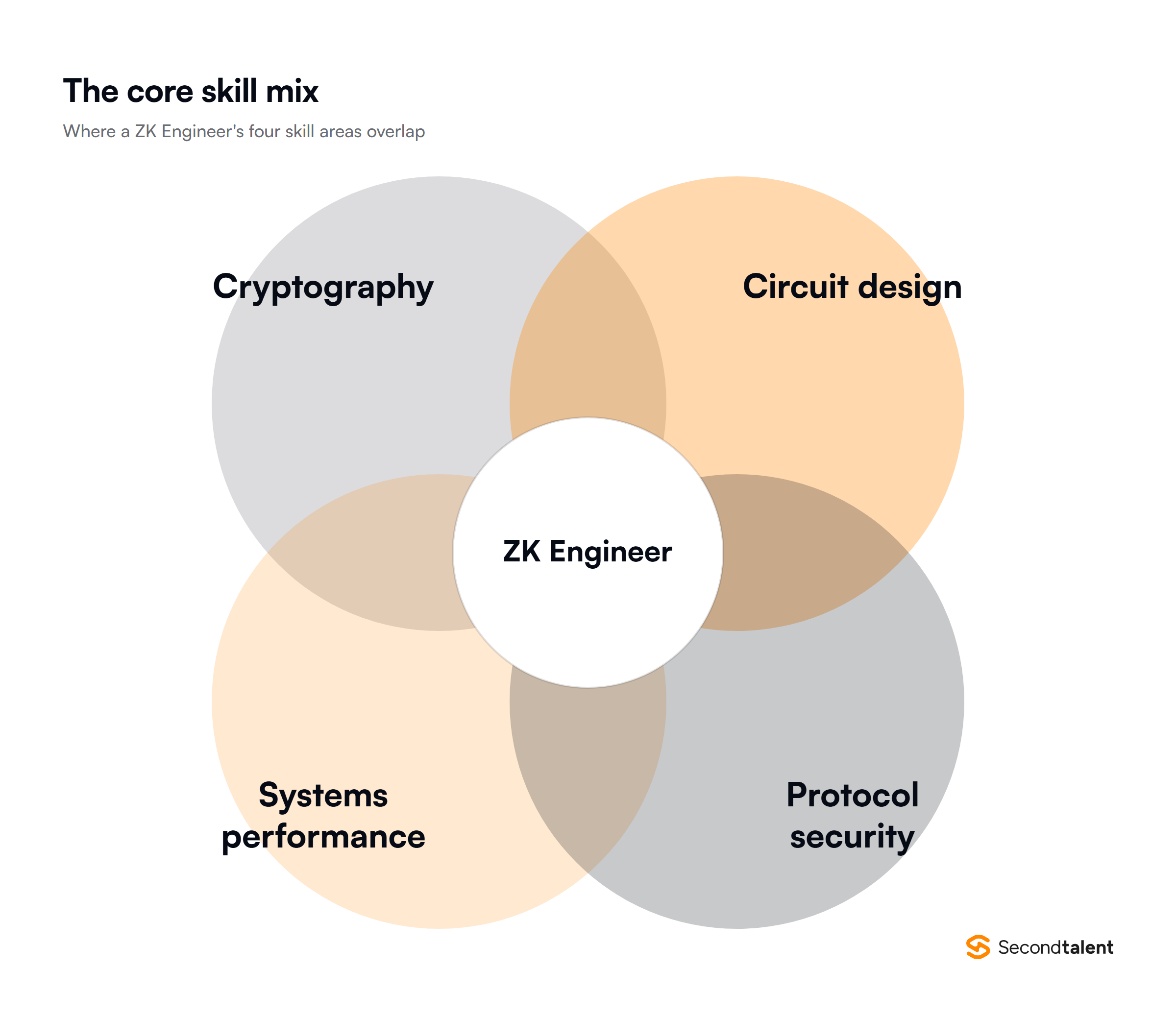
The role sits at the intersection of cryptography, compiler engineering, and distributed systems. ZK Engineers do not need to invent new proof systems, but they do need to understand the trade-offs across SNARK, STARK, Bulletproofs, FRI-based and pairing-based constructions deeply enough to choose the right tool for a given product requirement.
ZK Engineer Job Market and Career Opportunities
The ZK job market exploded after the Ethereum ecosystem committed to ZK rollups as a primary scaling strategy. zkSync, Starknet, Polygon zkEVM, Scroll, Linea, and dozens of application-specific ZK protocols have raised significant funding and hire ZK engineers aggressively. Outside Ethereum, ZK identity, ZK machine learning, and ZK privacy protocols are creating additional demand.
Supply is the bottleneck. Universities produce very few engineers with both cryptographic depth and shipping-grade software engineering, and the on-the-job ramp is long enough that career switchers tend to take months to become productive.
Average Salary Ranges (US-equivalent):
- Entry-level ZK Engineer: $140,000 – $190,000
- Mid-level ZK Engineer: $190,000 – $280,000
- Senior ZK Engineer: $280,000 – $450,000
- Principal ZK Engineer: $450,000 – $700,000+
Demand is heaviest at ZK rollup teams, ZK-focused infrastructure startups, privacy-focused L1 and L2 protocols, ZK identity projects, and a growing set of ZK machine-learning and ZK virtual machine teams. Several traditional cryptography research labs and security audit firms are also hiring ZK specialists at premium rates.
Essential ZK Engineering Skills and Qualifications
Core Knowledge Areas:
- Finite fields, elliptic curves, and pairing-based cryptography
- SNARK and STARK proof systems and their trade-offs
- Constraint systems, arithmetization, and R1CS
- Polynomial commitments (KZG, FRI) and their performance characteristics
- Circuit design idioms and common pitfalls (underconstrained circuits, soundness bugs)
- Recursive proof composition and proof aggregation
- EVM and other execution environments where proofs are verified
Technical Competencies:
- Hands-on fluency in at least one ZK DSL or framework (Circom, Halo2, Noir, RISC Zero, Cairo, Plonky, Gnark)
- Strong systems-language fluency (typically Rust or C++) for performance-critical prover code
- Solidity or equivalent for on-chain verifier integration
- Comfort reading academic papers and translating constructions into code
- Benchmarking, profiling, and optimization of prover performance
- Familiarity with GPU acceleration for proof generation
- Knowledge of common cryptographic libraries and primitives
Soft Skills:
- Patience for slow feedback loops while debugging proof failures
- Comfort with mathematical reasoning in everyday work
- Strong written communication for security-relevant design documents
- Discipline around adversarial thinking when reviewing your own code
ZK Engineer Career Paths and Specializations
The role specializes by what part of the ZK stack the engineer owns.
Circuit Engineering: Designing and implementing application-specific or virtual-machine-level circuits, with deep knowledge of arithmetization patterns, constraint efficiency, and circuit auditing.
Prover Performance Engineering: Optimizing prover throughput and latency, often with GPU acceleration, memory-layout tuning, and parallelization. A specialty unto itself.
ZK Virtual Machine Engineering: Working on full ZK execution environments such as zkEVMs, Cairo VMs, or RISC-V based provers like RISC Zero.
Cryptographic Protocol Engineering: Implementing new proof systems or composition schemes, often translating directly from research publications into production code.
Application-Layer ZK Engineering: Building consumer- or developer-facing products that use ZK underneath, with a focus on UX, integration, and SDK design.
ZK Auditing: Specialists at audit firms who review ZK circuits for soundness and completeness bugs, with deep skill in spotting underconstrained or completeness-broken circuits.
ZK Machine Learning: An emerging frontier where ZK proofs are used to attest to inference results or training data integrity.
ZK Tools and Technologies
Circuit DSLs and Frameworks:
- Circom, the long-standing R1CS-based circuit language with the largest tutorial base
- Halo2 for circuit design without a trusted setup, with deep ecosystem support
- Noir, designed for ergonomic circuit authoring with a Rust-like syntax
- Plonky2 and Plonky3 for high-performance FRI-based proofs
- Cairo for Starknet-style provable computation
- RISC Zero for general-purpose zkVM development
- Gnark for Go-based ZK applications
Prover and Verifier Libraries:
- arkworks and bellman as Rust-based building blocks
- snarkjs for browser-based proof generation
- libsnark for older but battle-tested workflows
Polynomial Commitments and Schemes:
- KZG, the workhorse of pairing-based SNARKs
- FRI, the foundation of STARK-style proofs
- IPA and Hyrax for transparent setup constructions
Acceleration and Infrastructure:
- icicle and other GPU acceleration libraries for proof generation
- Distributed proving services for high-throughput workloads
- Trusted-setup ceremony coordination tools
Integration Platforms:
- EVM verifier contracts in Solidity for on-chain verification
- Starknet, Aztec, Mina, and other ZK-native chains
- Cross-chain ZK bridges and light clients
Building Your ZK Engineer Portfolio
ZK hiring leans heavily on visible, well-explained work. The bar to entry is intellectual, not credentialed.
Project ideas that signal seriousness:
- A nontrivial circuit in Circom or Halo2 for a real problem (Merkle proof verification, vote tallying, age verification, signature schemes), with a clean repository and a written design doc
- A benchmark comparison of two proof systems on the same problem, with prover time, verifier time, proof size, and analysis
- A demo application that combines a circuit, a prover, and an on-chain verifier, deployed somewhere a hiring manager can try it
- A contribution to a mainstream ZK library or framework, ideally one that adds a missing primitive or fixes a performance regression
- A short technical writeup explaining a proof construction to other engineers, demonstrating both depth and the ability to communicate it
The portfolio narrative carries unusual weight in ZK. A handful of well-documented circuits with thoughtful trade-off discussion will outperform a long list of shallow demos.
ZK Engineering Methodology and Best Practices
Always start from the security properties. What does the proof actually attest to? Where could a malicious prover lie? What completeness obligations does the verifier impose? Write these out in plain language before writing any code.
Watch for under-constrained circuits. The most common ZK bug is a circuit that compiles, generates valid proofs for honest inputs, and silently accepts invalid inputs from a malicious prover. Manual constraint review is non-negotiable.
Use property-based testing aggressively. Soundness bugs hide in edge cases. Randomized inputs catch many of them that hand-crafted tests miss.
Audit your own work with adversarial intent. Imagine yourself trying to break your own circuit. Most ZK audits find the issues that the original engineer could have found with this mindset.
Treat trusted setup carefully. When a system requires a trusted setup, the ceremony is part of the security model. Document who participated, what was discarded, and how the contribution is verifiable.
Optimize prover performance only after correctness is settled. Premature constraint-count optimization is the source of many subtle bugs. Get the circuit right, then make it fast.
Build comprehensive verifier tests. Verifier code is what runs on-chain or at the security boundary. Test it against malformed proofs, malicious proofs, and edge-case inputs.
Future of ZK Engineering Careers
The frontier is moving fast in several directions at once.
zkEVMs are productizing. Layer 2 rollups based on ZK execution are scaling Ethereum and absorbing a growing share of transaction volume. The engineering teams behind them continue to hire aggressively.
Recursive proofs are becoming routine. Recursion enables proof aggregation, longer chain commitments, and entirely new product patterns. The engineers fluent in recursive constructions will own a disproportionate share of the next generation of products.
GPU and specialized hardware are reshaping prover economics. Off-the-shelf consumer GPUs already accelerate proving by orders of magnitude. ASICs and custom hardware are emerging. ZK engineers who pair circuit fluency with performance engineering will be in extreme demand.
ZK machine learning is leaving the lab. Provable inference, provable training data integrity, and ZK fine-tuning are early but credible. The product applications could be as big as the rollup market itself.
ZK identity and privacy are arriving. Selective disclosure, anonymous credentials, and privacy-preserving compliance are moving from research to production deployment. The application surface is much broader than crypto.
Getting Started as a ZK Engineer
Build mathematical intuition first. Finite fields, elliptic curves, polynomial commitments. Free resources from Stanford CS251, ZKLearning, the 0xPARC programming circuit course, and the Awesome ZK list cover the essentials.
Implement one circuit from scratch. A Merkle tree inclusion proof, a Pedersen hash, or an age-over-18 proof is enough to internalize the constraint-system mindset.
Pick one framework and go deep. Circom and snarkjs have the most tutorials. Halo2 is the right choice if you want production exposure. Noir is the most ergonomic starting point. Cairo if you are targeting Starknet.
Read recent papers actively. The ZK literature moves quickly. Following the major conferences, the IACR ePrint archive, and the protocol team blogs is how serious ZK engineers stay current.
Engage with the community. The 0xPARC Discord, ZK Hack events, the various rollup engineering channels, and the ZKResear.ch threads are where current state-of-the-art is debated. Get involved early.
Audit your way to fluency. Reading audit reports from groups like Veridise, OpenZeppelin, Spearbit, and Trail of Bits, and trying to find the bugs yourself before reading the conclusions, is one of the fastest ways to develop adversarial intuition.
ZK engineering is one of the highest-skill, highest-paid specializations in the modern software world. The intellectual barrier is real, the work is consequential, and the people who become fluent in this stack will spend the next decade building infrastructure that other engineers will only barely understand.