Traditional application security assumes an attacker has to find a flaw in your code. AI systems removed that assumption.
A model that reads a document, a web page, or a support ticket will act on instructions hidden inside it, and no amount of input validation on your own forms prevents that. The attack arrives inside the data the system was designed to read.
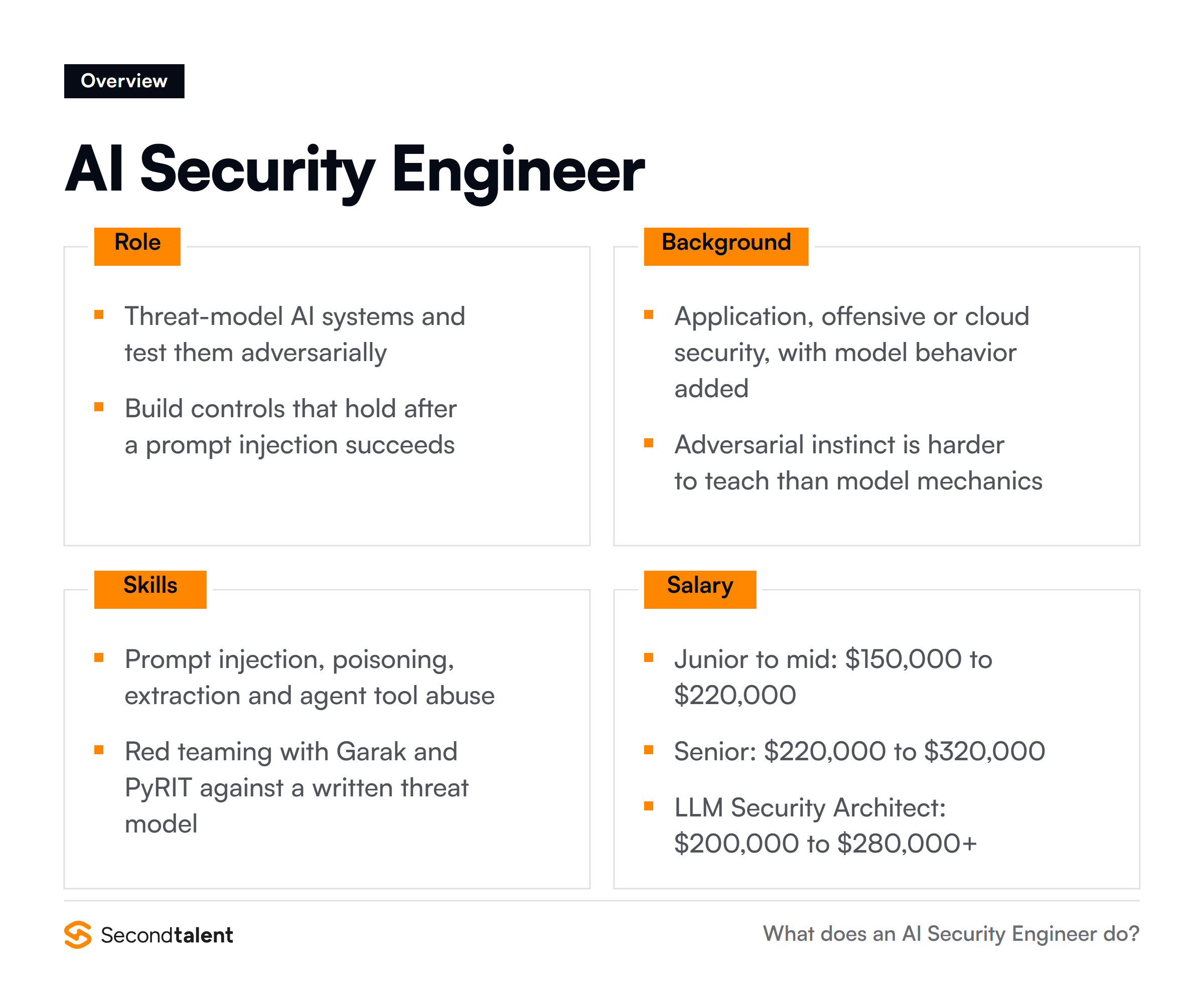
An AI Security Engineer defends that surface. They threat-model AI applications, test them adversarially, and build the controls that keep a model, an agent, and its tools from being turned against the organization that deployed them.
It is one of the fastest-growing specializations in security, and one where the defensive playbook is still being written.
What is an AI Security Engineer?
An AI Security Engineer secures machine learning and generative AI systems across their lifecycle: the training data, the model, the application wrapped around it, and the tools an agent can reach. The threat model is genuinely new.
Prompt injection, training data poisoning, model extraction, jailbreaking, and agent tool abuse have no clean equivalent in conventional application security.
Prompt injection is the defining problem.
A language model cannot reliably distinguish instructions given by a developer from instructions embedded in content it retrieves, so any system that reads untrusted text and then takes an action is exposed by design.
Mitigation is architectural, not a filter: constrain what the model can do, isolate untrusted content, and require confirmation for consequential actions.
Agent deployments raise the stakes further. An assistant that only answers questions leaks information at worst.
An agent with database write access, email sending, and a payment API can be manipulated into doing real damage, and the manipulation may arrive in a calendar invite. Securing delegated authority is now a large share of the job.
The role differs from an AI Safety Auditor, who assesses whether a system behaves acceptably, and from an AI Governance Specialist, who owns regulatory and policy compliance.
An AI Security Engineer is adversarial and technical: they build controls and they try to break them.
AI Security Engineer Job Market and Career Opportunities
AI security is one of the tightest talent markets in the industry, because it demands two scarce skill sets at once.
Security engineers who understand model behavior are rare, and machine learning engineers who think adversarially are rarer.
Most job postings now explicitly require experience with prompt injection, model evaluation, and adversarial testing frameworks such as Garak or PyRIT.
Practical DevSecOps’ 2026 analysis of emerging AI security roles lists AI Red Teamer, ML Security Engineer, AI Trust and Safety Analyst, and LLM Security Architect among the fastest-growing titles, and reports that engineers focused on agentic AI safety command a 20% to 30% premium over hires who only cover LLM application security.
Average Salary Ranges (US market):
- AI/ML Security Engineer, reported average: around $169,700
- Junior to mid-level, one to five years: $150,000 to $220,000
- Senior, five to eight years: $220,000 to $320,000
- LLM Security Architect: $200,000 to $280,000+
- Staff and principal at frontier labs and large platforms: $450,000+
Treat the top of that range as what it is: frontier lab and large platform compensation, not a market median. The wide spread reflects how differently a mid-sized enterprise and a model developer value this work.
The band most companies actually hire in is the $150,000 to $320,000 stretch.
Note that Second Talent’s own occupation set covers AI governance, safety auditing, and compliance in depth, but this is the adversarial engineering role.
Hiring across Asia reaches strong application security and offensive security engineers who transfer into AI security quickly, at rates well below the US bands above.
Essential AI Security Skills and Qualifications
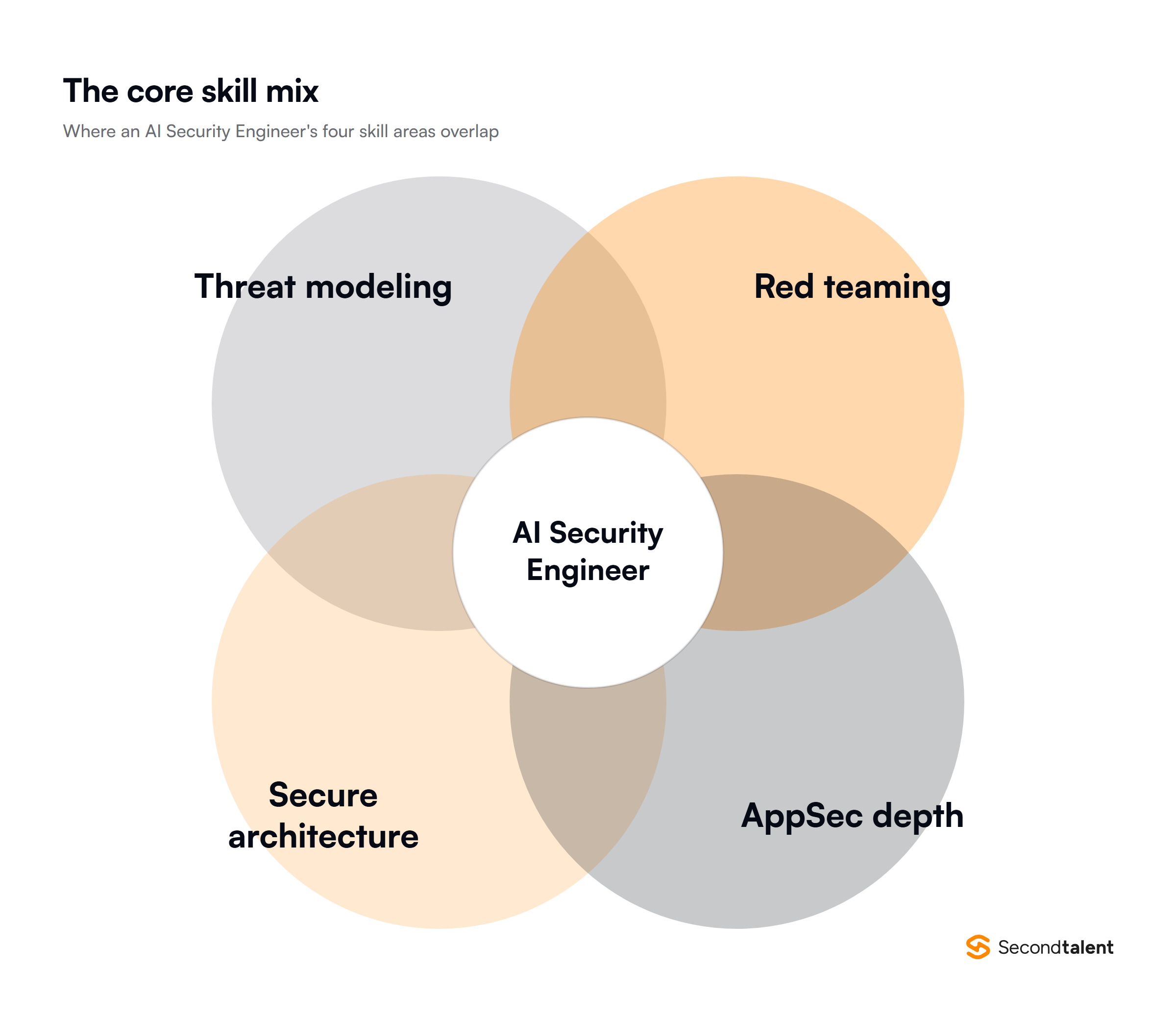
AI Threat Modeling:
- Prompt injection, direct and indirect, and why filtering alone does not solve it
- Training data poisoning and supply chain risk in datasets and open-weight model artifacts
- Model extraction, inversion, and membership inference attacks against deployed models
- Agent-specific risk: tool abuse, privilege escalation through delegated authority, and confused deputy patterns
Adversarial Testing:
- Red teaming language models systematically rather than by improvisation
- Automated adversarial frameworks including Garak and PyRIT
- Jailbreak technique families, and evaluating whether a mitigation generalizes or only blocks the example you tested
- Reproducible reporting, so a finding can be re-tested after a model update rather than re-discovered
Defensive Architecture:
- Isolating untrusted content from privileged instructions in the context assembly path
- Least privilege for tool access, with permissions enforced at the tool boundary rather than requested in a prompt
- Human-in-the-loop gates for consequential or irreversible actions
- Output handling: treating model output as untrusted input to whatever consumes it next, which is where injection becomes code execution
- Guardrails, content filtering, and rate limiting, with clear expectations about what each can and cannot stop
Security Fundamentals:
- Application security depth: authentication, authorization, secrets management, and secure API design
- Cloud security and infrastructure hardening for the platforms models run on
- Incident response adapted to systems where the vulnerable component is a probability distribution
- Familiarity with the OWASP Top 10 for LLM Applications, MITRE ATLAS, and the NIST AI Risk Management Framework
Educational Background: Most AI Security Engineers come from application security, offensive security, or cloud security, with model behavior learned afterwards.
That direction is generally faster than the reverse, because adversarial instinct is harder to teach than the mechanics of how a model consumes context.
AI Security Career Paths and Specializations
Career Progression:
- Application Security or Penetration Test Engineer → AI Security Engineer → Senior AI Security Engineer → LLM Security Architect → Head of AI Security
Specialization Areas:
- AI Red Teaming: Offensive testing of models and applications, the most visible entry point into the field
- Agent Security: Delegated authority, tool permissioning, and containment for autonomous systems
- ML Supply Chain: Dataset provenance, model artifact integrity, and third-party dependency risk
- Privacy and Data Protection: Preventing training data leakage, memorization, and inference attacks
- Security Architecture: Designing the reference patterns an organization builds every AI feature against
Agent security is where demand is growing fastest, and it is the specialization that carries the reported premium.
It also requires the broadest thinking, because the vulnerability is usually in how systems were connected rather than in any single component.
AI Security Tools and Frameworks
Adversarial Testing:
- Garak for automated LLM vulnerability scanning
- Microsoft PyRIT for risk identification in generative AI systems
- Custom attack suites built around an organization’s own tools and data
- Continuous red team runs in CI, so a model or prompt update is re-tested automatically
Frameworks and Standards:
- OWASP Top 10 for LLM Applications
- MITRE ATLAS, the adversarial threat landscape for AI systems
- NIST AI Risk Management Framework
- ISO/IEC 42001, where security work has to produce audit evidence
Runtime Controls:
- Guardrail and policy layers for input and output inspection
- Model gateways enforcing rate limits, quotas, and per-tenant isolation
- Sandboxing for code execution and tool calls
- Audit logging that records which agent took which action under whose authority
Supply Chain and Platform:
- Model artifact scanning and provenance verification
- Dataset lineage tracking
- Secret management for the credentials MCP servers and tool integrations hold
- Standard cloud security posture tooling applied to GPU and inference infrastructure
Building Your AI Security Portfolio
Portfolio Components:
- A Red Team Report: A structured assessment of an AI application you built or were authorized to test, with findings, severity, and reproduction steps
- An Indirect Injection Demonstration: A safe, self-contained example where content retrieved by a system changes its behavior, plus the architectural fix
- A Threat Model: A written threat model for an agent with tool access, covering trust boundaries and what fails if each control is removed
- A Mitigation Evaluation: Evidence that a defense you implemented generalizes, tested against attack variants rather than the single case that prompted it
Only test systems you own or are explicitly authorized to test, and say so clearly in the writeup. Demonstrated authorization discipline is itself a hiring signal in this field, and its absence is disqualifying.
AI Security Methodology and Best Practices
Assume prompt injection will succeed. Design so that a successful injection cannot do serious damage. Systems built on the assumption that the model will refuse a malicious instruction fail the first time it does not.
Enforce permissions at the tool, never in the prompt. An instruction telling a model to avoid certain data is guidance. A server that cannot return that data is a control. Only one of the two survives an adversary.
Treat model output as untrusted input. Output that flows into a shell, a browser, a database query, or another agent’s context is an injection vector. Most severe AI security findings are ordinary vulnerabilities reached through a model.
Separate trust levels in the context window. Developer instructions, user input, and retrieved content deserve different handling. Concatenating them into one undifferentiated block is the root cause of a large share of findings.
Re-test after every model change. Mitigations are behavioral, and a provider’s model update can silently invalidate a defense that was verified last month. Adversarial tests belong in continuous integration.
Gate consequential actions on a human. Irreversible operations, financial transactions, and external communications should require confirmation. The cost is small and it caps the blast radius of everything else.
Future of AI Security Careers
The attack surface is expanding faster than the defensive playbook. Every new capability, from tool use to computer use to multi-agent coordination, adds a class of risk before the corresponding controls are standardized.
That gap is what sustains demand for this role.
Expect regulation to pull security and governance closer together.
As AI-specific requirements bite, security engineers will increasingly be asked to produce evidence a control worked, not just to implement it, which is audit work in a security engineer’s hands.
Expect agent security to become its own discipline.
Delegated authority, inter-agent trust, and containment are already too large to be a sub-topic of application security, and the premium reported for agentic specialists reflects that separation happening in real time.
Expect the entry path to stay open to conventional security engineers. The fundamentals still dominate: most real findings in AI systems are authorization, injection, and data exposure problems reached through an unfamiliar door.
Getting Started as an AI Security Engineer
Practical Steps:
- Build a small AI application with tool access, then attack it yourself until you understand why filtering is not a fix
- Work through the OWASP Top 10 for LLM Applications and map each item to something in your own stack
- Learn Garak and PyRIT, and run a structured assessment rather than ad hoc prompting
- Study MITRE ATLAS to build a vocabulary for AI threats that other security professionals recognize
- Practice writing findings for two audiences: an engineer who needs a fix and an executive who needs a risk statement
- Follow agent security specifically, since that is where both the hardest problems and the highest pay currently sit
Candidates arriving from security usually need to build understanding of model behavior, context assembly, and evaluation.
Candidates arriving from machine learning usually need to build adversarial instinct and conventional application security depth. The security-first route is generally the faster one.
If you are hiring rather than applying, Second Talent places AI Security Engineers and other AI-native talent across Asia, with vetting, compliance, and payroll handled for you.
Frequently Asked Questions
What is prompt injection and why can it not simply be filtered out?
Prompt injection is an attack where instructions embedded in content a model reads are followed as though a developer had issued them.
Filtering fails because there is no reliable syntactic difference between an instruction and a description of one, and because the malicious text can arrive indirectly inside a retrieved document, a web page, or an email.
The durable mitigations are architectural: isolate untrusted content, limit what the model can do, and gate consequential actions on a human.
What is the difference between an AI Security Engineer and an AI Safety Auditor?
An AI Safety Auditor evaluates whether a system behaves acceptably: bias, harmful output, and alignment with stated policy.
An AI Security Engineer defends against adversaries: injection, poisoning, extraction, and abuse of an agent’s permissions. Safety asks whether the system does the wrong thing on its own. Security asks what an attacker can make it do.
Do I need a machine learning background to become an AI Security Engineer?
No, and most people in the role do not have one. Application security, offensive security, or cloud security experience transfers well, with model behavior learned on top.
Adversarial instinct is the harder half to acquire, which is why the security-to-AI path is usually faster than the reverse.
How much does it cost to hire an AI Security Engineer through Second Talent?
Cost depends on seniority and specialization, and agent security expertise carries a premium over LLM application security alone. Hiring across Asia reaches strong application and offensive security engineers at rates well below US bands.
Get in touch for a current rate breakdown.
How quickly can Second Talent place an AI Security Engineer?
We can usually present a shortlist of pre-vetted candidates within days, with placements typically completed in a few weeks depending on your interview process and start-date requirements.
Related Roles
Explore related roles you can hire on Second Talent: AI Safety Auditor, AI Governance Specialist, IT Compliance Analyst, Model Context Protocol (MCP) Engineer, AI Agent Operations Engineer, Ethical AI Compliance Officer.
Ready to hire? Hire AI Engineers: vetted AI-native talent, with first profiles in 24 hours.