Large language models do not actually know your company. They were trained on a snapshot of the public internet, frozen months ago, with none of your contracts, support tickets, internal docs, or product data. The way you make an LLM useful for a real business is not by retraining it. It is by giving it the right context, on demand, every time it answers.
RAG Engineers are the specialists who build that context layer. They design and operate retrieval-augmented generation pipelines that pull the right documents, code, tickets, or knowledge into the model at runtime, with chunking, embeddings, vector search, reranking, and evaluation that hold up in production.
What is a RAG Engineer?
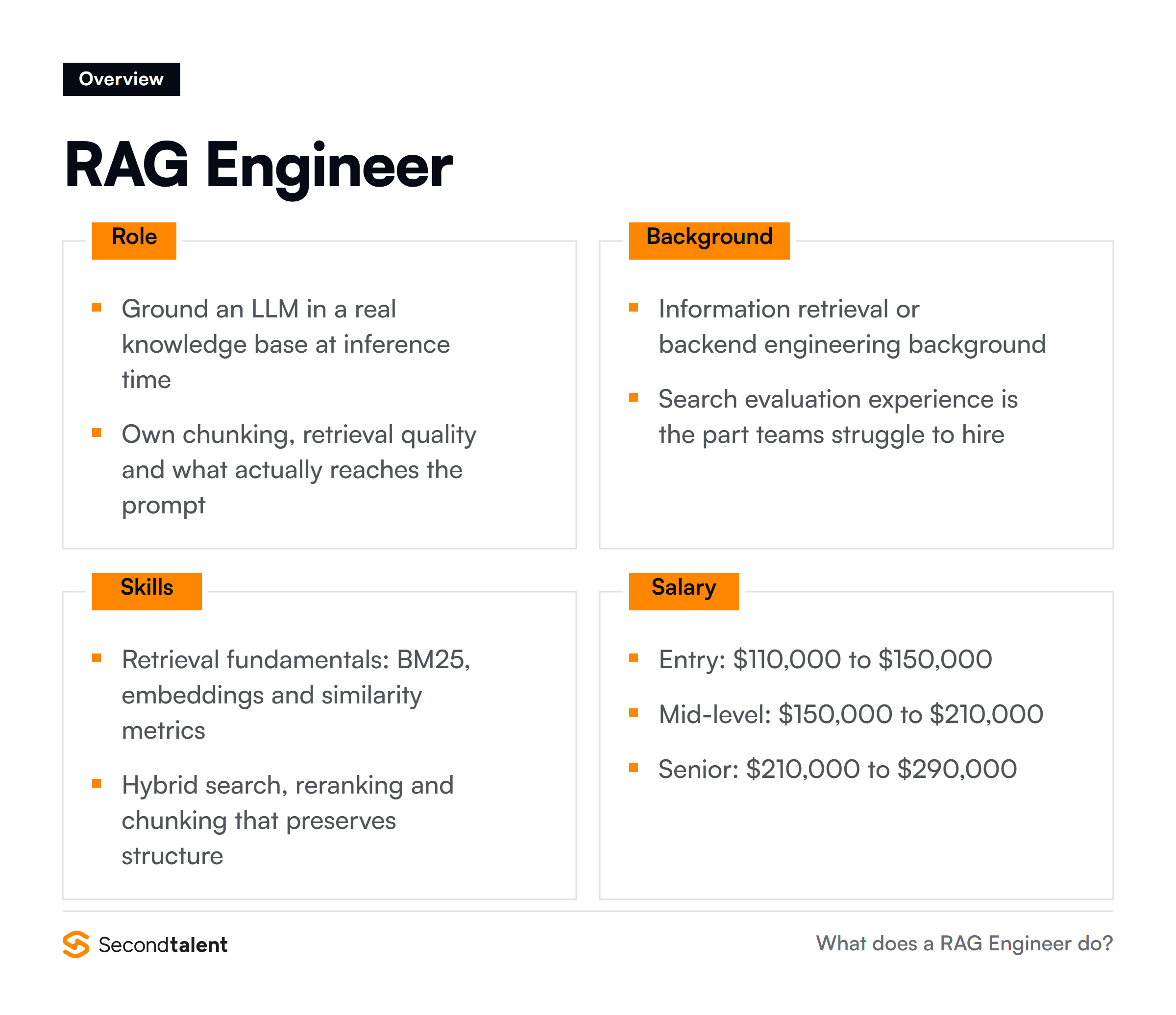
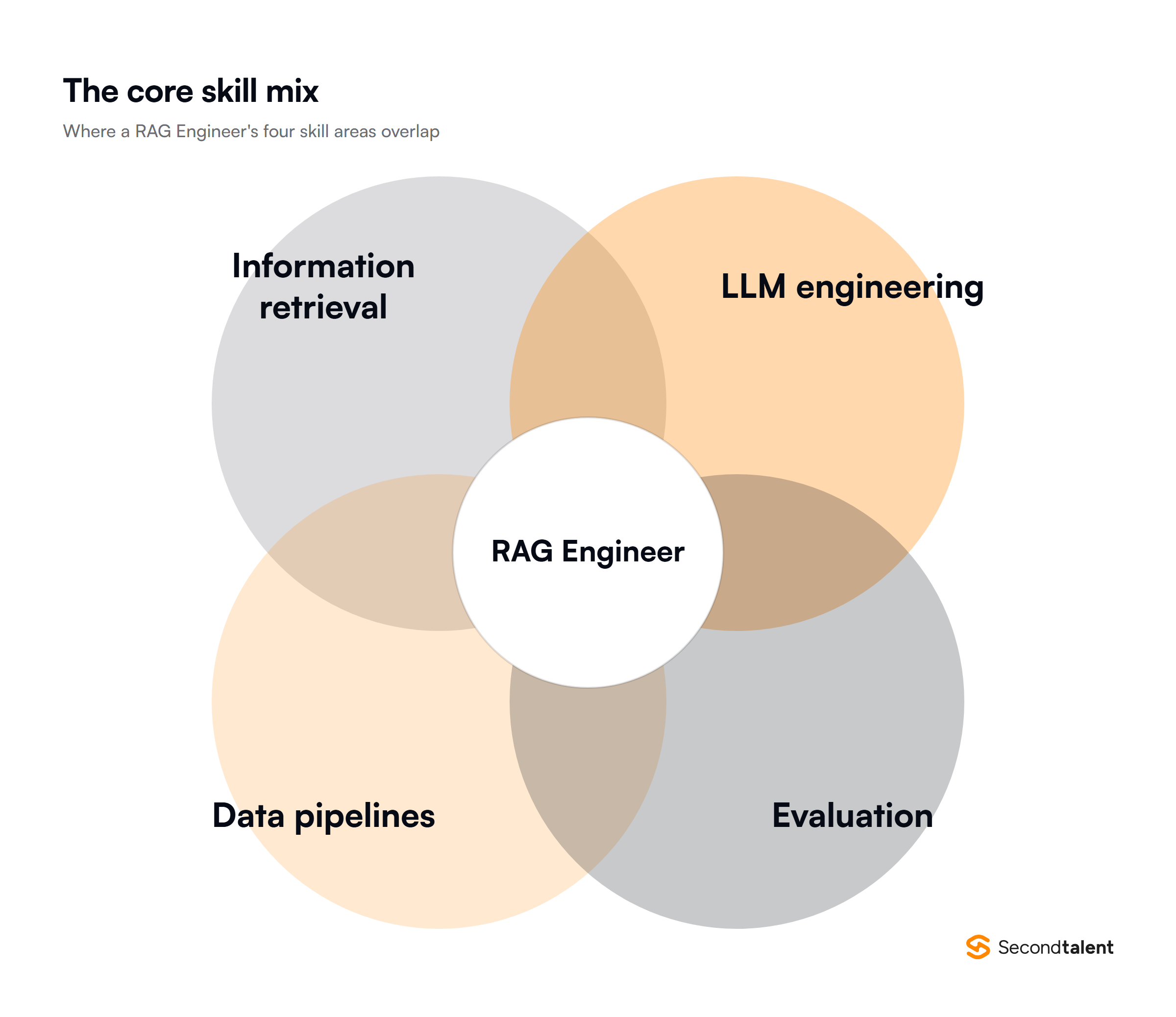
A RAG Engineer specializes in retrieval-augmented generation, the technique that grounds an LLM in a specific knowledge base by retrieving relevant content at inference time and injecting it into the prompt. The role combines information retrieval, embeddings, search engineering, and prompt design into one discipline.
The work is not about wiring up a vector database in an afternoon. Production RAG is about making the right document show up at the right moment, in the right form, with the right citations, every time. It is a search-quality problem and a systems-design problem at the same time.
RAG Engineer Job Market and Career Opportunities
RAG moved from research curiosity to enterprise default in 24 months. Almost every enterprise AI deployment shipping in 2026 leans on a RAG pipeline of some kind. Vector database providers report 5 to 10x revenue growth year over year, and the role is now showing up in job titles at every AI-native startup and every enterprise AI center of excellence.
Average Salary Ranges (US-equivalent):
- Entry-level RAG Engineer: $110,000 – $150,000
- Mid-level RAG Engineer: $150,000 – $210,000
- Senior RAG Engineer: $210,000 – $290,000
- Principal RAG Engineer: $290,000 – $400,000+
Demand is strongest in enterprise SaaS, legal tech, healthcare, financial services, customer support tooling, internal knowledge platforms, and any AI-native product where the model has to ground itself in a private corpus. Consulting firms and AI implementation partners are also hiring RAG specialists for client engagements.
Essential RAG Engineering Skills and Qualifications
Core Knowledge Areas:
- Information retrieval fundamentals (BM25, TF-IDF, inverted indexes)
- Embedding models, vector spaces, and similarity metrics
- Chunking strategies and document structure preservation
- Hybrid search combining keyword and semantic retrieval
- Reranking models and cross-encoder scoring
- Context window management and prompt construction
- Evaluation methodologies for retrieval quality and answer quality
Technical Competencies:
- Vector databases (Pinecone, Weaviate, Qdrant, Chroma, pgvector)
- Search engines (Elasticsearch, OpenSearch, Typesense, Meilisearch)
- Embedding models (OpenAI, Cohere, Voyage, open-source alternatives via Sentence Transformers)
- Frameworks like LangChain, LlamaIndex, Haystack for pipeline scaffolding
- Python proficiency for retrieval orchestration and evaluation harnesses
- Document parsing tools (Unstructured, LlamaParse, Tika, PyMuPDF)
- Observability for retrieval (latency, recall metrics, citation tracking)
Soft Skills:
- Patience for the iterative tuning loop that real RAG quality requires
- Strong stakeholder communication about what the model can and cannot answer
- Willingness to read raw retrieval logs to debug subtle quality issues
- A search-engineering mindset that treats every regression as a data problem
RAG Engineer Career Paths and Specializations
The discipline branches by document type and use case.
Enterprise Knowledge RAG: Building grounded assistants on top of Confluence, SharePoint, Notion, Google Drive, with permissions-aware retrieval and citation surfacing.
Code RAG: Retrieval over codebases for assistant tooling, with chunking that respects symbol boundaries and embeddings tuned for code semantics.
Legal and Compliance RAG: Long-document retrieval with strict citation requirements, often combined with structured extraction.
Customer Support RAG: Retrieval over knowledge bases, past tickets, and product docs, optimized for low-latency response and accurate deflection.
Multimodal RAG: Retrieval that includes images, diagrams, tables, and screenshots alongside text.
Agentic RAG: Combining retrieval with AI agent loops so the model can issue follow-up queries, refine searches, and reason over results across multiple retrieval calls.
RAG Engineering Tools and Technologies
Vector Databases:
- Pinecone for managed, low-latency vector search at scale
- Weaviate for hybrid search and rich metadata filtering
- Qdrant for self-hosted, performant, payload-rich workloads
- pgvector for teams already running Postgres
- Chroma for fast prototyping and developer experience
Embedding Models:
- OpenAI text-embedding-3 family for general-purpose use
- Cohere Embed v3 with multilingual variants
- Voyage AI for high-quality domain-tuned embeddings
- Open-source models from Sentence Transformers and BGE for self-hosted setups
Frameworks and Libraries:
- LangChain and LlamaIndex for retrieval pipeline scaffolding
- Haystack for production-grade RAG with full evaluation tooling
- DSPy for programmatic RAG optimization
- Custom Python orchestration for production reliability
Document Processing:
- Unstructured.io and LlamaParse for high-fidelity extraction
- PyMuPDF, pdfplumber, and Apache Tika for traditional parsing
- Vision-LLM-based extraction for complex layouts
Evaluation:
- Ragas, TruLens, and DeepEval for systematic RAG evaluation
- Custom golden datasets per use case
- Langfuse and Helicone for production trace analysis
Building Your RAG Engineering Portfolio
Hiring managers want to see end-to-end RAG, not a notebook with three documents.
Project ideas that signal seriousness:
- A grounded assistant over a real public corpus (10,000+ docs) with full citations, hybrid retrieval, reranking, and a published evaluation set
- A side-by-side comparison of chunking strategies on the same corpus with quantitative recall and answer-quality numbers
- A code-RAG demo over a popular open-source repository with symbol-aware chunking and an evaluation harness
- A multimodal RAG demo that retrieves over images, tables, and text with consistent citation surfacing
- A regression test suite that catches retrieval quality drops when models, embeddings, or chunking change
The differentiator is always the evaluation work. Anyone can wire up a vector store. The engineers who get hired are the ones who can prove their pipeline got better.
RAG Engineering Methodology and Best Practices
Build evaluation before you build retrieval. A golden dataset of 100 to 500 representative queries with expected answers is the foundation of every serious RAG project. Without it, every tuning decision is a guess.
Treat chunking as a first-class design decision. Naive fixed-token chunks lose context. Semantic chunking, recursive splitting, and document-structure-aware chunking each shine in different domains. Test them on your data, not someone else’s.
Use hybrid search by default. Pure dense retrieval misses exact-match needs. Pure keyword misses semantic similarity. Combine BM25 with embeddings, then rerank, and you outperform either alone on most corpora.
Rerank aggressively. Pulling 30 to 100 candidates and reranking down to 5 with a cross-encoder is one of the highest-leverage changes you can make. The latency cost is small, the quality lift is large.
Always cite. Production RAG without citations is product malpractice. Users need to verify, and developers need to debug.
Monitor retrieval, not just generation. A wrong answer that came from a perfect retrieval is a prompt problem. A wrong answer that came from missing retrieval is a search problem. Telemetry has to separate the two.
Plan for permissions. Enterprise RAG that does not enforce per-user access controls on retrieval is a data leak waiting to happen. Build permission filtering into the retrieval layer, not into post-processing.
Future of RAG Engineering Careers
The frontier is moving in several directions at once.
Long-context models are reshaping the trade-offs. Context windows of 1M-plus tokens mean some RAG problems collapse into pure long-context problems. But retrieval still wins on cost, latency, and groundedness verification. Specialists who can decide when to retrieve and when to stuff will be the most valuable.
Agentic RAG is becoming the default for hard questions. Single-shot retrieve-then-answer is being replaced by multi-step retrieval where the model decides what to search next based on what it has already learned.
Evaluation infrastructure is professionalizing. The eval tooling is finally catching up to the production tooling, and RAG engineers are expected to ship evals alongside features.
RAG is not a fad layer that the next model release will obsolete. It is the discipline of grounding language models in private knowledge, and that problem is here for the long run.
Getting Started as a RAG Engineer
Build one pipeline end to end, then build it five more times. Pick a corpus you care about. Build retrieval, generation, and evaluation. Then change one variable at a time and measure. The fluency comes from repetition.
Learn classical information retrieval. BM25, TF-IDF, inverted indexes, learning-to-rank. These are not obsolete. They are half of every production RAG stack.
Read the eval literature. The papers from Ragas, RAGAS, BEIR, and the LMSYS team are essential. So is the practical writing from production teams at Anthropic, OpenAI, and the leading enterprise AI vendors.
Get hands-on with at least two vector databases. The trade-offs are real, and abstraction layers only get you so far. Run Pinecone and Qdrant on the same workload. Notice the difference.
Build a public-facing demo with citations. A live RAG demo over a real corpus, with linked citations and a published evaluation report, is the single strongest portfolio piece in this field.
The role rewards engineers who care deeply about quality, who are comfortable reading raw retrieval logs at midnight, and who treat evaluation as a discipline rather than an afterthought. Get fluent now and you will spend the next decade shipping the systems that actually make enterprise AI useful.