Every large language model in production today was shaped, in part, by humans rating and correcting its answers. That work does not stop once a model ships — it is a continuous loop, and someone has to run it.
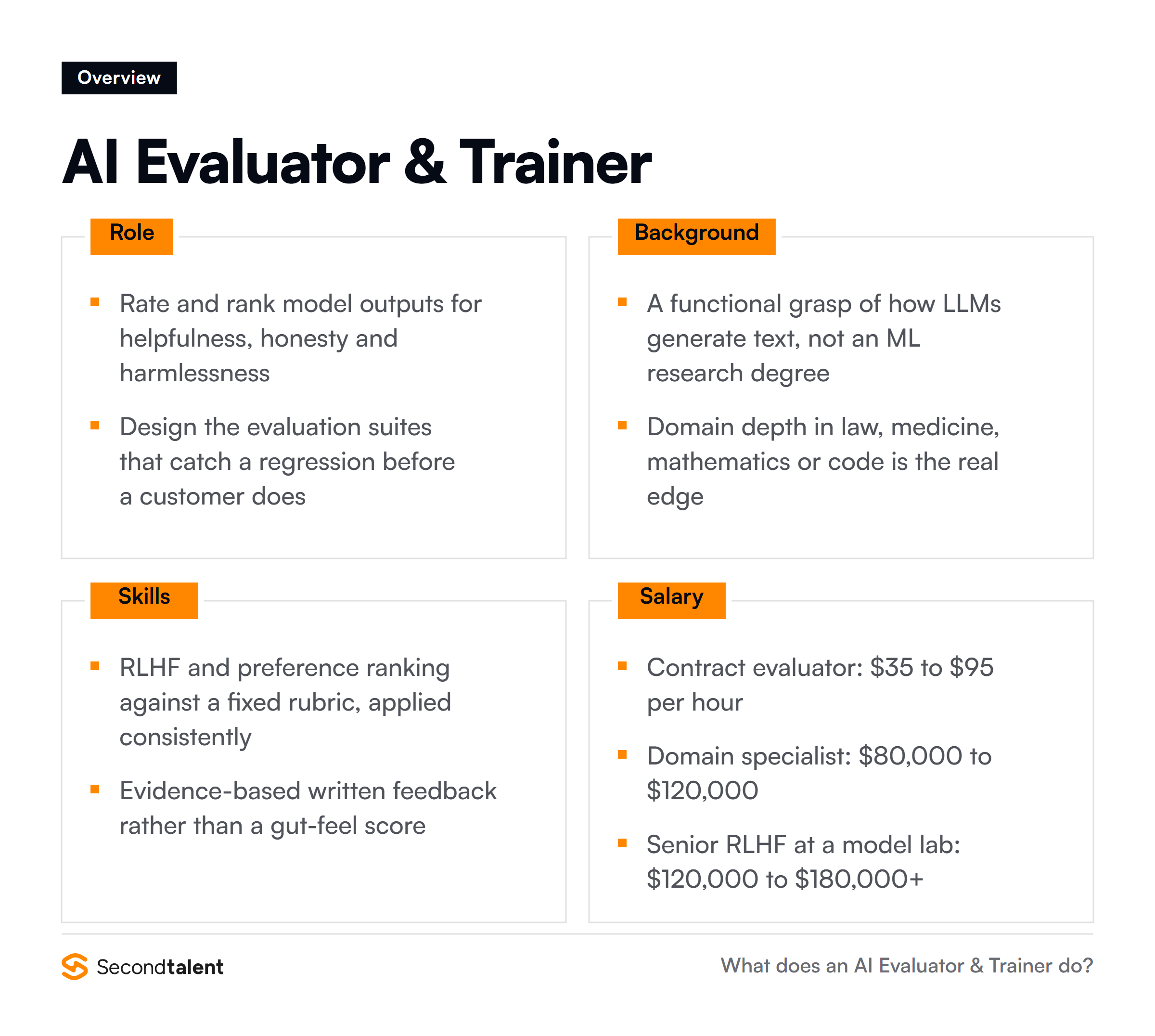
AI Evaluators and Trainers rate model outputs, write the preference judgments that reinforcement learning from human feedback (RLHF) depends on, and design the evaluation suites that catch a regression before a customer does.
They are distinct from data annotators labeling raw training data: their job is judging model behavior, not preparing the dataset a model learns from.
What is an AI Evaluator & Trainer?
An AI Evaluator & Trainer rates, ranks, and writes structured feedback on the outputs of a large language model, work that directly shapes how the next version of a model like GPT, Claude, or Gemini reasons and responds.
Core tasks include RLHF and preference ranking to optimize for helpfulness, honesty, and harmlessness, prompt-response evaluation, and flagging unsafe or incorrect content.
The role differs from a general AI Training Data Annotator in what’s being judged. An annotator typically labels raw data before training (this entity is a person, this sentence expresses this intent).
An Evaluator & Trainer judges a model’s own output after it generates a response, and often compares multiple candidate responses to decide which is better and why.
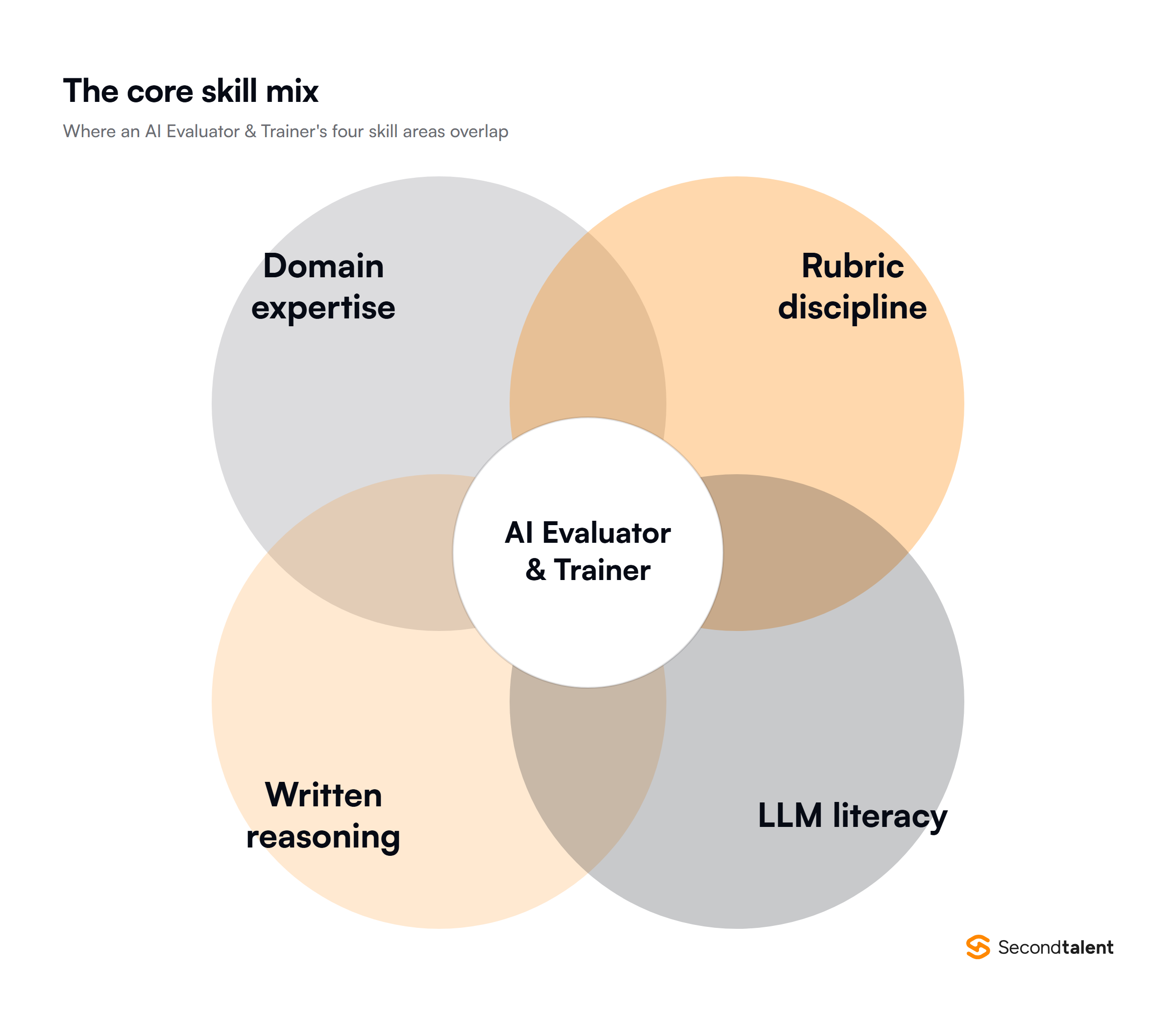
Clear, evidence-based writing is the non-negotiable skill: a rating without a specific, defensible reason attached teaches the model nothing useful.
Domain specialists (law, medicine, advanced mathematics, coding) are increasingly hired for this exact reason, since generalist raters can’t reliably judge whether a model’s calculus or case-law citation is actually correct.
AI Evaluator & Trainer Job Market and Career Opportunities
Demand for human AI evaluators and trainers is growing 25% to 35% annually, according to Mercor’s 2026 research on emerging AI job opportunities — work that a general AI Engineer or Machine Learning Engineer title does not fully cover, since it requires dedicated time judging output rather than building systems.
Model labs, applied AI startups, and increasingly enterprises running their own fine-tuning pipelines all compete for this talent, and domain-specialist evaluators (law, medicine, science, advanced coding) are in the tightest supply because generalist raters cannot reliably judge specialist correctness.
Average Pay Ranges (2026, US-anchored rates):
- General RLHF annotator / evaluator (hourly, contract): $35 – $95/hr
- Specialized domain trainer (coding, math, science): $40 – $80/hr, or $80,000 – $120,000 full-time
- Senior RLHF specialist at a major model lab (full-time, with benefits): $120,000 – $180,000+
Full-time roles at model labs and large tech companies pay well above the contract midpoint, especially for trainers with deep domain expertise.
Hiring across Asia gives access to strong domain specialists, particularly in coding and STEM fields, at a meaningful discount to US-anchored rates.
Essential AI Evaluator & Trainer Skills and Qualifications
Evaluation Skills:
- RLHF and preference ranking: judging helpfulness, honesty, and harmlessness across candidate responses
- Prompt-response evaluation and factuality review
- Following complex, multi-step evaluation protocols without drift or shortcut-taking
- Writing prompt-response pairs that demonstrate the target behavior, not just labeling existing ones
Judgment and Attention to Detail:
- Catching subtle factual errors, incomplete citations, and inconsistencies between an instruction and its output
- Domain expertise (law, medicine, mathematics, or a specific programming language) for specialist evaluation work
- Consistency: applying the same rubric the same way across hundreds of judgments
Communication Skills:
- Clear, evidence-based writing: explaining why one response beats another with specific reasoning, not a gut-feel score
- Comfort giving structured, critical feedback repeatedly without softening it
Technical Familiarity: A functional understanding of prompt engineering and how LLMs generate text is expected; deep ML research background is not, unless the role is specifically evaluation-harness design.
AI Evaluator & Trainer Career Paths and Specializations
Career Progression:
- Generalist RLHF Annotator → Domain-Specialist Trainer → Senior Evaluator / Rubric Designer → Evaluation Lead or Eval-Harness Engineer → Head of Model Quality or AI Training Operations
Specialization Areas:
- Coding Evaluation: Judging code correctness, style, and security across languages
- STEM and Mathematics: Verifying rigorous, step-by-step reasoning in technical domains
- Legal and Medical: High-stakes domains where an incorrect citation or claim carries real consequences
- Safety and Red-Teaming: Probing for harmful, biased, or unsafe outputs specifically
- Eval-Harness Design: Building the golden datasets and automated rubrics other evaluators work from
The path from hands-on rater to eval-harness designer is one of the more accessible routes into a more technical AI role without a traditional engineering background.
AI Evaluator & Trainer Tools and Platforms
Rating and Labeling Platforms:
- RLHF and preference-ranking interfaces used by model labs and their vendors
- Prompt-response comparison and side-by-side rating tools
- Rubric and style-guide documentation for consistent scoring
Evaluation Infrastructure:
- Golden datasets and regression test suites
- LLM-as-judge harnesses, used alongside human review rather than instead of it
- Dataset and prompt versioning tools
Domain Tooling:
- Code execution sandboxes, for verifying coding-evaluation judgments
- Citation and reference-checking tools, for legal and medical domains
- Calculators and symbolic-math checkers, for STEM evaluation
Building Your AI Evaluator & Trainer Portfolio
Portfolio Components:
- A Rubric You’ve Written: A scoring guide for evaluating a specific kind of model output, with clear pass/fail criteria
- Sample Judgments: A handful of before/after examples showing a flawed response, your rating, and your reasoning
- A Domain Credential: Relevant certification or demonstrated expertise (a coding portfolio, a legal or medical background) if pursuing specialist evaluation work
- A Consistency Check: Evidence you can apply the same rubric the same way across a large batch of judgments
Hiring managers weight domain credibility heavily for specialist roles: a generalist rater who has never written production code cannot reliably judge whether a model’s code review is actually correct.
AI Evaluator & Trainer Methodology and Best Practices
Always give a reason, not just a score. A numeric rating with no explanation is close to useless for improving a model; the written reasoning is the actual training signal.
Apply the rubric the same way every time. Inconsistent judgments across similar cases introduce noise the model then learns from just as readily as the signal.
Know the limits of your own expertise. Flag a case for a domain specialist rather than guessing on a legal, medical, or advanced technical judgment call you are not confident in.
Treat evaluation as a moving target. As a model improves, yesterday’s obvious failure modes disappear and new, subtler ones take their place — rubrics need regular review, not a one-time write-up.
Watch for reward hacking. If a model starts producing responses that score well on the rubric but feel wrong in practice, that is a signal the rubric itself needs revisiting, not that the model is done improving.
Future of AI Evaluator & Trainer Careers
This role is growing precisely because model capability keeps outpacing automated evaluation.
LLM-as-judge tooling helps at scale, but it still needs human-graded examples to calibrate against, especially in specialist domains where correctness is not obvious.
Expect continued fragmentation by domain.
Generalist RLHF work is increasingly commoditized, while domain-specialist evaluation (law, medicine, advanced math and science, security) is where wage growth and the most interesting technical work both concentrate.
Expect the eval-harness-design end of this career path to grow fastest.
As companies formalize evaluation the way they formalized QA for traditional software, the people who can build reusable, automatable rubrics will be in the most demand.
Getting Started as an AI Evaluator & Trainer
Practical Steps:
- Practice rating model outputs on a public benchmark or open dataset and writing out your reasoning
- Pick a domain you already have real expertise in (a language, a technical field, coding) rather than starting generalist
- Study a few published model cards or eval reports to see how labs frame “good” versus “bad” output
- Build a small rubric for a specific task and test it for consistency across several examples
- Look for roles at model labs, applied AI startups, and specialist data-and-eval vendors, not just generic “AI trainer” listings
Candidates arriving from a specific domain (law, medicine, engineering) usually need to build familiarity with prompting and LLM behavior; generalist raters usually need to build a specialization to access the higher end of the pay range.
Both routes are common.
If you are hiring rather than applying, Second Talent places AI Evaluators & Trainers and other AI-native talent across Asia, with vetting, compliance, and payroll handled for you.
Frequently Asked Questions
What is the difference between an AI Evaluator & Trainer and an AI Training Data Annotator?
An annotator labels raw data before a model is trained on it.
An AI Evaluator & Trainer judges a model’s own output after it generates a response, typically ranking or scoring competing responses and writing the reasoning behind that judgment.
The two roles use different skills day to day, even though both feed a model’s training pipeline.
Do I need a machine learning background to become an AI Evaluator & Trainer?
No. A functional understanding of prompt engineering and how LLMs generate text is expected, but the core skill is judgment: catching errors, applying a rubric consistently, and writing clear, evidence-based reasoning.
Domain expertise in a specific field often matters more than an ML background.
What is RLHF and why does it matter for this role?
RLHF (reinforcement learning from human feedback) is the process of training a model using human-provided rankings of its outputs instead of, or alongside, raw labeled data.
AI Evaluators & Trainers produce those rankings and the reasoning behind them, which is the direct signal RLHF optimizes against.
How much does it cost to hire an AI Evaluator & Trainer through Second Talent?
Cost depends on whether the work is generalist or domain-specialist, and on seniority. Hiring across Asia typically comes in well below US-anchored rates for equivalent expertise, particularly for coding and STEM domain specialists.
Get in touch for a current rate breakdown.
How quickly can Second Talent place an AI Evaluator & Trainer?
We can usually present a shortlist of pre-vetted candidates within days, with placements typically completed in a few weeks depending on your interview process and start-date requirements.
Related Roles
Explore related roles you can hire on Second Talent: AI Training Data Annotator, AI Safety Auditor, AI Alignment Researcher, Synthetic Data Curator, AI Research Scientist, AI Governance Specialist.