Ask a vector search system which suppliers are two steps removed from a sanctioned entity and it will return documents that sound relevant. Ask a knowledge graph and it will return the answer, with the path that produced it. Some questions are about similarity and some are about relationships, and only one of those is a retrieval problem.
A Knowledge Graph Engineer builds the structured layer that makes relationship questions answerable: the ontology that defines what entities exist, the pipelines that extract and resolve them from messy source data, and the graph that connects them. The discipline is decades old and has been pulled sharply back into demand by GraphRAG, where a graph supplies the grounding an AI system reasons over.
What is a Knowledge Graph Engineer?
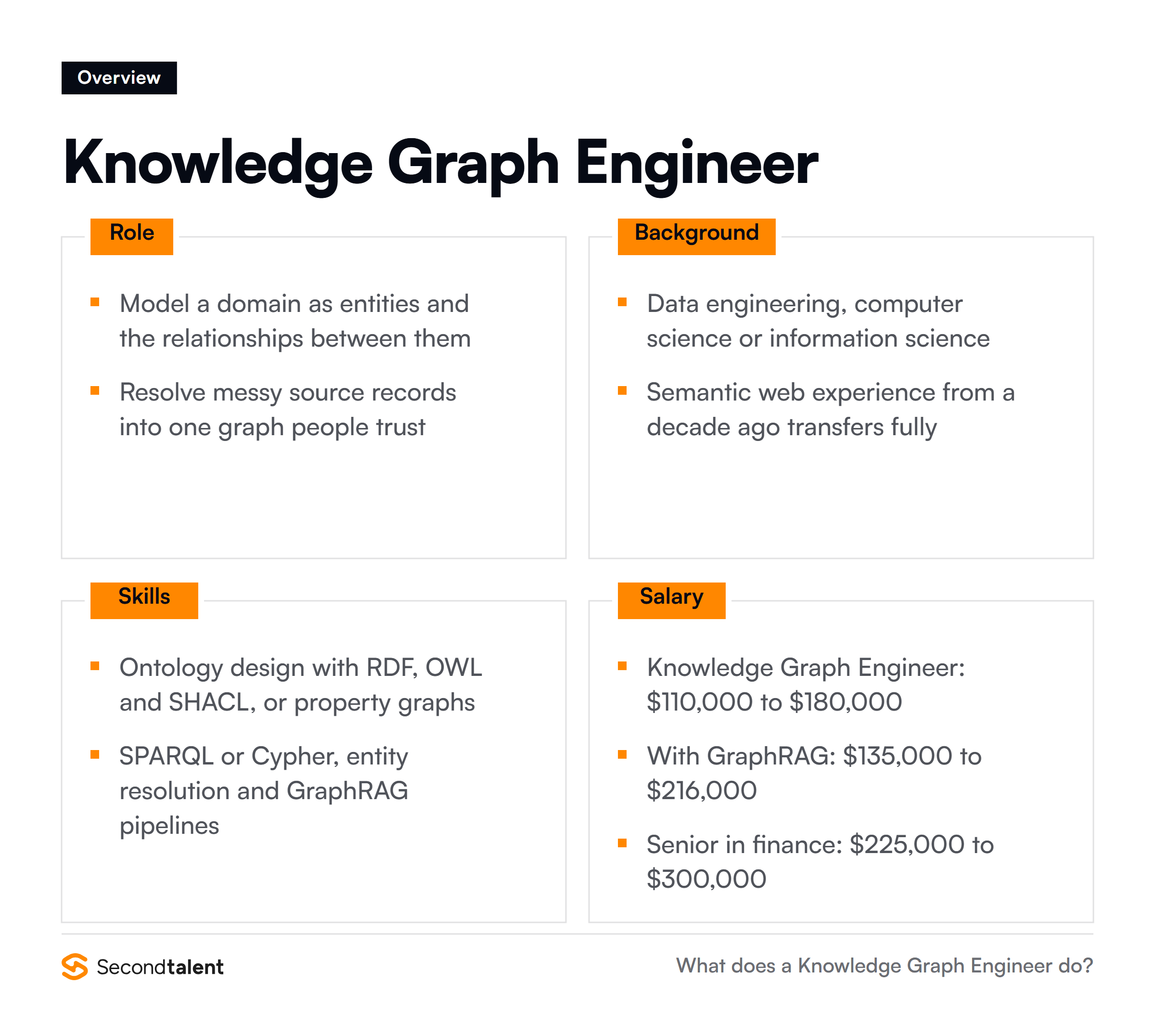
A Knowledge Graph Engineer designs and builds graph representations of an organization’s entities and the relationships between them: customers, products, suppliers, documents, transactions, people, and the connections that matter. The output is a queryable structure that answers questions no document store can, because the answer lives in the connections rather than in any single record.
The work has three layers. Ontology design defines the vocabulary: what an entity is, which relationships are valid, and what rules the graph must never violate. Data engineering populates it: extraction from structured and unstructured sources, entity resolution to decide that two records describe the same real-world thing, and incremental refresh as sources change. Query and serving make it usable, through graph queries, APIs, and increasingly through AI systems that traverse it.
Entity resolution is where most projects live or die. Deciding that “Acme Corp”, “ACME Corporation”, and “Acme Corp.” are one company, while “Acme Holdings” is a different one, is the difference between a graph people trust and one they quietly stop using. It is unglamorous, it is never fully automated, and it consumes more of the schedule than anyone plans for.
GraphRAG is what brought the role back into fashion. By combining a knowledge graph with retrieval, an AI system can follow explicit relationships instead of hoping that semantic similarity happens to surface the right chunk, which measurably improves multi-hop questions. That places this role next to RAG Engineers and Context Engineers rather than off in a corner of the data organization.
Knowledge Graph Engineer Job Market and Career Opportunities
Demand is steady and growing, with knowledge graph engineering reported at roughly 40% growth and repeatedly flagged as important infrastructure for retrieval and AI assistants. Job listings come from a recognizable set of employers: Amazon, Bloomberg, Oracle, Salesforce, Capital One, JPMorgan Chase, Apple, and Netflix all hire for it, which tells you where relationship data carries the most value.
Two categories of employer dominate. The first is organizations whose core problem is inherently a graph: finance and risk, pharmaceutical research, supply chain, fraud, and intelligence. The second is any large enterprise trying to make an AI assistant answer questions across systems that were never designed to talk to each other, where the graph becomes the connective layer.
Average Salary Ranges (US market):
- Knowledge Graph Engineer: $110,000 to $180,000
- Knowledge graph research engineer roles: $99,000 to $225,000
- Senior Data Engineer with GraphRAG experience: $135,000 to $216,000
- Senior knowledge graph roles at financial and quantitative firms: $225,000 to $300,000
The spread reflects sector more than seniority. A knowledge graph role at a quantitative fund is priced against that industry’s engineering bands, while the same skills at a mid-sized enterprise sit in the middle of the range.
Supply is genuinely constrained, because the skill set is unfashionable enough that few people trained into it recently and specialized enough that not everyone can pick it up quickly. Semantic web experience from a decade ago transfers almost completely, which makes experienced candidates from that era unusually valuable. Hiring across Asia reaches strong data engineers who take on graph work well below US bands.
Essential Knowledge Graph Skills and Qualifications
Ontology and Semantic Modeling:
- Ontology design: entity types, relationship types, hierarchies, and constraints that keep a graph coherent as it grows
- RDF, OWL, and SHACL for standards-based modeling and validation
- Property graph modeling as an alternative, and the judgment to pick between the two rather than defaulting
- Reusing established vocabularies where they exist instead of inventing a private schema for a solved problem
Graph Engineering:
- Query languages: SPARQL for RDF stores and Cypher or Gremlin for property graphs
- Graph database operation, including indexing, partitioning, and the performance behavior of deep traversals
- Graph algorithms: shortest path, centrality, community detection, and link prediction
- Scaling strategy, since a traversal that is instant on a million nodes can be unusable on a billion
Data Integration:
- Entity resolution and record linkage, including blocking strategies and human review workflows for ambiguous matches
- Relationship extraction from unstructured text, increasingly using language models with validation on top
- Ingestion pipelines from databases, APIs, and documents, with incremental update rather than full rebuild
- Provenance tracking, so every assertion in the graph can be traced to the source that produced it
AI Integration:
- GraphRAG patterns: using graph traversal to assemble grounded context for a language model
- Combining vector similarity with graph structure, since the two answer different question types
- Text-to-query generation, letting a model translate a natural language question into a graph query
- Graph embeddings, where relationship structure needs to feed a downstream model
Educational Background: Data engineering, computer science, and library or information science backgrounds all appear. Information science training is underrated here, because ontology design is a classification problem before it is an engineering one.
Knowledge Graph Career Paths and Specializations
Career Progression:
- Data Engineer or Backend Engineer → Knowledge Graph Engineer → Senior Knowledge Graph Engineer → Ontology Architect or Graph Platform Lead → Head of Data Architecture
Specialization Areas:
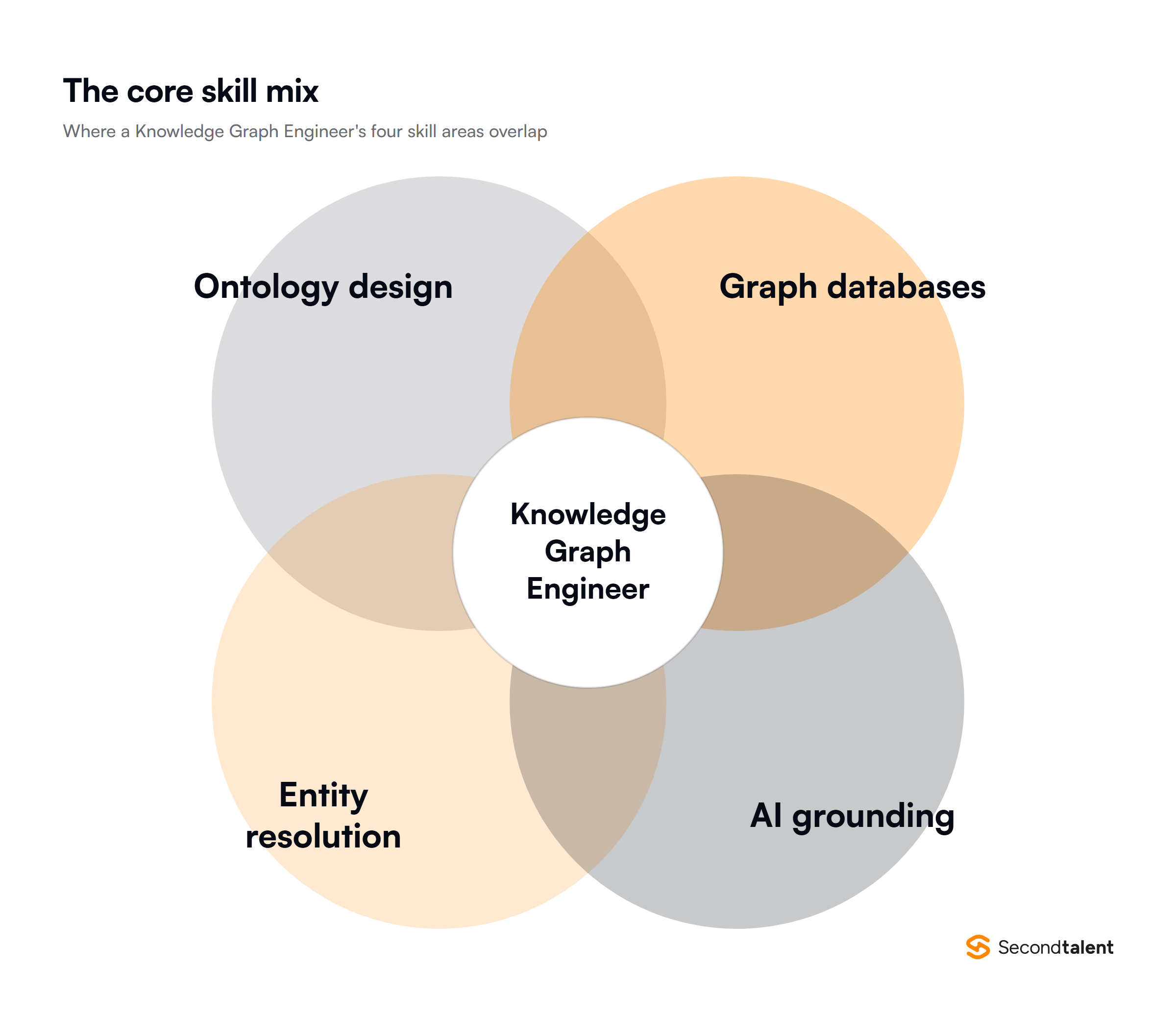
- Ontology Engineering: The modeling discipline itself, often a distinct title in large or regulated organizations
- GraphRAG and AI Grounding: Building the retrieval layer that AI systems traverse, the fastest-growing specialization
- Entity Resolution: Identity and matching at scale, which is its own deep problem in finance and healthcare
- Biomedical and Scientific Graphs: Drug discovery, clinical, and research graphs, where domain knowledge is as important as engineering
- Fraud and Risk Graphs: Networks of accounts, devices, and transactions where the pattern is the signal
The GraphRAG specialization is where new budget is appearing. Teams that built a vector-only retrieval system in 2024 and hit its limits on multi-hop questions are the ones now hiring for graph skills, often without having planned for a graph at all.
Knowledge Graph Tools and Technologies
Graph Databases:
- Neo4j, the most widely deployed property graph database
- GraphDB, Stardog, and Virtuoso for RDF and standards-based work
- Amazon Neptune and other managed graph services
- Apache Jena and RDF4J as framework-level toolkits
- TigerGraph and similar engines where traversal scale is the binding constraint
Modeling and Validation:
- Protege for ontology authoring
- SHACL for shape validation and data quality enforcement
- Reasoners for inferring implied relationships
- Established vocabularies such as schema.org, SKOS, and domain ontologies in life sciences and finance
Pipelines and Extraction:
- Python with graph libraries including NetworkX and RDFLib
- Entity resolution tooling, from open libraries to commercial matching engines
- Language-model-based relationship extraction, with validation against the ontology
- Streaming and batch ingestion frameworks for incremental graph updates
AI Integration:
- GraphRAG implementations, both open-source frameworks and bespoke pipelines
- Vector databases used alongside the graph for hybrid retrieval
- Text-to-SPARQL and text-to-Cypher generation
- Evaluation harnesses that measure multi-hop question accuracy specifically
Building Your Knowledge Graph Portfolio
Portfolio Components:
- A Built Graph: A real domain modeled end to end, from source data through ontology to queryable graph, with the modeling decisions explained
- An Entity Resolution Case: Messy duplicate records resolved, with your matching strategy, precision and recall, and how ambiguous cases were handled
- A GraphRAG Comparison: The same question set answered by vector-only retrieval and by graph-augmented retrieval, with measured differences on multi-hop questions
- An Ontology Writeup: A schema with its constraints, plus an honest account of what you deliberately left out and why
The modeling rationale matters more than the size of the graph. Anyone can load a public dataset into Neo4j. Explaining why an entity boundary sits where it does, and what breaks if it moves, is the evidence of judgment that hiring managers look for.
Knowledge Graph Methodology and Best Practices
Model for the questions, not for completeness. An ontology that tries to represent everything about a domain never ships. Start from the queries the business actually needs answered and model backwards.
Treat entity resolution as a first-class project. It is the largest source of both effort and distrust. Budget for human review of ambiguous matches from the start rather than assuming a threshold will settle it.
Track provenance for every assertion. When someone challenges a relationship in the graph, and they will, the only useful response is showing the source and the extraction that produced it.
Validate continuously with shapes. Constraint checking catches contradictions early. A graph that silently accepts invalid relationships degrades quietly until nobody trusts a query result.
Use the graph for what graphs are good at. Multi-hop relationships, path finding, and structural patterns. Full-text similarity belongs in a search index, and forcing it into the graph produces a slow version of a solved problem.
Plan for incremental refresh. Source data changes constantly. A pipeline that only supports full rebuilds becomes the reason the graph is three weeks stale.
Future of Knowledge Graph Careers
The AI grounding use case has changed this field’s trajectory. Knowledge graphs were an established but narrow specialty until retrieval-augmented systems needed structured, verifiable grounding, and the limits of similarity-only retrieval on multi-hop questions became widely felt. That gave a mature discipline a new and much larger audience.
Expect language models to remove the worst of the manual work. Relationship extraction from unstructured text, once the most tedious part of graph construction, is now substantially automatable with validation on top. That lowers the cost of building a graph and raises the number of organizations for which one is worth having.
Expect hybrid retrieval to become standard architecture. Vector search for similarity, graph traversal for relationships, and a system that routes between them. Engineers who understand both sides are better positioned than specialists in either.
Expect ontology skills to appreciate. As graphs proliferate, the constraint shifts from being able to build one to being able to model a domain so it stays coherent across teams and years, which is a scarcer and more durable skill.
Getting Started as a Knowledge Graph Engineer
Practical Steps:
- Build a graph over a domain you know well, so you can judge whether the model is right rather than only whether it loads
- Learn one query language properly, either SPARQL or Cypher, including how traversal cost behaves as the graph grows
- Do entity resolution on deliberately messy data and measure precision and recall on your matches
- Study ontology design fundamentals, including where established vocabularies already solve your problem
- Build a GraphRAG pipeline and compare it against vector-only retrieval on multi-hop questions
- Read job postings from finance, pharma, and supply chain employers, since that is where the deepest demand sits
Candidates arriving from data engineering usually need to build semantic modeling depth. Candidates arriving from library or information science usually need to build engineering skills around pipelines and scale. Both routes are well represented, and the second is underrated by most hiring teams.
If you are hiring rather than applying, Second Talent places Knowledge Graph Engineers and other AI-native talent across Asia, with vetting, compliance, and payroll handled for you.
Frequently Asked Questions
What is GraphRAG and why does it matter?
GraphRAG combines a knowledge graph with retrieval-augmented generation so an AI system can follow explicit relationships instead of relying only on semantic similarity. It matters most for multi-hop questions, where the answer requires connecting several facts that no single document contains. It also makes the reasoning path auditable, which matters in regulated settings.
What is the difference between a knowledge graph and a vector database?
A vector database finds content that is semantically similar to a query. A knowledge graph stores explicit, typed relationships between entities and lets you traverse them. Similarity questions suit vectors; relationship and path questions suit graphs. Most serious production systems now use both, routing each question to whichever structure can actually answer it.
Do I need semantic web experience to become a Knowledge Graph Engineer?
It helps considerably and transfers almost completely, since RDF, OWL, and SPARQL are still the standards-based backbone of the field. It is not required: many engineers enter through property graphs and Cypher, particularly on the GraphRAG side, and add the semantic web layer later.
How much does it cost to hire a Knowledge Graph Engineer through Second Talent?
Cost depends on seniority and domain, and financial and biomedical graph specialists command more than generalists. Hiring across Asia reaches strong data engineers with graph and ontology capability at rates well below US bands. Get in touch for a current rate breakdown.
How quickly can Second Talent place a Knowledge Graph Engineer?
We can usually present a shortlist of pre-vetted candidates within days, with placements typically completed in a few weeks depending on your interview process and start-date requirements.
Related Roles
Explore related roles you can hire on Second Talent: RAG Engineer, Context Engineer, Data Warehouse Engineer, Data Pipeline Engineer, Natural Language Processing (NLP) Engineer, Database Administrator (DBA).