TL;DR: Singapore full-stack developers earn $9,470 to $17,360+ a month working for international clients on our rate card, the highest of the four markets we compare, and we shortlist 6-8 candidates within 24 hours. The closest US benchmark, the BLS median for software developers, was $135,980 a year in May 2025.
Singpass is Singapore's national digital identity login, and its APIs must be fully compliant with FAPI 2.0 by 31 December 2026. For an existing login app, that means pushed authorization requests on the server and tokens bound to a private key. Ask a full-stack developer from Singapore whether their last product has made the move.
Key takeaways
- Singapore's floor sits $2,470 a month above Vietnam's ceiling on our full-stack cards.
- Singapore's privacy regulator generally bars organisations from collecting NRIC numbers, so a sign-up form that asks for one needs a legal reason.
- A developer on the card's range sits outside the hours and overtime part of the Employment Act, so the contract sets the shift.
- A contractor in Singapore keeps copyright in the code unless a written agreement says otherwise.
What Full-Stack Developers Earn in Singapore Working for International Clients
Singapore's floor of $9,470 is $2,470 above the top of Vietnam's range and nearly double Taiwan's floor. The figures are what developers in each market earn working directly for foreign companies, before any employer or platform costs.
| Market |
Monthly pay working for international clients (USD) |
| Singapore |
$9,470-$17,360+ |
| Malaysia |
$2,090-$5,040+ |
| Vietnam |
$3,000-$7,000+ |
| Taiwan |
$4,750-$6,650+ |
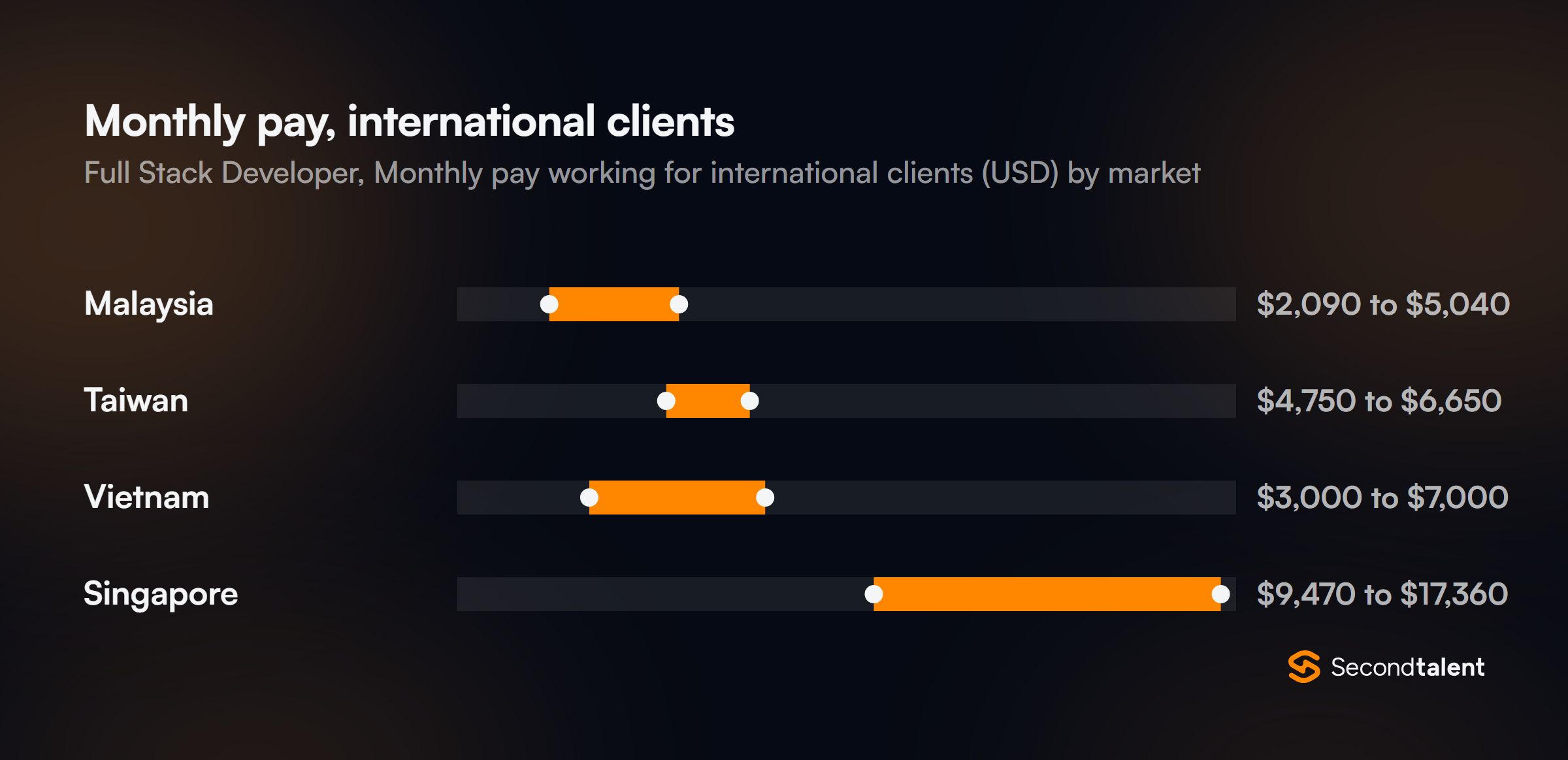
Monthly ranges from the Remote (Working for International Clients) figures on our rate cards for Singapore, Malaysia, Vietnam and Taiwan, converted at ExchangeRate-API mid-market rates for 14 September 2026.
The Singapore card quotes S$12,000 to S$22,000+ a month, converted at S$1.267 to the dollar, with the top left open. The Taiwan card covers senior developers only.
Through Second Talent you pay one monthly fee that bundles salary, payroll taxes, statutory contributions and our service fee, quoted per role and market. Our pricing page explains the monthly subscription, and our full-stack developers page compares the lower-cost markets in Asia.
US Pay Benchmark for Full-Stack Developers
A full-stack developer designs and builds whole applications, so the role maps to Software Developers (SOC 15-1252). Stack Overflow's 2025 survey puts US full-stack median pay at $138,000, close to the BLS figure below. Full-stack is also the most common role among respondents, at 27%.
| BLS OEWS, May 2025, national |
Software Developers (15-1252) |
| Median annual |
$135,980 |
| 10th percentile, monthly |
$6,870 |
| 25th percentile, monthly |
$8,770 |
| Median, monthly |
$11,330 |
| 75th percentile, monthly |
$14,330 |
| 90th percentile, monthly |
$17,890 |
Monthly figures are the annual wages on the OEWS profile for 15-1252 divided by 12, rounded to the nearest $10.
Salary is only part of the US cost. In the BLS Employer Costs for Employee Compensation release for June 2026, wages and salaries made up 68.5% of employer compensation costs for full-time private industry workers, and benefits the other 31.5%.
For a contract build, our full-stack developer cost-to-hire page puts a mid-level US freelancer at $85 to $135 an hour.
Time Zone Overlap: Singapore Against ET, CT and PT
A pull request opened at 6 pm in Singapore reaches New York at 6 am while daylight time lasts. It is waiting for your first review of the day. Singapore keeps UTC+8 all year with no daylight saving, and US daylight time runs from 8 March to 1 November 2026, per NIST.
The arithmetic: 9:00 am EDT (UTC-4) is 13:00 UTC, which is 9:00 pm in Singapore. Under EST (UTC-5) it is 14:00 UTC, or 10:00 pm.
| Singapore shift (UTC+8) |
ET overlap (EDT / EST) |
CT overlap (CDT / CST) |
PT overlap (PDT / PST) |
Hours between 10 pm and 6 am |
| 9 am-6 pm |
0 / 0 |
0 / 0 |
0 / 0 |
0 |
| 3 pm-12 am |
3 / 2 |
2 / 1 |
0 / 0 |
2 |
| 5 pm-2 am |
5 / 4 |
4 / 3 |
2 / 1 |
4 |
| 9 pm-6 am |
8 / 8 |
8 / 7 |
6 / 5 |
8 |
Each shift is nine clock hours with a meal break, counted against a 9 am to 5 pm US day.
The 3 pm row suits a front-end and API split: the developer ships through the Singapore afternoon and joins your New York standup before midnight. The 5 pm row gives an East Coast team five live hours in summer. Only the overnight row serves San Francisco for more than two hours.
Singapore law leaves these hours to the contract at this pay level. Part 4 of the Employment Act covers hours of work, rest days and overtime. The Ministry of Manpower confirms it applies only to workmen earning a basic S$4,500 a month or less and other employees earning S$2,600 or less. We fix the shift before the offer, which is how our placements get 4-6 hours of daily overlap with US hours.
Full-Stack Developer Skills to Screen For
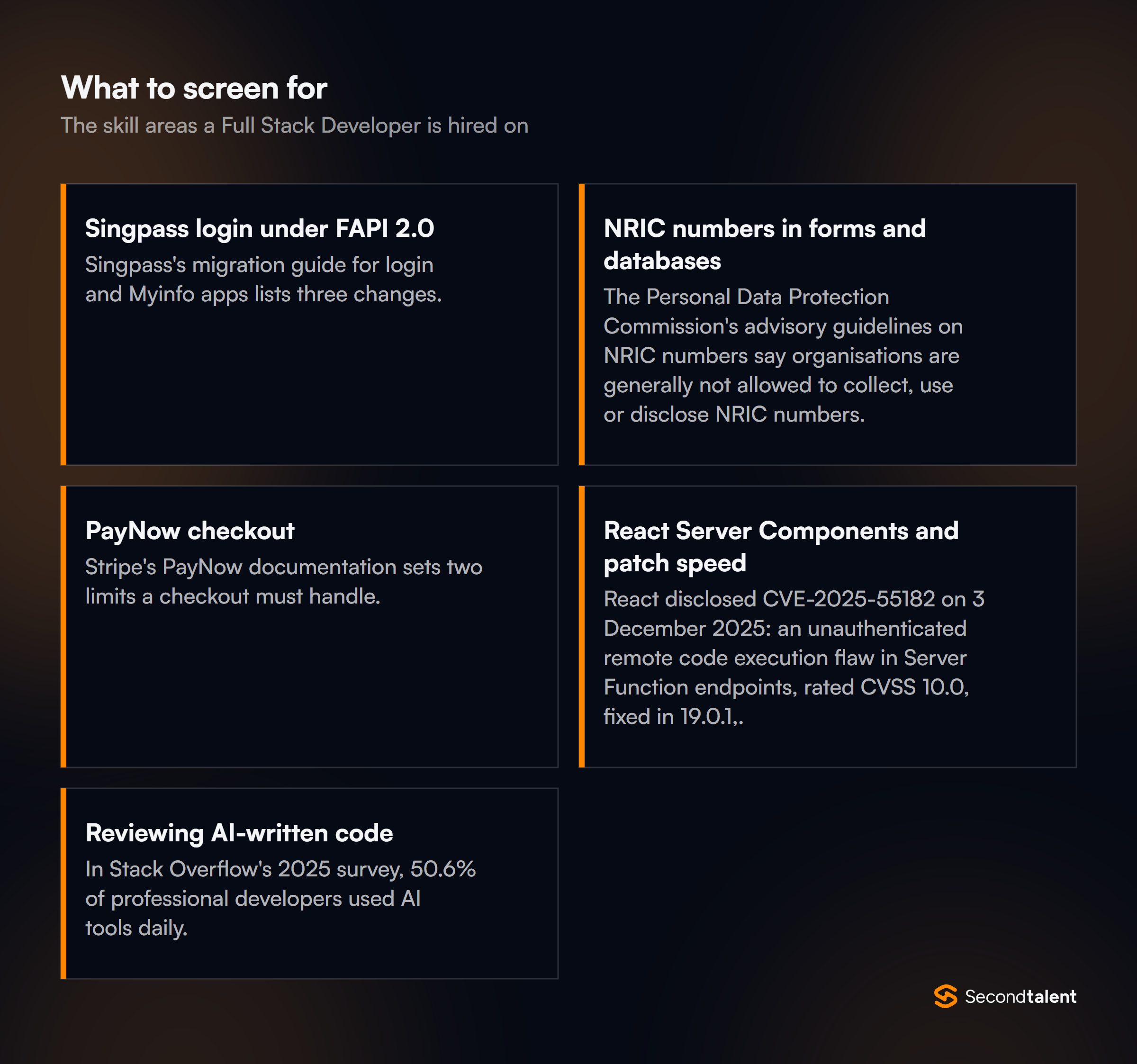
A US team selling into Singapore meets two local integrations early: Singpass for identity and PayNow for payment. Screen for both, then for the patch habits and code review any full-stack hire needs.
Singpass login under FAPI 2.0
Singpass's migration guide for login and Myinfo apps lists three changes. First, implement DPoP, which binds the authorization code and access token to a private key. Then send pushed authorization requests and handle error responses that now redirect back to your app.
During migration, a flow that starts with a pushed authorization request uses the new API. A browser redirect still reaches the old one. That split lets you move users over in stages. Ask the candidate to sketch that rollout, including where the DPoP key lives on the server.
NRIC numbers in forms and databases
The Personal Data Protection Commission's advisory guidelines on NRIC numbers say organisations are generally not allowed to collect, use or disclose NRIC numbers. Copies of the card get the same treatment. So do foreign identification and work permit numbers.
A December 2024 update adds that the PDPC advises against using NRIC numbers to authenticate identity or set default passwords. Hand the candidate a sign-up schema that keys users on NRIC and ask what they would change in the form, the table and the password reset flow.
PayNow checkout
Stripe's PayNow documentation sets two limits a checkout must handle. A QR code expires one hour after Stripe generates it, and later attempts fail with payment_intent_payment_attempt_expired.
You can refund a PayNow payment for up to 90 days. Stripe reports the result later, through a refund.updated or refund.failed webhook. Ask the candidate to build the page a customer returns to after the QR code expires, and the support flow for a refund that fails.
React Server Components and patch speed
React disclosed CVE-2025-55182 on 3 December 2025: an unauthenticated remote code execution flaw in Server Function endpoints, rated CVSS 10.0, fixed in 19.0.1, 19.1.2 and 19.2.1. Ask how long the candidate's last team took to ship the patch, and how they confirmed which deployed services ran an affected version.
Reviewing AI-written code
In Stack Overflow's 2025 survey, 50.6% of professional developers used AI tools daily. Among all respondents, 66% named "AI solutions that are almost right, but not quite" as a frustration.
A full-stack change touches the form, the API and the schema at once, so an almost-right suggestion can pass review in one layer and break another. Give the candidate an AI-generated pull request that validates input in the browser only, and see whether they find the missing server check.
Contractor or Employer of Record in Singapore
Software is not one of the nine categories of commissioned work that can be "work made for hire" under 17 U.S.C. § 101, and a transfer must be in writing and signed under § 204(a).
Singapore's Copyright Act 2021 makes the author the first owner of a work under section 133, subject to a contrary written agreement. Section 134 makes the employer first owner of work an employee creates in the course of a contract of service. A contractor therefore keeps the code, front-end assets and tests unless the agreement assigns them.
As under § 204(a), section 138 makes an assignment valid only in writing, signed by the assignor.
IRS Publication 515 says the place where services are performed determines the source of the income, so a developer working from Singapore earns foreign-source income. A foreign individual gives the payer Form W-8BEN to certify foreign status.
The Ministry of Manpower says there is no single conclusive test to tell a contract of service from a contract for service. Its factors include control over the work and who provides the tools and workplace. It also asks whether the person trades on their own account, sharing in profit or risk of loss. Employers pay CPF contributions for Singapore Citizens and Permanent Residents earning more than $50 a month.
A developer who owns your product surface full time looks like an employee on those factors. Our Employer of Record service employs that developer in Singapore, the Singapore EOR page has the local details and our Singapore payroll guide covers contributions and tax. This is a summary, not legal advice.
|
Independent contractor |
Employer of Record |
| Legal employer |
None; the developer invoices you |
The EOR's Singapore entity |
| US paperwork |
Form W-8BEN from the developer |
Service agreement with the EOR |
| IP |
Written assignment of code, assets and tests (section 133) |
Employer first owner (section 134), passed on through your EOR agreement |
| Local labor law |
MOM contract-of-service factors if you control the work |
Employment Act, with CPF for Citizens and Permanent Residents |
| Pay currency |
Agreed in the contract, often USD |
Singapore dollar payroll run by the EOR |
English Level and Working Norms in Singapore
EF's English Proficiency Index 2025 publishes no Singapore country page, so there is no score to quote. Article 153A of Singapore's Constitution names English as one of four official languages, with Malay, Mandarin and Tamil. Test written English directly with a pull request description and a short design note.
Flexible hours come with a formal process for employees. Since 1 December 2024, the Tripartite Guidelines on Flexible Work Arrangement Requests have asked employers to run a process for formal requests. Those requests can cover flexi-time and staggered hours.
The guidelines document asks for a written decision within two months. An EOR hire who later wants a different shift will use that route.
The Ministry of Manpower's public holiday list has two dates left in 2026. Deepavali falls on Sunday 8 November, with Monday 9 November off for employees whose rest day is Sunday, and Christmas on 25 December. Chinese New Year 2027 falls on 6 and 7 February, a weekend, with 8 February off for those resting on Sunday.
Thanksgiving on 26 November 2026 is a working day in Singapore, so a developer there can run a release while your US team is away.
Full-Stack Developer Hiring Process in Singapore
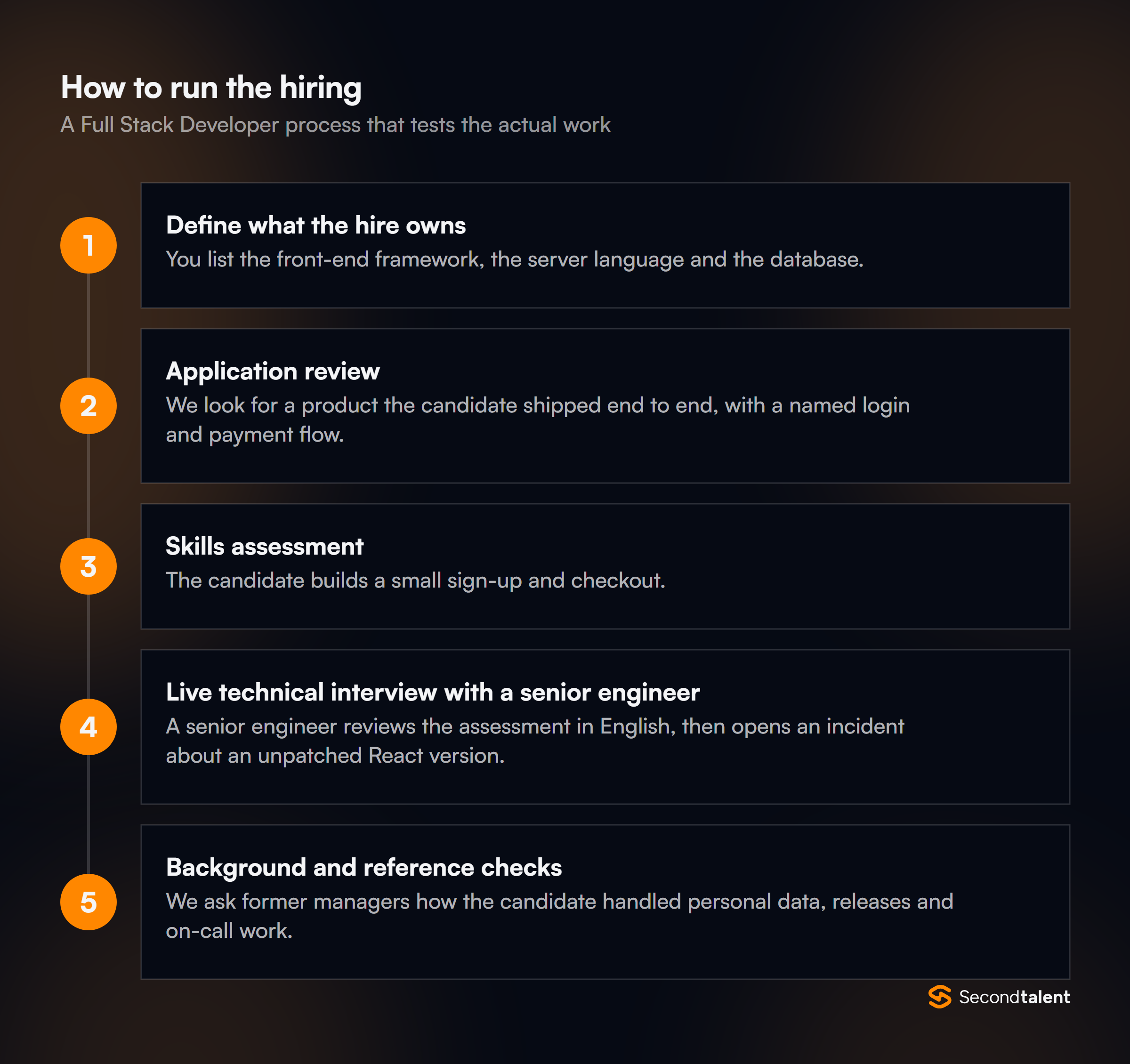
Second Talent's vetting covers stages 2 to 5 before you see a profile.
Stage 1: Define what the hire owns
You list the front-end framework, the server language and the database. Name the local integrations in scope, such as Singpass, Myinfo and PayNow. Add the personal data the app holds and a shift from the table above.
Stage 2: Application review
We look for a product the candidate shipped end to end, with a named login and payment flow. Work for a bank or payments company counts when the candidate can describe the controls they built and who reviewed them.
Stage 3: Skills assessment
The candidate builds a small sign-up and checkout. It needs a login that sends a pushed authorization request, a schema with no NRIC numbers and a payment page that survives an expired QR code. We score the pull request description with the code.
Stage 4: Live technical interview with a senior engineer
A senior engineer reviews the assessment in English, then opens an incident about an unpatched React version. The questions cover the patch timeline, DPoP key storage and a refund that failed after 30 days.
Stage 5: Background and reference checks
We ask former managers how the candidate handled personal data, releases and on-call work. You then choose the contractor or EOR route above and sign the IP assignment.
Hire Full-Stack Developers from Singapore with Second Talent
We shortlist 6-8 candidates within 24 hours from 100,000+ pre-vetted engineers, accepting only the top 1% of applicants. Full-stack developers from Singapore come with $0 upfront, no lock-in and 4-6 hours of daily overlap with US hours. We handle contracts, payroll and equipment, with compliant EOR contracts in Singapore.
Our pricing page sets out the monthly subscription, and for service-heavy products we also staff back-end developers in Singapore.