TL;DR: Singapore game developers earn $11,840 to $22,100+ a month working for international clients on our rate card, the highest of the four markets we compare, and we shortlist 6-8 candidates within 24 hours. The closest US benchmark, the BLS median for software developers, was $135,980 a year in May 2025.
Garena's Free Fire drew more than 100 million average daily active users in the second quarter of 2026, per Sea Limited's results. Garena belongs to Sea, founded in Singapore in 2009. Ask a Singapore candidate from a live game that size for one event they owned from build to player.
Key takeaways
- Singapore's floor sits $1,640 a month above Hong Kong's on our game developer cards.
- Unity Pro becomes mandatory above $200,000 in annual revenue and funding, while Unreal Engine charges 5% after the first $1,000,000 per product.
- Since 31 August 2026, Google Play accepts new games and updates only if they target Android 16.
- A contractor in Singapore keeps copyright in code, shaders and tools unless a signed written agreement assigns it.
What Game Developers Earn in Singapore Working for International Clients
Singapore tops Hong Kong by $1,640 at the floor and $1,700 at the ceiling, and its floor is about four times Malaysia's. The figures are what developers in each market earn working directly for foreign companies, before any employer or platform costs.
| Market |
Monthly pay working for international clients (USD) |
| Singapore |
$11,840-$22,100+ |
| Hong Kong |
$10,200-$20,400+ |
| Malaysia |
$2,950-$6,140+ |
| Vietnam |
$2,710-$5,800+ |
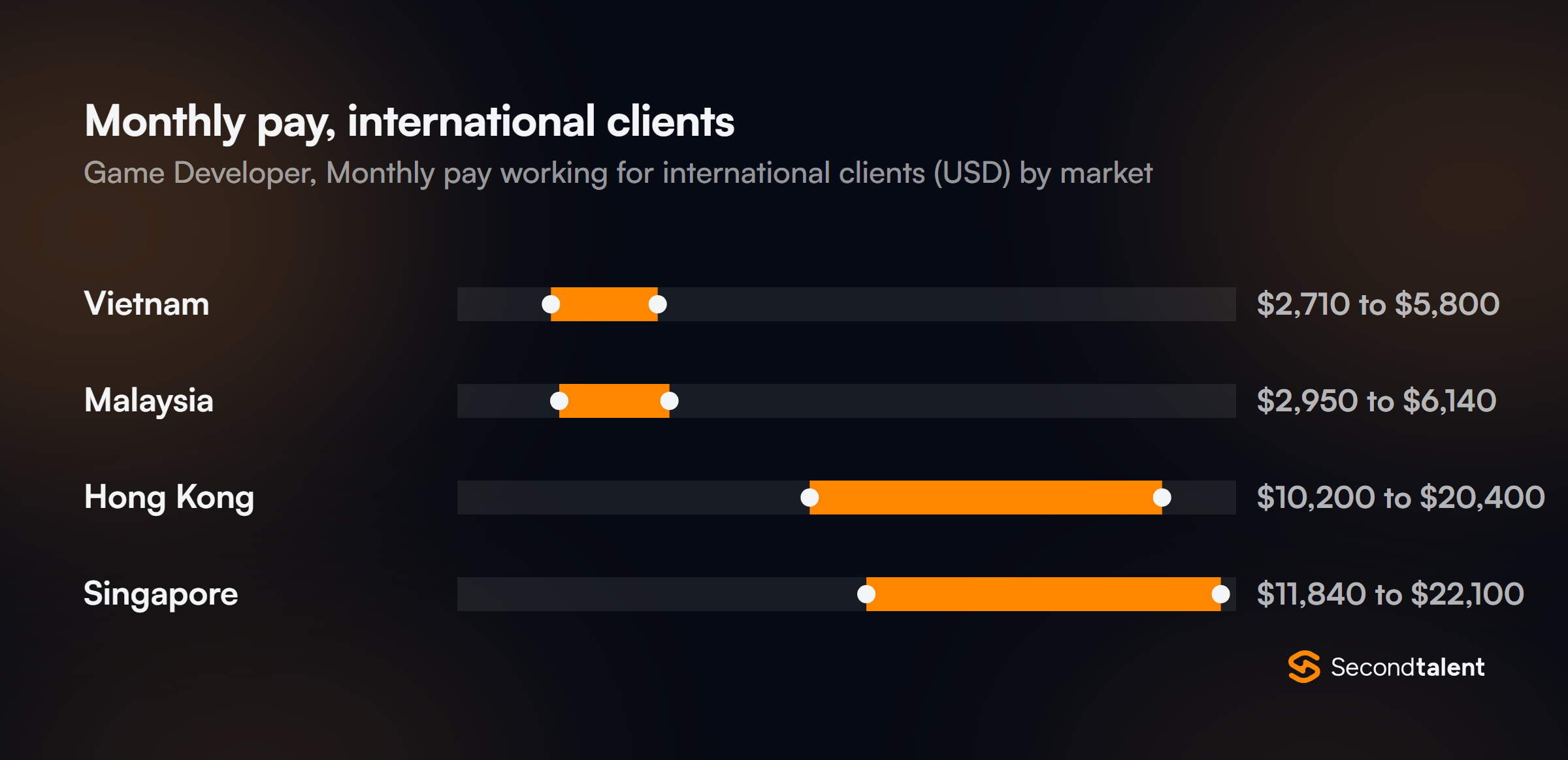
Monthly ranges from the Remote (Working for International Clients) figures on our rate cards for Singapore, Hong Kong, Malaysia and Vietnam, converted at ExchangeRate-API mid-market rates for 14 September 2026.
The Singapore card quotes S$15,000 to S$28,000+ a month, converted at S$1.267 to the dollar. It names Ubisoft, Bandai Namco and Garena as the studios where local salaries run highest.
Through Second Talent you pay one monthly fee that bundles salary, payroll taxes, statutory contributions and our service fee, quoted per role and market. Our pricing page explains the monthly subscription, and our game developers page compares the lower-cost markets in Asia.
US Pay Benchmark for Game Developers
BLS has no game programmer occupation, so the role maps to Software Developers (SOC 15-1252), the occupation that writes the gameplay, engine and backend code a studio ships.
| BLS OEWS, May 2025, national |
Software Developers (15-1252) |
| Median annual |
$135,980 |
| 10th percentile, monthly |
$6,870 |
| 25th percentile, monthly |
$8,770 |
| Median, monthly |
$11,330 |
| 75th percentile, monthly |
$14,330 |
| 90th percentile, monthly |
$17,890 |
Monthly figures are the annual wages on the OEWS profile for 15-1252 divided by 12, rounded to the nearest $10.
Salary is only part of the US cost. In the BLS Employer Costs for Employee Compensation release for June 2026, wages and salaries made up 68.5% of employer compensation costs for full-time private industry workers, and benefits the other 31.5%.
If you need a contractor for one milestone, our game developer cost-to-hire page puts a mid-level US freelancer at $85 to $135 an hour.
Time Zone Overlap: Singapore Against ET, CT and PT
A Singapore developer who starts at 7 am catches the end of a Los Angeles workday. Singapore stays on UTC+8 all year, and US daylight time runs from 8 March to 1 November 2026, per NIST.
The arithmetic: 7:00 am in Singapore is 23:00 UTC the day before. That is 4:00 pm PDT (UTC-7), one hour before a 5 pm finish, and 3:00 pm PST (UTC-8) after 1 November, two hours before it.
| Singapore shift (UTC+8) |
ET overlap (EDT / EST) |
CT overlap (CDT / CST) |
PT overlap (PDT / PST) |
Hours between 10 pm and 6 am |
| 7 am-4 pm |
0 / 0 |
0 / 0 |
1 / 2 |
0 |
| 4 pm-1 am |
4 / 3 |
3 / 2 |
1 / 0 |
3 |
| 6 pm-3 am |
6 / 5 |
5 / 4 |
3 / 2 |
5 |
| 10 pm-7 am |
7 / 8 |
8 / 8 |
7 / 6 |
8 |
Each shift is nine clock hours with a meal break, counted against a 9 am to 5 pm US day.
A live game needs cover for incidents in both time zones. The 7 am row suits a Pacific studio: the developer picks up the crash reports from your afternoon while you are still online. The 4 pm row gives a New York team its whole morning, 9 am to 1 pm, for an event launch.
Keep the shared hours for build reviews and live incidents. We set the shift before the offer, which is how our placements get 4-6 hours of daily overlap with US hours.
Game Developer Skills to Screen For
GDC's 2026 State of the Game Industry survey found 42% of developers using Unreal Engine as their primary engine and 30% using Unity. Screen for depth in your engine, then for the economics of a live game.
Live operations and in-game economies
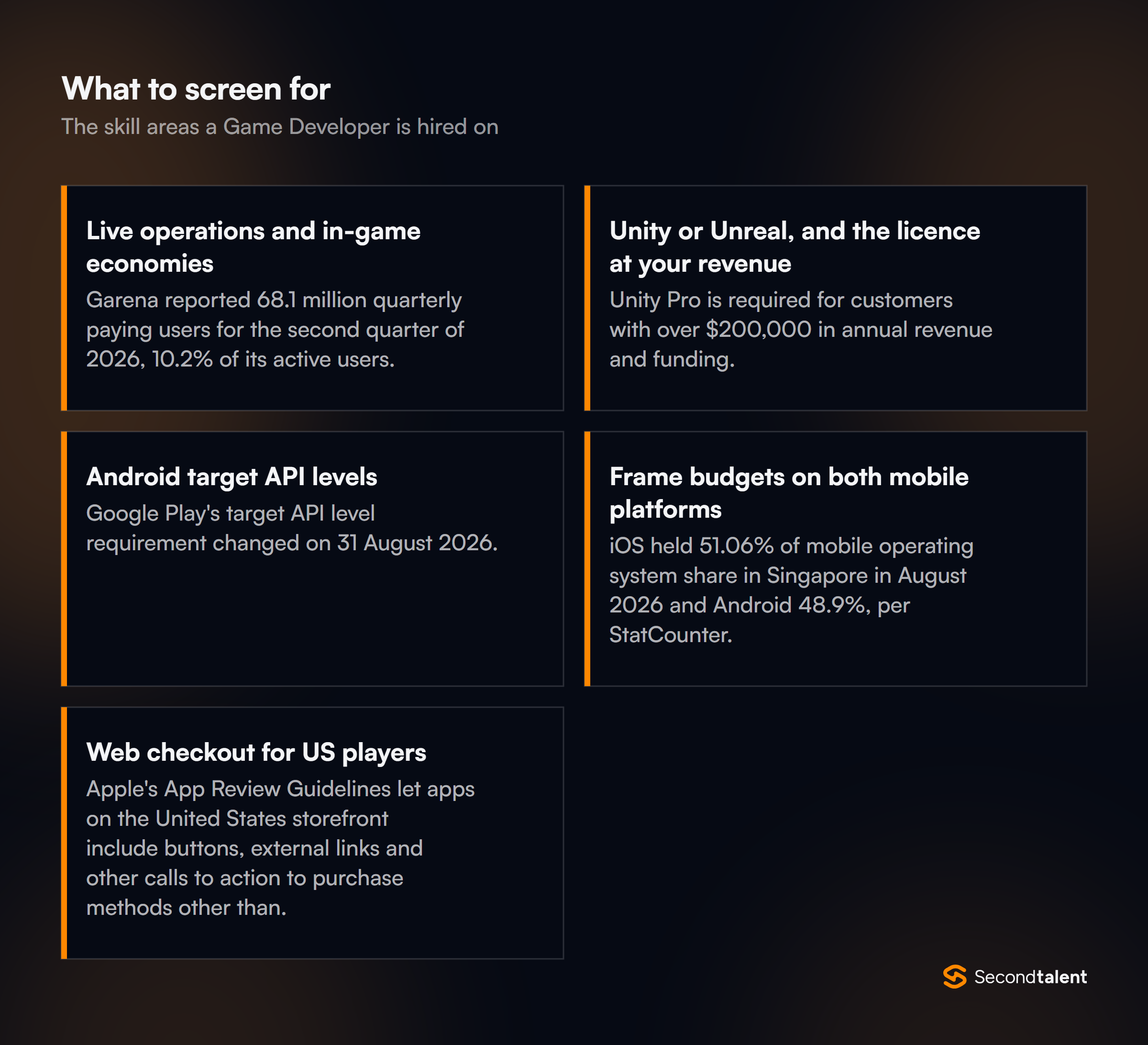
Garena reported 68.1 million quarterly paying users for the second quarter of 2026, 10.2% of its active users. Bookings rose 15.5% to $763.5 million, and average bookings per user reached $1.15.
Ask the candidate how they rolled out a limited-time event behind a server flag. Then ask which metric told them to pull it, and how purchases stayed server-authoritative when a client sent a forged receipt.
Unity or Unreal, and the licence at your revenue
Unity Pro is required for customers with over $200,000 in annual revenue and funding. Unity cancelled its Runtime Fee for games on 12 September 2024.
Epic's Unreal Engine EULA sets a 5% royalty after the first $1,000,000 in lifetime gross revenue per product. The rate drops to 3.5% for a Launch Everywhere with Epic release. Ask which engine the candidate would choose for your next title and what the licence costs at your forecast.
Android target API levels
Google Play's target API level requirement changed on 31 August 2026. New apps and updates must now target Android 16 (API level 36), and existing apps must target Android 15 to stay available to new users on newer devices. Ask for the last target SDK bump the candidate shipped from Unity or Unreal, and which third-party plugin needed an update.
Frame budgets on both mobile platforms
iOS held 51.06% of mobile operating system share in Singapore in August 2026 and Android 48.9%, per StatCounter. A game built for players there has to hold its frame budget on both. Ask for a frame they cut from 33 milliseconds to 16, on which device, and which profiler showed the cost: Unity's Profiler, Unreal Insights or Xcode Instruments.
Web checkout for US players
Apple's App Review Guidelines let apps on the United States storefront include buttons, external links and other calls to action to purchase methods other than in-app purchase. Other storefronts keep the older rules. Ask how the candidate would add a web store for US players while players in Singapore keep in-app purchase.
Contractor or Employer of Record in Singapore
Software is not one of the nine categories of commissioned work that can be "work made for hire" under 17 U.S.C. § 101, and a transfer must be in writing and signed under § 204(a).
Singapore's Copyright Act 2021 points the same way. Section 133 makes the author first owner unless a written agreement says otherwise. Under section 134, the employer owns work made in the course of a contract of service. Section 138 requires an assignment in writing, signed by the assignor. List gameplay code, shaders, editor tools and build scripts in the contractor's assignment.
IRS Publication 515 says the place where services are performed determines the source of the income, so a developer working from Singapore earns foreign-source income. A foreign individual gives the payer Form W-8BEN to certify foreign status.
For the local test, the Ministry of Manpower sees no single conclusive test of employment. It looks at who controls the timing and method of work, who provides the tools, and whether the person carries the profit or loss. Employers pay CPF contributions for Singapore Citizens and Permanent Residents earning more than $50 a month.
A developer who joins your sprint reviews and works your engine and build machines full time looks like an employee on those factors. Our Employer of Record service employs that developer in Singapore, and the Singapore EOR page has the local details. This is a summary, not legal advice.
|
Independent contractor |
Employer of Record |
| Legal employer |
None; the developer invoices you |
The EOR's Singapore entity |
| US paperwork |
Form W-8BEN from the developer |
Service agreement with the EOR |
| IP |
Signed written assignment of code, shaders and tools (sections 133 and 138) |
Employer first owner (section 134), passed on through your EOR agreement |
| Local labor law |
MOM factors if you set hours, tools and methods |
Employment Act, with CPF for Citizens and Permanent Residents |
| Pay currency |
Agreed in the contract, often USD |
Singapore dollar payroll run by the EOR |
English Level and Working Norms in Singapore
Singapore has no page in EF's English Proficiency Index 2025, so no score applies. Its Constitution lists English among four official languages, with Malay, Mandarin and Tamil. Game work puts English in patch notes, bug reports and store copy, so have finalists write a patch note for a balance change.
Crunch is a contract question at this pay level. Part 4 of the Employment Act covers hours, rest days and overtime pay. The Ministry of Manpower says it reaches only workmen on a basic salary of S$4,500 or less and other employees on S$2,600 or less. Write launch-week hours and any time off in lieu into the offer.
The Ministry's public holiday calendar has Deepavali on Sunday 8 November 2026, with the Monday off for employees who rest on Sundays, and Christmas on 25 December. Chinese New Year 2027 lands on 6 and 7 February, with Monday 8 February off for those who rest on Sundays.
Thanksgiving on 26 November 2026 is a working day in Singapore, so a developer there can watch a holiday event go live while your US team is off.
Game Developer Hiring Process in Singapore
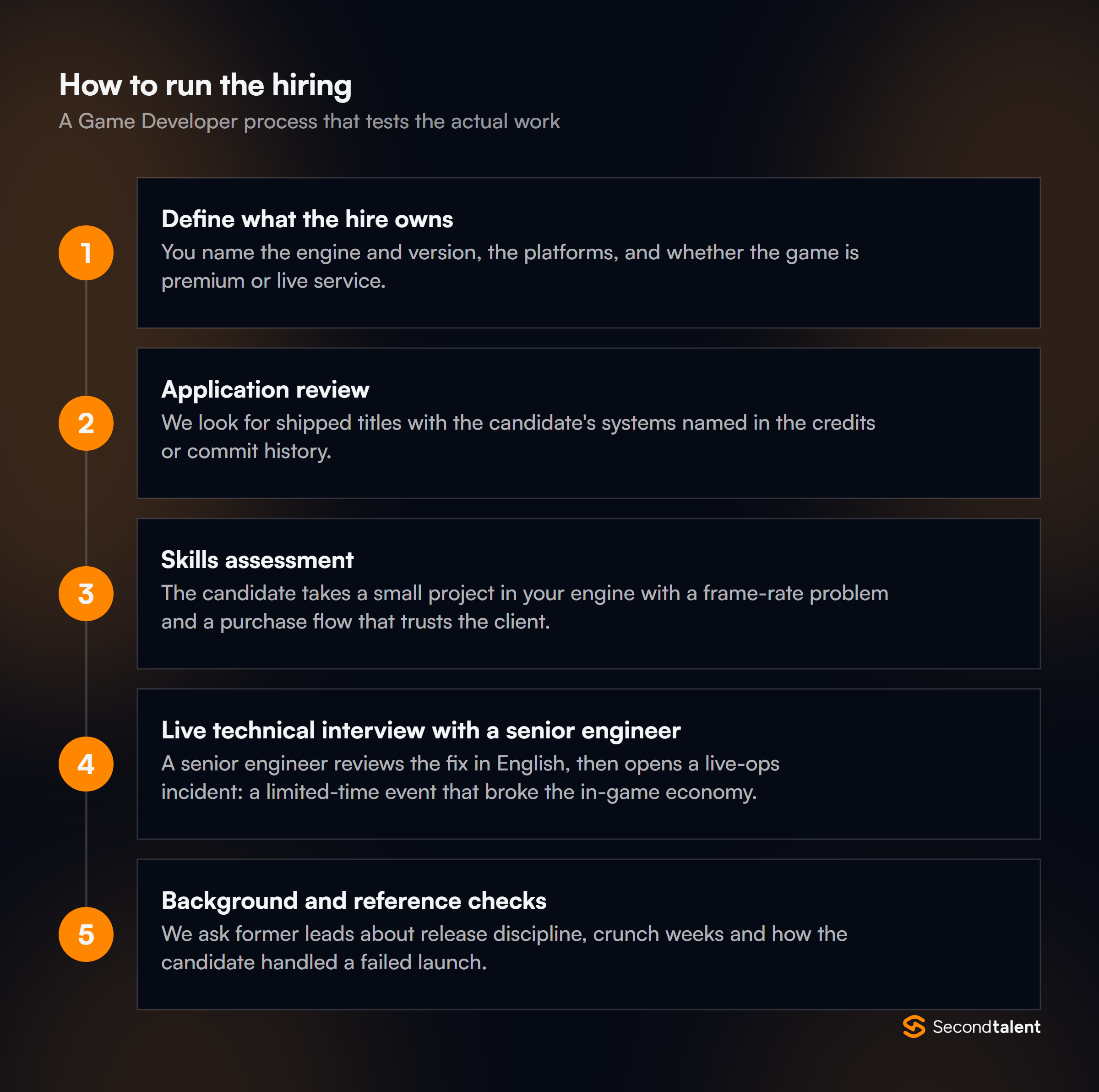
Second Talent's vetting covers stages 2 to 5 before you see a profile.
Stage 1: Define what the hire owns
You name the engine and version, the platforms, and whether the game is premium or live service. Add the systems the hire owns, such as gameplay, netcode, tools or the store, and pick a shift from the table above.
Stage 2: Application review
We look for shipped titles with the candidate's systems named in the credits or commit history. A studio CV that lists AAA credits needs a clear answer on which code they wrote.
Stage 3: Skills assessment
The candidate takes a small project in your engine with a frame-rate problem and a purchase flow that trusts the client. They profile the build, fix both issues and write up what they changed.
Stage 4: Live technical interview with a senior engineer
A senior engineer reviews the fix in English, then opens a live-ops incident: a limited-time event that broke the in-game economy. The questions cover rollback, server flags and the Android target SDK bump.
Stage 5: Background and reference checks
We ask former leads about release discipline, crunch weeks and how the candidate handled a failed launch. You then choose the contractor or EOR route above and sign the IP assignment.
Hire Game Developers from Singapore with Second Talent
We shortlist 6-8 candidates within 24 hours from 100,000+ pre-vetted engineers, accepting only the top 1% of applicants. Game developers from Singapore come with $0 upfront, no lock-in and 4-6 hours of daily overlap with US hours. We handle contracts, payroll and equipment, with compliant EOR contracts in Singapore.
Our pricing page sets out the monthly subscription, and for a native iPhone build we also staff iOS developers in Singapore.