TL;DR: Singapore is the one market in the region where statutory employer cost turns on who you hire, not how much you pay. CPF applies only to Citizens and Permanent Residents, at 17% from the employer and 20% from the employee for staff aged 55 and under.
We employ staff in Singapore through our own entity, so these are the numbers we run every month. This guide covers what you owe, what your employee takes home, and why two identical salaries can cost you S$16,000 a year apart.
Key takeaways
- Statutory employer cost turns on nationality, not salary. About 17% for a Citizen or PR, about 0.14% for a pass holder.
- The CPF Ordinary Wage ceiling rose to S$8,000 on 1 January 2026, the final step of the phased increase.
- CPF rates for staff over 55 rose again in January. Check the age bands on your existing team.
- There is no minimum wage, but the LQS moves to S$1,800 in July and work pass floors bind higher.
- Employment Pass salaries rise to S$6,000 for new applications from January 2027. Reprice before renewal, not at it.
What employing someone in Singapore costs
For a Citizen or PR aged 55 or under, add 17% of wages up to the CPF ceiling, plus the Skills Development Levy. For an Employment Pass holder, add the Skills Development Levy alone.
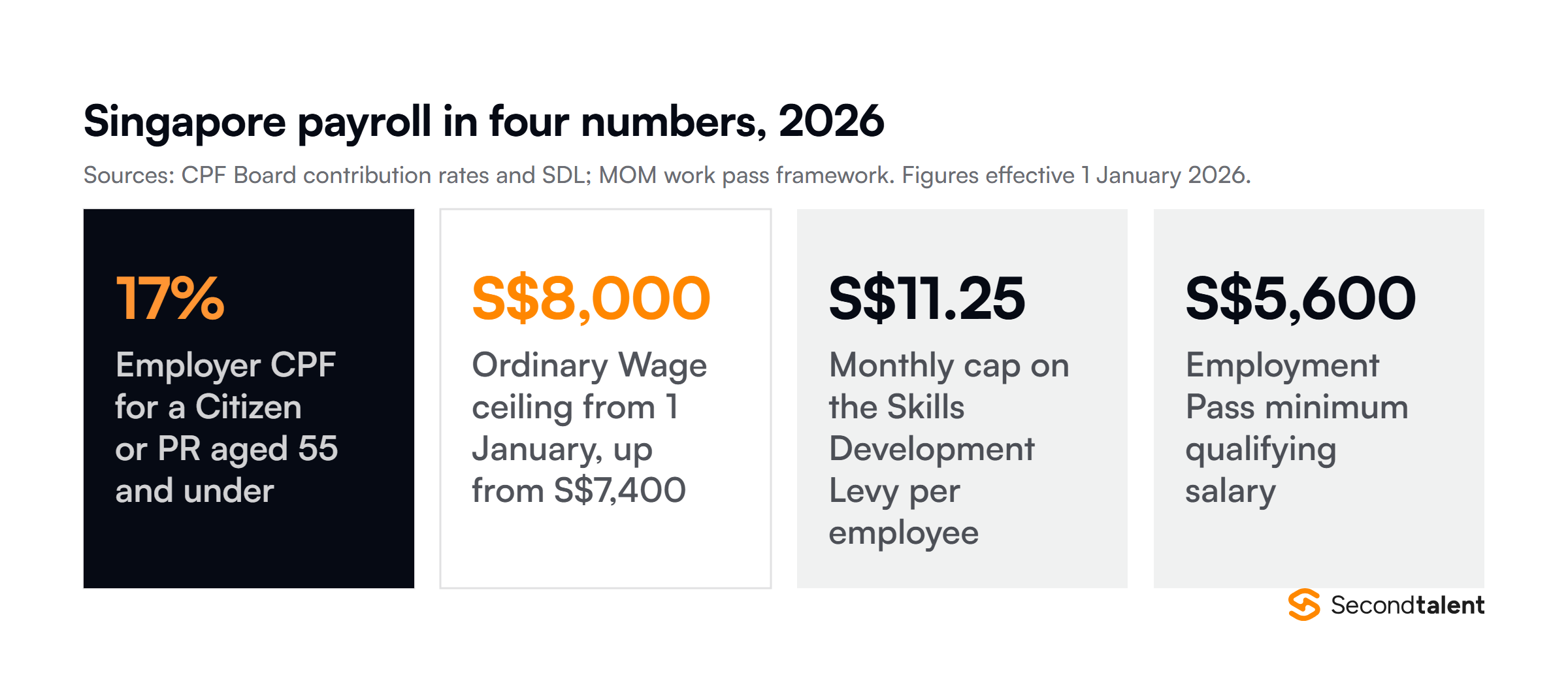
That gap is the single most important fact in Singapore payroll. There is no employer social contribution for work pass holders at all, which makes the headline employer burden either about 17% or a rounding error.
One qualification matters before you generalise from that. S Pass and Work Permit holders attract a monthly Foreign Worker Levy that runs into the hundreds of dollars per worker, varying by pass type, sector and your dependency ratio. Employment Pass holders attract no levy at all, which is why the comparison below uses an EP
CPF applies to Citizens and PRs only
The Central Provident Fund is a mandatory savings scheme for Singapore Citizens and Permanent Residents. Foreign nationals holding an Employment Pass, S Pass or Work Permit are excluded, and employers must not make CPF contributions for them.
Contribution rates step down with age, and two of those bands rose again on 1 January 2026 as part of the plan to lift retirement savings for older workers.
Download this guide as a PDF
The full 2026 Singapore payroll, benefits and tax guide, including CPF rates by age, the income tax schedule, work pass thresholds, leave entitlements and both worked examples, formatted for sharing with your finance team.
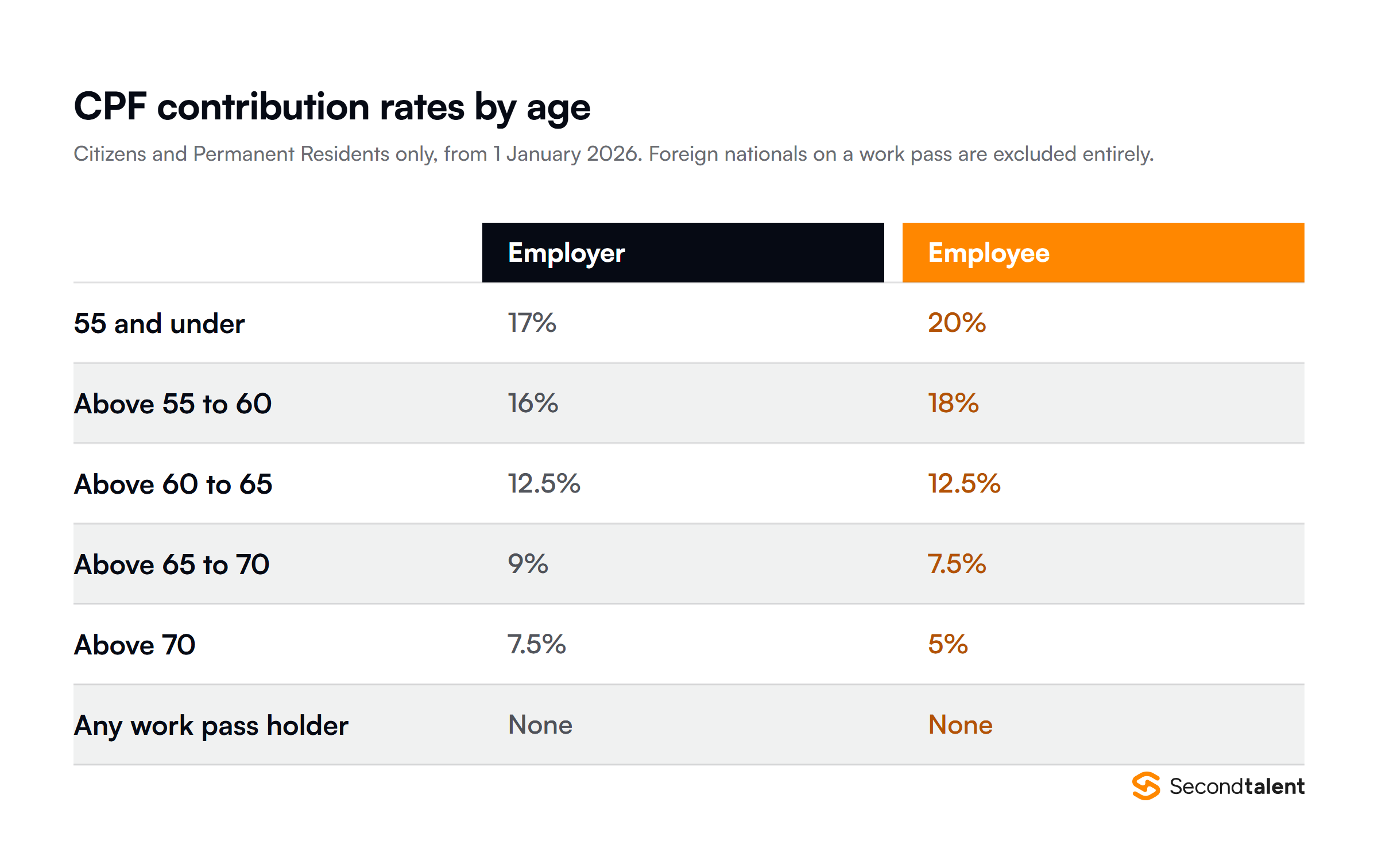
Two ceilings apply. The Ordinary Wage ceiling caps monthly salary subject to CPF at S$8,000 from 1 January 2026, up from S$7,400. The Additional Wage ceiling then caps total annual CPF wages, including bonuses, at S$102,000.
The Skills Development Levy applies to everyone
SDL is 0.25% of monthly wages on the first S$4,500, with a S$2 floor and a S$11.25 ceiling per employee. It applies to local and foreign staff, full-time and part-time. It is small, and it is the one statutory employer cost you owe on an Employment Pass holder.
What a hire actually costs
The same S$8,000 salary, paid to a Citizen and to an Employment Pass holder, produces very different numbers on both sides of the payslip.
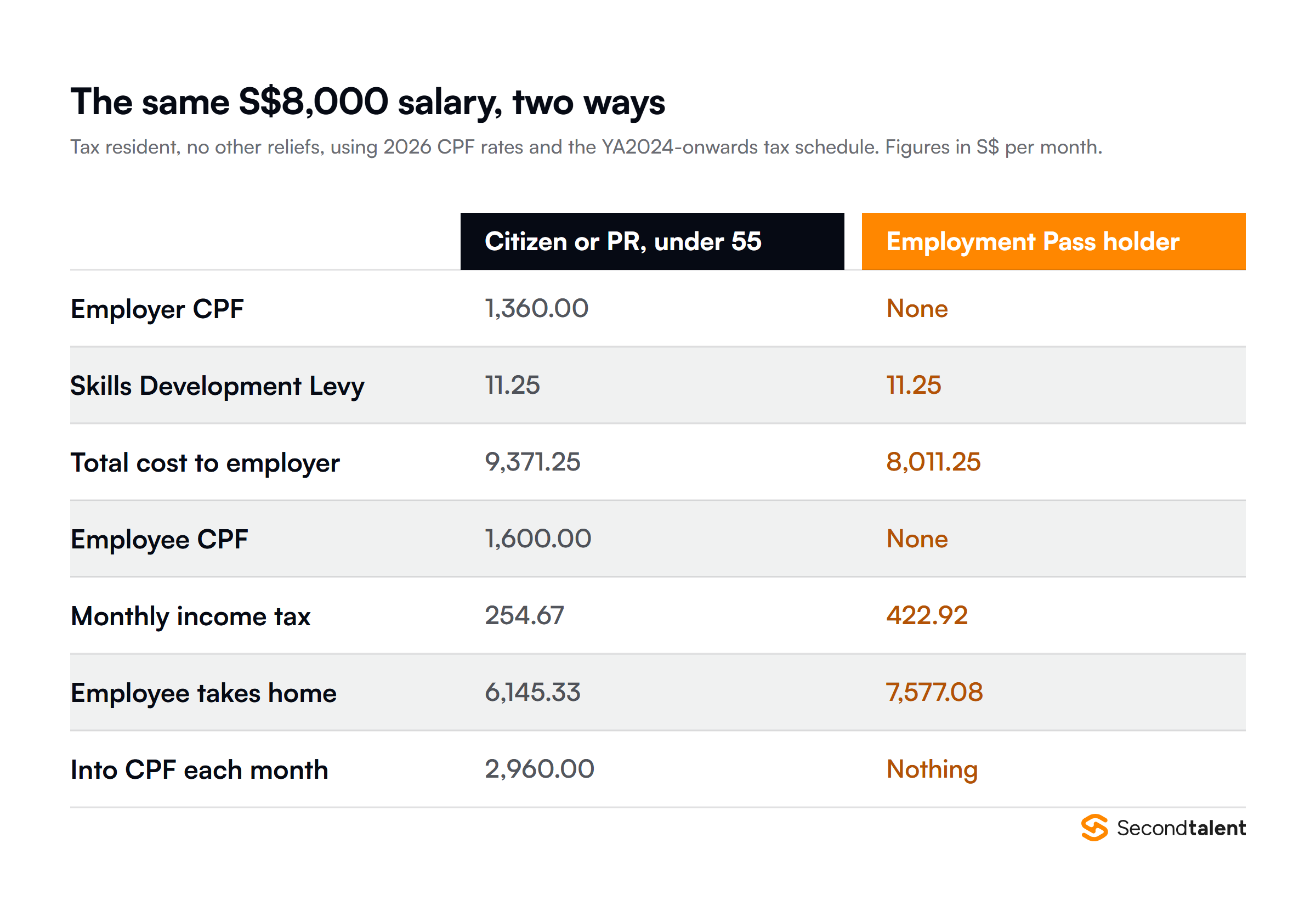
The employer pays S$1,360 a month more for the Citizen, which is S$16,320 a year. The Employment Pass holder takes home about S$1,432 more each month.
Neither is simply better value. The Citizen has S$2,960 a month going into CPF across both sides, which is deferred pay rather than a cost with nothing behind it. The pass holder has more cash and no retirement savings.
Our EOR cost calculator models the full stack, and the Singapore EOR page covers what we handle on your behalf.
Income tax
Residents pay progressive rates from 0% to 24%. There is no monthly withholding for most employees: staff file and pay their own tax annually, which surprises employers arriving from PAYE systems.
| Chargeable income (S$) | Rate on the band |
|---|---|
| 0 to 20,000 | 0% |
| 20,001 to 30,000 | 2% |
| 30,001 to 40,000 | 3.5% |
| 40,001 to 80,000 | 7% |
| 80,001 to 120,000 | 11.5% |
| 120,001 to 160,000 | 15% |
| 160,001 to 200,000 | 18% |
| 200,001 to 320,000 | 19% to 20% |
| 320,001 to 1,000,000 | 22% to 23% |
| Over 1,000,000 | 24% |
Mandatory CPF contributions are not taxable income, so a Citizen’s chargeable income starts materially lower than a pass holder’s on the same salary. That partly offsets the CPF deduction on take-home pay.
One employer obligation does bite. Before a foreign employee leaves Singapore or changes employer, you must file Form IR21 and withhold monies for tax clearance, normally at least one month ahead.
What changed in 2026
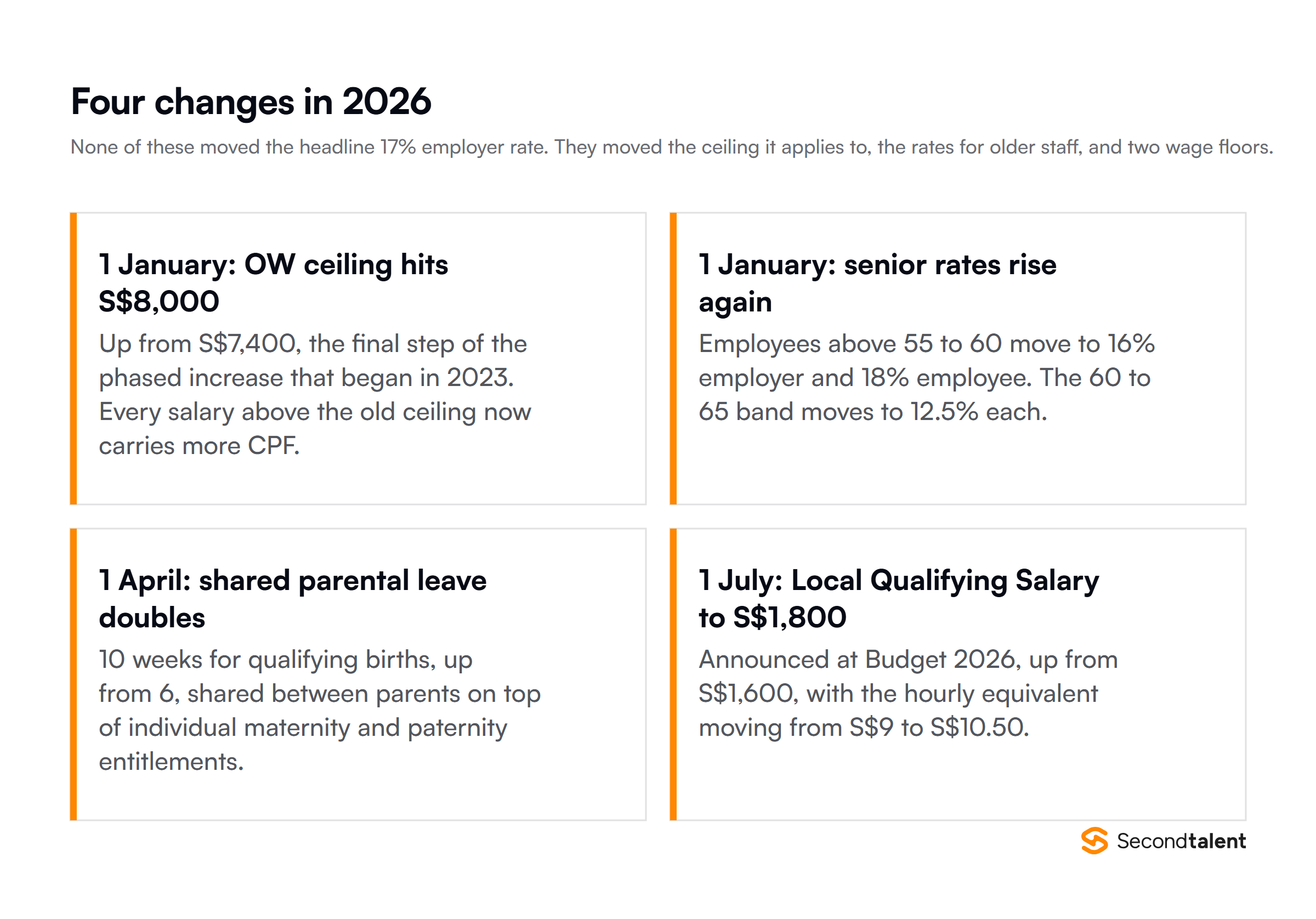
None of these changed the headline 17% employer rate. They moved the ceiling it applies to, the rates for older staff, and two wage floors, so the cost of an existing team went up without any rate rising.
There is no minimum wage, but there are three floors
Singapore has no universal minimum wage. Three separate mechanisms set wage floors instead, and which applies depends on the sector and on whether you employ foreign workers.
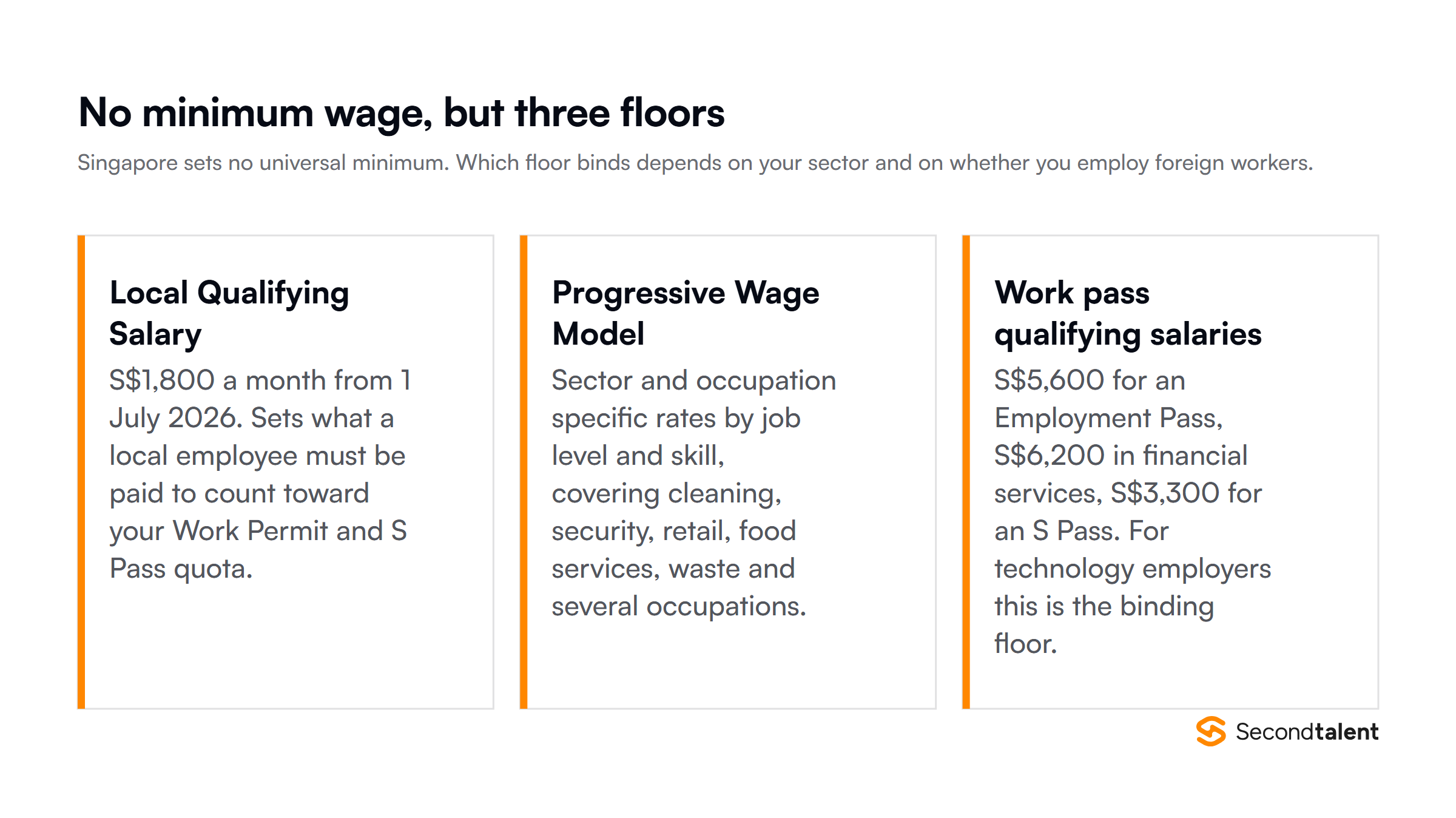
The Local Qualifying Salary rises from S$1,600 to S$1,800 on 1 July 2026, announced at Budget 2026. It matters if you hire foreign workers, because it sets what a local employee must be paid to count toward your Work Permit and S Pass quota.
For most technology employers the binding floor is the work pass salary, not the LQS. An Employment Pass needs at least S$5,600 a month, or S$6,200 in financial services, and older candidates need more.
Work passes and COMPASS
An Employment Pass application clears two gates. It must meet the qualifying salary, then score at least 40 points on the COMPASS framework, which weighs salary, qualifications, workforce diversity and local employment share.
Candidates earning S$22,500 a month or more are exempt from the points assessment. Everyone else is scored, and a company with a thin local hiring base loses points that a strong candidate then has to make up elsewhere.
Budget for the 2027 increase now
Employment Pass qualifying salaries rise to S$6,000, and S$6,600 in financial services, for new applications from 1 January 2027 and for renewals from 1 January 2028. S Pass floors move to S$3,600 and S$4,000. A pass holder sitting just above today’s threshold will fail their renewal unless you reprice the role first.
Leave entitlements
- Annual leave: 7 days after the first year, rising by one day per year of service to 14 days. Many employers offer more to compete.
- Sick leave: 14 days of outpatient leave and up to 60 days of hospitalisation leave, the 60 inclusive of the 14.
- Maternity leave: 16 weeks of Government-Paid Maternity Leave for eligible mothers.
- Paternity leave: 4 weeks, mandatory for eligible fathers of Singaporean children born from 1 April 2025.
- Shared parental leave: 10 weeks for qualifying births from 1 April 2026, up from 6 weeks, shared between parents on top of individual entitlements.
- Public holidays: 11 gazetted days a year.
Government-paid schemes reimburse the employer up to a cap, so the cash cost is lower than the headline weeks suggest. The scheduling cost is not, and the parental leave pool grew materially this April.
Notice, termination and retirement
Notice is whatever the contract says. Where it is silent, the statutory default runs from one day for under 26 weeks of service to four weeks for five years or more, and either side may pay salary in lieu.
There is no statutory severance for dismissal. Retrenchment benefits are a matter of contract or practice, commonly two weeks to one month of salary per year of service, and employers with at least 10 staff must notify MOM of any retrenchment.
The statutory retirement age is 63, and eligible employees have a right to re-employment to 68. Both are on a legislated path upward, so treat them as moving numbers rather than fixed ones.
Benefits beyond the statutory minimum
CPF covers retirement, housing and MediSave, but it is not health insurance in the way candidates expect. Group medical and hospitalisation cover is the standard addition for professional roles.
- Medical insurance for pass holders is mandatory. Employers of Work Permit and S Pass holders must provide medical insurance of at least S$60,000 a year per worker. Employment Pass holders sit outside that rule, so cover for them is a commercial decision.
- Group medical and dental: expected at senior and technical levels, and a common reason offers are declined when it is missing.
- Flexible work arrangements: since December 2024, employers must have a proper process for considering formal requests. The obligation is to consider and respond, not to grant.
- Additional leave: statutory annual leave starts at 7 days, well below what the market offers, so most technology employers pitch 14 to 21 from day one.
Watch the Workplace Fairness Act as it comes into force. It creates statutory protection against discrimination on defined grounds and will require employers to review hiring and grievance processes rather than rely on the tripartite guidelines alone.
Registering as an employer
Singapore is the fastest incorporation in the region, and the employer registrations behind it are light. A private limited company can be registered with ACRA in days.
- ACRA: incorporate, with at least one director ordinarily resident in Singapore.
- CPF Board: register as an employer before the first CPF submission for a Citizen or PR. SDL is collected through the same channel.
- IRAS: register for the Auto-Inclusion Scheme, which is compulsory for employers with 5 or more employees.
- MOM: obtain work pass approvals before any foreign national starts, and check COMPASS before you make the offer.
The resident director requirement is the usual blocker for a first hire. It is also why a Singapore entity is worth opening earlier here than elsewhere in the region, once you are past a couple of employees.
Running payroll each month
- Pay salary within 7 days of the end of the salary period, and overtime within 14 days.
- Submit CPF and SDL through CPF EZPay by the 14th of the following month.
- Issue itemised payslips, which are mandatory, and keep employment records.
- File employee income under the Auto-Inclusion Scheme by 1 March each year.
- File Form IR21 and withhold monies for tax clearance before a foreign employee leaves or changes employer.
If you are choosing a system to run this on, our comparison of payroll software in Singapore covers the local options.
Salary advances and short-term credit
The payment timing above is strict, and that is exactly why the request lands on payroll rather than on a line manager. An employee short of cash between cycles has no informal route in Singapore.
An employer can advance salary. Under the Employment Act the recovery runs in instalments over no more than 12 months, with each instalment capped at 25% of the salary for that period. Document both the advance and the schedule before the money moves, because an undocumented advance is difficult to recover cleanly at termination.
Where the employer declines, employees go to licensed moneylenders, and the terms there are capped by law rather than by the lender. A Singapore payday loan from a licensed lender is limited to 4% interest a month, an administrative fee of up to 10% of the principal, and a late fee of up to S$60 a month.
Two further caps are worth knowing. Total charges on a loan cannot exceed the principal, and unsecured borrowing across all licensed moneylenders combined is capped at six times monthly income for anyone earning S$20,000 a year or more, or S$3,000 below that.
Frequently asked questions
What is the total employer cost of hiring in Singapore?
About 17% on top of gross salary for a Citizen or PR aged 55 or under, capped at S$8,000 of monthly wages, plus the Skills Development Levy. For an Employment Pass holder it is the levy alone, capped at S$11.25 a month.
Do foreigners pay CPF in Singapore?
No. CPF applies only to Singapore Citizens and Permanent Residents. Employers must not contribute CPF for Employment Pass, S Pass or Work Permit holders, which is the opposite of the position in Malaysia and Vietnam.
What is the CPF salary ceiling in 2026?
The Ordinary Wage ceiling is S$8,000 a month from 1 January 2026, the final step of the phased increase that began in 2023. The Additional Wage ceiling caps total annual CPF wages, including bonuses, at S$102,000.
Does Singapore have a minimum wage?
No universal one. The Local Qualifying Salary rises to S$1,800 a month on 1 July 2026 for firms employing foreign workers, sectoral Progressive Wage Model rates set floors by job level, and work pass qualifying salaries set the effective floor for foreign hires.
Can I pay a Singapore employee without a local entity?
Not directly. CPF registration, SDL and the Auto-Inclusion Scheme all require a registered local employer, and only a Singapore entity can sponsor a work pass. An employer of record in Singapore holds the contract on its own entity and handles the filings.
Our EOR versus entity calculator models the crossover, the Singapore EOR provider comparison covers the local market, and this Singapore and Malaysia expansion case study shows how it runs in practice.
Hiring in Singapore?
Second Talent employs staff in Singapore on our own entity and handles contracts, CPF, SDL, payslips and tax clearance, so the rules above become our problem rather than yours. We also source the candidates. Tell us the role and we will come back with candidates and a full employment cost.
This guide is general information, current as at the date of publication, and is not tax or legal advice. CPF ceilings, work pass thresholds and wage floors are all on legislated upward paths. Confirm your position with a qualified adviser before acting.


![How to Hire Developers in Asia Remotely. How to Hire Developers in Asia Remotely from the USA [2026], by Second Talent.](https://www.secondtalent.com/wp-content/uploads/2026/09/hire-developers-in-asia-remotely-featured-v2-768x403.jpg)
![Workplace Diversity Statistics. Top 100+ Workplace Diversity Statistics [2026], by Second Talent.](https://www.secondtalent.com/wp-content/uploads/2026/09/workplace-diversity-statistics-featured-v2-768x403.jpg)