TL;DR: An Australian company with no Philippine entity can hire through an employer of record, which employs the developer locally for US$459 to US$699 a month on top of salary. Plan on four to seven weeks from brief to start date, mostly because a Philippine employee owes their current employer one month's notice. Australian super does not apply to work done in the Philippines.
Under the Philippine Intellectual Property Code, code that a freelancer writes for you belongs to the freelancer unless a written contract says otherwise.
So the cheapest way to start, a contractor paid by invoice, is also the one that leaves your codebase's copyright with someone else by default.
- 1If you direct a contractor's hours and methods, a Philippine labour tribunal can treat them as your employee, whatever the contract is called.
- 2Probation lasts at most six months. Keep a developer on past it and they are a regular employee by law.
- 3Perth shares Manila's clock all year. A Sydney summer workday starts at 6am in Manila.
- 4The 2026 Philippine calendar has 18 holidays and special days before the two Eid holidays are added.
Four Ways to Hire a Developer in the Philippines
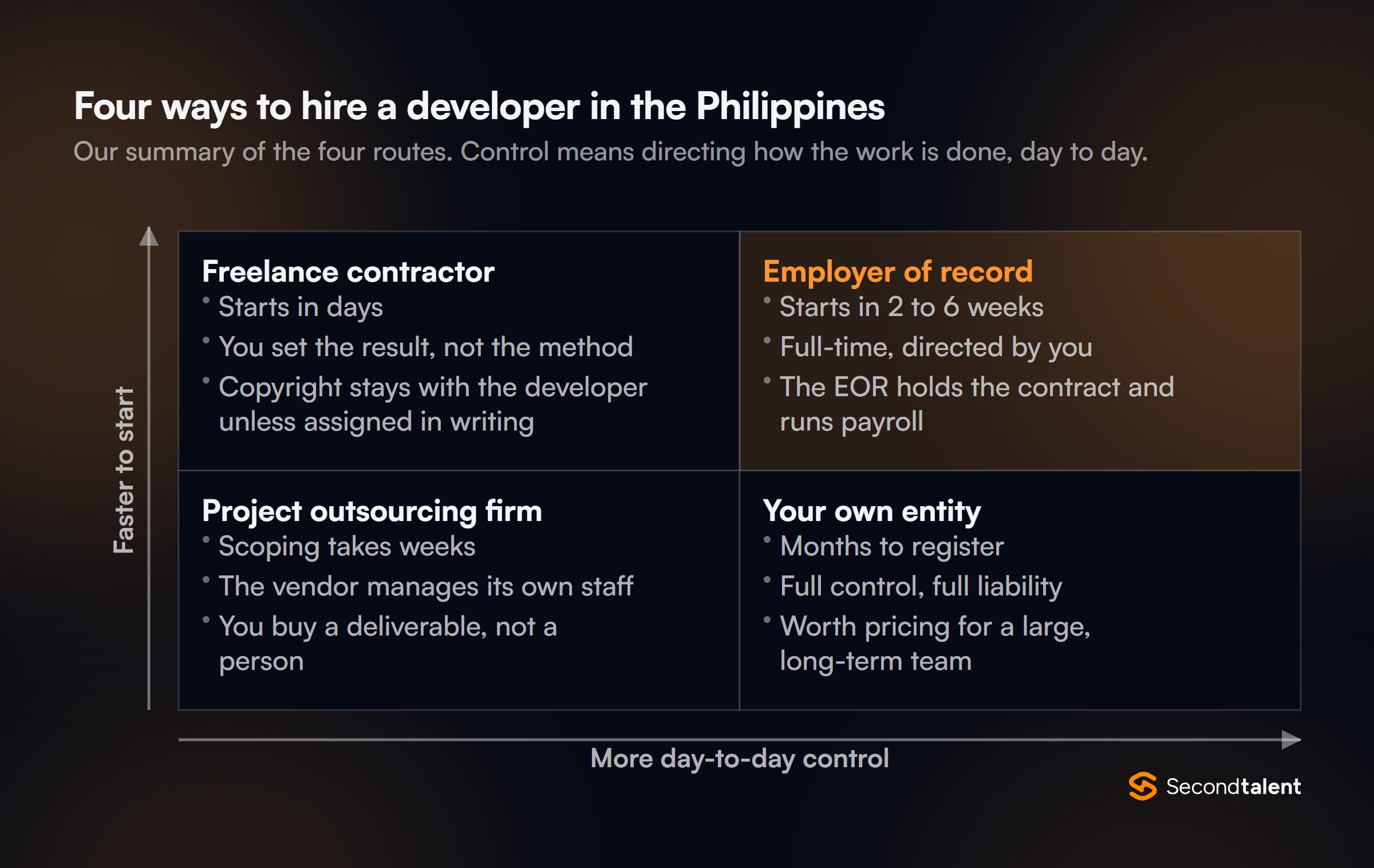
An Australian company with no Philippine entity has four routes. They differ on who employs the developer, how closely you can direct the work, and who answers to the Philippine labour department if something goes wrong.
| Route | Legal employer | Cost on top of pay | Labour law risk sits with |
|---|---|---|---|
| Freelance contractor | Nobody, it is a services contract | Payment fees only | You, if a tribunal finds the contractor is an employee |
| Employer of record | The EOR's Philippine company | US$459 to US$699 a month, plus statutory costs | The EOR |
| Project outsourcing firm | The vendor | The vendor's margin, inside its rate | The vendor |
| Your own entity | Your Philippine subsidiary | Registration, accounting, payroll staff | You |
For a first one to five developers, we recommend an employer of record. It is the only route that gives you a full-time developer you manage like your own staff, without owning the employment risk.
The other three make sense in narrower cases, covered at the end of this guide.
Hiring a Freelance Contractor
A contractor is the fastest start. You agree a rate, the developer invoices you, and you pay in Australian or US dollars.
There is no payroll to run, and no 13th-month pay or social insurance to fund, because the contractor registers with the Bureau of Internal Revenue and pays their own tax.
Super is not owed either. The ATO says an employer does not have to pay the super guarantee for a foreign resident paid for work done outside Australia. A contractor is outside the super guarantee in most cases anyway.
The risk is the label. Philippine courts decide whether someone is an employee with a four-fold test: who hired them, who pays them, who can dismiss them, and who controls the work. Control carries the most weight.
In Royale Homes v. Alcantara (2014), the Supreme Court drew the line at whether the company dictated "the means and methods" of the work or only the result.
- Paid per milestone or invoice
- Sets their own hours and tools
- Free to take other clients
- Paid a fixed monthly amount
- Joins your stand-ups at set hours
- Works only for you, on your tickets, for years
A developer in the right-hand column who is later dismissed can claim the rights of a regular employee, including back pay and the 13th month.
That is a dispute in a Philippine forum, under Philippine law, against a company with no local presence.
The IP point needs a clause, not a judgement call.
Section 178.4 of the Intellectual Property Code gives you ownership of a commissioned work, but "the copyright thereto shall remain with the creator, unless there is a written stipulation to the contrary".
Every contractor agreement needs an assignment of copyright in the code, signed before the first commit.
Hiring Through an Employer of Record
An employer of record is a Philippine company that signs the employment contract, registers the developer with SSS, PhilHealth and Pag-IBIG, runs payroll and files the tax.
You choose the developer, set the work and the hours, and pay one monthly invoice.
The invoice has three parts: the salary, the statutory costs the law adds to it, and the provider's fee. List fees run from US$459 to US$699 a month per employee across Multiplier, Deel, Remote and Oyster.
At Deel's US$599, the fee is a third of the total for a mid-career developer.
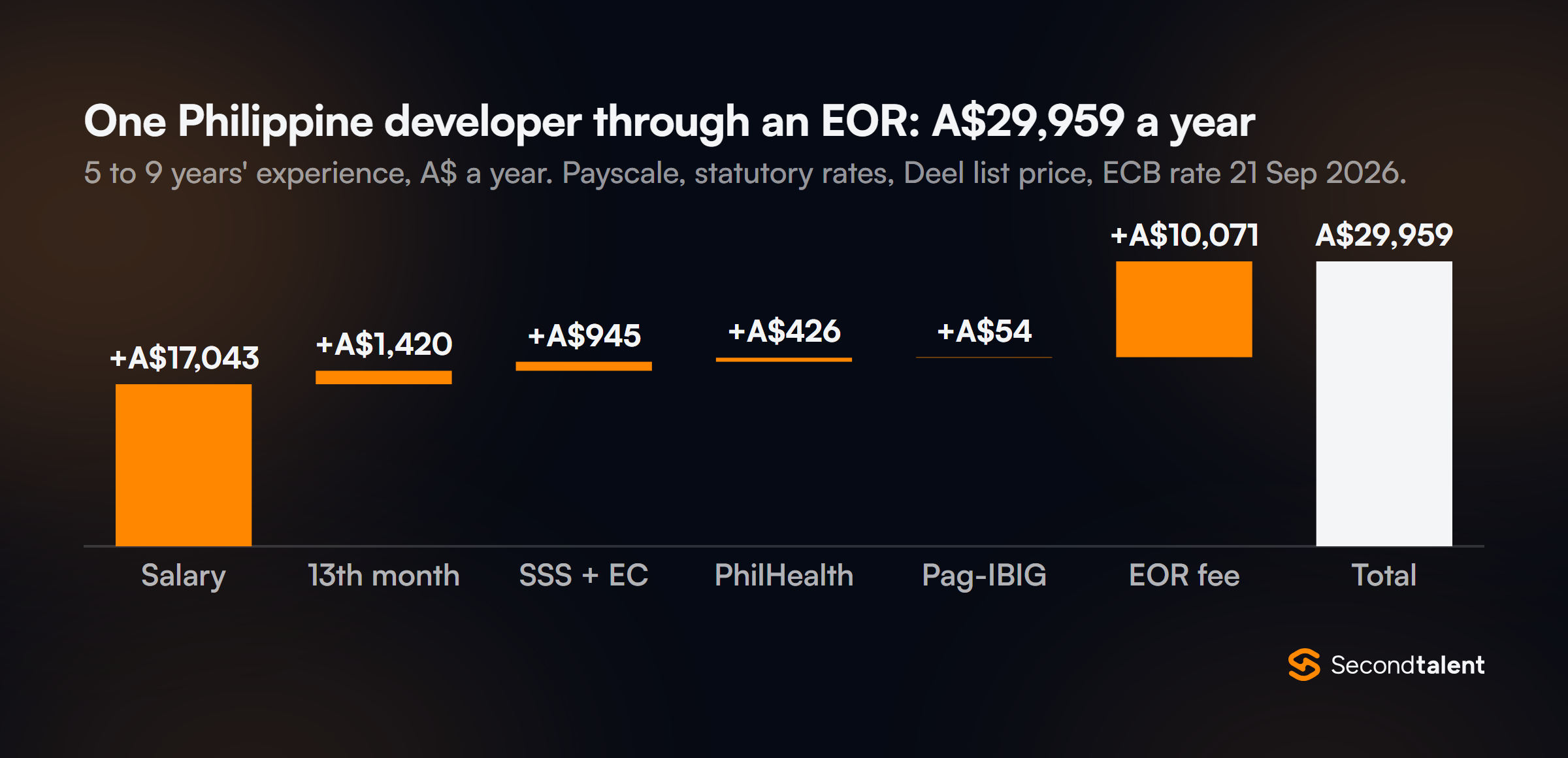
The 13th-month payment is the largest statutory line: one twelfth of a year's basic pay, due by 24 December, under the labour department's statutory benefits handbook.
The SSS employer share is 10% of a monthly salary credit capped at ₱35,000, per Grant Thornton, so it stops rising once a salary passes that cap.
Our cost of software developers in Australia vs the Philippines breakdown runs the same model at four experience levels against Sydney and Melbourne salaries.
The EOR fee is the number that surprises Australian teams most when I price a first hire. On an entry-level salary, it is more than half of what the developer costs you.
Our Philippines employer of record page lists what the service covers, and the employer of record cost guide compares pricing models across providers.
The Hiring Process, Week by Week
The slowest step is not yours. Article 285 of the Labor Code (renumbered 300) lets an employee resign "by serving a written notice on the employer at least one (1) month in advance".
A developer who signs your offer on a Friday usually starts four to five weeks later.
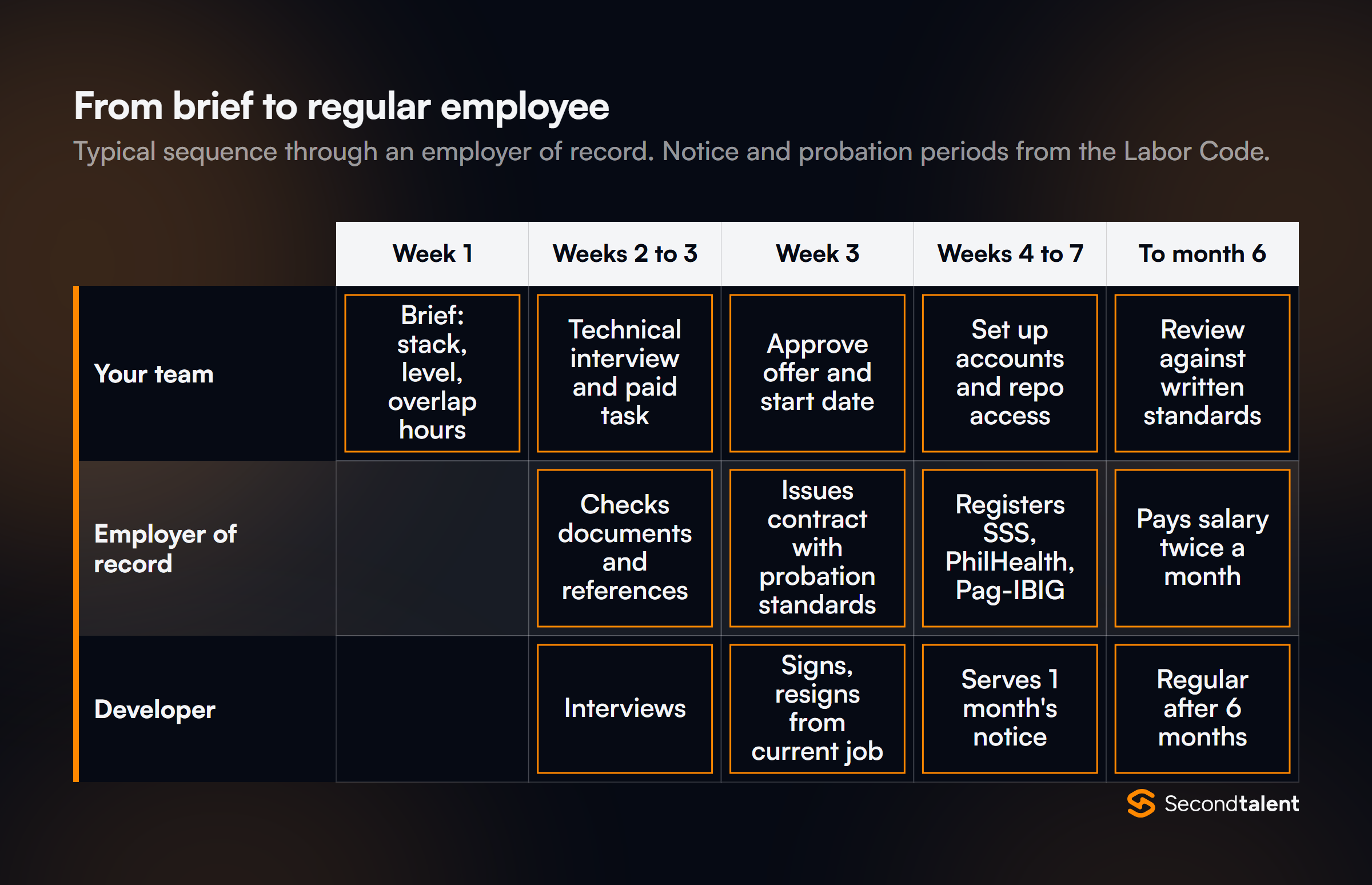
The brief decides the shortlist. Name the stack and the level, and state the overlap hours as a Manila time window, not "Sydney hours". "7am to 3pm Manila time" tells a candidate what the job asks of their mornings.
Advertised pay sets a floor: JobStreet puts software engineer pay at ₱100,000 a month in Mandaluyong and ₱75,000 in Taguig, against a national ₱45,000 to ₱55,000.
Probation needs its standards written down on day one. The same code caps probation at six months.
It allows dismissal during probation only for a just cause or for failing "reasonable standards made known by the employer to the employee at the time of his engagement". Standards you never wrote down are hard to rely on later.
So name them in the offer letter: a code review pass rate, delivery against sprint commitments, attendance at the agreed hours.
Pay runs twice a month. Article 103 requires wages "at least once every two (2) weeks or twice a month at intervals not exceeding sixteen (16) days", as laborlaw.ph sets out. The usual cycle is the 15th and the last day of the month.
An Australian company used to monthly pay runs has to change its habits if it employs directly; an EOR handles the cycle and still bills you monthly.
Working Hours, Holidays and Overtime
Manila runs on UTC+8 with no daylight saving, so its gap to Sydney, Melbourne and Adelaide changes twice a year. Queensland has no daylight saving either, so a 9am Brisbane stand-up is 7am in Manila all year.
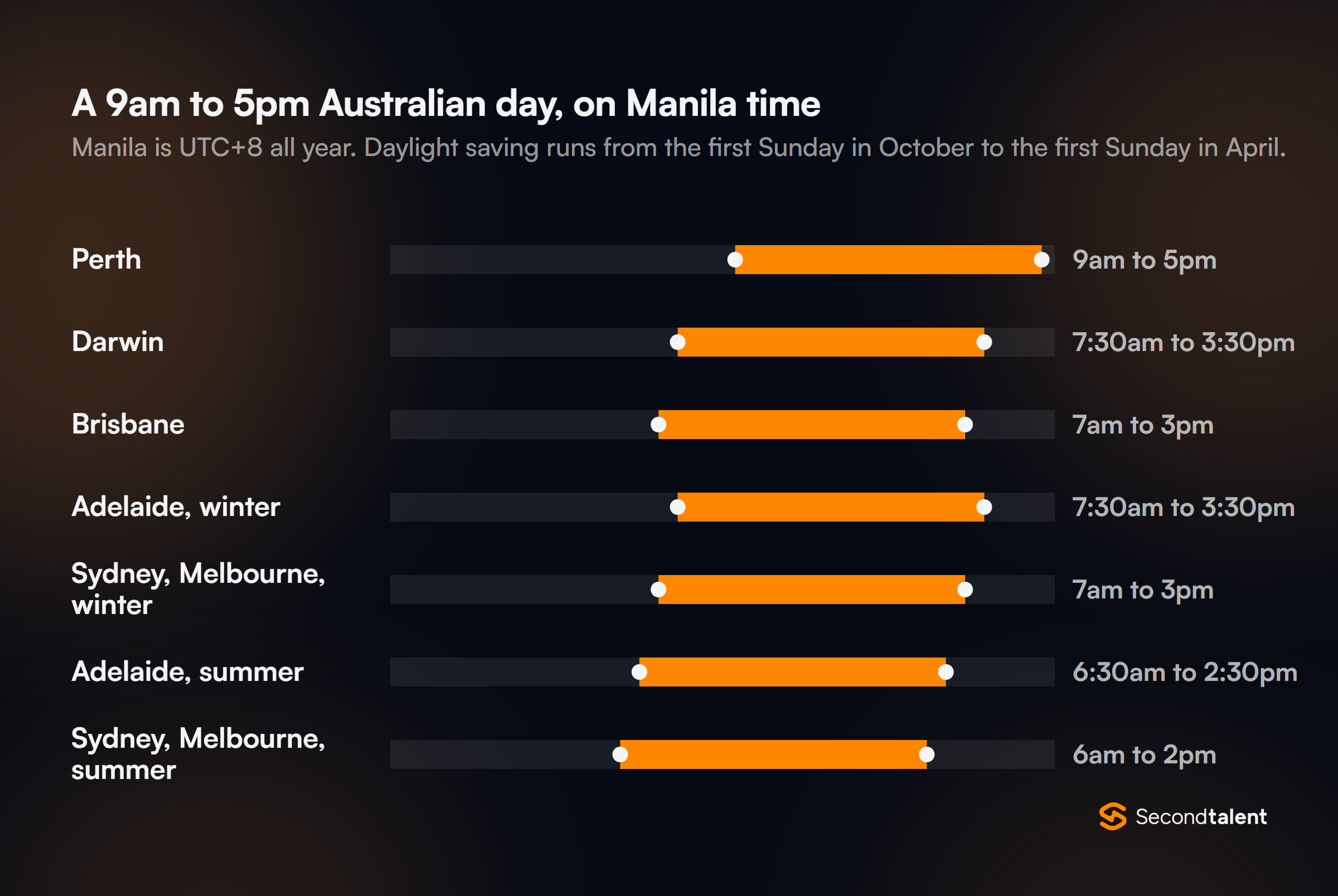
Every row stays clear of the night shift. The statutory benefits handbook adds at least 10% to pay for hours worked between 10pm and 6am. A Sydney team in daylight saving that asks for a 5:30am Manila start crosses that line.
A developer who also covers a late Sydney release ends up working past 10pm. Our Australia and Southeast Asia time zone guide lays out meeting windows for each city.
Holidays cluster. Proclamation No. 1006 sets 10 regular holidays, 4 special days and 4 additional special days for 2026. The President declares Eidul Fitr and Eidul Adha later, once the Islamic calendar dates are set.
Plan sprints around these runs:
Under the same handbook, a developer who works a regular holiday is paid at least 200% of the daily rate, and a special day worked earns an extra 30%. If your release falls in Holy Week, either pay the premium or move the release.
Data, Code Ownership and Privacy
A developer with production access can see customer data, which brings in two privacy laws.
Under Australian Privacy Principle 8, a company that discloses personal information to an overseas recipient must take reasonable steps to make sure the recipient does not breach the principles.
Section 16C of the Privacy Act makes the Australian company accountable for what the recipient then does, as the OAIC's APP 8 guidelines explain.
On the Philippine side, the Data Privacy Act of 2012 covers personal information processed in the country, enforced by the National Privacy Commission.
In practice the controls that satisfy both are the same: least-privilege access, masked or synthetic data in development, company-managed devices, and confidentiality and data-handling terms in the contract.
For employees, code ownership is simpler than for contractors.
Section 178.3 gives the employer copyright in work that "is the result of the performance of his regularly-assigned duties, unless there is an agreement, express or implied, to the contrary".
Put an assignment in the contract anyway, naming your company as owner rather than the EOR, because the default rule only protects you if the job description covers the work.
When Your Own Entity Makes Sense
Foreign ownership is less of a barrier than many expect. The Foreign Investments Act, as amended in 2022, allows full foreign ownership of export enterprises, those exporting at least 60% of their output.
The US$200,000 minimum paid-in capital applies to small domestic-market enterprises, as Grant Thornton's summary sets out. A development centre that bills all its work to an Australian parent sells abroad, not locally.
The cost is the overhead. An entity has to register with the SEC and the BIR, keep books, file returns, run twice-monthly payroll and handle every SSS, PhilHealth and Pag-IBIG remittance itself.
Those costs stay the same whether you employ three developers or thirty. Our Philippines payroll, benefits and tax guide covers the monthly mechanics an in-house team would own.
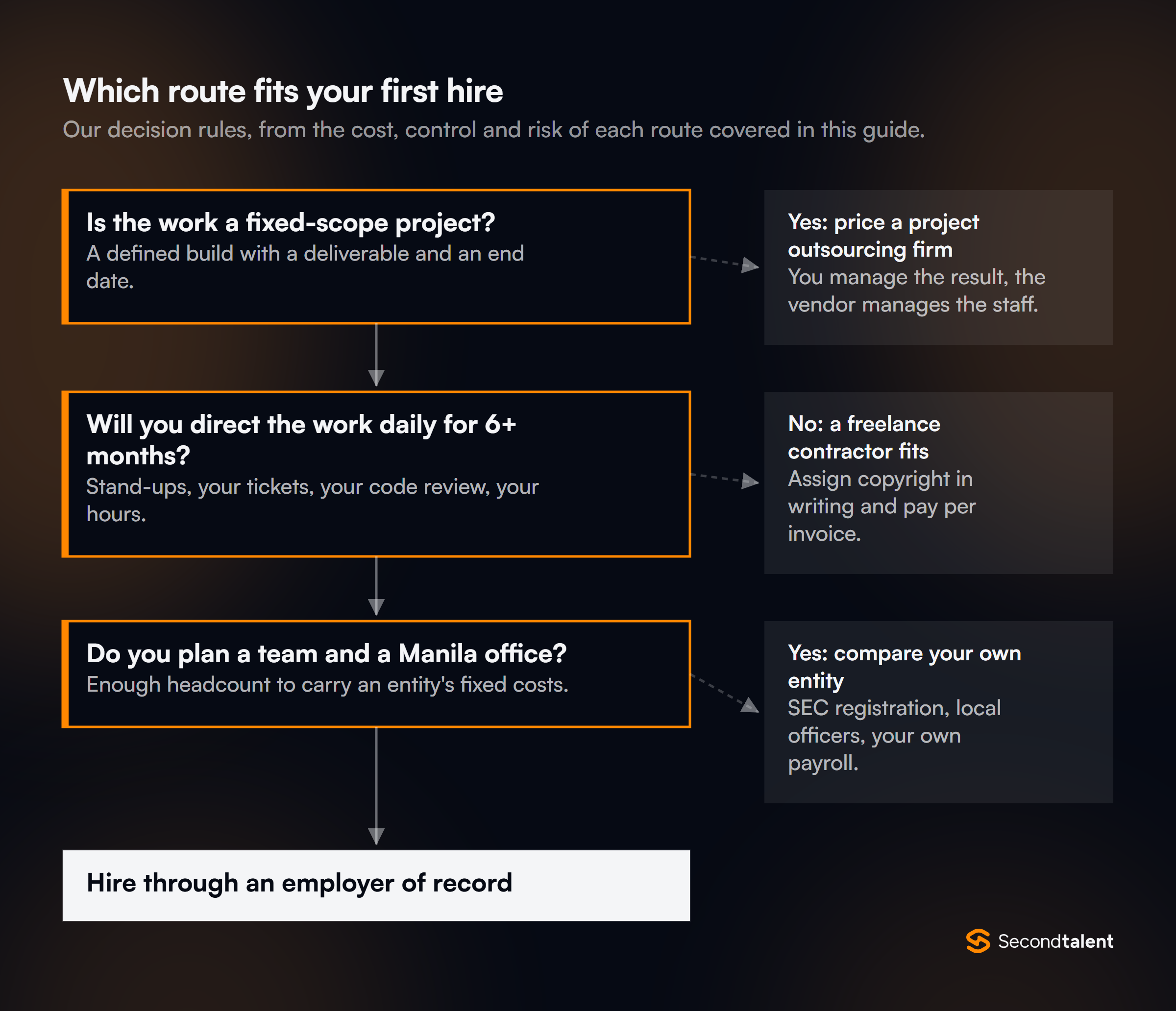
The project route belongs to fixed-scope work: a build with a deliverable and an end date, where you want to manage the result and not the developers. The offshore staffing companies in the Philippines list covers the larger providers.
Our guide to engineering talent in the Philippines covers the stacks and the cities.
Hire a Philippine Developer with Second Talent
We match Australian teams with vetted developers from the Philippines, usually within 24 hours, and can employ them through our employer of record so you need no local entity.
Teams hiring through us typically pay 50-70% less than for an Australian hire. There is no cost until you hire. Tell us who you need.
Frequently Asked Questions
Can an Australian company employ a Filipino developer directly, without an entity or an EOR?
Not easily. Employing someone in the Philippines means registering as an employer with SSS, PhilHealth, Pag-IBIG and the BIR, and those systems expect a local business.
That is why companies without an entity use either a contractor agreement or an employer of record.
Can I move a contractor onto an employer of record later?
Yes. The EOR signs a new employment contract with the developer, usually from the first day of a pay period. Get the contractor to assign copyright in everything written so far before the switch.
The employee rule in Section 178.3 does not reach back to work done as a contractor.
What should a Philippine developer cost?
It depends on the stack and the level more than the city. Our software developer salary rate card for the Philippines gives monthly ranges, and the cost to hire in the Philippines page prices ten common roles.