TL;DR: An automation engineer builds systems that follow fixed paths, such as scripts, RPA bots and n8n or Workato workflows; an AI agent developer builds LLM systems that choose their own steps and tools. Coinbase posts its senior IT automation engineer at $113,815 to $133,900 base, while Sierra and Decagon post agent engineers at $175,000 to $390,000. Hire the automation engineer when rules cover each case, and the agent developer when inputs are messy text and steps vary.
Coinbase's senior IT automation engineer posting names n8n, Airflow, Temporal, Jira and Workato, and mentions AI once, as a tool to use "responsibly".
Lyft's intelligent automation posting, for a Workato and Boomi engineer, asks for a year or two of building AI agents in Workato Genie and a year of deploying MCP servers. I read both on October 5, 2026, with nine other postings.
- 1Gartner counts RPA rebranded as agents as "agent washing", and estimates only about 130 of thousands of agentic AI vendors are real.
- 2RPA vendor UiPath now calls itself "a global leader in agentic automation".
- 3Workflow tool n8n went from a $2.5 billion to a $5.2 billion valuation in under a year.
- 4In Stack Overflow's 2025 survey, 37.9% of developers said they had no plans to use AI agents.
What is the difference between an automation engineer and an AI agent developer?
An automation engineer builds systems that run the same steps every time a trigger fires. An AI agent developer builds systems where a large language model decides which steps to take and which tools to call. The first job writes the path.
The second job sets limits on a path the model picks for itself.
Anthropic drew the same line in its December 2024 guide, Building effective agents. "Workflows are systems where LLMs and tools are orchestrated through predefined code paths," it says.
Agents "dynamically direct their own processes and tool usage." A workflow can still call a model to read an email or draft a reply, as long as a developer fixed the order of the steps.
Two questions decide which kind of system a task needs: is the input structured, and are the steps known in advance?
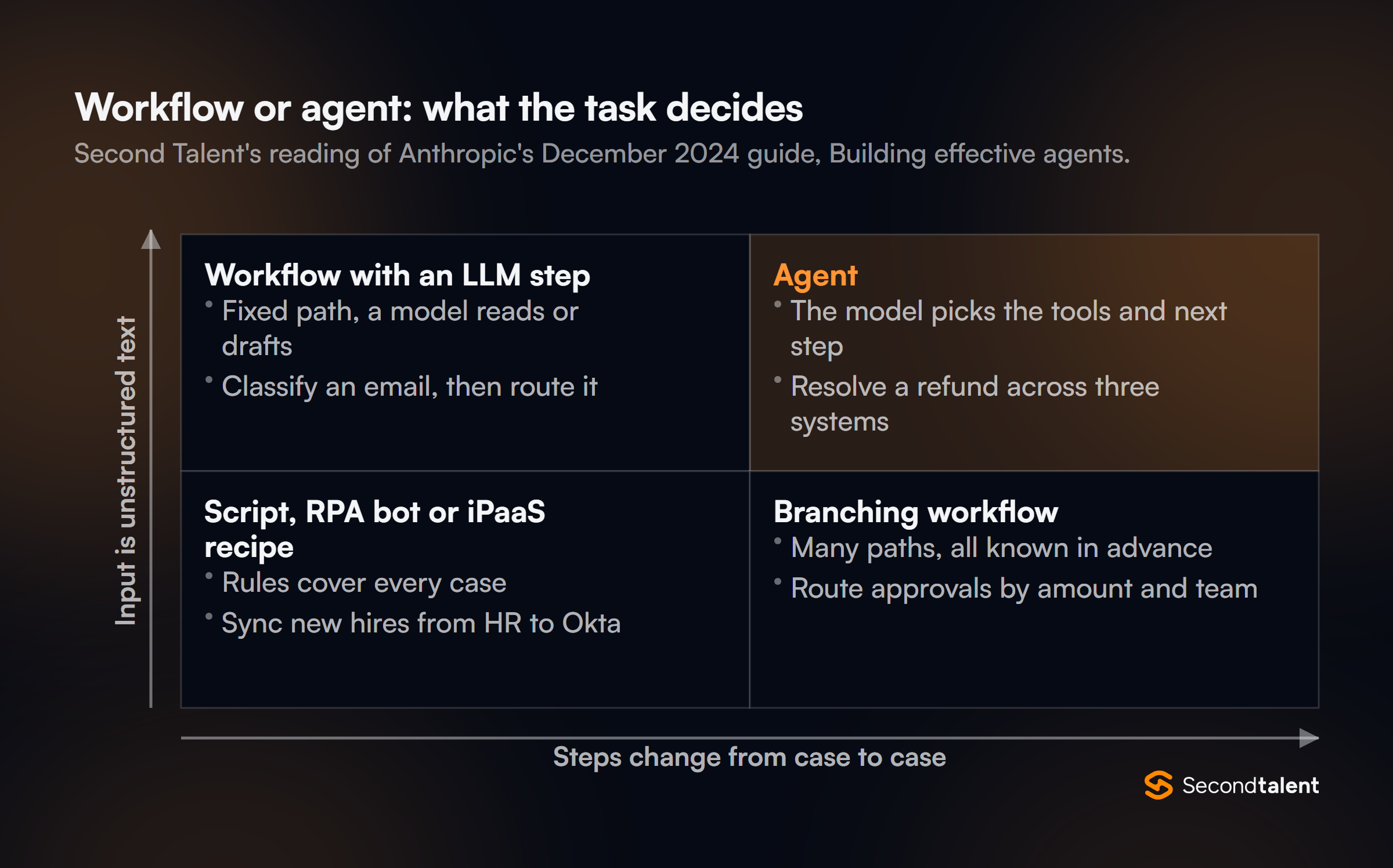
The bottom-left box is the automation engineer's home ground. The top-right box is the agent developer's. The two boxes in between are where most of the hiring confusion sits, because both roles can build them.
Our automation engineer role guide and AI agent developer role guide cover each job on its own. Automation of factory hardware, with PLCs and robots, is a separate job: the industrial automation engineer.
What each role builds day to day
Coinbase's IT Tooling team shows what current automation work looks like.
Its senior IT automation engineer owns "the self-service workflows, bots, and integrations that employees interact with daily, from ticket triage and access reviews to onboarding and offboarding".
Each of those tasks has a known start, a known end and a rule for each case.
Agent postings describe a different week. Brex's forward deployed agent builder embeds with internal teams, including "shadowing and learning different job functions", then ships agents that take over those workflows.
Cloudflare's AI agents engineer in Bangalore builds customer support agents and is told to "Cut cost per case and time to first response. Prove it with data."
- Own the architecture of IT automations across n8n, Airflow, Temporal and Jira
- Lead complex projects from discovery to production
- Build shared frameworks and reusable components
- Set code review practices and engineering standards
- Embed with partner teams to learn how they work
- Scope, design and deploy agents that take over real workflows
- Integrate agents with internal systems, APIs and data
- Define evaluation frameworks and success metrics
The last line on each side is the real split. An automation engineer tests whether the workflow ran.
An agent developer has to measure whether the agent made good choices, which is why evals show up in agent postings and not in automation ones.
Sierra's 2024 post introducing the AI agent engineer role put it in one line: "AI agents are nondeterministic and built on tools uncommon in modern software stacks."
Where the two roles now overlap
The overlap is widest on business systems teams. Lyft's intelligent automation posting wants six to eight years of Workato and Boomi integration work.
It also wants the engineer to "build and support AI Agents (Genies) for Legal and business-process automation", including prompt design and document processing for contracts and filings. That is one job description carrying both roles.
Toast puts both halves in one title. Its GTM engineer for sales workflow automation builds "the agents and automations that run inside Toast's sales motion".
The posting asks for at least one LLM workflow or agent that a business team used in production, "with tool calling, error handling, and some form of evaluation". Toast tells candidates they will walk the panel through it.
The workflow vendors describe the same middle ground. n8n framed the market as two camps in the post announcing its $180 million Series C in October 2025:
"Pure autonomy creates magic when it works but proves too unpredictable for business-critical workflows. Pure rule-based routing offers predictability but demands more time and often developers for every change."
n8n blog, n8n raises $180m to get AI closer to value with orchestration, October 9, 2025
Anthropic's own DevOps / AgentOps engineer posting shows where this ends up. The engineer builds a release pipeline with three lanes: "fully agentic, human-in-the-loop, and AI-assisted".
Part of the job is deciding what agents in the pipeline "are not trusted to do unsupervised". That is an automation engineer's control mindset applied to agents.
Our AI workflow automation specialist guide covers the no-code end of the same overlap.
Skills and tools
APIs and integrations are the one skill all five postings below share. Past that, the lists split by role. I marked a skill as named if the posting mentions it anywhere, as a requirement or a nice-to-have:
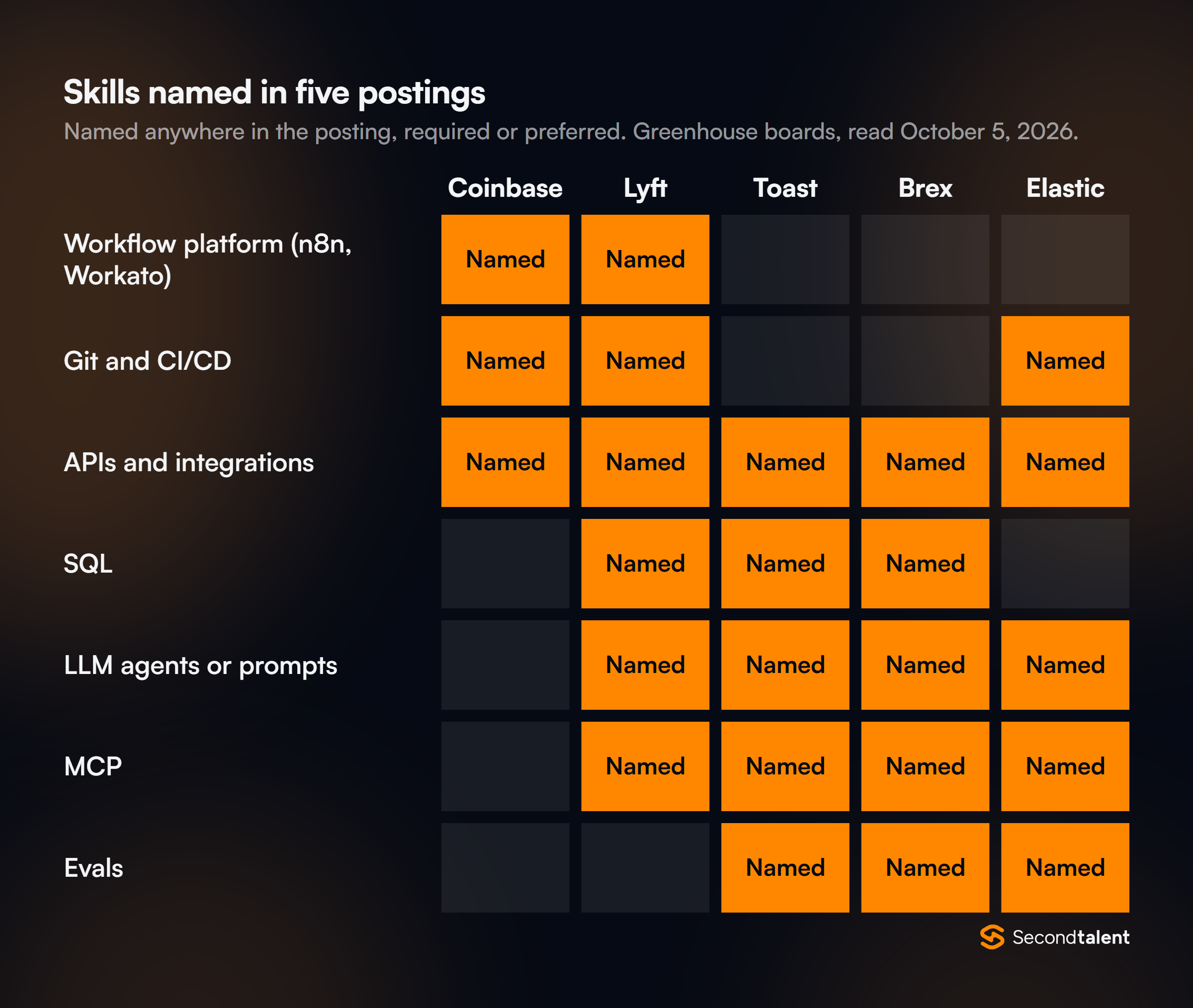
Coinbase's automation posting is the only one with no LLM skill on the list.
Elastic's agentic AI engineer sits at the other end: prompt engineering, tool calling, structured outputs, MCP, and frameworks such as LangGraph, LangChain and AutoGen.
Lyft sits in the middle, which is why its column fills in on both halves.
Open-source tools lead the agent side's toolkit. Stack Overflow asked 3,758 developers who build agents which orchestration tools they had used in the past year:
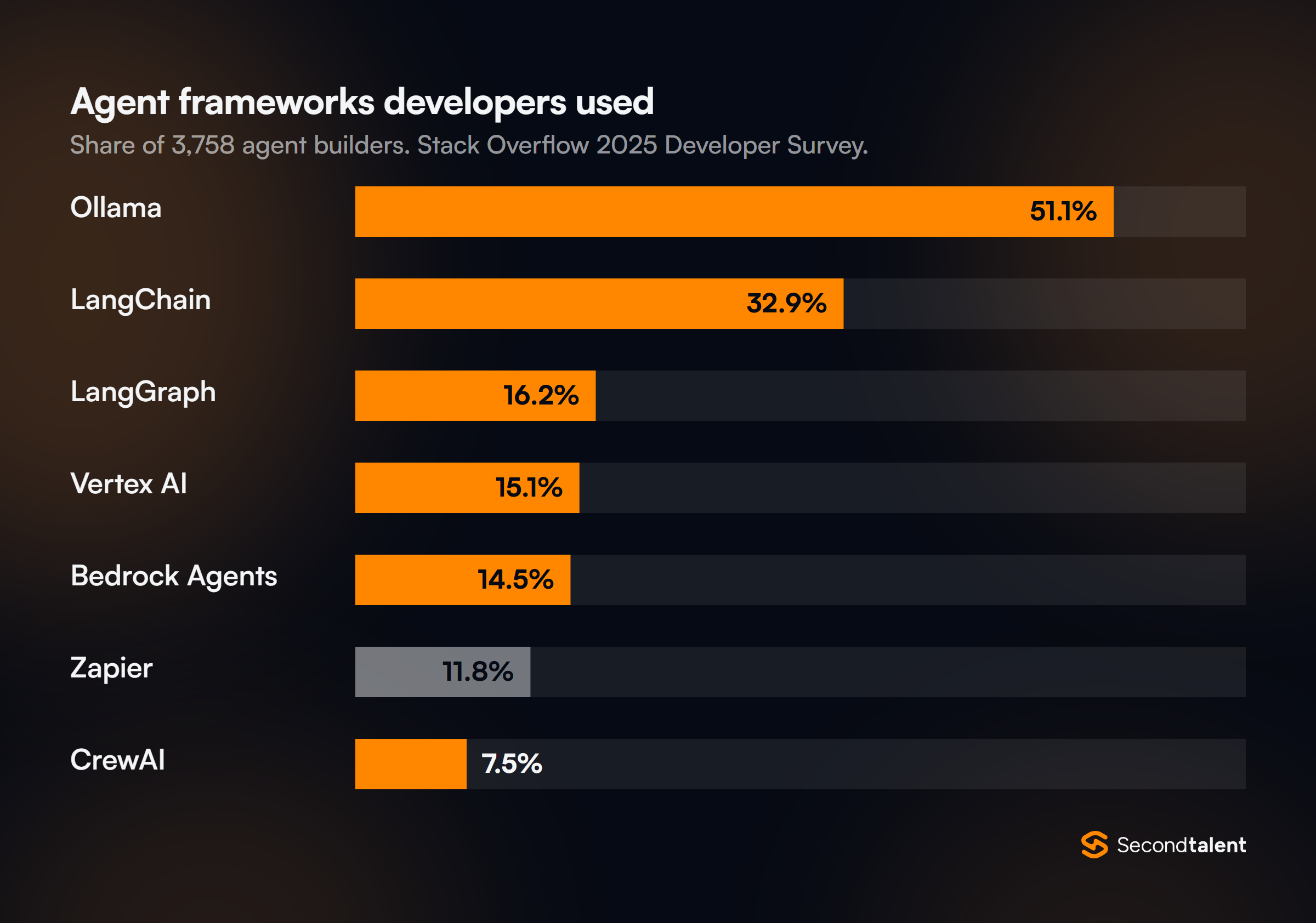
Zapier, a classic automation tool, made the list at 11.8%, ahead of CrewAI. For a ranked view of the code frameworks, see our guide to the top LLM frameworks for building AI agents.
The background each employer asks for differs as well. Coinbase asks for five years "in IT engineering, automation, or systems engineering".
Brex asks for four years in engineering, product or applied AI, "with a track record of shipping AI/automation systems to production".
Toast welcomes GTM, business systems, forward deployed or data engineering, and weighs "the depth of what you've shipped over the title you held".
Pay: what the postings say
Agent titles at agent-first companies pay the most, but the label alone does not set the range. Each company posts these US base ranges on its own board:
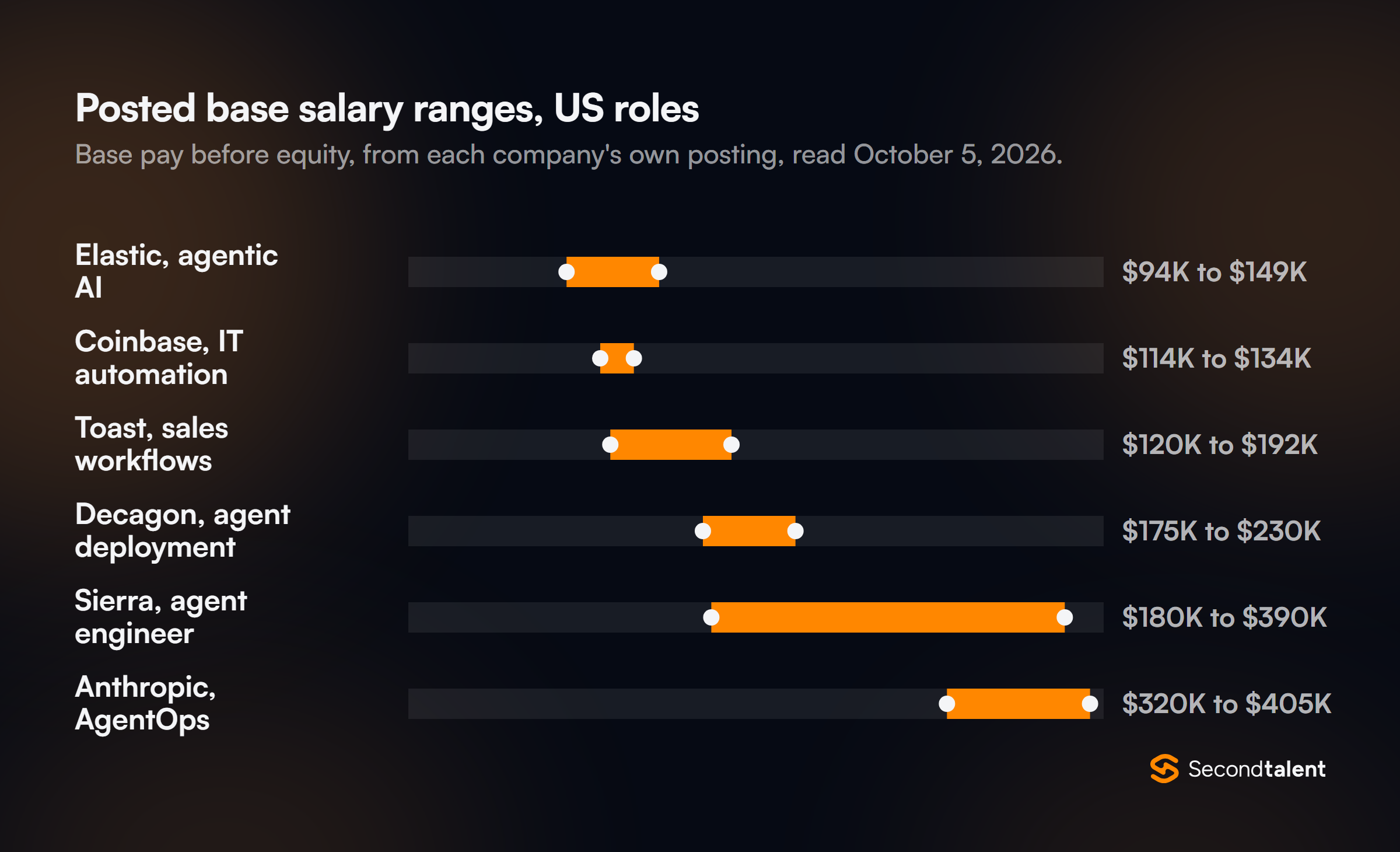
Elastic's agentic AI engineer, an IT team role, has the lowest floor on the chart at $94,300. In its select high-cost cities, including San Francisco and New York, the range moves to $113,300 to $179,200.
Sierra's agent engineer range is the widest, and Sierra posts its new-graduate agent engineer role at $150,000 to $180,000.
Seniority moves automation pay as much as the agent label does. Toast's staff software engineer for finance automation pays $193,000 to $309,000 in its top pay zone.
That role turns "working agentic prototypes built by Finance operators" into monitored, permissioned services. Decagon's agent deployment engineer sits at $175,000 to $230,000.
All of these are base salaries, before equity or bonus. Outside the US, our automation engineer cost guide, AI agent developer cost guide and AI agent developer rate card track rates by market.
Demand: where the work is moving
Gartner expects agents to reach a large share of business software within two years. Its two 2025 forecasts:
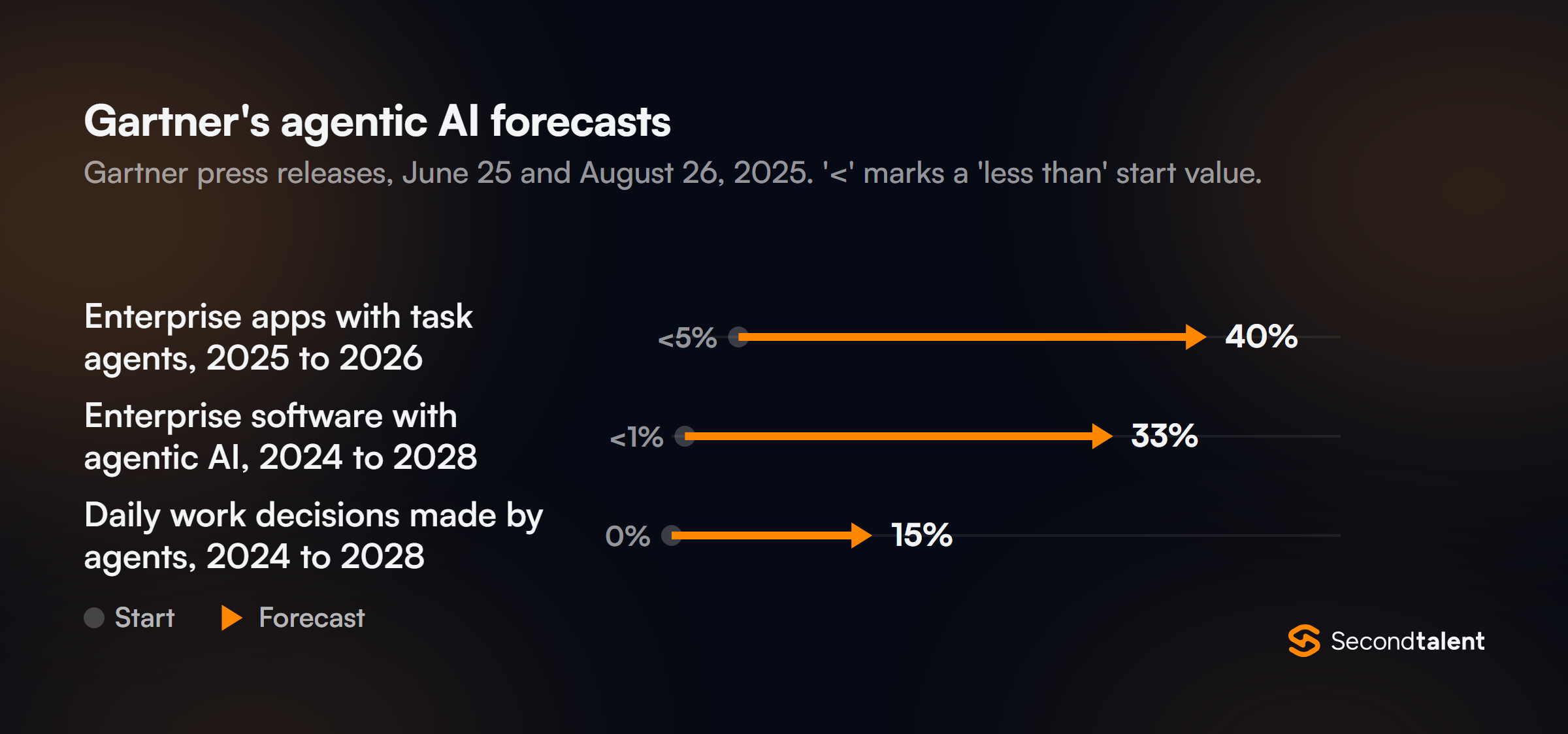
The same firm is blunt about failure. Its June 2025 release says over 40% of agentic AI projects will be canceled by the end of 2027, "due to escalating costs, unclear business value or inadequate risk controls".
It lists RPA rebranded as agents among the causes of hype. The August release calls AI assistants being labeled agents "the most common misconception".
The automation vendors are moving toward agents rather than away from them. UiPath's fiscal 2026 results quote its CEO pitching "deterministic automation, agentic AI, and enterprise-grade orchestration together on a single platform".
SAP's investment in n8n, reported by Tech.eu, puts n8n's workflows inside Joule Studio, SAP's agent-building tool.
Developers are slower than the vendors. The 2025 Stack Overflow Developer Survey asked whether respondents use AI agents at work:
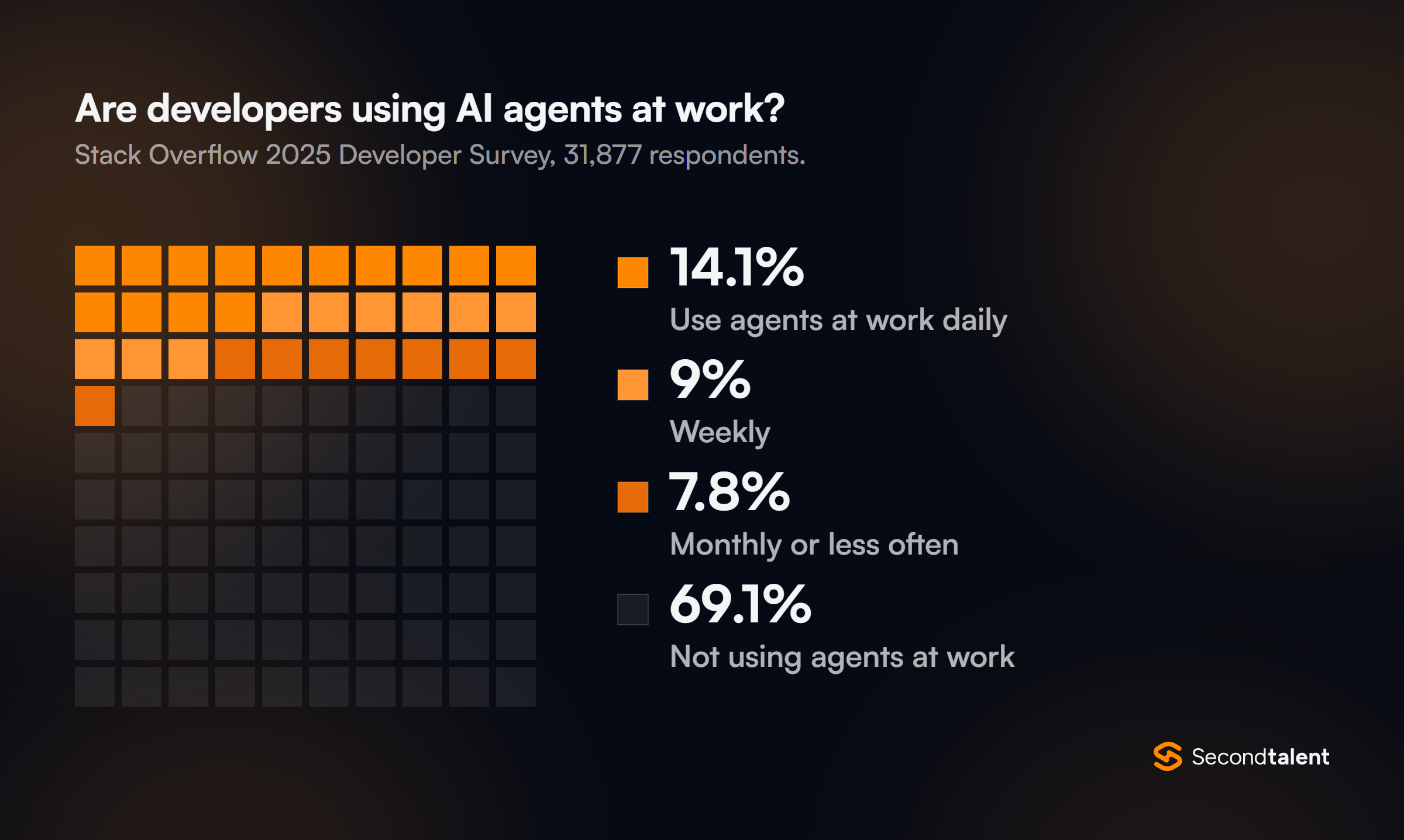
Of the 69.1% not using agents, 17.4% plan to and 13.8% use AI only as autocomplete. For more adoption figures, see our roundup of AI agents statistics for 2026.
Which one to hire
Hire an automation engineer when you can write each case as a rule. Hire an AI agent developer when the input is unstructured text and the next step depends on what the text says.
Anthropic's guide gives the same order: "we recommend finding the simplest solution possible, and only increasing complexity when needed."
The cost of skipping that order is real. Anthropic notes that "agentic systems often trade latency and cost for better task performance".
Toast's finance automation posting asks for this judgment by name: knowing "when an AI agent is required versus a traditional backend system or cron job".
A team with one engineer can start with the hybrid. Look for an automation engineer who has shipped one agent to production, the bar Toast sets.
Cloudflare, Sierra and Decagon, which run customer-facing agents, hire dedicated agent engineers for that work.
For an automation engineer moving into agent work, the gap is narrower than the titles suggest. APIs and integrations sit on all five postings in the skills chart; the rows Coinbase leaves blank are LLM agents, MCP and evals.
Hire automation and AI agent engineers from Asia
We match you with vetted AI agent developers, AI automation engineers and n8n developers in 24 hours, at 50-70% below US cost.
Every placement carries a 90-day, one-time replacement guarantee, and we employ engineers through our own EOR in 9 Asian markets.
Our monthly plan is $4,999 a month for a senior engineer, all-inclusive. Tell us what you want to automate and we will send a shortlist.
Frequently Asked Questions
Are AI agents replacing RPA?
Not on the vendors' own account. UiPath sells deterministic automation and agents on one platform, and n8n pitches control over where a workflow sits between rules and autonomy. Gartner counts RPA relabeled as agents as "agent washing".
Is a test automation engineer the same as an automation engineer?
No. A test automation engineer automates software testing with tools such as Selenium or Cypress, and our test automation engineer guide covers that role.
Which language does each role use?
Python is the common ground. Toast asks for Python or TypeScript plus SQL, Elastic for Python or TypeScript, and Cloudflare for TypeScript or Rust.
Workflow platforms such as Workato add their own scripting, and Lyft lists Ruby, Python and JavaScript for custom connectors.