TL;DR: Xiaomi's current MiMo models are MiMo-V2.6-Pro (1.02T parameters, $0.435 in and $0.87 out per million tokens) and MiMo-V2.6-Flash (309B, $0.14 and $0.28), both MIT-licensed with a 1M-token context. V2.6-Pro scores 46 on the Artificial Analysis Intelligence Index, the highest of any open-weights model. MiMo-V2.5 and V2.5-Pro leave the API on October 21, 2026.
In March 2026 an anonymous model called Hunter Alpha appeared on OpenRouter and passed one trillion tokens of usage before Xiaomi said who had built it. Xiaomi then revealed it as an early test build of MiMo-V2-Pro. Eleven months earlier, the entire MiMo line had been a single 7-billion-parameter reasoning model.
- 1Every open MiMo checkpoint ships under plain MIT, so commercial use and fine-tuning need no extra licence.
- 2The Batch API halves the V2.6 price, and UltraSpeed costs ten times the standard rate for up to 20x faster output.
- 3Both V2.6 models read text, images, video and audio natively; only the output is text.
- 4The smallest new model is a 9B distill on a Qwen base, small enough for a single consumer GPU.
The MiMo Models at a Glance
Xiaomi has published 30 repositories under its XiaomiMiMo Hugging Face account since April 2025, plus three API-only models. The table covers the main checkpoint of each release; base, SFT and quantized variants sit beside them.
| Model | Released | Total / active params | Context | Weights | API status |
|---|---|---|---|---|---|
| MiMo-V2.6-Pro | Sep 22, 2026 | 1.02T / 42B | 1M | MIT | Current, $0.435 / $0.87 |
| MiMo-V2.6-Flash | Sep 22, 2026 | 309B / 15B | 1M | MIT | Current, $0.14 / $0.28 |
| MiMo-V2.6-Distill-Qwen-9B | Sep 2026 | 9B dense | Not stated | MIT | Weights only |
| MiMo-V2.5-Pro | Apr 23, 2026 | 1.02T / 42B | 1M | MIT | Ends Oct 21, 2026 |
| MiMo-V2.5 | Apr 23, 2026 | 310B / 15B | 1M | MIT | Ends Oct 21, 2026 |
| MiMo-V2-Pro | Mar 18, 2026 | 1T+ / 42B | 1M | None | Retired Jun 30, 2026 |
| MiMo-V2-Omni | Mar 18, 2026 | Not disclosed | 256K | None | Retired Jun 30, 2026 |
| MiMo-V2-Flash | Dec 16, 2025 | 309B / 15B | 256K | MIT | Retired Jun 30, 2026 |
| MiMo-7B family | Apr 2025 | 7B dense | 32K | MIT | Weights only |
MiMo-V2.6-Pro: The Flagship
Artificial Analysis spent $0.13 per task running V2.6-Pro through its whole index, and the resulting score of 46 is the top mark for any open-weights model. The same page calls it slow: 42 tokens a second at the median provider. It is the model to pick when the answer matters more than the wait.
Under the hood it is a 70-layer mixture-of-experts. Sixty layers use sliding-window attention over the last 128 tokens and ten use global attention, which keeps the KV cache small at a 1M-token context. A 681M-parameter vision encoder and a 308M audio tokenizer sit in front of the language backbone, and a five-layer drafter predicts seven tokens per pass for speculative decoding. The MiMo-V2.6-Pro-RL model card lists all of it.
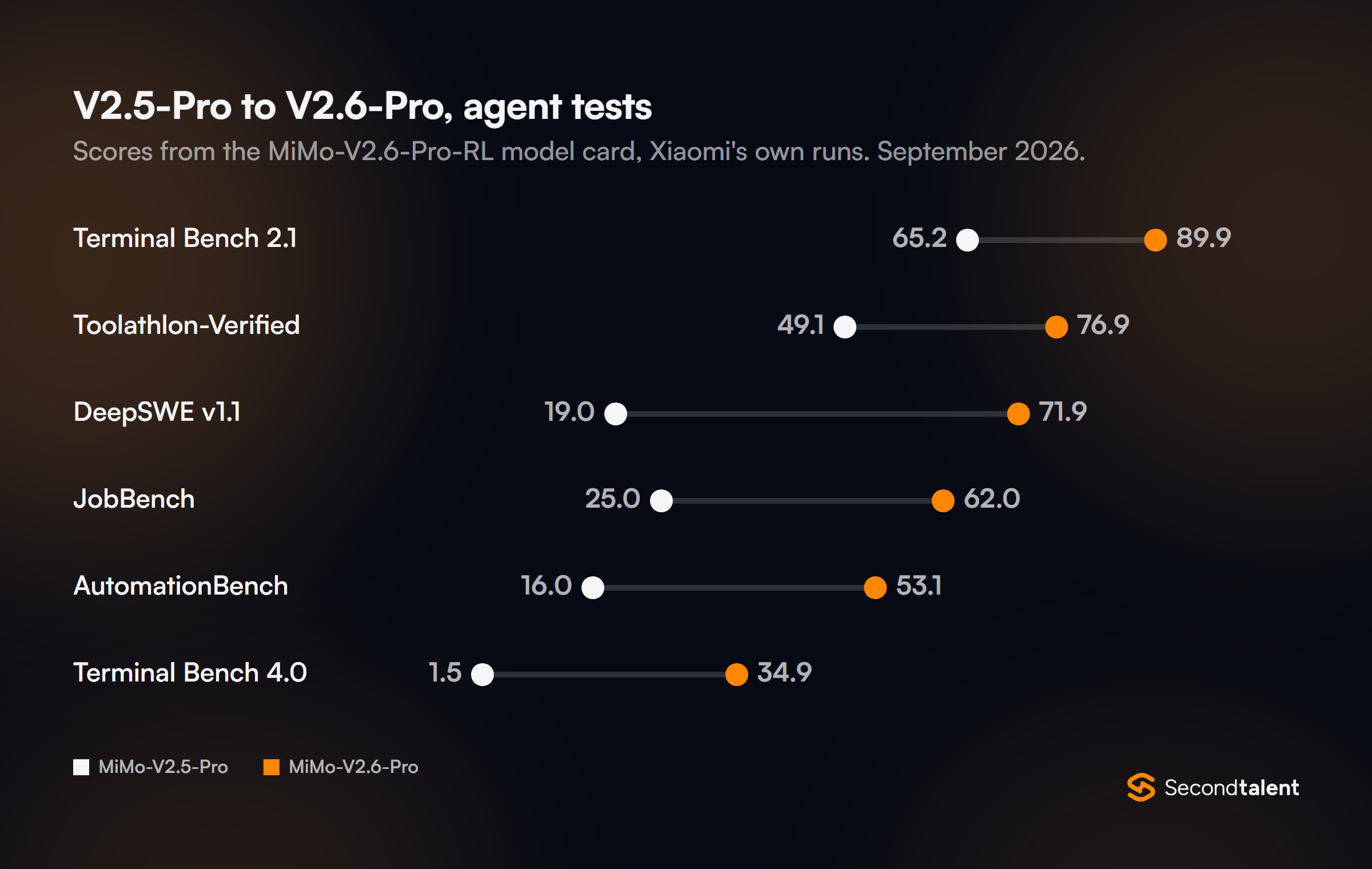
Xiaomi's own benchmark table puts the jump from V2.5-Pro at its widest on long agent tasks. DeepSWE v1.1, a long-horizon software engineering test, went from 19.0 to 71.9. Terminal Bench 4.0 went from 1.5 to 34.9, still well short of the 49.0 the same table gives Claude Opus 5.
Five days after launch Xiaomi pushed a second checkpoint, MiMo-V2.6-Pro-MOPD. Its model card says the first release sometimes repeated the same tool call over and over inside agent loops, "appearing busy while making no progress". The MOPD checkpoint folds a short specialised-teacher pass into training to cut that repetition. If you self-host V2.6-Pro for agents, start from the MOPD weights.
MiMo-V2.6-Flash and Pro-UltraSpeed
Flash costs a third of Pro per token and finishes within a few points of it on most of Xiaomi's agent tests: 67.9 against 71.9 on DeepSWE, 87.6 against 89.9 on Terminal Bench 2.1. The catch is length. Artificial Analysis counted 240 million tokens generated across its index for Flash, against 140 million for Pro, so the per-task saving is closer to half than two thirds. The Flash model card lists 309B total and 15B active parameters on a 48-layer backbone, with the same encoders and drafter as Pro.
MiMo-V2.6-Pro-UltraSpeed is not a separate model. It is a faster serving mode of Pro that runs at up to 20 times its output speed. Xiaomi described the V2.5 version as an FP4-quantized backbone with a block-diffusion drafter in its MiMo-V2.5-Pro-FP4-DFlash release, and has not published the V2.6 setup. It costs $4.35 in and $8.70 out per million tokens, exactly ten times standard Pro, and it has no batch option.
What the V2.6 Training Run Cost
Xiaomi streamed the V2.6 reinforcement learning run live and published the bill on its launch page. Each model completed 30 RL steps over roughly 750,000 trajectories in under six days, with 1,568 samples per update and 3.5 to 3.7 billion tokens per step.
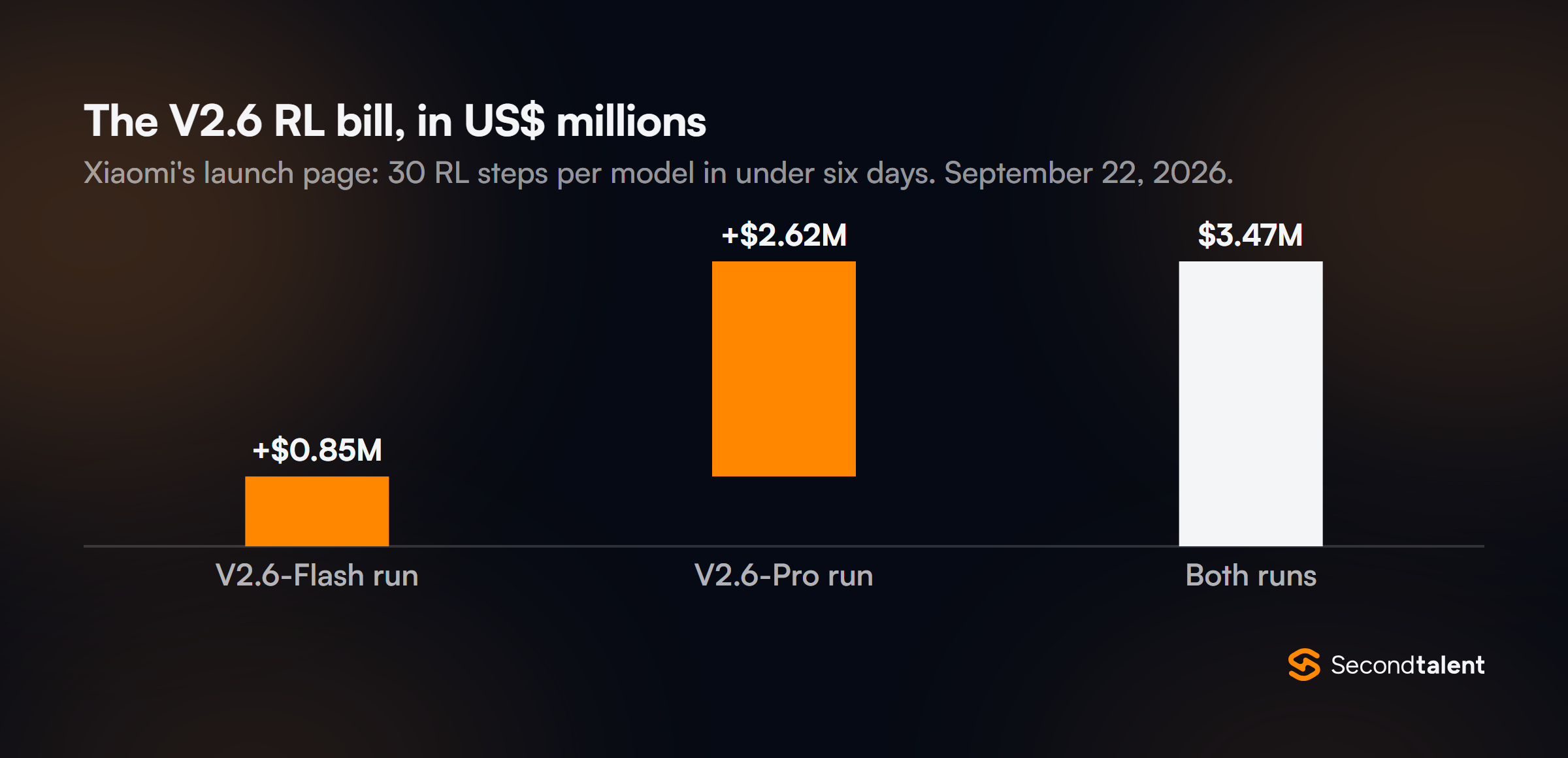
The two runs together cost about $3.47 million. Over those 30 steps, V2.6-Pro's DeepSWE score rose from 58.4 to 72.57 and Flash's from 48.8 to 65.68. Xiaomi says it is releasing the technical report, training environments and RL code so others can reproduce the run. The report is a PDF inside the Pro model repository.
"In an era when compute is brutally scarce, we still chose to dedicate a team of several dozen people to one goal over an extended period: scaling up RL."
Fuli Luo, head of Xiaomi MiMo, quoted by VentureBeat, September 2026
MiMo-V2.5 and V2.5-Pro: Retiring on October 21
The V2.5 pair entered public beta on April 23, 2026, and Xiaomi released the weights under MIT a few days later, base models included. V2.5-Pro shares V2.6-Pro's 1.02T size and was pretrained on 27 trillion tokens. MiMo-V2.5 was the first natively omnimodal open MiMo, a 310B model trained on about 48 trillion tokens with Xiaomi's own vision and audio encoders.
On May 27, 2026 Xiaomi cut V2.5 API prices permanently, by up to 99% on some rates, and dropped the surcharge for long inputs. V2.6 kept those prices. Both V2.5 model names stop working at 10:00 Beijing time on October 21, 2026, and unlike the V2 retirements there is no automatic switch: requests will return an error. Changing mimo-v2.5-pro to mimo-v2.6-pro is the whole migration, because the prices match.
MiMo-V2-Flash, V2-Pro and V2-Omni
The V2 generation is where MiMo turned from a research model into a product. Three months separated the first open MoE from the first trillion-parameter one.
MiMo-V2-Flash introduced the design every later model kept: five sliding-window layers to one global layer, a 128-token window, and three multi-token prediction layers that Xiaomi says roughly triple output speed. It launched at 73.4 on SWE-bench Verified.
MiMo-V2-Pro raised the ratio to seven to one and the size past one trillion parameters, priced at $1 in and $3 out up to 256K tokens and double that beyond. V2-Omni added image, video and audio understanding with a 256K window, and V2-TTS was a speech model pretrained on more than 100 million hours of audio. Only V2-Flash ever had open weights, and they are still on Hugging Face.
The 7B Generation: Reasoning, Vision, Audio and Robots
Xiaomi's first MiMo release was MiMo-7B, a reasoning model trained from scratch on about 25 trillion tokens and released in four checkpoints: Base, SFT, RL-Zero (reinforcement learning straight from the base) and RL. Its RL version scored 55.4 on AIME 2025, ahead of OpenAI o1-mini's 50.7 in Xiaomi's table, and a May 2025 refresh (MiMo-7B-RL-0530) lifted that to 70.2. Three spin-offs followed on the same 7B backbone.
MiMo-VL pairs the 7B backbone with a vision encoder and a 128K context, so it runs on modest hardware. MiMo-Embodied is the most Xiaomi-specific: one model for both robot task planning and driving scenes, which fits a company that also builds cars. All of these are MIT-licensed weights with no hosted API.
Speech Models: MiMo-V2.5-TTS and ASR
Xiaomi's speech line now sits on its own version track. The MiMo-V2.5-TTS series launched on April 23, 2026 as three models: mimo-v2.5-tts with preset voices, mimo-v2.5-tts-voicedesign, which builds a new voice from a one-sentence description, and mimo-v2.5-tts-voiceclone, which copies a voice from a few samples. All three are still free for a limited time. MiMo-V2.5-ASR is the open one: MIT weights for Mandarin, English, code-switched speech and dialects including Wu, Cantonese, Hokkien and Sichuanese. On the API it costs $0.074 per hour of audio.
MiMo-V2.6-Distill-Qwen-9B: The Small One
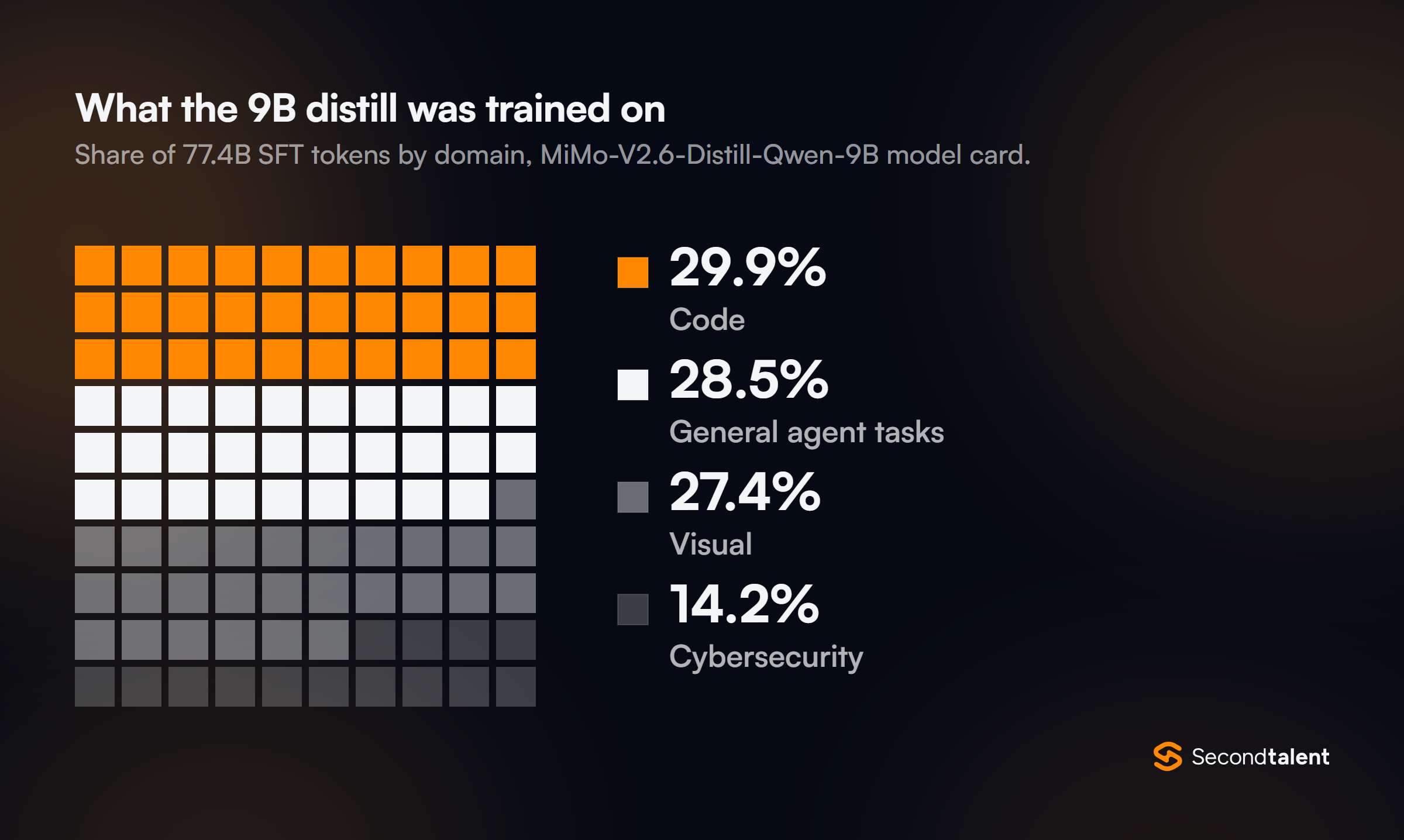
The 9B release is not a shrunken MiMo. It is Alibaba's Qwen3.5-9B fine-tuned on 77.4 billion tokens of data that MiMo-V2.6 generated, and Xiaomi calls it a starting point for agentic RL research rather than a product. The biggest gains over the base Qwen are on agent work: AutomationBench rose from 5.0 to 30.3 and SWE-bench Pro from 32.0 to 44.6, while SWE-bench Verified barely moved, 60.0 to 61.1.
Xiaomi releases it under MIT, and the Qwen3.5-9B base underneath is Apache 2.0, so both sets of terms are permissive. For how the Qwen line itself developed, see our guide to every Qwen model.
MiMo Pricing and the Token Plan
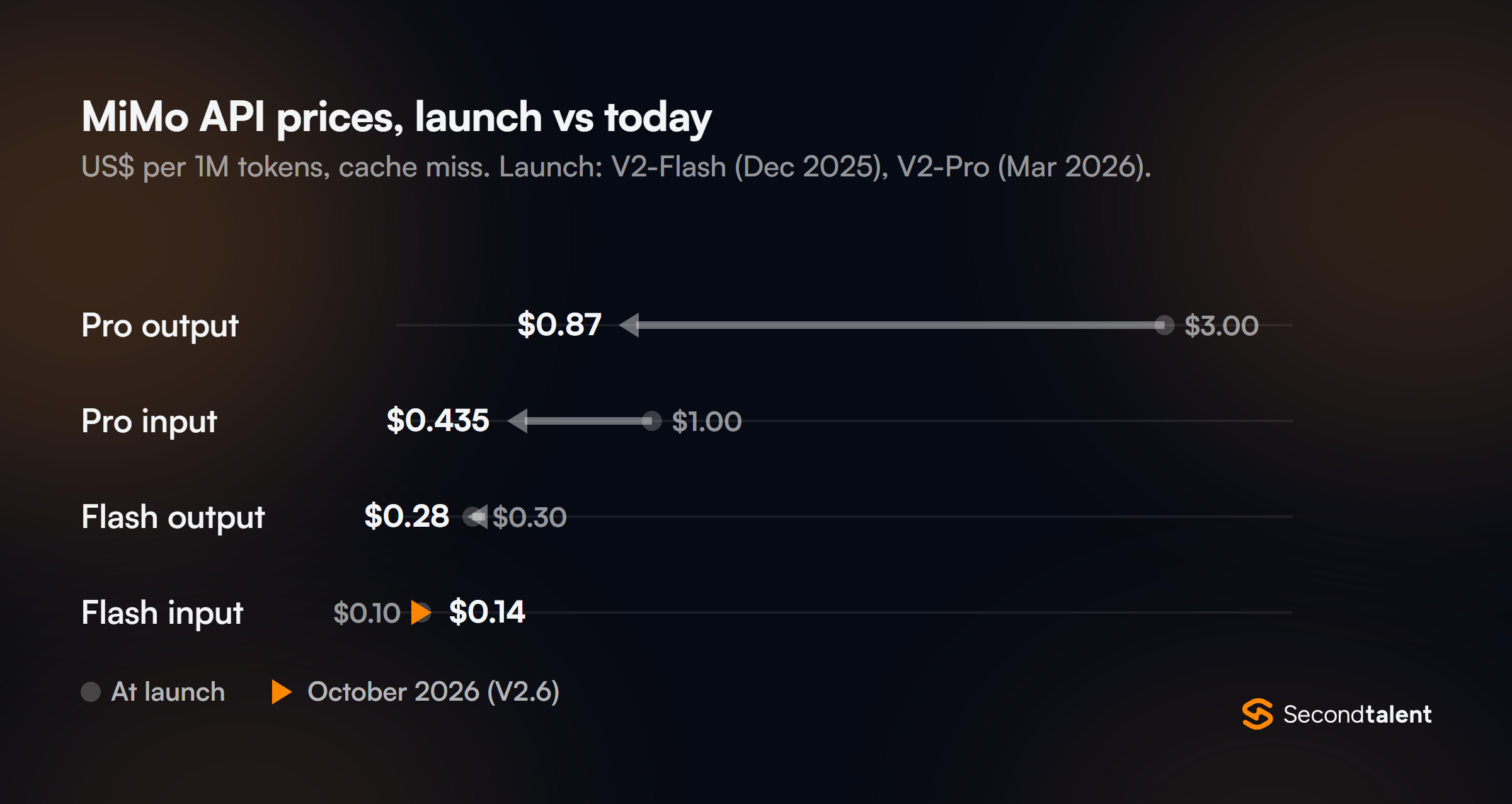
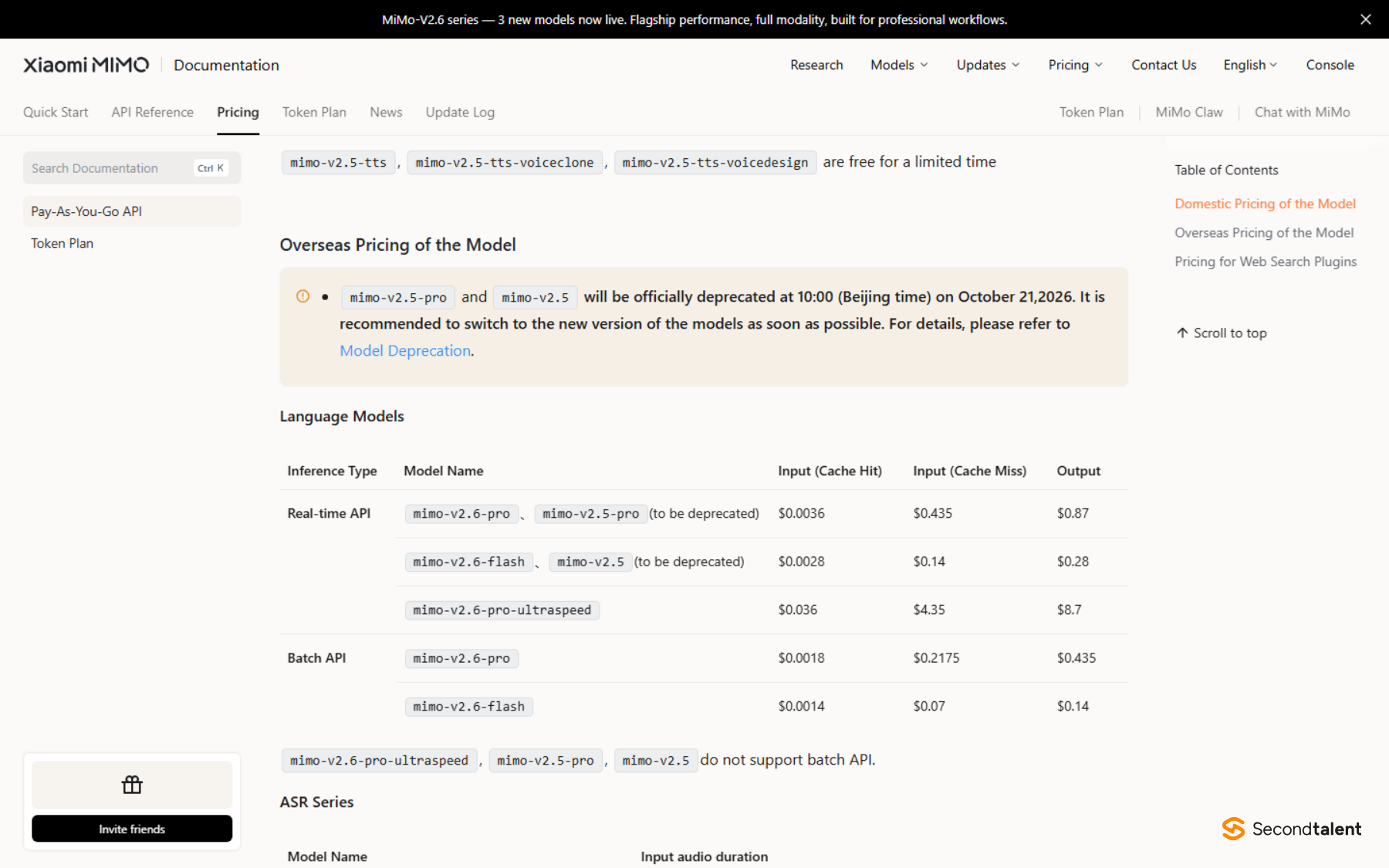
Xiaomi has cut MiMo prices since launch. V2-Pro opened at $3 per million output tokens; the V2.6-Pro that replaced it costs $0.87. The one rate that went up is Flash input, from $0.10 on V2-Flash to $0.14 today. V2-Flash requests have routed to the larger omnimodal V2.5 since June 18.
| Model | Input, cache hit | Input, cache miss | Output | Batch output |
|---|---|---|---|---|
| MiMo-V2.6-Pro | $0.0036 | $0.435 | $0.87 | $0.435 |
| MiMo-V2.6-Flash | $0.0028 | $0.14 | $0.28 | $0.14 |
| MiMo-V2.6-Pro-UltraSpeed | $0.036 | $4.35 | $8.70 | Not offered |
| MiMo-V2.5-ASR | $0.074 per hour of input audio | Not offered | ||
A cache hit on V2.6-Pro costs less than 1% of a miss, and cache writes are free for now, so long agent sessions that resend the same context cost a fraction of the list rate. Web search is billed on top at $5 per 1,000 calls outside China.
For developers who work inside coding agents, the Token Plan is a monthly subscription at $6, $16, $50 or $100, paid in credits. A V2.6-Pro output token costs 600 credits and a Flash output token 200, and usage between 00:00 and 08:00 Beijing time burns 20% fewer credits. Xiaomi says it works with OpenCode, OpenClaw and Claude Code. The models are also on OpenRouter at the same list prices.
Context Windows and Output Limits
MiMo went from a 32K context to 1M tokens in under a year, and the jump came with V2-Pro in March 2026. Every current text model now accepts 1M tokens in and returns up to 128K tokens out, at the same per-token price whatever the input length since the May 2026 repricing.
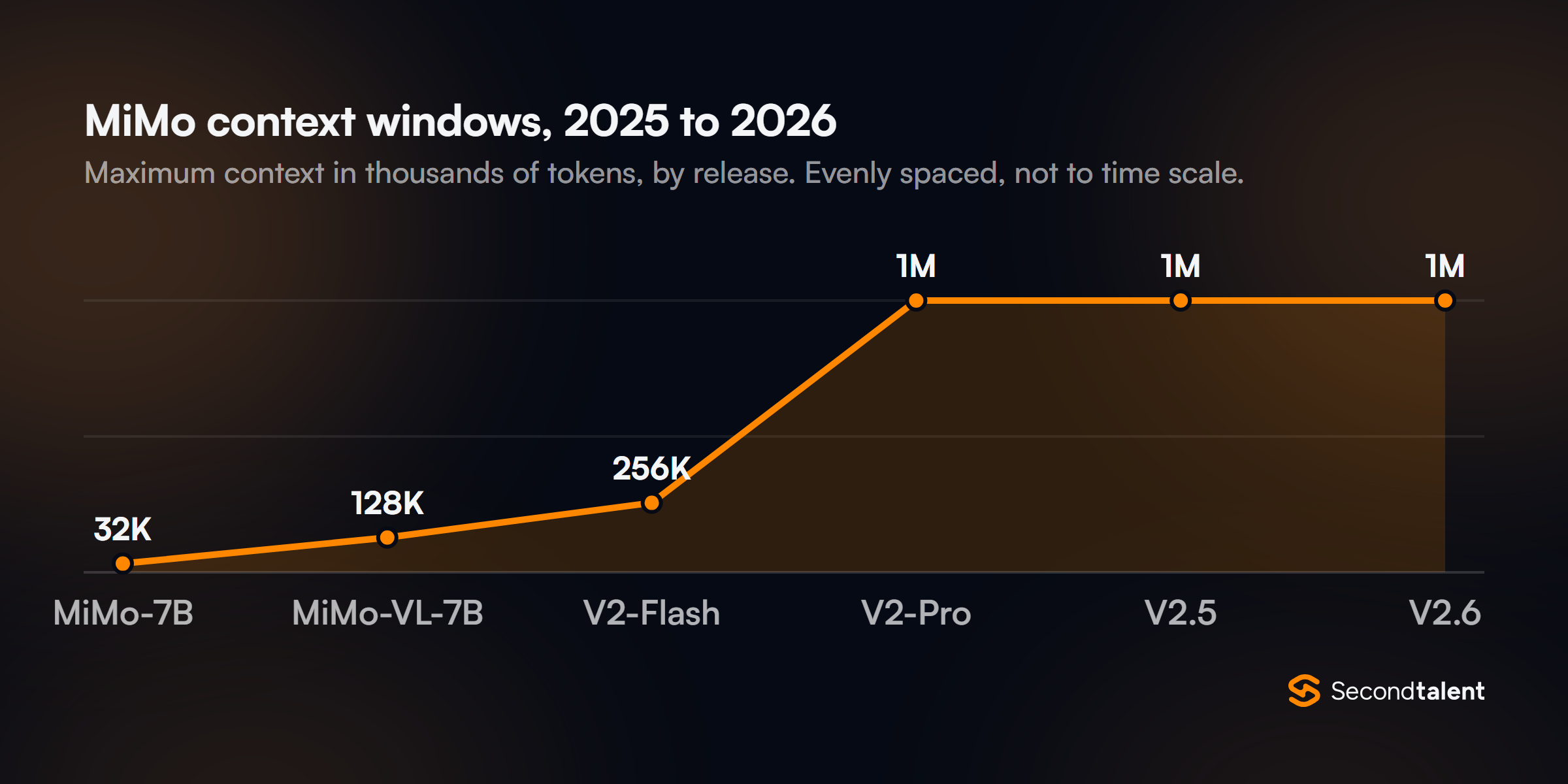
The base checkpoints are the exception. MiMo-V2.5-Base and V2.5-Pro-Base stop at 256K, because Xiaomi extends the window from 32K to 256K to 1M during post-training. Anyone fine-tuning from a base model has to redo that extension. The ASR and TTS models take 8K tokens per request. The default rate limit on the API is 100 requests and 10 million tokens a minute per account.
Licence and Self-Hosting
MIT is as permissive as model licences get. There is no revenue threshold, no attribution rule and no separate agreement for model-as-a-service businesses, which is not true of Kimi K3 or the big Qwen3.8 weights. Our MiMo vs Kimi vs Qwen comparison sets the three licences side by side.
- vLLM recipe uses 8-way tensor parallelism
- SGLang recipe spans two nodes with expert parallelism
- You own uptime, scaling and the MOPD upgrade
- $0.87 per million output tokens, half that on batch
- UltraSpeed mode only exists here
- Model names retire on Xiaomi's schedule
For most teams the API is cheaper: a 1T-parameter model needs a multi-GPU server running all day, and only steady, heavy traffic pays for one. Flash is the realistic self-hosting target: 15B active parameters is a lighter decode load, and Xiaomi's SGLang and vLLM recipes cover it.
Which MiMo Model Should You Use?
Start with V2.6-Flash and move to Pro when a task fails. The table maps common jobs to a model.
| Job | Model | Why |
|---|---|---|
| Coding agents, long refactors | V2.6-Pro (MOPD weights if self-hosted) | 71.9 on DeepSWE, fewest repeated tool calls |
| High-volume chat, extraction, tagging | V2.6-Flash on the Batch API | $0.14 per million output tokens |
| Live voice or real-time UI agents | V2.6-Pro-UltraSpeed | Up to 20x Pro's output speed |
| Image, video or audio understanding | V2.6-Flash | Native omnimodal input at Flash prices |
| Transcription in Chinese dialects | V2.5-ASR | $0.074 an hour, open weights |
| Research on one GPU | V2.6-Distill-Qwen-9B | 9B dense, MIT, agent-tuned |
For the wider field of Chinese labs, our roundup of Chinese open-source LLM leaders covers the companies behind them.
Compare other model families
Build on MiMo With the Right Engineers
Wiring MiMo into an agent harness, or serving a trillion-parameter model on your own GPUs, takes engineers who have done it before. We place vetted LLM developers from Asia, and our LLM developer cost guide shows what a hire costs. Tell us what you are building and we will send a shortlist within 48 hours.
Frequently Asked Questions
Is Xiaomi MiMo open source?
Most of it. Every MiMo model on Hugging Face, from MiMo-7B to V2.6-Pro, is MIT-licensed, and V2.6 also comes with Xiaomi's RL code and training environments. The exceptions were MiMo-V2-Pro, V2-Omni and the TTS models, which were only ever available through the API.
Can I use MiMo for free?
The open weights cost nothing to download, and the TTS series is free on the API for a limited time. API use of the text models is paid, by the token or through the Token Plan.
Can I use the MiMo API outside China?
Yes. The MiMo API Platform bills overseas accounts in US dollars at separate rates from the RMB price list, and the V2.6 models are also sold through OpenRouter.