Skip to content

Perplexity AI Features and Capabilities in 2026: The Complete Guide

By Elton Chan 15 min read

TL;DR: Perplexity AI now has 45M+ users, Deep Research, agentic Computer tools, and a full browser. Here is everything it can do in 2026.

Google has dominated search for over 25 years. Now a startup is changing how people find information online. Perplexity AI processes over 1 billion queries per month in 2026. It does not give you a list of links. It gives you direct answers with sources you can verify.

We have seen this shift among our clients. Engineering teams and product managers at startups across Asia now use Perplexity as their primary research tool. One CTO we work with said his team cut their research time in half after switching from Google to Perplexity for technical documentation searches.

This guide covers every major Perplexity AI feature in 2026. We include pricing, real benchmarks, and how businesses are using it. Whether you are evaluating it for your team or building products on its API, this is what you need to know.

Quick Overview: Perplexity AI in 2026

FeatureWhat It DoesAvailable On
AI SearchAnswers questions with real-time web data and inline citationsFree, Pro, Max
Deep ResearchMulti-step analysis using hundreds of sources. Runs on Claude Opus 4.5/4.6Pro, Max
Model CouncilRuns your query through 3 AI models at once and compares outputsPro, Max
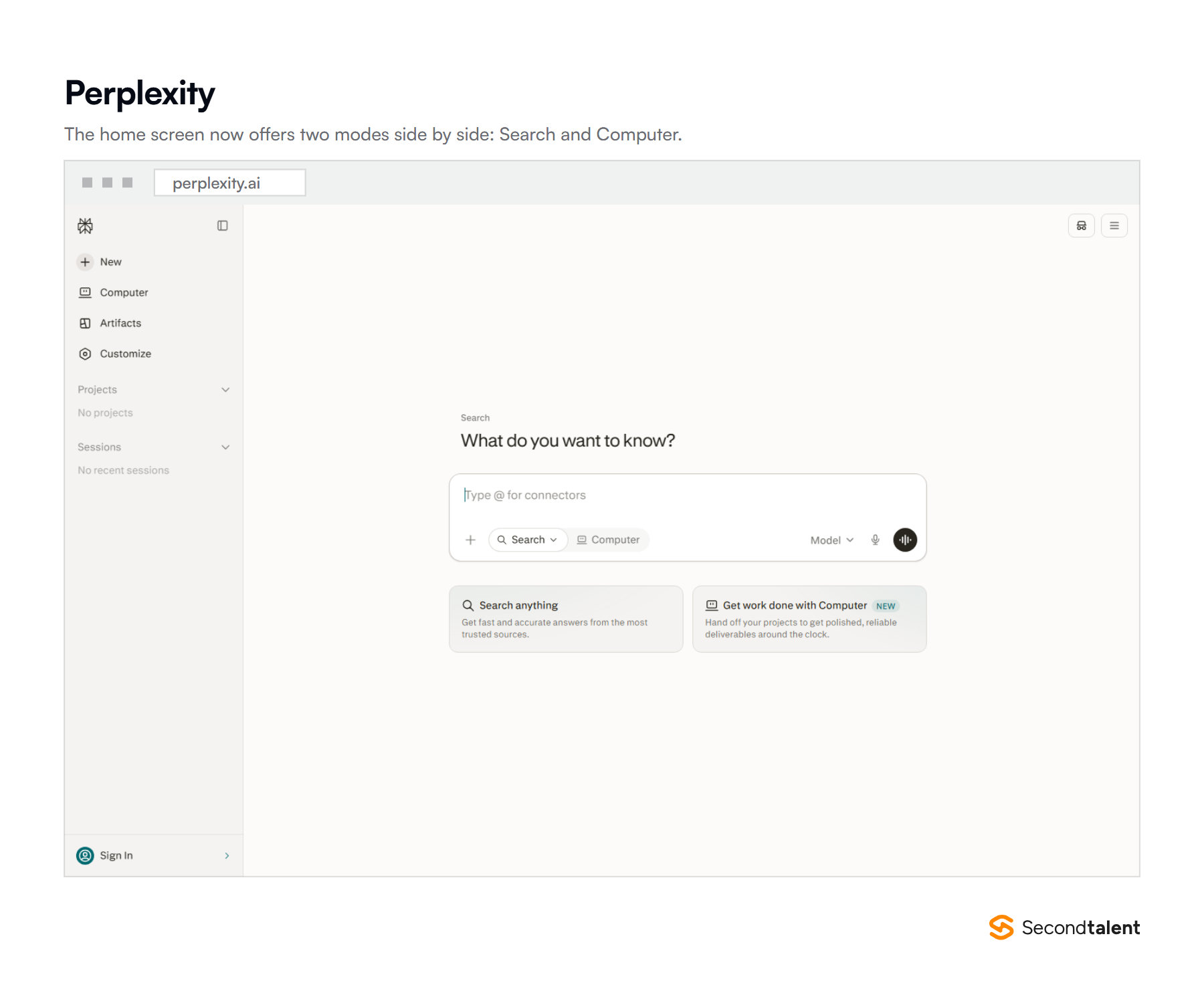
Perplexity ComputerAutonomous AI agent that executes workflows across 19 modelsMax only
Personal ComputerAlways-on AI on a dedicated Mac mini. Works 24/7 as a digital proxyMax only
Comet BrowserAI-native Chromium browser with built-in assistantFree (all platforms)
Sonar APISearch-grounded AI API for developers. OpenAI-compatiblePay-as-you-go
EnterpriseAdmin controls, audit logs, model restrictions, team SpacesEnterprise Pro/Max

Perplexity has grown from a simple AI search tool to a full platform. It now competes with Google, ChatGPT, and even enterprise software companies like Microsoft and Salesforce.

Perplexity AI Growth and Market Position

AI Chatbot Market Share 2026 - ChatGPT 82.7%, Perplexity 8%, Microsoft Copilot 7.2%

The numbers tell the story. Perplexity AI has grown faster than almost any AI product except ChatGPT.

As of early 2026, Perplexity has over 45 million monthly active users. That is more than double the 22 million it had at the start of 2025. The platform attracts 170 million global visitors each month.

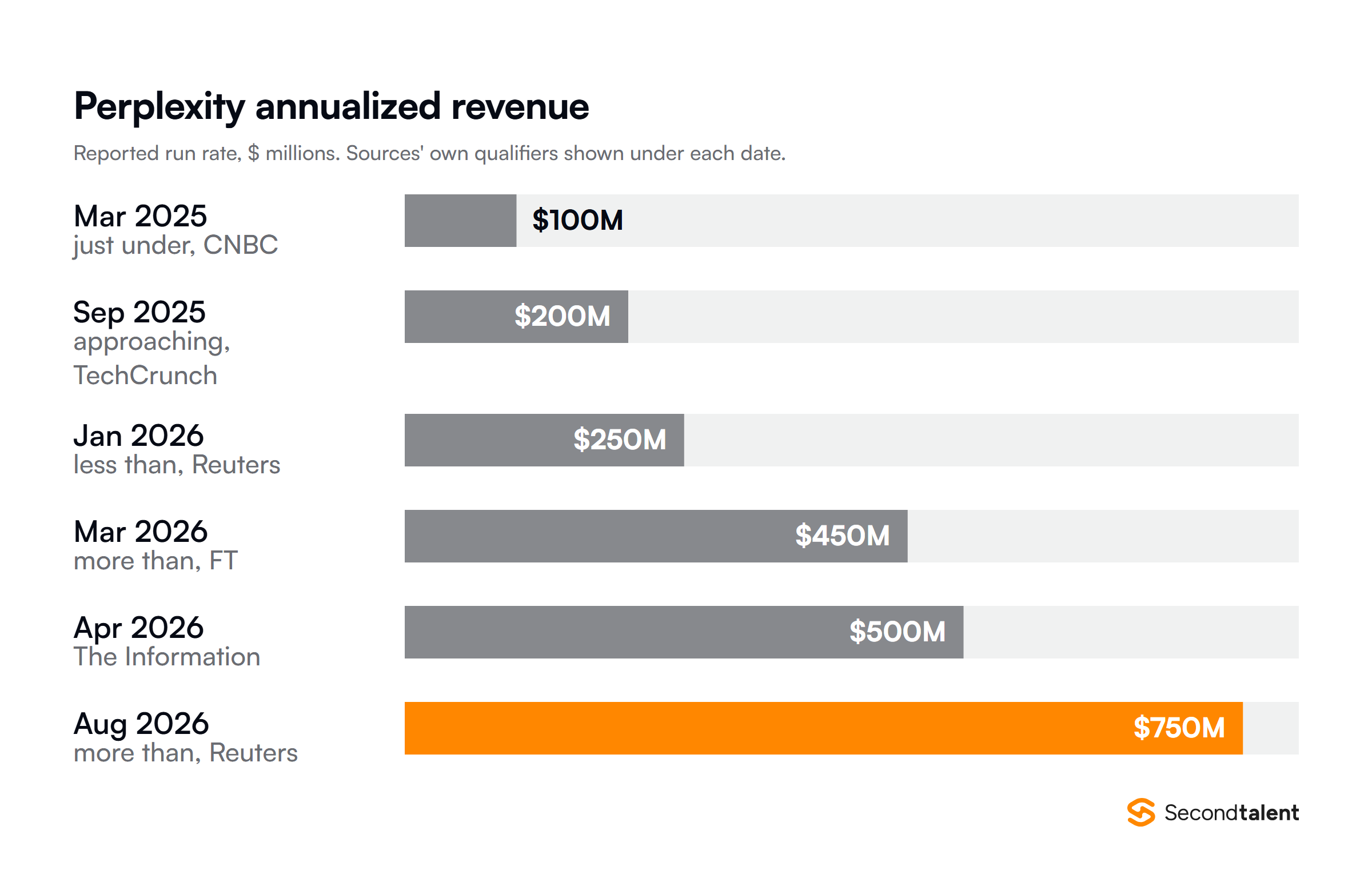
Revenue hit $200 million in 2025. That was a 300% increase from the previous year. In 2026, annualized recurring revenue climbed past $450 million in March alone. The company is valued at approximately $20 billion.

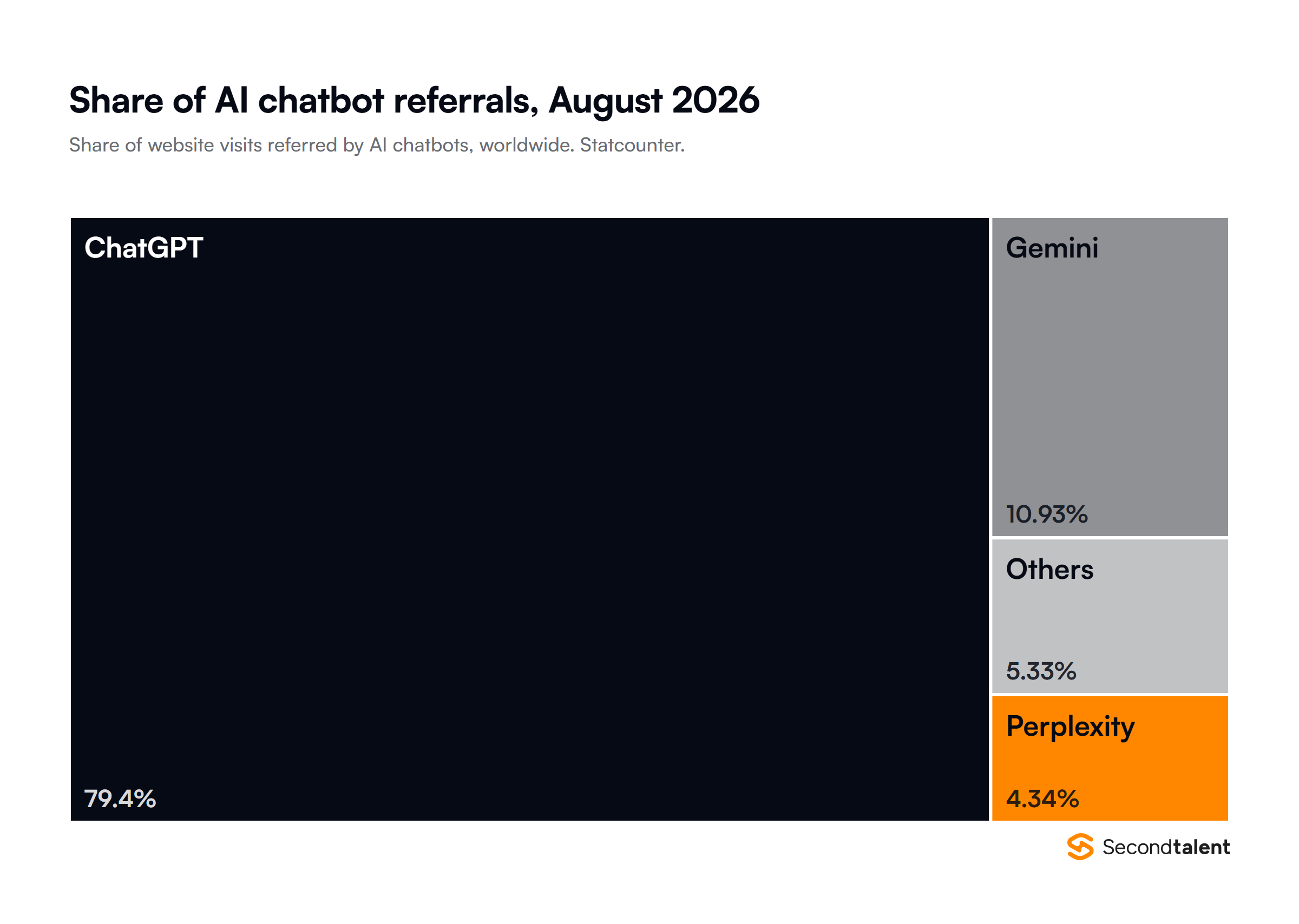
Perplexity holds between 6% and 8% of the AI chatbot market share. ChatGPT leads with about 83%. Microsoft Copilot sits at 7%. But Perplexity is growing faster than both in percentage terms.

AI Chatbot Market Share 2026

ChatGPT
82.7%
Microsoft Copilot
7.2%
Perplexity AI
8.0%
Others
2.1%
Perplexity AI Growth Metrics - 45M MAU, 170M visitors, $450M ARR

Perplexity’s main product is its AI search engine. You ask a question in plain language. It searches the web in real time, reads the results, and gives you a single answer with citations.

This is different from Google in two ways. First, you get a direct answer instead of 10 blue links. Second, every claim links to its source. You can check the facts yourself. Independent benchmarks show Perplexity achieves 92% factual accuracy on real-time queries. ChatGPT scores 87% on the same tests.

The search engine indexes over 50 billion web pages. It updates in real time. When you search for breaking news or recent data, Perplexity pulls fresh information within minutes of publication.

For businesses, this means faster research. We placed a product manager at a Singapore startup last quarter. She told us she uses Perplexity for competitive analysis, market sizing, and technical research daily. Tasks that used to take 2 hours now take 30 minutes.

Deep Research: Multi-Step Analysis

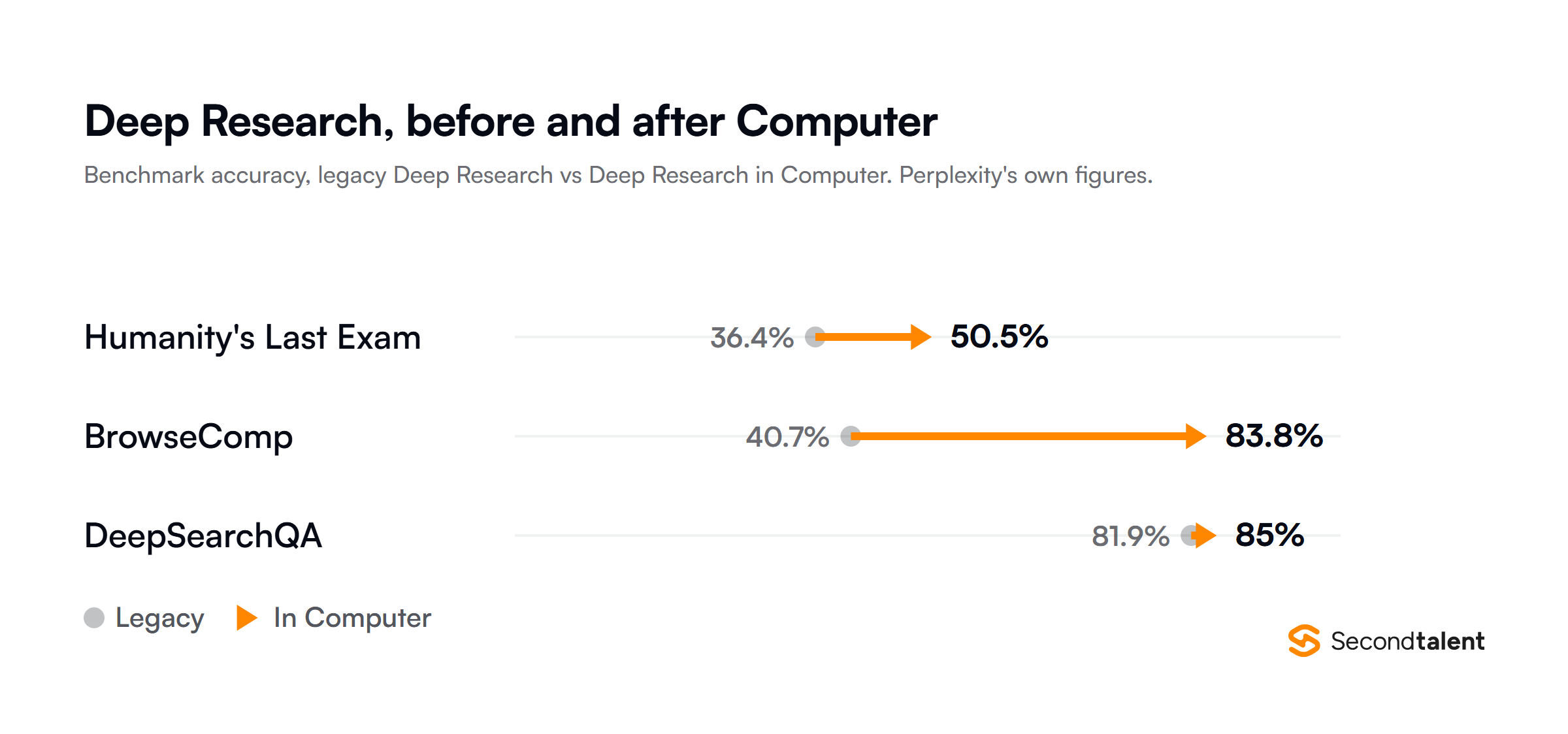
Deep Research is Perplexity’s premium research feature. It does not just search once. It searches dozens of times across hundreds of sources. It reads full articles, compares data, and writes a detailed report.

As of 2026, Deep Research runs on Claude Opus 4.5 and 4.6 for Pro and Max users. This gives it strong reasoning and analysis capabilities. Perplexity says it achieves state-of-the-art performance on external research benchmarks.

A typical Deep Research query takes 2 to 5 minutes to complete. In that time, the system may visit 100 or more web pages. It cross-references data points, flags contradictions, and produces a structured report with sections and citations.

This is useful for investment research, market analysis, and technical evaluations. One venture capital firm we work with uses Deep Research to generate preliminary due diligence reports on startups. It used to take an analyst 4 hours per company. Now it takes 10 minutes, plus 30 minutes of human review.

Model Council: Compare AI Models Side by Side

Model Council launched on February 5, 2026. It lets you run a single query through three different AI models at the same time. You see all three responses and can compare them.

Available models include GPT-5.2, Claude 4.6, and other frontier models. You pick which three you want. The system runs your query through all of them in parallel.

This feature solves a real problem. Different AI models have different strengths. GPT-5.2 might give a better creative answer. Claude 4.6 might give a more accurate technical answer. By comparing three outputs, you get a more reliable result.

Engineering teams use Model Council for code reviews and architecture decisions. When the stakes are high, you want more than one opinion. Model Council gives you three in the time it takes to get one.

Perplexity Computer: Autonomous AI Agent

Perplexity Computer is one of the biggest launches of 2026. It is an autonomous AI agent that can execute complex workflows on your behalf. It can browse the web, use software, fill forms, and manage multi-step tasks without your input.

The agent uses 19 different AI models. It picks the best model for each step of a task. It can even create subagents to handle specific parts of a workflow in parallel.

Real use cases include: reviewing documents, planning marketing campaigns, adjusting ad spend, generating tax filings, and booking travel. The system handles cognitive work that previously required a human at every step.

Perplexity reports that 57% of all agent activity focuses on cognitive work. Software engineers, financial analysts, and market strategists are the most common users. The enterprise version launched in early 2026, with over 100 enterprise customers requesting access in a single weekend.

Computer is available only on the Max plan at $200 per month. It is the most expensive Perplexity feature. But for teams that rely on research and analysis, the time savings are significant.

Personal Computer: Always-On AI

Personal Computer takes the Computer agent further. It is an always-on AI that runs on a dedicated Mac mini. It merges your local files, apps, and sessions with Perplexity Computer.

This means the AI works 24/7. It monitors triggers, executes proactive tasks, and carries work forward around the clock. You can control it from any device, anywhere.

Security is built in. Every sensitive action requires explicit approval. There is a full audit trail and a kill switch. You stay in control of what the AI can and cannot do.

This feature targets power users and enterprise teams. Think of it as a digital assistant that never sleeps. It can handle overnight research, monitor data sources, and have reports ready when you start your workday.

Comet Browser: AI-Native Web Browsing

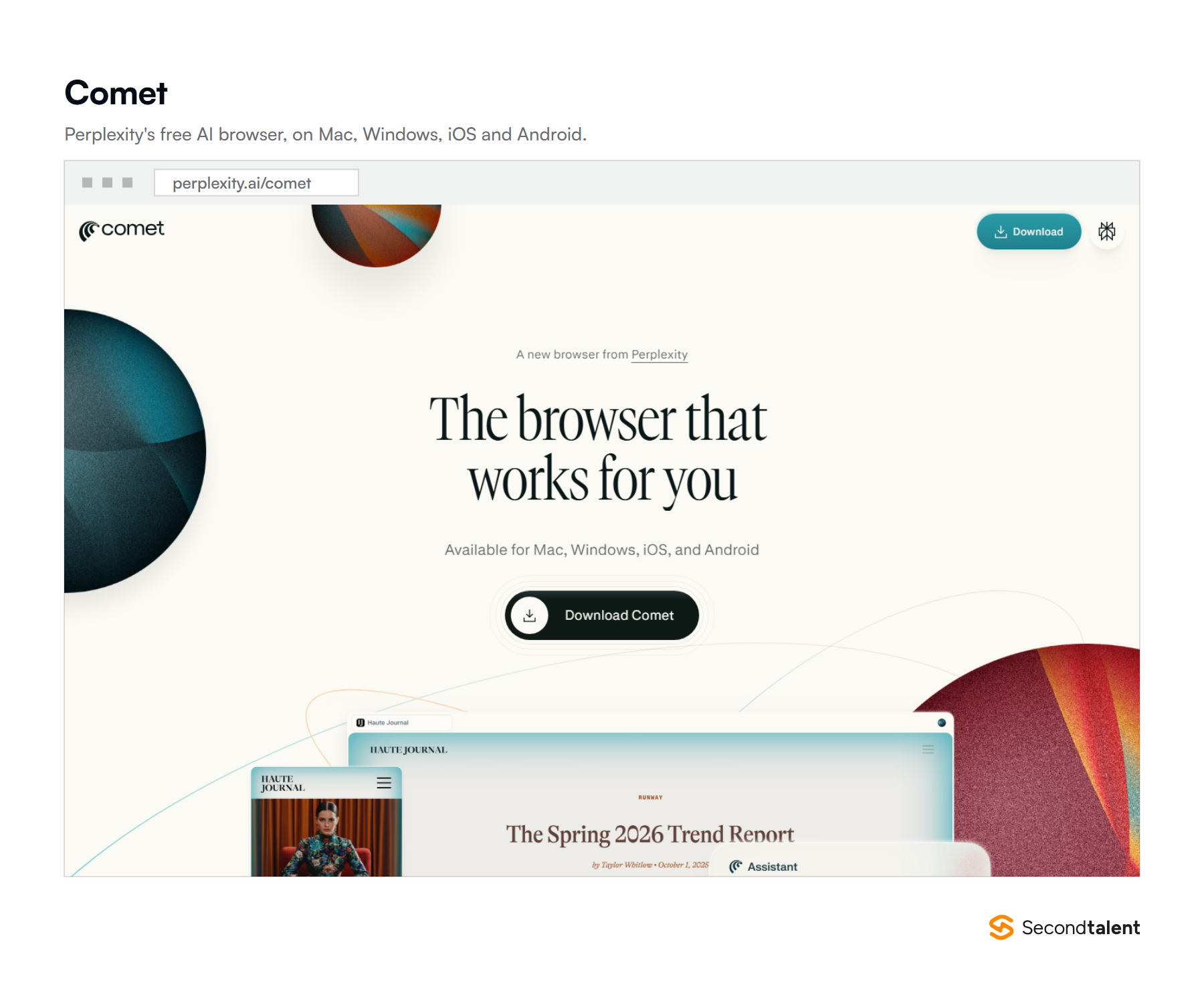
Comet is Perplexity’s AI-powered web browser. It is built on Chromium and works like Chrome or Edge. But it has an AI assistant built into every page.

The browser launched on Windows and macOS in July 2025. It came to iOS in March 2026. It is free on all platforms.

Key features include in-page research, page summarization, and autonomous multi-step tasks. You can chat with the content of any web page. Ask questions about what you are reading, and Comet answers using the page content plus web search.

Comet also handles practical tasks. It can book flights, manage email, fill forms, and translate pages automatically. The Computer agent can take full control of Comet to complete complex browser-based workflows.

For engineering teams, Comet is useful for documentation research. You can highlight code snippets and ask Comet to explain them, find related documentation, or suggest improvements. All without leaving the page.

Perplexity AI Pricing in 2026

Perplexity AI Pricing - Free to $325/mo Enterprise Max

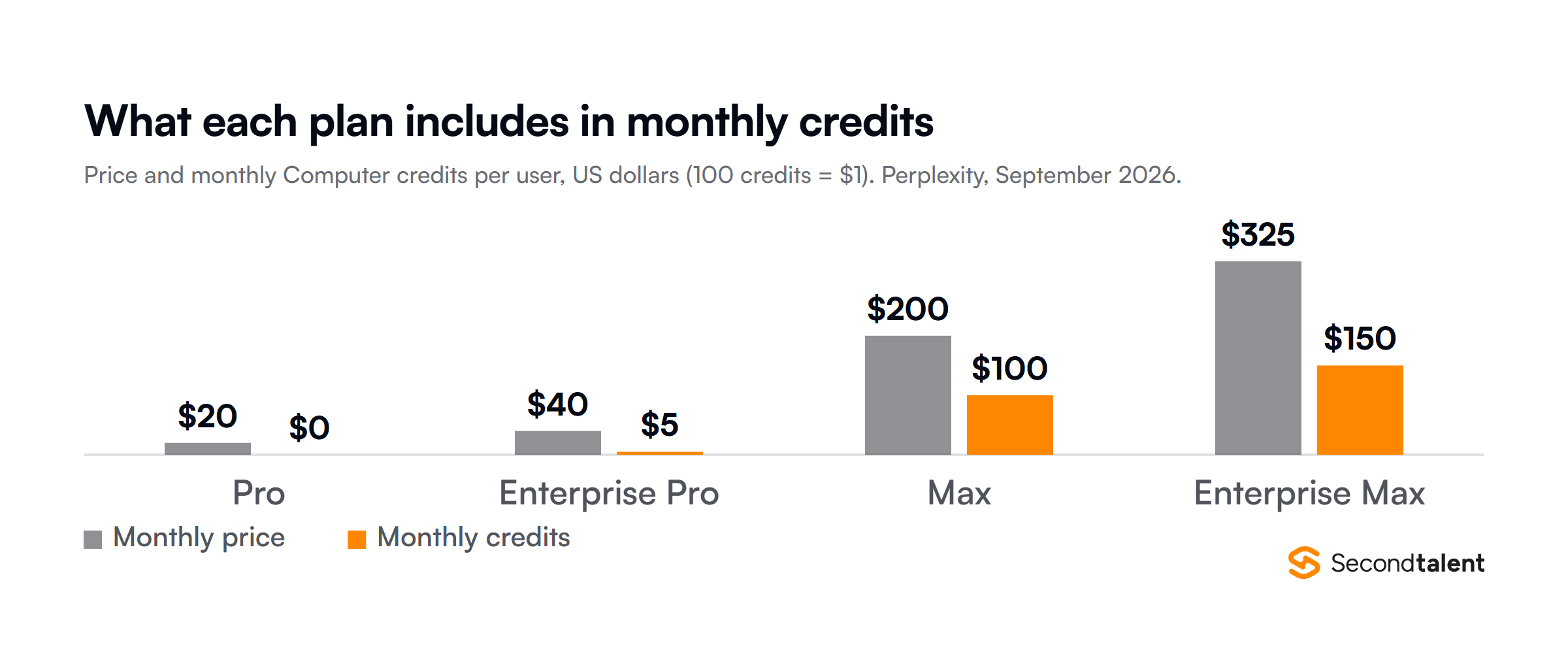
Perplexity now has five tiers for individual and enterprise users. Here is the full breakdown.

PlanPriceKey FeaturesBest For
Free$0Limited daily searches, basic models, no file uploadCasual users
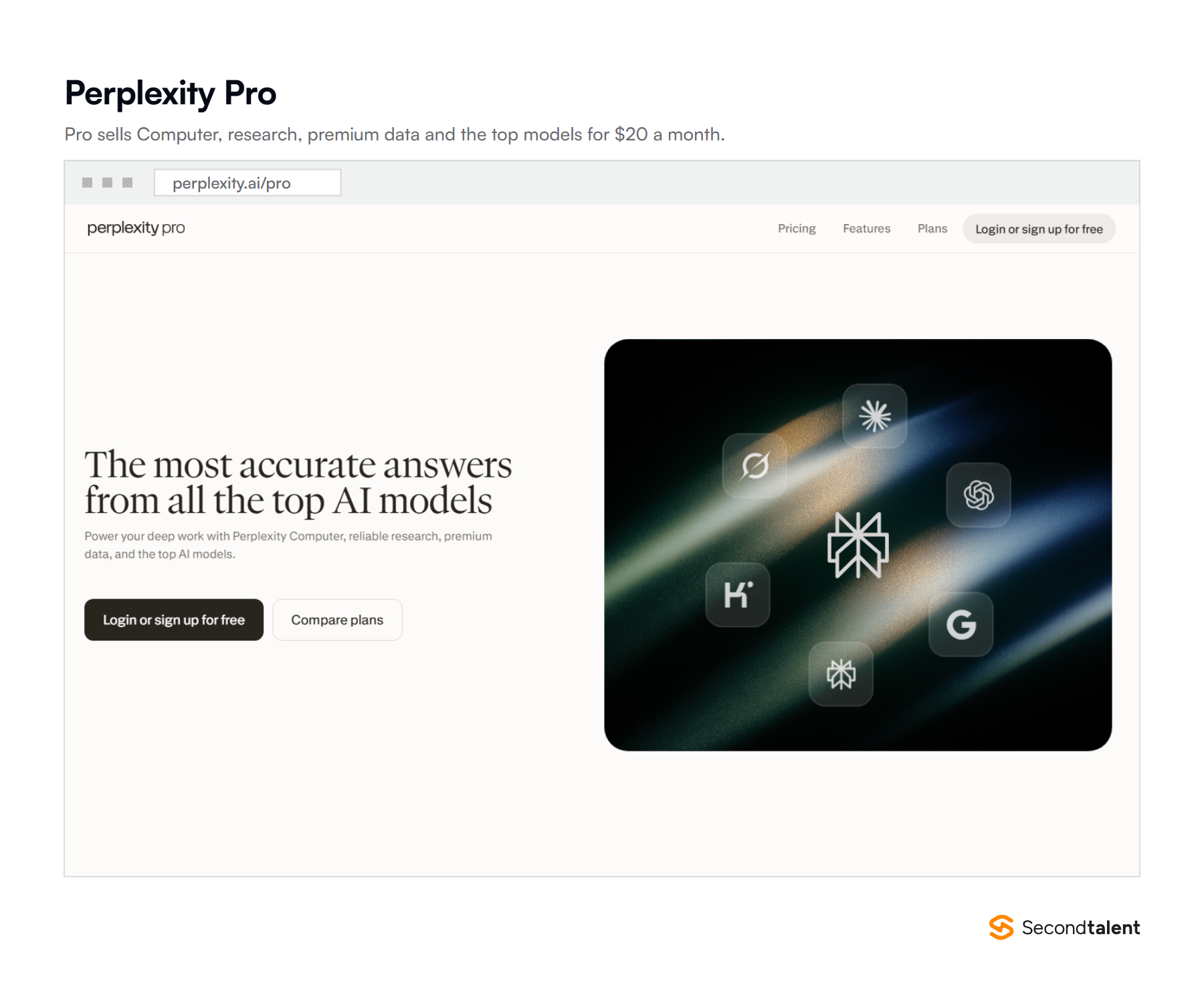
Pro$20/month or $200/yearUnlimited Pro Search, Claude/GPT-4o/Mistral, file uploads, image generationProfessionals
Max$200/monthAll Pro features + Computer agent, Personal Computer, all frontier modelsPower users
Enterprise Pro$40/seat/monthAll Pro features + admin controls, audit logs, SSOTeams
Enterprise Max$325/seat/monthAll Max features + enterprise security, dedicated supportResearch teams

The Pro plan at $20 per month is the sweet spot for most professionals. You get unlimited searches, access to multiple AI models, and file upload capabilities. The Max plan at $200 per month is expensive but includes the Computer agent, which can save hours of work per day for heavy users.

Students and educators can get Pro for $10 per month. Some universities offer the first 12 months free.

Monthly Cost by Plan (USD)

Free
$0
Pro
$20
Enterprise Pro
$40
Max
$200
Enterprise Max
$325

Sonar API: Build AI Search Into Your Products

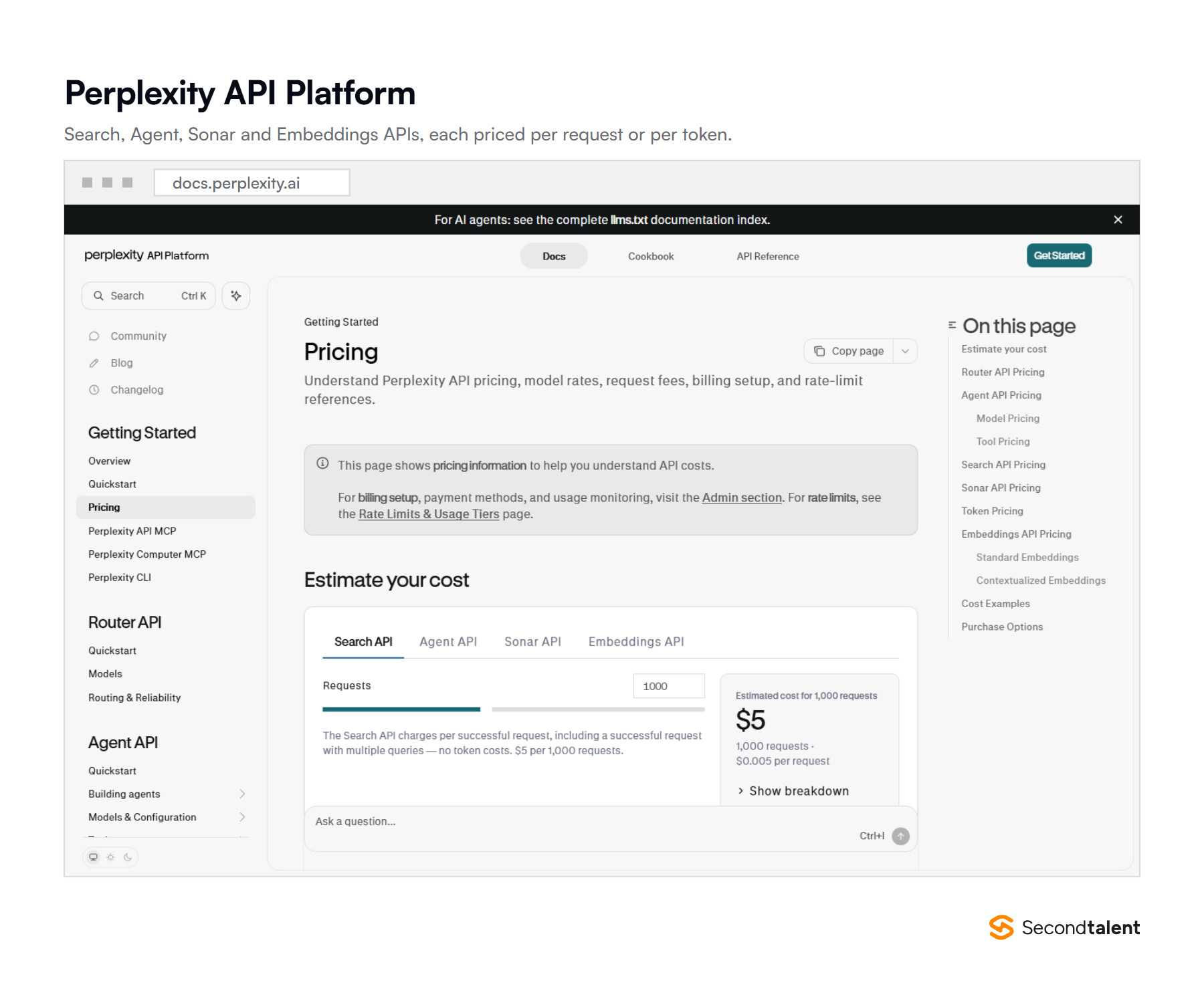
Perplexity’s Sonar API lets developers add AI-powered search to their own applications. It is one of the most developer-friendly AI APIs available in 2026.

The API is OpenAI-compatible. If your app already uses OpenAI’s API, you can switch to Perplexity by changing the base URL and model name. No other code changes needed.

The platform includes four APIs under one key:

  • Search API: Real-time web-grounded retrieval across 200+ billion indexed URLs
  • Agent API: Orchestrate multi-step workflows with AI agents
  • Embeddings API: Vector embeddings for retrieval at scale
  • Sandbox API: Secure code execution for AI-generated code

Pricing starts at $1 per million input tokens and $1 per million output tokens. There are no monthly minimums. You pay only for what you use.

We have seen startups in Southeast Asia build products on top of the Sonar API. One client built an internal knowledge base that searches their company documents and the web simultaneously. Another built a customer support tool that answers questions using their product documentation plus real-time web data. Both shipped in under two weeks using the API.

Perplexity vs. ChatGPT vs. Google in 2026

Search Accuracy - Perplexity 92% vs ChatGPT 87% on real-time queries

Each tool has its strengths. The smart approach in 2026 is knowing which tool to use for each task.

CategoryPerplexity AIChatGPTGoogle Search
Best forResearch, fact-checking, cited answersContent creation, coding, conversationLocal results, shopping, breaking news
Citation qualityInline citations on every responseCitations available but inconsistentLinks to source pages
Real-time dataYes, 50B+ pages indexedYes, with web browsingYes, largest index
Factual accuracy92% on real-time queries87% on real-time queriesVaries by source
Monthly active users45M+400M+ weekly8.5B+ searches/day
Free tierLimited daily searchesGPT-4o with limitsUnlimited
AdvertisingNo adsAds launched in 2026Ads in 25.5% of AI results

Perplexity wins on research quality and citation accuracy. ChatGPT wins on content creation and coding assistance. Google wins on breadth, local search, and shopping. Most professionals use all three.

One key difference: Perplexity abandoned advertising entirely. ChatGPT launched ads and hit $100 million in annualized ad revenue within weeks. Google weaves ads into 25.5% of its AI-generated results. If you want unbiased search results, Perplexity is the only major option without ads.

Enterprise Features and Business Adoption

Perplexity’s enterprise push is one of the biggest stories of 2026. The company now serves tens of thousands of enterprise clients. About 11% of organizations that use generative AI tools have adopted Perplexity.

Enterprise features include admin controls for feature access, model restrictions, audit logs with AI-generated answers, SSO integration, and shared Spaces for team collaboration.

The most active enterprise users are in research-heavy industries. Legal teams use it for contract analysis and compliance checks. Investment teams use it for market intelligence and due diligence. Marketing teams use Perplexity Computer to automate campaign planning.

Perplexity has transformed from a consumer search tool into a direct competitor to Microsoft and Salesforce in the enterprise AI space. It is no longer just about search. It is about automating knowledge work.

How Teams Are Using Perplexity AI

Based on our work with engineering and product teams across Asia, here are the most common use cases we see.

Technical research. Engineers use Perplexity to find documentation, compare libraries, and debug issues. The citation feature means they can trace every answer back to the source documentation.

Market analysis. Product managers use Deep Research to generate market reports. It pulls data from multiple sources and synthesizes it into a single document. This used to require an analyst and several hours. Now it takes minutes.

Competitive intelligence. Sales and strategy teams use Perplexity to track competitors. They monitor product launches, pricing changes, and hiring patterns. The real-time search means the data is always current.

Content verification. Writers and editors use Perplexity to fact-check articles before publication. The inline citations make verification fast. You can click through to the original source in seconds.

API integration. Development teams build Perplexity’s search into their own products. Customer support bots, internal knowledge bases, and research tools all benefit from web-grounded AI responses.

What Perplexity Does Better Than Competitors

Perplexity is not the biggest AI platform. But it does several things better than ChatGPT and Google.

Citations on every response. This is Perplexity’s biggest advantage. Every factual claim links to its source. You never have to wonder where the information came from. ChatGPT provides citations inconsistently. Google gives you links but not synthesized answers.

No advertising. Perplexity’s answers are not influenced by ad revenue. When you search for a product or service, you get unbiased results. This matters for business decisions.

Multi-model access. You are not locked into one AI model. Pro users can switch between Claude, GPT-4o, and Mistral. Model Council lets you compare three models at once. No other platform offers this level of model flexibility.

Real-time web search. Perplexity’s search is always live. It does not rely on training data from months ago. When you need current information, the results are fresh.

Limitations and Drawbacks

Perplexity is not perfect. Here are the main limitations you should know about.

The free tier is very limited. You get only 5 to 10 Pro searches per day. For any serious use, you need a paid plan.

The Max plan at $200 per month is expensive for individual users. Enterprise Max at $325 per seat per month is a significant investment for teams. Smaller companies may find the cost hard to justify.

Perplexity is weaker than ChatGPT for content generation and coding. It is built for search and research, not creation. If you need to write long documents, generate code, or have extended conversations, ChatGPT is still the better tool.

The Computer agent is powerful but still new. It can make mistakes on complex workflows. You should review its output carefully, especially for tasks involving financial data or legal documents.

Who Should Use Perplexity AI

Which Perplexity Plan Fits Your Needs?

Select the option that best describes your primary use case.

If your job involves research, analysis, or fact-checking, Perplexity Pro is worth the $20 per month. The time savings pay for themselves within the first week for most professionals.

If you build software products that need search or web-grounded AI, the Sonar API is a strong option. It is cheaper than building your own search pipeline and more accurate than most alternatives.

If you manage a team that does heavy research, the Enterprise plans offer real value. Admin controls, audit logs, and shared Spaces keep everything organized and secure.

Building With AI: The Talent You Need

Perplexity AI shows where the industry is heading. AI search, autonomous agents, and multi-model platforms are the new standard. Companies that adopt these tools early will move faster than competitors.

But adopting AI tools is only half the equation. You need engineers who know how to build with them. You need product managers who understand AI capabilities. You need data scientists who can evaluate and fine-tune model outputs.

We work with companies across Asia that are building AI-powered products. They use tools like Perplexity’s Sonar API, build internal AI agents, and integrate multiple models into their workflows. The demand for AI and ML engineers has never been higher.

Perplexity AI ROI Calculator

Estimate how much time your team could save with Perplexity Pro.

5 people
3 hours
$50/hr

The Bottom Line

Perplexity AI in 2026 is no longer just a search engine. It is a research platform, an AI agent framework, a browser, and a developer API. It processes over a billion queries per month. It serves 45 million users. And it is growing faster than the rest of the market.

For professionals, Pro at $20 per month is a no-brainer. The research time savings alone justify the cost. For power users, Max at $200 per month gives you access to autonomous AI agents that handle complex workflows. For teams, the Enterprise plans add the controls and security you need.

The companies building the most competitive products in 2026 are the ones using tools like Perplexity. But tools alone are not enough. You need the right team to build with them.

If you are hiring engineers, AI specialists, or marketers who understand the AI landscape, we can help. Second Talent connects companies with pre-vetted talent across 9 Asian markets. No upfront fees. Shortlists in 24 hours.

Get matched with top talent today →

Ready to hire AI-native talent in Asia?

Get pre-vetted senior engineers matched to your stack in 24 hours. $0 upfront. Pay only when you make a hire.

Start Hiring

Written by

Elton Chan is the Co-Founder of Second Talent, a solution that connects global tech leaders with top-tier tech talent across Asia. He specializes in talent solutions and has led Second Talent’s rapid growth since 2024, helping scale its network to over 100,000 pre-vetted developers and earning industry recognition as the #1 in the Global Hiring category on G2. A long-time entrepreneur with deep roots in digital transformation, Elton previously co-founded Branch8, a Y Combinator–backed e-commerce technology firm, and served as the Founding Chairman of HKEBA, a leading Asia-focused business association driving innovation, digital education, and cross-border collaboration. His work bridges technology, talent, and business strategy to shape how companies scale in an increasingly remote and digital world.

More posts by Elton Chan →

Keep Reading

Artificial intelligence | May 11, 2026

How Enterprises Are Using AutoGen in 2026: Use Cases, Architecture, and Cost

Microsoft AutoGen powers production multi-agent AI workflows in 2026. We cover the eight enterprise use cases, architecture patterns,…

Artificial intelligence | May 9, 2026

Top 5 Chinese AI Search Engines in 2026

5 leading Chinese AI search engines in 2026: Baidu's ERNIE, Doubao, DeepSeek, Kimi, and Qwen. Capabilities and use…

Artificial intelligence | May 9, 2026

Top 20 AI Fintech Startups in Asia (2026)

20 AI fintech startups across Asia reshaping payments, lending, and risk in 2026. Funding, products, and where they…

Artificial intelligence | May 9, 2026

How Much Software Is Written by AI in 2026? The Real Numbers

How much code is AI-generated in 2026, by company and by language. Survey data, GitHub Copilot stats, and…

Artificial intelligence | May 9, 2026

ChatGPT Statistics 2026: Users, Revenue, and Enterprise Adoption

ChatGPT hit 900M weekly active users and $25B annualized revenue in 2026. Full stats on growth, enterprise adoption,…

Artificial intelligence | May 9, 2026

AI Impact on the Job Market in 2026: What the Data Shows

AI is reshaping the 2026 job market: where roles are disappearing, where new ones are emerging, and what…

Hiring | May 18, 2026

How to Hire Engineers When You’re Not Technical in 2026

TL;DR: Use structured interviews, technical assessments, and trusted partners to hire engineers without coding knowledge. You built your…

Country Guides | May 9, 2026

Tech Job Market Trends 2026: Hiring, Pay, and What Comes Next

Tech job market trends in 2026: hiring slowdowns, pay shifts, AI-driven role changes, and where engineering demand is…

Country Guides | May 9, 2026

Thailand Payroll Process: The Complete 2026 Guide

Run payroll in Thailand in 2026: progressive taxes, social security, monthly filings, and the deadlines you cannot miss.

WhatsApp