TL;DR: A database administrator keeps the databases running: backups, patches, access rights and performance. A database manager runs the database team; when that means staff and budget, US job data counts it with IT managers at a $175,140 median, against $104,620 for DBAs (May 2025). Many employers use "database manager" for a senior hands-on DBA, so read the duties before the title.
The US Labor Department's O*NET database files "Database Manager" as a job title for database administrators, next to "Database Engineer". On paper, the two can be one job.
I read the BLS and O*NET entries and the AWS, Microsoft and Google docs on October 5, 2026. The split that matters is running databases versus running the team.
- 1BLS projects no growth in DBA jobs from 2025 to 2035, and 9% growth for database architects.
- 2On Amazon RDS, AWS takes over 10 of the 11 management tasks in its own comparison table. Query and application tuning stays with you.
- 3BLS lists 5 years or more of related work experience for IT managers, the category for a database manager who leads staff.
- 4Microsoft still certifies a cloud database administrator; Google Cloud certifies a database engineer for much the same work.
What is the difference between a database administrator and a database manager?
A database administrator (DBA) is the specialist who installs, secures, backs up and tunes a company's databases. A database manager leads the DBAs and owns the plan: staffing, standards, security policy and disaster recovery.
The DBA works on the database. The manager works on the team and the decisions around it.
Ourdatabase administrator role guide lists database manager as the leadership step after senior DBA, which is how most career ladders treat it.
- Plan and install upgrades of database software
- Implement security measures for data files
- Specify user access levels for each part of the database
- Test changes to databases and applications
- Train users and answer their questions
- Assign and review the work of technical staff
- Set priorities, standards and deadlines
- Recruit, hire, train and supervise staff
- Plan data security and disaster recovery
- Meet vendors and department heads to resolve problems
The left column comes from O*NET's Database Administrators profile (15-1242.00).
The right one comes from Computer and Information Systems Managers (11-3021.00), the code a manager of database staff falls under once supervision is the main job.
Where each title sits in the official job codes
O*NET splits database work across two technical codes and one management code. Employers' own titles cross all three codes:
So a "Database Manager" ad can land in either place. If the role patches servers and answers tickets, it is a DBA job with a senior title. If it hires, sets budgets and reports to the CIO, it is an IT manager job.
Search O*NET for "database manager" and Database Administrators comes back as the first match. IT managers come seventh.
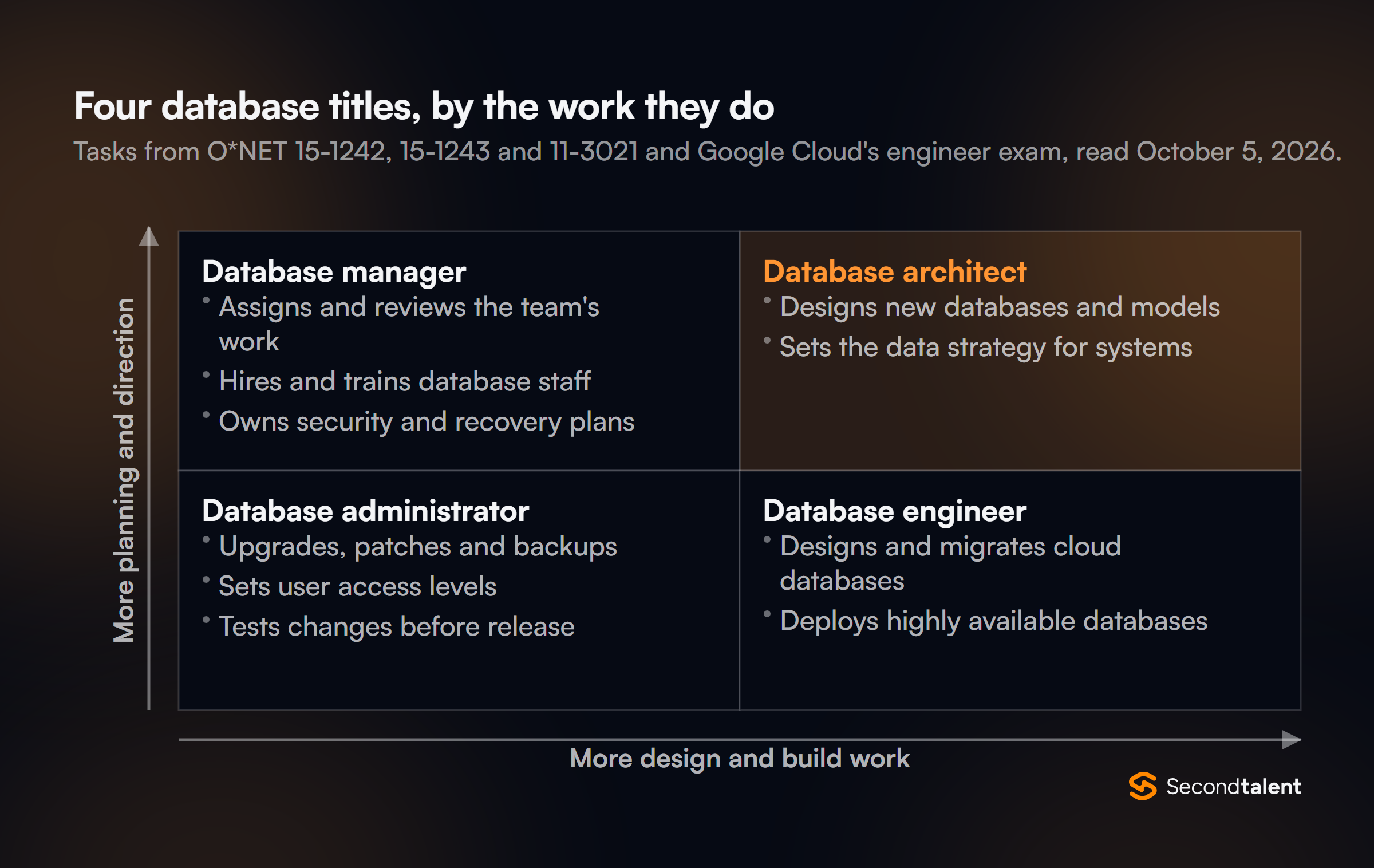
The architect code is the one most firms forget. O*NET's Database Architects profile covers the staff who "design databases to support business applications, ensuring system scalability, security, performance, and reliability".
The matrix below places all four titles by the work they do:
Pay: what each title earns
The pay gap follows the job code, not the title. BLS put the median database administrator at $104,620 in May 2025 and the median database architect at $139,500.
A database manager counted as an IT manager sits in a band with a $175,140 median, according to the BLS handbook entry for computer and information systems managers.
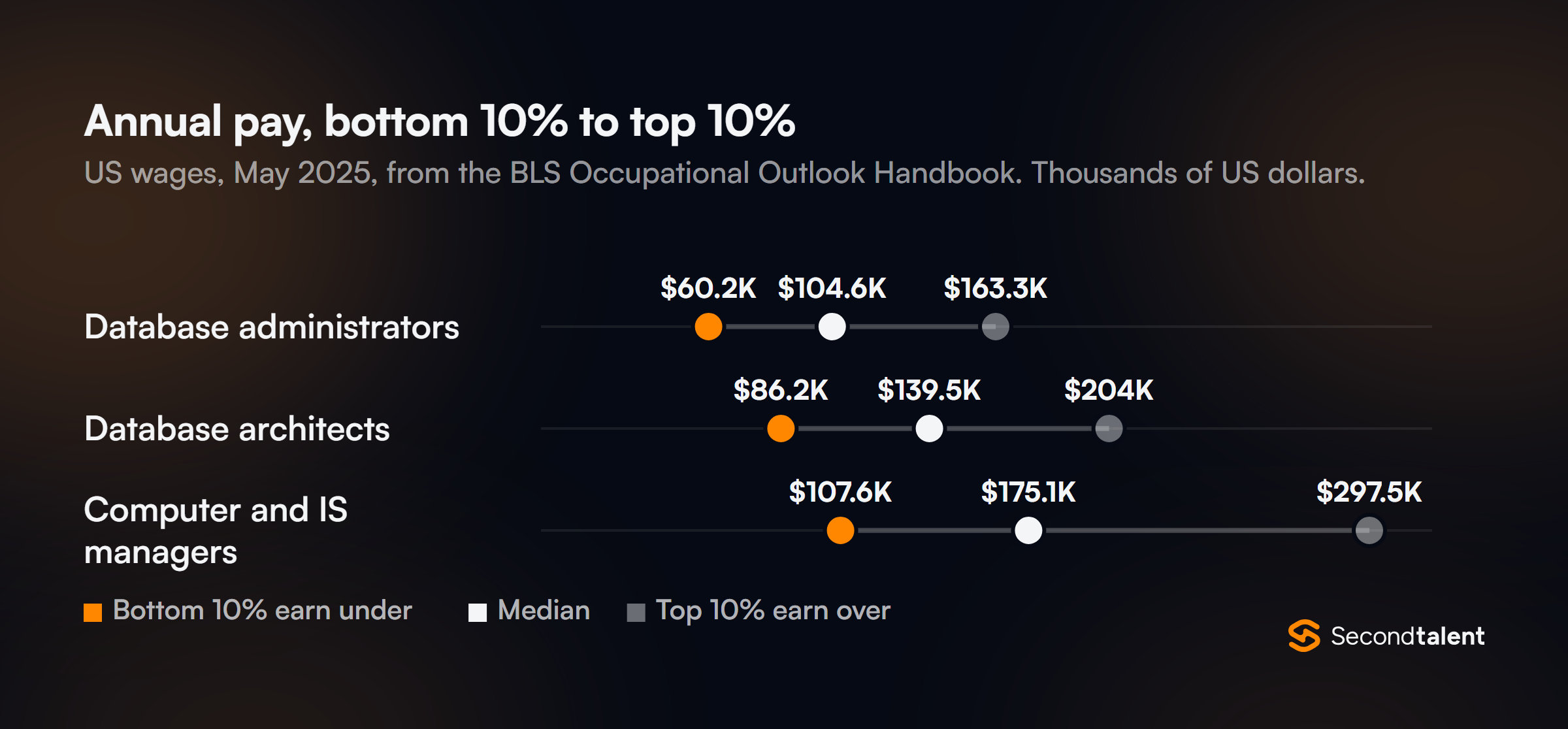
The manager band is the widest by far. Its top tenth earns over $297,510, against $163,320 for the top tenth of DBAs. The spread comes from the category itself, which holds help desk managers and CIOs alike.
Its median is not a database manager's median.
Industry moves DBA pay too. In the BLS pay tables, DBAs in management of companies earned a $124,270 median and those in computer systems design $124,130. In educational services the median was $86,330.
Our DBA cost guide breaks freelance rates down by country and level.
Job outlook: flat for DBAs, growing above them
BLS expects DBA employment to go from 75,000 to 74,900 between 2025 and 2035, a loss of 100 jobs. Database architects are projected to add 6,500. The handbook gives one reason:
"Demand for database administrators may be limited as fewer of these workers are expected to be needed as many companies operate in the cloud, allowing fewer administrators to serve more companies at the same time."
U.S. Bureau of Labor Statistics, Occupational Outlook Handbook, Database Administrators and Architects
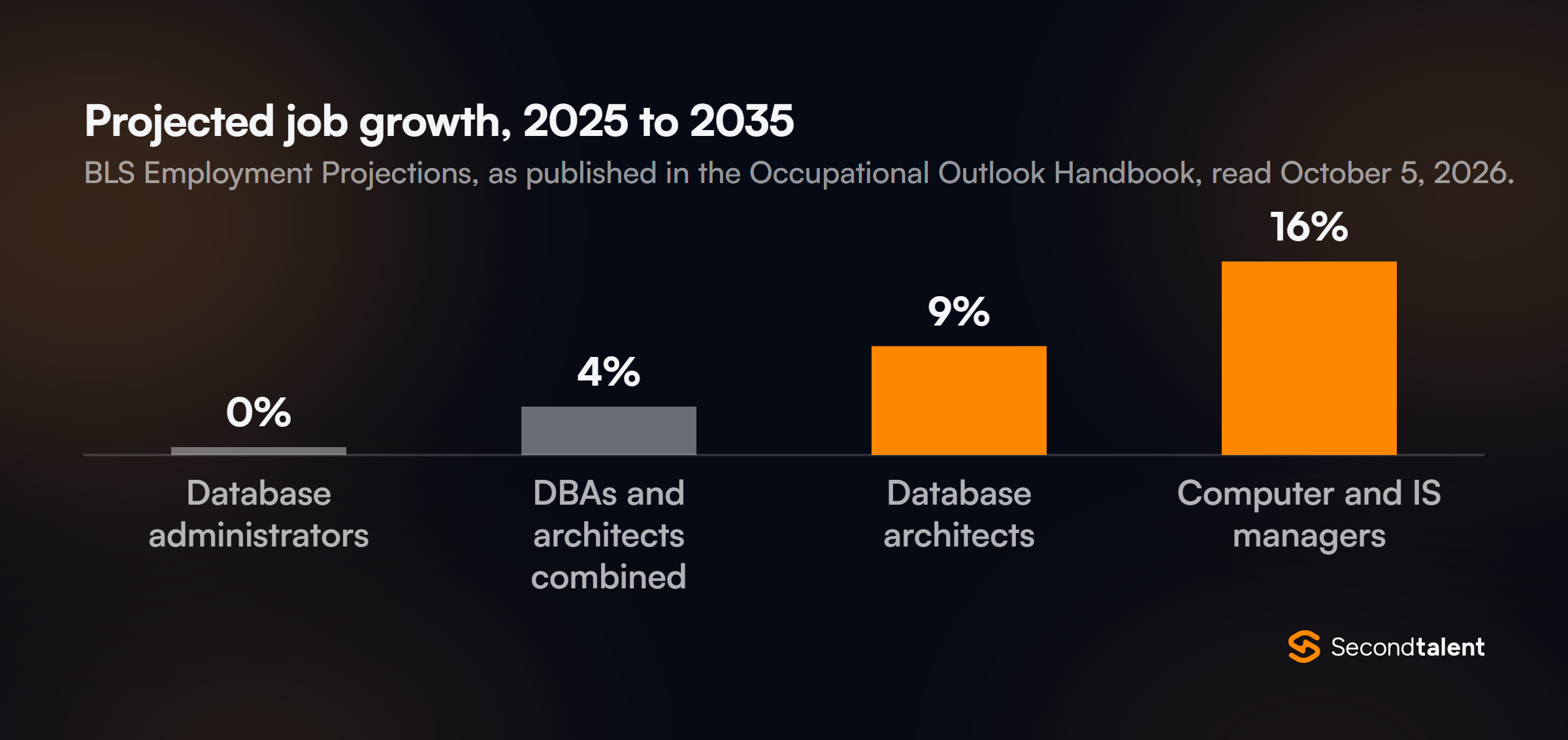
Flat does not mean no hiring at all. BLS still expects about 7,300 openings a year for DBAs and architects together, many of them to replace workers who retire or change jobs.
The largest employers differ too. Computer systems design firms employ 14% of DBAs but 23% of database architects. Educational services employ 11% of DBAs, a share that does not appear among the architects' top five employers.
How cloud-managed databases changed the DBA job
AWS publishes the clearest picture of what moved. Its Amazon RDS user guide lists 11 management tasks and marks who does each one on three hosting models. On your own servers the customer does all 11.
On a database you install yourself on Amazon EC2, the customer still does 8. On RDS, the customer keeps one:
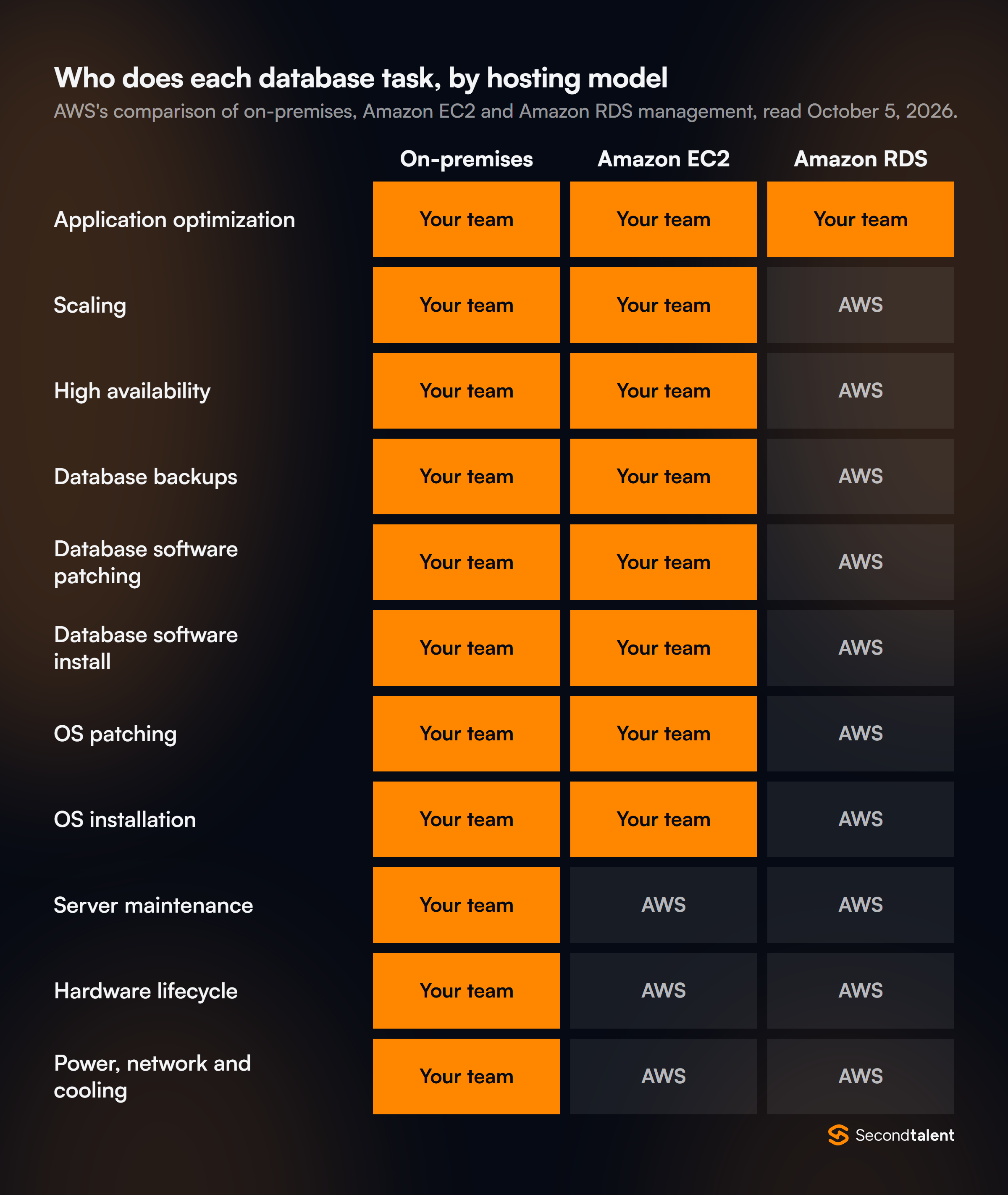
The task left over is the hard one. AWS states that "you are responsible for query tuning", and that "monitoring and tuning are highly individualized processes that you own". Backups, patches, installs and failover went to the provider.
Schema design, indexes and slow queries did not.
Microsoft draws the same line for Azure SQL Database. Microsoft handles "all patching and updating of the SQL and operating system code".
The customer can then "focus on the domain-specific database administration and optimization activities that are critical for your business." The DBA job shrank at the bottom and stayed at the top.
That is why a team on managed databases can need fewer DBAs and still need database skill.
For a small team running PostgreSQL on a managed service, the work left is the work our PostgreSQL interview guide tests for: query plans, indexing and schema changes, not backups.
Where the database engineer fits
A database engineer designs, builds and automates databases, in code and often in the cloud.
Google Cloud's Professional Cloud Database Engineer certification defines the role as someone who "designs, creates, manages, and troubleshoots Google Cloud databases".
It expects five years of database and IT experience, two of them on Google Cloud.
The exam tests design, migration and deployment of highly available databases. That is closer to architect work than to the patching and access control in O*NET's DBA list.
Microsoft gives the same work another name: its Azure Database Administrator Associate credential covers availability, security, performance and the "operational aspects of cloud-native and hybrid data platform solutions".
The engine mix shapes the hire. In the 2025 Stack Overflow Developer Survey, PostgreSQL was the most used database among all respondents, ahead of MySQL, SQLite and SQL Server. Start a database engineer search from the engines you run.
Our MySQL and DynamoDB interview guides cover two common ones.
The operations side has a name of its own. Laine Campbell and Charity Majors published Database Reliability Engineering with O'Reilly in October 2017. It applies site reliability engineering to database work.
Its opening line: "The infrastructure-as-code revolution in IT is also affecting database administration." Our site reliability engineer guide covers the overlap.
Skills and the path between the roles
The DBA's skills are technical and narrow. They cover SQL, one or two engines, backup and recovery, access control and tuning. O*NET reports that 89% of DBA positions require a bachelor's degree.
Our role guide adds scripting in PowerShell, Python or Bash for routine tasks.
Most of the manager's skills are not about databases. BLS says IT managers "typically need work experience in a related information technology (IT) job", and lists 5 years or more as the usual requirement.
A senior DBA who becomes a database manager trades tuning work for hiring, on-call rotas, vendor deals and budget.
The common routes run like this:
- Junior DBA to DBA to senior DBA, deepening one engine such as Oracle, SQL Server or PostgreSQL.
- Senior DBA to database manager, taking on staff and planning.
- Senior DBA to database architect, the growing branch in the BLS projections.
- DBA to database or reliability engineer, moving into code and automation on cloud platforms.
- DBA to data engineer, moving from storing data to building pipelines, a path close to the data warehouse engineer role.
Which one to hire
Hire a DBA if you run your own database servers or a self-managed install on cloud machines. Hire a database engineer if the work is building: new schemas, migrations to a managed service or automation.
Add a database manager only when several database staff need a lead.
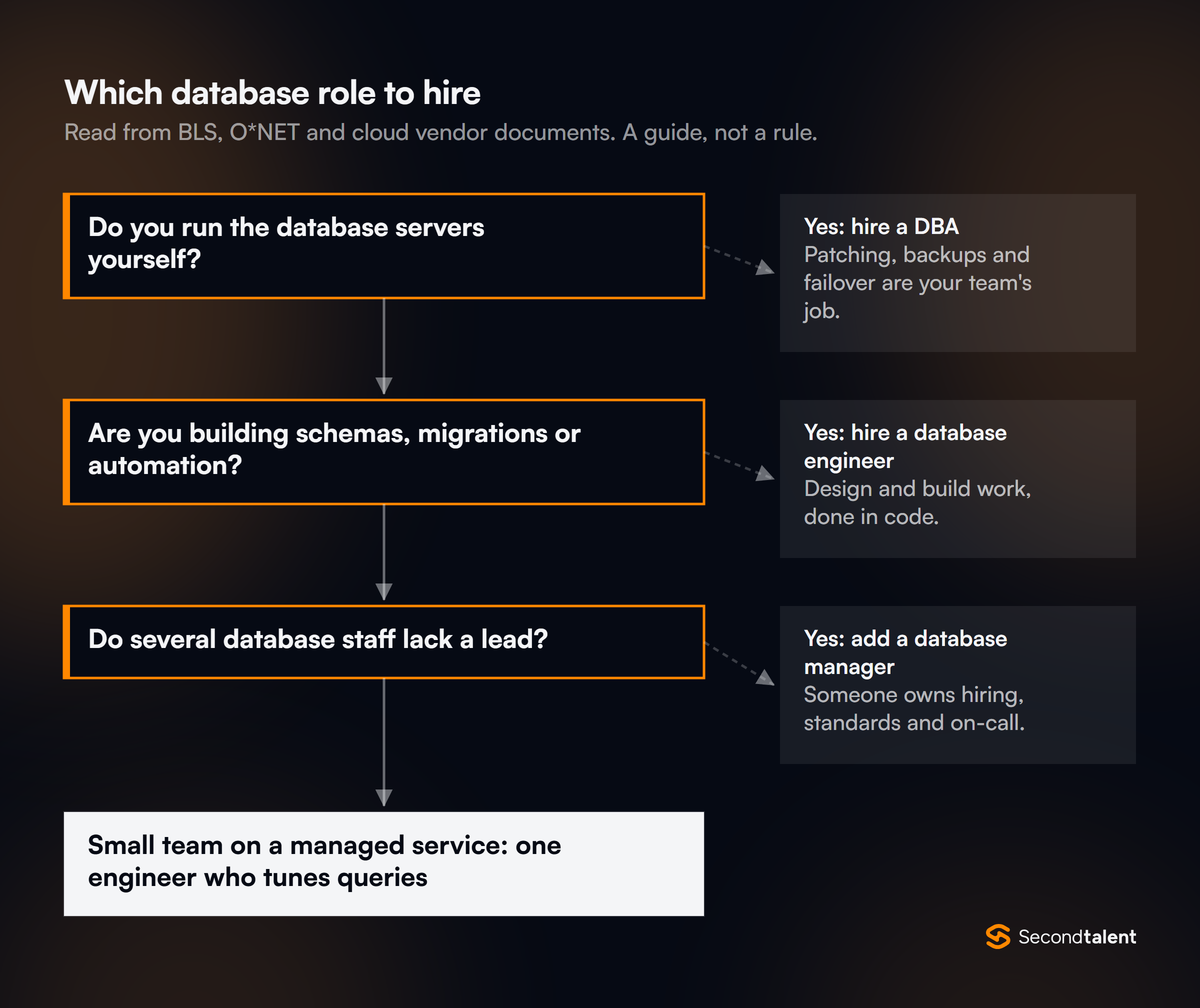
Most startups on RDS, Cloud SQL or Azure SQL fall into the last box. AWS's table leaves them one task, application and query tuning. That is a job for an engineer who knows the engine.
A firm with many self-hosted Oracle or SQL Server instances is different. There the DBA team, and a manager over it, still earns its keep.
Hire database engineers from Asia
We match you with vetted data and database engineers and cloud engineers in 24 hours, at 50-70% below US cost. Each hire carries a 90-day, one-time replacement guarantee.
We employ them through our own EOR in 9 Asian markets, including Vietnam, the Philippines and India.
Our monthly plan is $4,999 a month for a senior engineer, all-inclusive. Tell us what your databases run on and we will send a shortlist.
Frequently Asked Questions
Is a database manager also a piece of software?
Yes, in some products. IBM's Db2 documentation calls an instance "a logical database manager environment", and "database management system" (DBMS) is the general term for engines such as PostgreSQL.
Check whether a search result means the job or the software.
Which certifications fit each role?
For a cloud DBA, Microsoft's Azure Database Administrator Associate (exam DP-300, 100 minutes, 12-month renewal). For a database engineer, Google Cloud's Professional Cloud Database Engineer (2 hours, $200).
Does a database administrator need to write code?
Yes: SQL, plus scripts for routine work. Microsoft's DP-300 exam has a section on configuring and managing the automation of tasks. On a managed service, the provider already automates backups and patching.