TL;DR: Index.dev ships LATAM and Eastern European engineers at $60 to $120 per hour. The 7 alternatives below cover Asian timezones, deeper vetting, transparent pricing, and rates from $7 to $200 per hour.
You searched for Index.dev alternatives because something did not fit. It was the 48-hour match window, the hidden upfront deposit, the LATAM-only coverage, or a shortlist that did not meet your bar. You are not alone. The SHRM 2025 Recruiting Benchmark Report puts the average US engineering role at 50 to 62 days to fill, up 24% since 2021. The World Economic Forum’s Future of Jobs Report 2025 (PDF) shows 63% of employers now cite the skills gap as the top barrier to transformation. Korn Ferry forecasts 85 million unfilled roles by 2030, costing $8.5 trillion in lost output.
Founders want faster matches, tighter vetting, and a rate card they can plan around. Each platform below solves one of those better than Index.dev does.
- Lower total cost: Southeast Asia senior rates run $3,000 to $6,000 per month. US equivalents cost $8,000 to $18,000.
- Faster first match: Second Talent ships a shortlist in under 24 hours. Index.dev needs 48.
- No upfront deposit: Index.dev holds a non-disclosed deposit. Several platforms below charge $0 upfront.
- Real timezone coverage: LATAM platforms struggle when your team sits in Europe, Australia, or Asia.
- Deeper technical vetting: Top alternatives accept 1% to 3% of applicants, not the softer screen Index.dev uses.
Full breakdown below.
7 Index.dev Alternatives at a Glance
| Platform | Best For | Hourly Rate | First Match | Region |
|---|---|---|---|---|
| Second Talent | Full-time Asia hires, any budget | $7 to $40 | Under 24 hours | Philippines, Vietnam, Indonesia, India |
| Toptal | Premium short contracts | $90 to $200+ | 24 to 48 hours | Global, skews US and Eastern Europe |
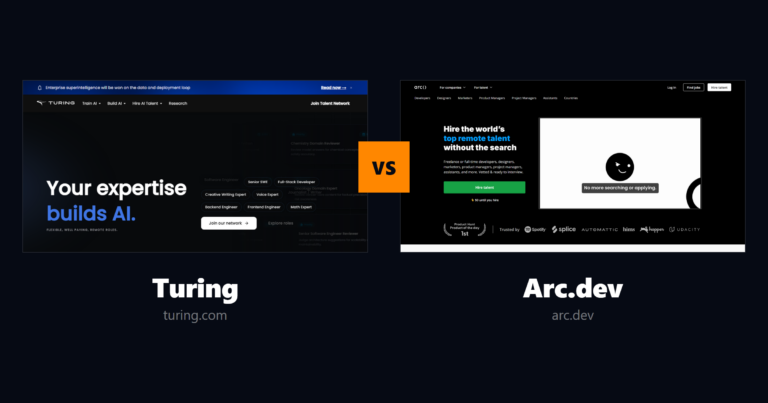
| Turing | Long-term remote contract | $95 to $250 | 3 to 4 days | India-heavy, global |
| Andela | Dedicated full-time, 6+ months | $60 to $120 equiv. | 2 to 4 weeks | Africa, LATAM, Eastern Europe |
| Arc.dev | Contract or permanent | $60 to $120 | 3 days to 2 weeks | LATAM, Eastern Europe |
| Lemon.io | Transparent startup rates | $45 to $85 | 24 to 48 hours | Ukraine, Poland, LATAM |
| Proxify | European timezone coverage | $50 to $90 | 2 days | Europe primarily |
Which Index.dev alternative fits your team?
Select your binding constraint below.
Senior engineers from $3,000 to $6,000 monthly. No upfront deposit. Dedicated full-time. Matched in under 24 hours. See Second Talent rates →
Second Talent covers GMT+5:30 to GMT+8. Overlaps Europe, Australia, US west coast. LATAM platforms break down outside Americas hours. Hire Asian talent →
$90 to $200 per hour, 2 to 5 week vetting on their side. Or compare rate cards for a dedicated hire. Compare rate cards →
Second Talent interviews 6 to 8 candidates from 830 applicants per role. Lemon.io rejects 98%. Skip AI-only screens. Read vetting guide →
Related comparisons: Toptal alternatives · Lemon.io alternatives · Turing alternatives · Proxify alternatives · Andela alternatives · Arc.dev alternatives
Why Teams Look Beyond Index.dev
Index.dev built a solid product for one slice of the market. Latin American and Eastern European contractors on full-time or long freelance arrangements, vetted in three stages, matched in roughly 48 hours. That fits a specific buyer. It does not fit everyone.
The most common complaints surface on Sitejabber and neutral review roundups. Vetting that misses experience level. A non-transparent upfront deposit that confuses budgeting. Geographic concentration that leaves Australia, Singapore, and Germany-based teams out of sync. Gartner’s emerging technology survey shows 64% of IT leaders now flag talent shortage as the top barrier to tech adoption, up from 4% in 2020. Teams cannot wait 48 hours for a first match, then two weeks for vetting to land.

The seven platforms below each solve a different problem. Three beat Index.dev on cost. Two beat it on vetting depth. One beats it on speed. Only one covers Asia hours the way global teams now need.
1. Second Talent: Southeast Asia Senior Engineers, $0 Upfront
Second Talent is the only entry on this list built specifically around Southeast Asia. Our engineers sit in nine Asian markets including Vietnam, the Philippines, Indonesia and Singapore. That means GMT+5:30 to GMT+8 coverage, which overlaps 4 to 8 hours with Europe, all day with Australia, and the morning hours with US west coast. It also means lower rates than any Western-sourced competitor.
Our standard salary bands come directly from our rate card. Senior engineers run $3,000 to $6,000 a month, flat and all-in. Equivalent US senior total compensation, per the Stack Overflow 2024 Developer Survey, is $170,000 base, or roughly $220,000 to $250,000 fully loaded. That is $8,000 to $18,000 per month. A 50 to 70% saving is normal, not aspirational.
We match in under 24 hours. Vetting runs four stages across technical assessment, AI-native tooling, English at C1+, and a behavioural interview. We shortlist 6 to 8 profiles from roughly 830 applicants for each search. There is no upfront deposit. Pay only on hire. 30-day replacement guarantee, unlimited replacements. AI and ML engineers, full-stack, and backend are all in the bench.
Where we are weaker. We are not a pool for 10-hour freelance gigs. Our minimum is full-time or long-term contract. If you need a weekend sprint, pick Toptal or Lemon.io.
Our engineers are AI-native by default. Fluency with Claude Code, Cursor and Copilot is assessed during vetting rather than assumed from a CV. You can search and shortlist the bench yourself in the Second Talent platform, or brief a recruiter and let us run the search. Coverage is engineering-first, with a limited non-technical bench across design, sales development and operations.
2. Toptal: Premium Short Contracts at Top-of-Market Rates
Toptal is the oldest brand in this category, founded 2010. It markets the “top 3%” globally. Rates run $90 to $200 per hour and climb further for specialists. A full-time equivalent typically costs $2,500 to $3,900 weekly.
The vetting reputation is the main reason to consider them. Five stages across 2 to 5 weeks. Language, personality, skill review, live screen, test project. They accept under 3% of applicants. That bar earns positive Hacker News threads from both sides of the marketplace.
Where Toptal breaks down. The rate card is brutal for startups. Trustpilot reviews and Sitejabber reports describe “overpriced, underqualified contractors” in some cases. They are contract-focused, with no real dedicated Asia staffing. If your burn rate cannot absorb $180 per hour, Toptal is not the move. If you need a 3-week emergency migration and budget is not the issue, they are.
3. Turing: AI-Driven Matching for Long-Term Remote Contracts
Turing was founded in 2018 and pushes an AI-led matching thesis. The platform claims a 3M+ applicant pool, filtered by automated tests plus interviews designed by former Google, Meta, and Microsoft engineers. Rates land $95 to $250 per hour on the client side. Engineer pay runs notably lower than that spread, a common marketplace tension.

The core strength is pool size. If you need a Rust engineer with an embedded systems background who also writes Python, Turing’s filter will surface someone. The weakness is concentration risk. Most of that pool sits in India, and timezone management becomes an ongoing tax for US or European teams without overlap windows.
Critical reviews on Sitejabber (3.4 stars across 137 reviews) flag “astronomical rates for average developers” and missed meetings. A widely shared Hacker News thread reported Turing scraping emails from open source contributions and sending automated messages under maintainer names. Pick Turing if you want scale and AI-assisted matching. Skip it if you want clean vendor hygiene or Asia coverage beyond India.
4. Andela: Dedicated Full-Time Hires from Africa, LATAM, and EU
Andela began as an African engineering training network. It has since pivoted into a global full-time remote marketplace, adding LATAM and Eastern Europe. Pricing is not public. Multiple comparison sites estimate $60 to $120 per hour equivalent for senior roles.
The upside is dedicated engineering talent with full-time commitment. You are not sharing the engineer with three other clients. The downside is speed and pricing opacity. Time to hire runs weeks, not days. Multi-round interview loops are standard. Terminal.io’s alternative roundup describes “long interview steps, unclear pricing, or less control over the developers.” Andela’s own Glassdoor reviews surface retention challenges on the engineer side.
Pick Andela if you want a large, established brand and can absorb a 2 to 4 week timeline. If you need to onboard a senior engineer within 7 days, look elsewhere.
5. Arc.dev: Contract or Permanent, AI-Assisted Shortlists
Arc sits in the middle of the market. AI-screened shortlists, human technical interviews, both contract and permanent placement paths. Rates track Index.dev closely at $60 to $120 per hour. Contract time to hire is 3 days. Permanent placement runs up to 2 weeks and costs roughly 3 months of annual salary.
What Arc does well is flexibility. One platform for a contract engagement that later converts to a full-time offer. That is rare. What it does less well is curation at the senior end. Independent reviews note that heavy AI screening “misses nuance in senior engineering evaluations,” and shortlists sometimes read as generic.
Pick Arc if you want option value on contract-to-permanent. Skip it if you specifically need a senior IC with a narrow stack and you cannot afford a generic shortlist.
6. Lemon.io: Transparent Rates for Startup Teams
Lemon.io is the clearest example of how to price this category without friction. $45 to $85 per hour, published openly. First match in 24 to 48 hours. Five-stage manual vetting with a 98% rejection rate. Focus is Ukraine, Poland, Romania, with recent LATAM expansion.

Lemon.io is built for startups. Freelance or long-term contract engagements. No enterprise sales loop. If you are a seed or Series A team that wants a senior React engineer at $65 per hour starting Monday, this is the platform. The main drawback shows up on senior specialist roles. Trustpilot reviews mention matches where the assigned developer was a strong generalist but not the specialist requested. Be specific on requirements.
7. Proxify: European Timezone Coverage at Mid-Market Rates
Proxify runs a 4,000+ engineer network heavily weighted to Europe. Rates sit in the $50 to $90 per hour range. Monthly engagement is $5,500 to $10,000 with a 40-hour monthly minimum. First shortlist in roughly 2 days. One-week typical ramp.
Vetting claims a 1% acceptance rate across resume, live coding, technical deep-dive, and English screen. If your team sits in Berlin, Stockholm, or Amsterdam and you want engineers in overlapping hours, Proxify is the closest European-native option. Trustpilot reviewers occasionally flag language or specialization mismatches, which suggests you should run your own technical round on top of theirs.
Pick Proxify if Europe is non-negotiable. Skip it if cost is the primary driver, since Southeast Asia or Eastern European freelance platforms beat the per-hour rate.
What Founders Are Saying on Reddit, LinkedIn, and X
The data tells one story. Real operator voice tells another. The public forum record on these platforms is surprisingly consistent.
“Toptal are some of the best people I’ve worked with, both as an applicant and someone hiring.”
muzani on Hacker News, 2022 (still the top-rated comment on contractor marketplaces)
“I got a congratulations email for completing a JavaScript test I never took. It felt like a Nigerian prince scam.”
muzani on Hacker News describing Turing’s automated outreach, 2022
“Marketplace platforms treat contractors as commodities, which limits personalized evaluation and networking opportunities.”
version_five on Hacker News, on the commoditization problem
The takeaway repeats across every thread we reviewed. Premium brands earn trust through vetting. Scale-first platforms earn complaints through automation. The middle of the market wins when pricing is transparent and the human touch is real. That shapes our own process. We interview 6 to 8 candidates per role, written recommendations arrive within 24 hours, and your account manager is the same person from search to onboarding.

How to Pick the Right Alternative
Rank your constraints before you pick a platform. That sounds obvious, yet most buyers skip this step and regret it at month three.
- Cost is the binding constraint. Pick Second Talent for dedicated full-time. Pick Lemon.io for freelance. Both beat Index.dev on rate and on deposit structure.
- Timezone is the binding constraint. Pick Second Talent for Asia and EU-overlap. Pick Proxify for European core hours. Pick Index.dev only if LATAM overlap with US is genuinely what you need.
- Vetting depth is the binding constraint. Pick Toptal, Lemon.io, or Second Talent. Each rejects 97% or more of applicants. Avoid platforms that rely on AI screening alone.
- Speed is the binding constraint. Pick Second Talent for under 24 hours. Lemon.io and Toptal follow at 24 to 48.
- Flexibility is the binding constraint. Pick Arc.dev for contract-to-permanent option value. Pick Toptal for short sprints. We do not compete on sub-month engagements.
We worked with a seed-stage fintech that had tried Index.dev, Turing, and Arc in six months. Their constraint was timezone. Their engineers sat in Singapore and their London-based CTO wanted four hours of overlap. We placed two Vietnam-based senior engineers in 9 days. Both are still there 18 months later.
We also worked with a US healthtech Series B where the constraint was cost. They had Turing contractors at $135 per hour. We replaced with two Philippines-based seniors at $5,500 monthly each. Total annual saving was $284,000 with no loss in velocity. Full compliance was managed through our EOR.
FAQ
Is Index.dev the same as Toptal or Turing?
No. All three are vetted developer marketplaces. Index.dev is LATAM-heavy with 48-hour matching. Toptal is premium-priced with deeper vetting. Turing pushes AI-driven matching at scale with a heavily India-based pool.
What does Index.dev cost in practice?
Published rates are $60 to $120 per hour. The upfront deposit amount is not disclosed on the public site and applies against your first invoice if you hire, or refunds if you do not. Many teams find that lack of transparency a reason to shortlist alternatives.
How much cheaper is Southeast Asia compared to Index.dev’s LATAM pool?
Roughly 50 to 70% for equivalent seniority. A senior engineer at Index.dev at $90 per hour costs about $14,400 monthly at 40 hours per week. Our senior band tops out at $6,000 monthly for the same commitment. The gap is timezone and geography, not quality.
Will I lose quality if I move from Index.dev to a cheaper platform?
Only if the platform sacrifices vetting to hit a low rate. Second Talent rejects 99%+ of applicants and interviews 6 to 8 per role. Lemon.io rejects 98%. Proxify claims 1% acceptance. The platforms below that quality bar are easy to spot. They publish low rates without a vetting funnel.
How long does onboarding take with Second Talent?
First shortlist in under 24 hours. Final interviews within 4 to 6 days. Signed and starting work inside 7 to 10 days for most roles. Full hiring flow and timeline here.
Index.dev solves LATAM. The seven alternatives above cover the rest of the world, most seniority bands, and most budget ranges. If your binding constraint is cost, timezone, or vetting depth, start with us. No upfront fees. First shortlist in 24 hours. Tell us what you need →
Hiring contractors rather than employees changes the arithmetic. The freelance developer rate index prices 14 roles across nine regions, benchmarked against North America and sourced from published wage data.