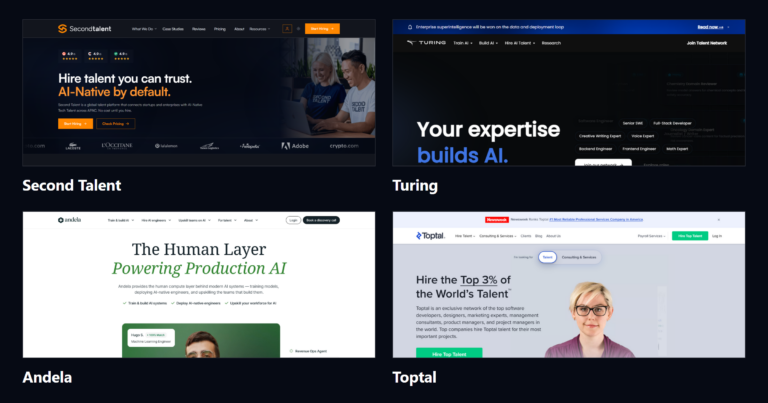
Turing built its name on remote developer hiring: AI matching from a pool of more than 3 million engineers, a hire in about 4 days and a risk-free trial.
That business is no longer on offer to startups. Turing’s homepage now recruits experts for AI work, its old hire pages for roles such as Python developers and AI engineers redirect to its expert-network page, and its services page sells training data to frontier AI labs and agentic AI projects to enterprises (all checked on October 12, 2026).
It raised a $111M Series E at a $2.2 billion valuation in March 2025 to fund that shift. If you are a US startup that used to hire through Turing, or had it on your list, the 10 alternatives below still sell engineers.
Where an entry compares itself with Turing, it refers to the terms Turing offered while it sold developer hiring.

Quick Comparison (Updated July 2026)
What changed at Turing, and what a US startup pays instead
Turing no longer publishes a developer hiring offer, so there is no Turing price to compare. Here is what a US startup gets from Second Talent instead, next to what Turing’s site shows today.
| For a US startup | Turing (today) | Second Talent |
|---|---|---|
| Sells developer hiring to startups | No; old hire pages redirect to its expert network | Yes: vetted AI-native engineers and specialists from Asia |
| Published price | None | From $29 an hour, up to $50, billed monthly; $0 until you hire |
| One engineer, 160 hours a month | Not offered | $4,599 to $5,999 |
| First candidates | Not offered | A shortlist of 6 to 8 vetted profiles in 24 hours |
| If the hire does not work out | Not offered | 90-day, one-time replacement |
| Overlap with US hours | Not offered | 4 to 6 hours a day |
Most teams leaving Turing want the same thing it used to sell: a remote engineer who joins the team and stays. That is all Second Talent does, typically 50 to 70% below a US hire. See our published pricing.
1. Second Talent

Second Talent is the closest replacement for what Turing used to sell: a dedicated remote engineer on your team.
A Second Talent engineer is $29 to $39 an hour, billed monthly, or $4,599 to $5,999 for a 160-hour month, with employment included.
Vetting is entirely human across four stages, with 6 to 8 profiles shortlisted per role from roughly 830 applicants, so nobody reaches your shortlist without a person having spoken to them.
Engineers work 4 to 6 hours a day inside US working hours.
Pros
- About a Third of the Cost or Less: $4,599-$8,000/mo dedicated, against about $24,000 for a Turing senior at $150/hr.
- All-Human Vetting: Four stages ending in a live behavioural interview, no AI ranking step.
- Transparent Rate Bands: Published by seniority, where Turing bundles pay and platform fee with no public card.
- Faster First Match: Under 24 hours, against Turing’s ~4 days.
- Compliance Included: A managed Employer of Record covers employment, payroll, and exits.
- AI-Native by Default: Engineers who build with Claude Code, Cursor and Copilot every day, with AI-tool fluency assessed during vetting rather than assumed from a CV.
- Self-Serve or Managed: Search and shortlist the vetted bench yourself in the Second Talent platform, or brief a recruiter and get a matched shortlist in 24 hours.
Cons
- Much Smaller Pool: Nine Asian markets against Turing’s 3M+ global network.
- Less Niche Depth: Turing carries specialist AI and ML profiles that a focused bench will not.
- Not for Short Gigs: A few weeks of help fits an hourly platform better.
- Smaller Brand: Less name recognition in enterprise procurement.
Best For
- Teams whose Turing invoice has outgrown the value, particularly at 40 billed hours a week.
- Buyers who want a human accountable for the shortlist rather than an algorithmic ranking.
- Asia, EMEA, and US West Coast businesses that need genuine Asia-hours overlap.
- Companies that want employment compliance handled rather than left with them.
Key Features
- First matched shortlist in under 24 hours, with a written recommendation.
- Four-stage vetting: technical assessment, AI-native tooling, English at C1+, and a behavioural interview.
- Benches across full-stack, backend, frontend, mobile, and data roles.
- 90-day, one-time replacement guarantee.
- Optional managed Employer of Record across nine Asian markets.
- 92% talent retention across placements, with 200+ companies hiring through the platform.
Pricing Structure (2026)
- $29 to $39 USD per hour per engineer, billed monthly (160 hours at $29 is $4,599), all-in.
- Employment, payroll, tax and exits included in the monthly rate.
- No deposit and no fees until a hire is made.
- Flat monthly billing per engineer with no long-term lock-in.
2. Toptal

Toptal is the premium human-vetted answer to Turing’s automated one.
Founded in 2010, it markets the top 3% of applicants, screened across four manual stages running 2 to 5 weeks and ending in a paid test project, then hand-matched in under 24 hours.
It holds 4.8 stars across 2,300+ Trustpilot reviews and reports a 98% trial-to-hire success rate, against Turing’s markedly weaker review profile.
Rates of $60 to $150+ per hour actually undercut Turing at the mid-range, though a $79 per month platform fee applies before you see anyone.
Pros
- Human Vetting Throughout: Four manual stages with a paid test project, no AI ranking.
- Often Cheaper: $60-$150+/hr against Turing’s $100-$200.
- Faster Match: Under 24 hours, against Turing’s ~4 days.
- Much Stronger Reviews: 4.8 stars across 2,300+ Trustpilot reviews.
- Undivided Focus: Talent marketplace is the whole business.
Cons
- Upfront Cost: A $79 monthly subscription, where Turing charges nothing to start.
- Specialists Cost More: Above $200/hr for highly specialised talent.
- Smaller Pool: A curated network rather than 3M+ profiles.
- Markup: Reviews report the platform adding up to 50% on freelancer rates.
Best For
- Companies that want human vetting and are willing to pay a deposit for it.
- Mission-critical projects where developer quality is paramount.
- Procurement processes where a recognised brand matters for sign-off.
Key Features
- An exclusive network marketed as the top 3% of freelance talent worldwide.
- A personalised matching service where Toptal experts hand-pick candidates.
- Engagements are flexible (hourly, part-time, or full-time) with a 2-week risk-free trial.
- A network spanning engineers, designers, product managers, and finance experts.
Pricing Structure (2026)
- $79/month subscription fee while actively searching.
- Blended hourly rates typically $60-$150/hr; specialists $200+.
- Full-time developers cost $2,400-$6,000/week ($125k-$312k annually).
3. Arc.dev

Arc.dev runs the same AI-assisted model as Turing but layers a human technical interview on top and charges substantially less: $60 to $100+ per hour against Turing’s $100 to $200.
Its network is about 450,000 engineers across 190 countries, marketed at a top 2% acceptance rate, with shortlists returned by its HireAI engine within 72 hours, faster than Turing’s roughly 4 days.
It also offers a permanent placement path at around a quarter of annual salary, which Turing does not, and nothing is charged to start searching.
Pros
- Roughly Half the Rate: $60-$100+/hr against Turing’s $100-$200.
- Human Interview Layer: AI screening is followed by a human technical interview.
- Faster Shortlist: 72 hours against Turing’s ~4 days.
- Permanent Path: Direct-hire placement available, which Turing does not offer.
- Self-Serve Browsing: Review profiles yourself rather than waiting on a match.
Cons
- Smaller Pool: 450,000 against Turing’s 3M+.
- AI Screening Persists: Reviews note shortlists can turn generic on narrow stacks.
- Permanent Fee: Roughly 25% of annual salary for a direct hire.
- Less Niche AI Depth: Turing’s specialist AI and ML bench is deeper.
Best For
- Teams that like Turing’s model but not its rate.
- Companies that want the option to convert a contractor into a permanent employee.
- Businesses needing follow-the-sun coverage from a global pool.
Key Features
- A pre-vetted pool of roughly 450,000 engineers across 190 countries.
- The HireAI matching engine, returning a shortlist within 72 hours.
- Both contract and permanent placement paths, plus a risk-free trial.
- Claimed savings of up to 58% versus local hiring.
Pricing Structure (2026)
- Contract rates typically $60-$100+/hr; full freelance range $15-$110+.
- Permanent placement at roughly 25% of annual salary.
- No upfront cost to start searching.
4. Lemon.io

Lemon.io is the direct rebuttal to AI screening.
Its four-stage process is entirely human, covering resume, soft skills, English, and a live technical interview run by senior engineers, accepting about 1.2% of applicants and rejecting anyone with fewer than five years in the required stack.
That addresses the most common Turing complaint, that automated matching places technically capable engineers who then fail on communication or seniority nuance in sprint two.
The network broadened in 2026 to span Europe, Latin America, and the US, with rates of $55 to $200+ per hour and a 4.8-star Trustpilot record. The constraint is a 160-hour minimum.
Pros
- Zero AI Screening: Four entirely human stages with a 1.2% acceptance rate.
- Lower Entry Rate: Starts at $55/hr against Turing’s $100 floor.
- Much Stronger Reviews: 4.8 stars on Trustpilot.
- Fast Matching: Candidates typically within 24-48 hours, against Turing’s ~4 days.
- No Lock-In After Minimum: Month-to-month, with no penalty to switch developers.
Cons
- 160-Hour Minimum: A full month must be committed upfront.
- Upfront Deposit: Required before work starts, where Turing charges nothing to begin.
- Smaller Pool: A curated network rather than 3M+ profiles.
- Freelance-First: Not built for dedicated full-time headcount.
Best For
- Teams burned by an AI-matched hire that failed on soft skills or seniority.
- Startups that can commit to at least a full month of work.
- Buyers who rank vetting depth above pool size.
Key Features
- A curated network spanning Europe, Latin America, and the US.
- Four-stage human vetting with a 1.2% acceptance rate.
- Matching within 24-48 hours, with a dedicated manager and replacement guarantee.
- Month-to-month engagements after the minimum.
Pricing Structure (2026)
- Tiered hourly rates from $55 to $200+ depending on seniority and stack.
- A minimum engagement of 160 hours is mandatory.
- An upfront deposit is required before work commences.
5. Revelo

Revelo solves the timezone problem Turing can only promise around.
Turing’s bench skews heavily to India and it offers a scheduled 4-hour daily overlap; Revelo’s 400,000+ vetted developers sit across 18 Latin American countries, so US-hours alignment is geographic rather than negotiated.
It also runs an Employer of Record underneath, meaning the engineer is properly employed rather than contracted, which Turing does not offer.
Shortlists of three to five human-screened candidates arrive within 72 hours, with a 14-day average time to hire. You pay only if you hire, and the $500 non-refundable start fee older reviews mention has been dropped.
Pros
- Real Timezone Alignment: A LATAM bench matched to US hours by geography, not scheduling.
- Employment Handled: Payroll, benefits, taxes, and compliance managed across 18 countries.
- Lower Rate Floor: $25-$105/hr against Turing’s $100 floor.
- Human Screening: Identity-confirmed, skills-tested, human-reviewed shortlists.
- Pay Only If You Hire: No start fee, plus a 14-day risk-free trial.
Cons
- Single Region: 18 Latin American countries against Turing’s global pool.
- No Published Rate Card: Quotes are per role.
- Higher All-In Monthly: Full-time placements typically $8,000-$12,000/mo.
- Narrower Niches: Reviews note fewer specialisms than large global platforms.
Best For
- US teams for whom the 4-hour overlap window has proven insufficient.
- Companies that want nearshore engineers as employed headcount rather than contractors.
- Teams without a local entity that still need compliant employment in Latin America.
Key Features
- 400,000+ vetted developers across 18 Latin American countries.
- Human-screened shortlists of three to five candidates within 72 hours.
- Employer of Record covering payroll, benefits, taxes, and compliance.
- A 14-day average time to hire and a 14-day risk-free trial.
Pricing Structure (2026)
- Hourly rates of roughly $25-$105 depending on stack and seniority.
- Full-time placements typically $8,000-$12,000/mo all-in.
- You pay only if you hire, with no start fee.
- Stated savings of 30-50% versus equivalent US hires.
6. CloudDevs

CloudDevs is the fastest and most transparent option against Turing’s opaque bundled pricing.
It publishes its rates outright at $45 to $75 per hour, roughly a third to a half of Turing’s, sources from Mexico, Brazil, Argentina, Colombia, and Peru from an advertised network of 500,000+, and assigns talent within 24 hours rather than about 4 days.
Billing is weekly with cancellation after any week, against Turing’s 40-hour weekly contract assumption. There is a 7-day risk-free guarantee and no fees until you hire. Its model changed in 2026 and now spans junior, mid, and senior tiers.
Pros
- Published Pricing: $45-$75/hr stated openly, where Turing has no public rate card.
- Roughly Half the Rate: Well below Turing’s $100-$200 band.
- Fastest Assignment: 24 hours against Turing’s ~4 days.
- Weekly Cancellation: Roll off after any week rather than committing to 40-hour weeks.
- US Timezone Overlap: A LATAM bench aligned to US working hours.
Cons
- Much Smaller Pool: Five countries against Turing’s global 3M+ network.
- Shallower Vetting: Three stages, with no equivalent of Turing’s multi-stage technical tests.
- Shorter Guarantee: 7 days against Turing’s 14-day trial.
- Interview Friction: Reviews report delays and thin feedback during interviews.
Best For
- Teams that want published pricing rather than a bundled quote.
- US companies that want timezone-aligned LATAM developers on a flexible contract.
- Businesses that need a developer working by tomorrow.
Key Features
- A network advertised at 500,000+ developers across five Latin American countries.
- Talent assigned within 24 hours, across junior, mid-level, and senior tiers.
- Three-stage vetting including a monitored live-coding challenge.
- A 7-day risk-free guarantee, and weekly billing with no lock-in.
Pricing Structure (2026)
- Published hourly rates of $45-$75, averaging about $28/hr junior and $58/hr senior.
- Monthly equivalents of roughly $4,500 junior to $9,200 senior.
- All-inclusive rates with no fees until a hire is made.
7. Upwork

Upwork removes the platform margin entirely. Where third-party reviews estimate Turing retaining 50 to 55% of every invoice, Upwork charges clients a 5% marketplace fee and lets you negotiate directly with the freelancer.
In 2026 it lists more than 18 million registered freelancers across 180+ countries and 90+ service categories, serving roughly 785,000 active clients. The cost you avoid is real; the work you take on is the vetting Turing automates.
For a well-scoped project with in-house technical screening, that is a strong trade. For a long-term senior hire without it, it is not.
Pros
- No Platform Margin: A 5% client fee rather than an estimated 50-55% bundled markup.
- Unmatched Variety: 18M+ freelancers across 90+ categories and every seniority level.
- Direct Rate Negotiation: You see and agree the freelancer’s actual rate.
- Any Contract Length: A two-day task is as viable as a two-year engagement.
Cons
- No Pre-Vetting: You own the entire screening process that Turing automates.
- Inconsistent Quality: Outcomes vary widely without a curation layer.
- Fee Stack: A $0.99-$14.99 contract initiation fee per contract on top of the marketplace fee.
- Slower Hiring: Posting, collecting bids, and interviewing takes longer than a 4-day match.
Best For
- Businesses hiring across a wide variety of roles, both inside and outside of tech.
- Clients who have the time and in-house expertise to run their own vetting.
- Short, well-defined projects with tight budgets.
Key Features
- A global marketplace of 18M+ freelancers in thousands of skill categories.
- A job posting and bidding system that drives competitive pricing.
- Built-in time-tracking and payment protection through milestones and escrow.
- An “Expert-Vetted” tier that surfaces pre-screened top-rated talent for a premium.
Pricing Structure (2026)
- Freelancers set their own rates; the platform average is around $39/hr.
- Basic plan clients pay a 5% marketplace fee, or 3% for eligible US clients paying by checking account.
- A one-time contract initiation fee of $0.99-$14.99 per new contract.
- Freelancers pay a variable 0-15% service fee, replacing the flat 10% rate on 1 May 2025.
8. Fiverr Pro
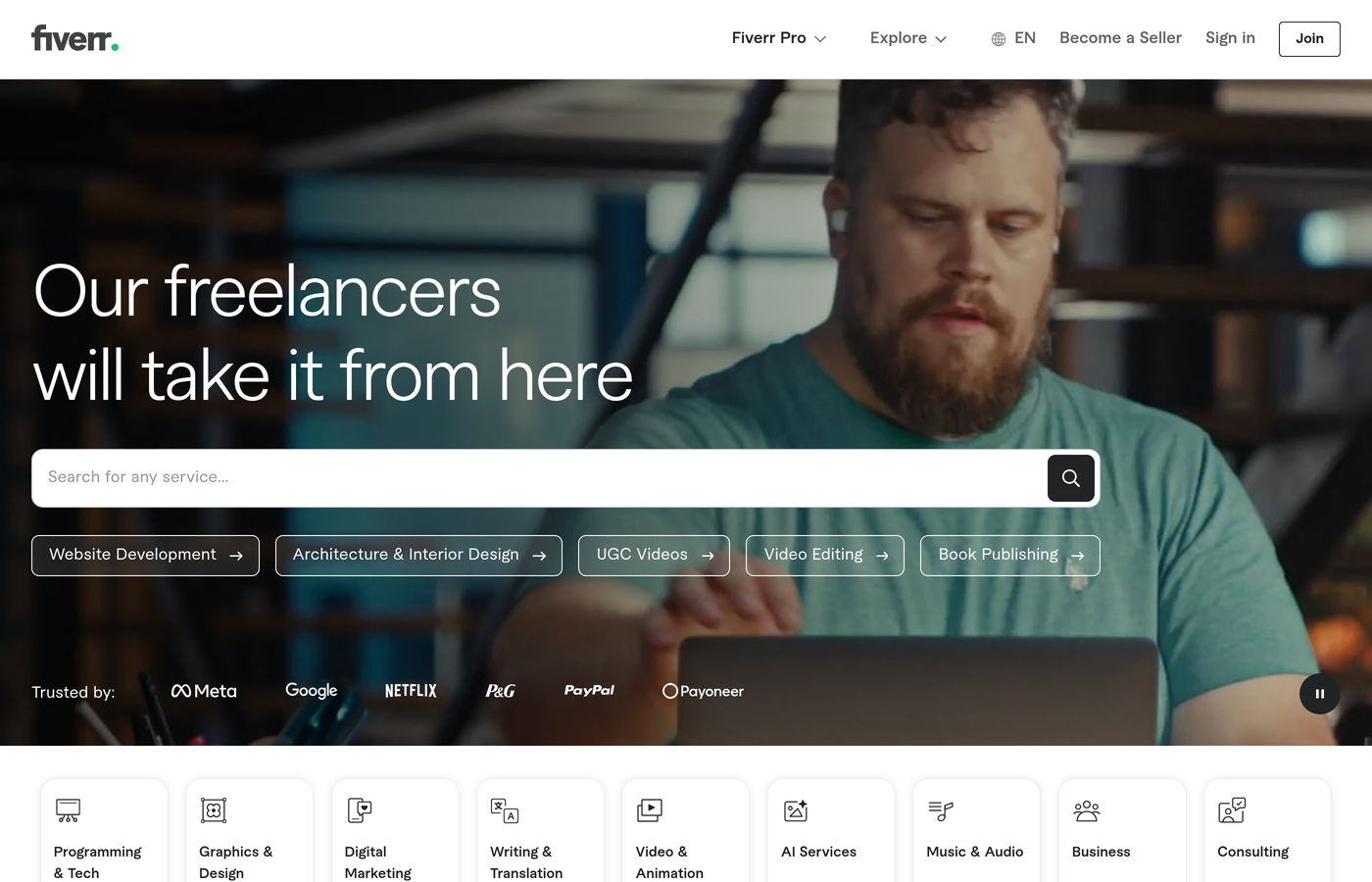
Fiverr Pro is the vetted tier of the largest packaged-services marketplace, and it works on a fundamentally different unit than Turing. Turing places an engineer who bills hours; Fiverr Pro sells a defined deliverable at a fixed price.
Its acceptance rate for Pro applications runs roughly 8 to 12%, and buyers pay a 5.5% service fee, with Pro Advanced at $129 per month and Pro Essential available to accounts spending $1,000 or more annually.
That makes it a genuinely cheap option for scoped work, and a poor one for an embedded engineering role. Budget 20 to 30% above the listed price once fees and add-ons land.
Pros
- Fixed-Price Deliverables: You buy an outcome, not billed hours.
- Far Cheaper for Scoped Work: A 5.5% buyer fee against Turing’s bundled hourly rate.
- Vetted Tier: Pro screening accepts roughly 8-12% of applicants.
- Immediate Start: Browse and order without a matching process.
Cons
- Wrong Unit for Embedded Roles: Not built for a full-time engineer on your codebase.
- Fee and Add-On Creep: Budget 20-30% above the listed price; a $3 small-order charge applies under $100.
- Subscription for Advanced: Pro Advanced runs $129/month.
- Outsourced Vetting: Part of the 2026 verification process is handled by third parties.
Best For
- Well-scoped, self-contained deliverables with a clear definition of done.
- Teams that want a fixed price rather than an open-ended hourly commitment.
- Buyers who need work started today without a matching cycle.
Key Features
- A vetted Pro tier layered on the wider Fiverr marketplace.
- Packaged, fixed-price deliverables rather than hourly engagements.
- Team management, sourcing support, and structured payment options on business plans.
- Individual vetted freelancers rather than agencies.
Pricing Structure (2026)
- A 5.5% buyer service fee, plus a $3 small-order charge on orders under $100.
- Pro Advanced at $129/month; Pro Essential available at spend of $1,000+ annually.
- Pro Enterprise on custom pricing.
- Budget roughly 20-30% above the listed gig price once fees and add-ons are included.
9. Gun.io

Gun.io is the domestic answer to Turing’s offshore-weighted bench.
It focuses on experienced US and Canada-based contract developers, screened by software and then personally reviewed by senior engineers, and reports that 70% of currently engaged developers have 10+ years of experience.
Where Turing promises a 4-hour daily overlap from an India-heavy pool, Gun.io gives complete US working-hours alignment.
Rates are comparable at $100 to $200+ per hour, but with no bundled-margin opacity: employers see the full rate upfront. Full-time placements are charged at 20% of the first year’s negotiated salary.
Pros
- Full US Overlap: Domestic talent rather than a scheduled 4-hour window.
- Human Vetting: Software screening followed by senior-developer review.
- Deep Seniority: 70% of engaged developers have 10+ years of experience.
- Transparent Rate Display: The full rate is visible upfront, unlike Turing’s bundled pricing.
- Flexible Structures: Pay-as-you-go, monthly retainers, or retained search.
Cons
- No Cost Saving: $100-$200+/hr, matching Turing’s band with no offshore discount.
- Narrow Geography: US and Canada only.
- Full-Time Fee: 20% of the negotiated first-year salary for permanent placements.
- Budget Complaints: Some users report unexpected cost increases and thin communication about overruns.
Best For
- Companies with onshore or domestic-contractor requirements.
- Teams that need complete US working-hours overlap, not a partial window.
- Longer-term contracts where deep seniority justifies a premium rate.
Key Features
- A curated network weighted toward senior US and Canada developers.
- Software screening followed by human review from senior engineers.
- Pay-as-you-go packages, monthly retainers, or a retained search team.
- Full rate visibility upfront, with no hidden platform additions.
Pricing Structure (2026)
- Developer rates generally $100-$200+/hr, inclusive of Gun.io’s fee.
- Custom pay-as-you-go packages and monthly retainer options.
- Full-time placements charged at 20% of the first year’s negotiated salary.
10. Proxify

Proxify was founded in Sweden in 2018 and weights its network toward Europe, though it now spans about 30 countries. It is the strongest fit when European core hours matter, which Turing’s India-weighted bench does not serve well.
Vetting is human across resume, live coding, technical deep-dive, and English screens, with a claimed 1 to 3% acceptance rate, and rates of $35 to $55 per hour make it roughly a third of Turing’s cost.
There is a 40-hour monthly minimum and a first shortlist in about 2 days. One note on reviews: many blogs still repeat an old 4.8-star figure; the current Trustpilot rating is 4.4 across roughly 298 reviews.
Pros
- Roughly a Third of the Cost: $35-$55/hr against Turing’s $100-$200.
- Strict Human Vetting: A 1-3% acceptance rate across four stages.
- European Core Hours: Real-time overlap for EU-based teams.
- Faster Shortlist: About 2 days against Turing’s ~4.
- Admin Handled: Proxify manages HR and administrative tasks.
Cons
- 40-Hour Monthly Minimum: Short tasks are not supported.
- Limited Asia or LATAM Depth: Coverage is Europe-weighted.
- Smaller Pool: About 30 countries against Turing’s global network.
- Outdated Ratings Circulating: The real Trustpilot figure is 4.4, not the 4.8 many blogs repeat.
Best For
- European teams that need core-hours overlap rather than an offshore window.
- Budget-conscious buyers who still want a strict vetting bar.
- Projects with at least 40 hours/month of ongoing work.
Key Features
- Pre-vetted developers delivered in an average of 2 days.
- Four-stage human vetting with a stated 1-3% acceptance rate.
- Teams integrated in 2 weeks or less, across about 30 countries.
- 500+ tech skills covered, with HR and admin handled.
Pricing Structure (2026)
- Hourly rates of $35-$55, or roughly $5,600-$8,800/mo per engineer.
- 40-hour monthly minimum commitment.
- All expenses included; no hidden costs.
How to Choose a Turing Alternative in 2026
Turing’s strengths are genuine: pool size, niche stack coverage, and no upfront cost. The complaints that push teams away cluster into four, and each points at a different replacement.
If your objection is cost, note that the rate is not the whole story, since third-party reviews estimate a 50 to 55% platform margin.
Proxify runs about a third of the price, and Second Talent’s monthly model changes the arithmetic completely.
If your objection is AI screening, particularly a match that looked strong on paper and failed on communication in sprint two, then Lemon.io (1.2% acceptance, all human), Toptal (top 3%, four manual stages), and Proxify (1 to 3%) all screen with human reviewers.
If your objection is timezone, the India-weighted bench and a scheduled 4-hour window are structural: Revelo and CloudDevs give you geographic LATAM alignment, Gun.io gives full US hours, and Proxify gives European core hours.
And if your objection is focus, that the company’s attention has moved toward AI-lab data work, then any of the specialists above treat staffing as the whole business.
The Real Cost Comparison
- A Proxify senior at $45/hr is roughly $7,200/month for the same working hours.
- A CloudDevs senior at $57.50/hr is roughly $9,200/month, with the rate published openly.
- A dedicated Second Talent senior is $4,599 to $5,999/month, with employment and compliance included.
The Signal to Switch
- Your matched engineer is technically strong but the seniority or communication gap surfaced after the trial window closed.
- The 4-hour overlap has become the bottleneck on every code review and incident.
- You are billing 40 hours a week indefinitely, which is a full-time role priced as a contract.
- You cannot answer what share of your invoice reaches the engineer, and that matters for renewal.
Turing now answers a different question: how does an AI lab or enterprise buy training data and expert AI work. If you need an engineer on your own team, one of the ten alternatives above is where to look.
Tell us what you need and we will send a shortlist in 24 hours →
Frequently asked questions
Does Turing still hire developers for companies?
Not for startups. On October 12, 2026, Turing’s old developer hire pages redirected to a page recruiting experts for AI work, and its services page sold training data to frontier AI labs and agentic AI projects to enterprises.
Who are Turing’s competitors for hiring developers?
Second Talent, Toptal, Arc.dev, Lemon.io, Revelo, CloudDevs, Upwork, Fiverr Pro, Gun.io and Proxify, each compared above. For AI training data, its competitors are firms such as Mercor.
Hiring contractors rather than employees changes the arithmetic. The freelance developer rate index prices 14 roles across nine regions, benchmarked against North America and sourced from published wage data.